The Shepherd Beside Us

(By Guest Blogger Dawn Van Beck)

Let’s talk sheep.

Jesus talks a lot about sheep. Throughout most of the book of John, chapter 10, He speaks of sheep as an analogy for His people, His followers.

Therefore, Jesus said again, “I tell you the truth, I am the gate for the sheep. All who ever came before me were thieves and robbers, but the sheep did not listen to them. I am the gate; whoever enters through me will find pasture. The thief comes only to steal and kill and destroy; I have come that they may have life, and have it to the full.” (John 10:7-10)

A shepherd guards the gate to keep wolves out. He guides his flock to green pastures where they find their supply of life. Jesus illustrates how He is the gatekeeper and the good shepherd for each of us. He guards and protects us (His sheep) from danger. He leads us to places of abundance where we find nourishment, comfort, and peace. Resting in the pasture God provides, we find a permanent state of enjoying all we need to live the full, abundant life He desires for us.

Now, you may be thinking this all sounds great and wonderful, but are you and I really being compared to sheep? Is this good or bad? Hmmmmm.

The prophet, Isaiah, suggests we all are “like sheep” and “have gone astray;” “each of us has turned to our own way” (Isaiah 53:6). Research suggests that sheep tend to wander off from the flock and become lost, giving them a common, negative description. Therefore, we assume they are dumb, stupid.

Sheep get a bad rap.

I have a feisty Dachshund named Lilly, who obeys me, most of the time.

She stops what she’s doing when I admonish her. She comes running when I call out her name. She sits at attention and listens for my direction. Lilly is not always successful in her efforts to follow me though. She has her own will. She sometimes wanders off or gets sidetracked, or even lost (mostly due to any nearby lizard diversion). Overall, despite her lizard distractions, Lilly has a sincere intent to please and obey me.

Reflecting on our likeness to sheep, my Lilly comes to mind. I am her gatekeeper, protecting her from harm. I am her shepherd, leading her to sources of sustenance and comfort. Even though she occasionally becomes preoccupied with lizards (and goes astray), she follows me, because . . . she knows my voice.

Jesus speaks again, providing an action step on our part.

My sheep listen to my voice; I know them, and they follow me (John 10:27).

If we desire to be led, we must listen to our leader.

Sheep are not dumb. They are dependent. And they know the voice of their shepherd.

A flock of sheep has a dependent relationship with their shepherd. They require guidance to identify the proper fields to graze in. Given they are easy targets, they need protection from swift, aggressive wolves. Sheep can live with little worries because they enjoy the direction, protection, and strength of their shepherd who leads them so they can thrive.

We, too, are dependent, which is most definitely not a weakness or defect, but rather, a blessing.

How glorious it is to rest under the direction and protection of our shepherd, Jesus. He leads us to lush pasture where there is fulfilling refreshment and shelter from the elements. He does not keep us on a leash (like I do with Lilly) but allows us to freely roam, provided we remain within reach of His voice.

How do we hear His voice?

  • Confess. Eliminate any sin barriers that may prevent you from hearing God’s voice.
  • Read the Bible. Reading Scriptures helps you discover God’s promises and who He is.
  • Pray. Your prayer conversations provide intimate communication with God.
  • Get Quiet. Cut out the noise in your life so you are ready to listen and hear God.

We must trust our leader, Jesus, and listen attentively to His voice. This is how God will lead us to the richest and safest of life-giving pastures.

——

Dawn Van Beck is an author and speaker passionate about helping women discover the redemptive power of God’s forgiveness so they may walk in the freedom of Christ. She has authored several short story collections, which include fiction romance and inspirational stories, along with two children’s books. Her first non-fiction book for Christian women, Deliver Me: Ditching Your Shame and Embracing God’s Freedom, is soon to be published. 
Chewing on the Door

I’ve mentioned that my word for 2025 is REST. To share more, here’s my journal entry from 1-1.

Five years ago I was very focused on the practical rhythm of rest. Nothing wrong with that. It led me to this season.

’25 seems to be a year where I get to focus on the emotional and spiritual reality of rest.

Let things come. Don’t try to build the door. Address the door that opens. Don’t force your way through the door.

Trust Jesus when he said, “I am the door.”

Appreciate what’s at your feet. Running to what you see elsewhere or hoping to find isn’t rest.

The following day I chatted some with my spiritual director about these thoughts. He responded, “Looks like you need to keep chewing.”

In that chewing, I invited some other folks to join me in posting about this “I AM” statement. Tomorrow I’ll share one of those.

I’m still chewing.

Photo by Xiangkun ZHU on Unsplash

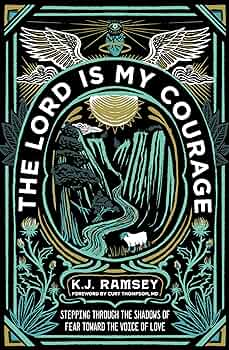
The Lord Is My Courage (book review)

I don’t recall what I thought I was going to get from K.J. Ramsey’s book The Lord Is My Courage. But here’s what I know I got:

  • New Language
  • Deeper Understanding
  • Fresh Appreciation

Ramsey’s approach to this subject is 1/4 part self-therapy, 1/4 part reader-therapy, 1/4 part church culture review, and 1/4 scripture exposition. That’s a lot. For her. And for the reader.

David, who wrote both Psalm 27 and Psalm 23, knew what it was like to have an enemy, knew how it felt to be afraid, and knew how much it hurt to wonder if you are heard.

Chapter 5, “He Makes Me Lie Down”

For this response, I took my time. Like a good meal, it’s better to pace yourself. The two chapters worth savoring the most were Chapters 5 and 20.

Chapter 5 includes nuggets rooted in a distinction of translation. Some scholars prefer a translation of the Greek to read “he settles me down” instead of “he makes me lie down.” Is that a big deal? To K.J., yes. “I thought God was a shepherd who made me lie down.  I needed to encounter God as a shepherd who settled me down.”

These kinds of bites are served throughout the book. The one I enjoyed the most was this one from chapter 20.

In John 16, Jesus is telling us, Peace is found only in my presence. And I will not leave you alone.

And then Jesus says to “take heart,” which can also be translated as “have courage,” telling us that our future is secure because he has already overcome the world.

Fear is just courage’s preamble. When we practice remembering that the Spirit of Christ is our companion, fear simply becomes one more prompt to pay attention to the voice and presence of Love. Fear doesn’t have to be an enemy to conquer. It can be a place to be companioned by Love.

Ramsey definitely follows the theme of the book, folded creatively in each chapter. Here are five illustrations:

  • “Courage is the practice of risking to trust that we have a Good Shepherd who is with us always-no matter what.”
  • “Courage is resisting the hurried pace of modern life and embracing the slower rhythm our bodies need to regulate and rise.”
  • “It takes courage to quit doing things for God to commune with God.”
  • “Courage is choosing to commune with someone who has already chosen to be with us.”
  • “Courage is simply the choice to be found.”

Is this book for you? If you enjoy the Psalms, yes. If you appreciate the integration of scripture and psychology, yes. If you are struggling with current or past church experiences, yes. If you like brain food, yes. If you could use a fresh look at who God is, yes. Chances are, yes.

Lay It Down Day(s)

In the Christian world, Sunday is a special day. It’s a day set aside for several reasons, depending on which lane of Christianity you’re following. I’ve been pondering this since before my alarm was set to go off this morning. I’m thinking in some ways Sundays aren’t necessarily special. More on that later.

This week had peaks and valleys. If I’m not paying attention, I can relive the valleys to the point the peaks are forgotten. That’s what I was dealing with to start the day-and I wasn’t even out of bed.

Before the alarm sounded, God and I had a talk. (SIDENOTE: A definition for prayer that I read yesterday described prayer as what happens when you pay attention. It’s okay if you stop to chew on that.) In thinking about heading to church this morning, we landed on this mindset: Everything the last six days have offered did not have to dictate how I showed up to this day. In fact, for the day to be what it’s intended, start by laying down whatever isn’t needed for the day.

What did that include?

  • Unresolved conflict
  • Confusion
  • Unanswered questions
  • Unmet expectations
  • Disappointment

To be clear, by laying it down we didn’t say these things don’t matter. Act like the week was just one big peak experience. Nothing truthful about that.

Laying it down meant don’t let it consume this day. If Sunday is going to be what it’s meant to be, I decided I didn’t need to carry those valleys into it. Today didn’t have to be a valley. The valley could have a small peak.

My word for the year is rest. I’m finding more and more that rest is a state of mind. Rest is possible in the valley just as much as it is atop the peak. It has to be chosen. That doesn’t make the valley disappear, nor does it mean the valley magically lights up. It means my body, mind, and spirit don’t have to hurry finding the path out of the valley. Chances are probably greater if I enter the church doors having already laid things down I will receive what God knows I need. I might even be able to help someone else lay something down.

Which leads me back to Sundays being special. Sure, it’s the day of gathering. But imagine if the other six days of the week were considered just as opportunistic. What if every day was a Lay It Down day? What if God and I had a similar talk every morning before standing up for my first step? I’m guessing that paying attention effort would result in more day’s intentions transpiring, valley or peak.

7 Lies Singles Are Tempted to Believe

During the 2024 holiday season I attended a party where I was the only non-coupled person. I had emotions about it. These emotions aren’t new. They certainly surface more around holidays, which I personally started noticing about seven or eight years ago.

These emotions if left unchecked can lead your mind down all kinds of paths, many which are based off some isolated statement or some cultural bias. Bottom line: You can start believing lies.

Before identifying some of these lies, here are a few facts to let you know you aren’t as alone as you might think.

  • According to the U.S. Census Bureau, 46.4% of adults in the United States are single, which is nearly every other adult aged 18 or older. This includes those who are divorced, widowed, or have never married.
  • In 2023, there were approximately 38.1 million single-person households in the United States. This is an increase from the previous year, when there were 37.89 million single-person households.

Already you can identify some of the lies about being single, right? But let’s name them, if for no other reason but to expose them.

#1 Other: This lie says you are outside the norm. You are other. You do not fit in with everyone else.

#2 Needy: This lie says when you acknowledge the emotions of being single you are immediately classified as needy. You aren’t allowed to feel those things; suppress them and move on.

#3 Unhireable: This lie says that if you want to succeed in your career, it’s impossible as a single person. Hireable people have partners. The best teamplayers are in a relationship.

#4 Second-rate: This lie sounds like #1, but it’s not. It says something is wrong with you. You can’t possibly be top shelf.

#5 Alone: This lie comes from the reality that much of the time you are by yourself. Being by yourself therefore equals being alone. It rejects the idea that having friends or a faith system changes the definition.

#6 Damaged: It’s possible this lie has actually been spoken about/over/to you. It’s sorta like the idea that just because you read something on the internet it must be true.

#7 Unlovable: This lie seems to have its roots in doomsday, what if, cause and effect thinking. If you don’t have someone saying they love you from a romantic relationship, then you aren’t.

Single person, I’m not going to insult your intelligence by stating the truths that dispel these lies. Rather, I’m just going to encourage you to consider what I did on my way home from that party.

Feel the feelings, identify the lies, speak truth over yourself, and make the choice to believe it.

Photo by Brooke Cagle on Unsplash