Keep Looking

Father

I looked for you today

In the drizzling rain

In the psalmist’s lyrics

In a believer’s curiosity

In a mourner’s heartbreak

Son

I looked for you today

In a partner’s forgiveness

In an artist’s healing

In a woman’s pain

In a dreamer’s frustration

Spirit

I looked for you today

In a grandpa’s tears

In a friend’s question

In a pastor’s story

In a buyer’s decision

There you were

Everywhere saying, “Keep Looking”

Photo by Erik Mclean on Unsplash

Journaling For Beginners, Part 3: Three Imagining Questions

In the last week, I heard another pre-determined set of questions that take a different approach to reflective journaling. They came from chapter three, “Hello To the Imagination,” in Padraig O Tauma’s In the Shelter.

  • How would you describe today?
  • Have you seen anything interesting on the way?
  • Is it working?

What I like about this set of questions is their openness. They create reflection that is deeper and broader, not solely focused on what happened after the alarm sounded.

Asking yourself to think about what you saw interesting is a different way of remembering. It’s not asking you to judge. Basically, what caught your attention, what made you curious. Feels like neuroplasticity in action.

Yes, the vagueness of “it” in question three is intentional. You get to decide what “it” is. You might need more than a page for that one occasionally.

Personally, I don’t see myself using this set of questions regularly. But they make a great tool, one I’ve chosen to add to the box.

Photo by Ahmet Yüksek ✪ on Unsplash

Journaling For Beginners, Part 2: 30-Day Challenge

Another approach to journaling is answering a pre-determined set of questions. I’ve come across two this year that I’ve engaged.

The first one I started on Easter Sunday. It was a 30-Day challenge created by Alex Banayan, author of The Third Door.

Now, before you dismiss it thinking you can’t commit to something 30 days in a row, here’s your better option. Think 30 consecutive journal entries. Some missed days along the journey are to be expected and shouldn’t be viewed as failing. I took 40 days. No guilt or shame.

The focus is similar to yesterday’s post-a review of your day. But answering three questions may take a little more time and thought. Here they are:

  • What filled me with enthusiasm today?
  • What drained me of energy today?
  • What did I learn about myself today?

The balance in these questions is healthy. You give yourself an opportunity to engage what fills you, to overcome what drains you, and to grow in understanding yourself.

Banayan encourages this reflection as a final entry following the challenge: Read back over your entries to identify patterns for all three questions. That exercise will take some time. No rush. I didn’t do that in one setting, by the way. Took one question at a time over a couple of days.

What I liked about this challenge was that it led to progress. If you’re wanting more from your journaling than reflection, this challenge is for you.

Photo by Jac Alexandru on Unsplash

Journaling for Beginners, Part 1: Focus on Wins

In the last month, two younger men have asked how to start journaling. Love it. Speaks to many things about their approach to life and their desire to grow.

When I said something akin to, “There’s no right way to journal; you’ll figure out what works best for you,” they both pretty much responded, “Not helpful.”

To be helpful, I shared this approach that I started in January after reading Dan Sullivan and Dr. Benjamin Hardy‘s The Gap and The Gain: The High Achiever’s Guide to Happiness, Confidence, and Success. Bottom line: Focus on Daily Wins.

The exercise is simple. At the end of the day, within the hour before going to bed, write down three wins from the day. This effort has many possible positive outcomes: better sleep, grateful mindset, acknowledging progress, and fostering happiness.

To increase your gain more, a deeper step is to write down three wins to achieve the next day. No more than three. This focus has the potential to improve setting priorities and increasing productivity.

No matter your age or season of life, I’m guessing trying this approach to journaling for the next month could be fruitful, maybe even life changing. After 15 years of this practice, here’s how Dan Sullivan describes its impact:

I go to bed feeling excited about the next day. I wake up the next morning excited. Oftentimes, what happens is I have wins bigger than the three I had imagined the night before.

If you’re struggling in your journaling discipline, give this focus a try. You are already winning. Take note.

Photo by Kelly Sikkema on Unsplash

Let’s Talk

Started listening to a new audio book, In the Shelter by Padraig O Tuama. In chapter one he asked an interesting question about prayer, one I’ve not heard worded this way before. “Where is it that we are when we pray?”

It’s a different way to challenge one’s emotional and mental approach to prayer.

We are often in many places. We are saying to ourselves, “I should be somewhere else,” or, “I should be someone else,” or “I am not where I say I am.” In prayer, to begin where you are not is a poor beginning.

To begin where you are may take courage or compromise or painful truth telling; whatever it takes, it’s wise to begin there. The only place to begin is where I am.

Not where you want or feel you ought to be. This could mean rather than naming your present state-confused, frustrated, hurt, angry, lonely, unhappy, etc.-you ask for where you want to be or where you feel it is your duty to be-fulfilled, joyful, connected, healed, satisfied, understood, peaceful, etc.

Not in many places. We can often pray about what has happened, what we fear is going to happen rather than what is happening in this moment. We can be drawn to focus on the past or the future to the point that the present is ignored, maybe even avoided. The result that we aren’t even intending can be distance, even creating space for drifting to begin.

I believe what he’s encouraging is twofold. One is raw honesty. The other is naked vulnerability.

Prayer that is honest and vulnerable, not pious or fake, says to God, “I’m here. I believe you are too. Let’s talk.”

Photo by Fallon Michael on Unsplash

Monks, Nuns, and Celibacy

I listened to Kathleen Norris’s book The Cloister Walk this week. Fascinating.

A highlight was Chapter 13, an honest look at her 10 years of relationships with celibate men and women.

In them the strengths of celibacy have somehow been transformed into an openness that attracts people of all ages, all social classes. They exude a sense of freedom.

She acknowledges her own struggle to understand how this can be, yet rejects culture’s prejudice take on reasons for celibacy.

As celibacy takes hold in a person over the years, as monastic values supersede the values of the culture outside the monastery, celibates become people who can radically assess those of us out in the world, if only because they’ve learned how to listen without possessiveness, without imposing themselves. With someone who is practicing celibacy well, we may sense that we are being listened to in a refreshingly deep way. And this is the purpose of celibacy. Not to obtain an impossibly cerebral goal mistakenly conceived as holiness, but to make oneself available to others, body and soul. Celibacy, simply put, is a form of ministry.

Natural tendency is to reject what we don’t understand or aren’t willing to be open to accept as necessary.

Ministry is a choice.

Availability is a choice.

Listening is a choice.

Our obedience to God’s choices for us won’t always be understood or accepted by others. Jesus actually told us to expect this to happen, to follow calling, to be about the Father’s work.

It’s necessary for transformation, for freedom.

Be strong in your obedience. Your body and soul will thank you. So will other’s.

Photo by Nikhil Singh on Unsplash

Sabbath Beauty

My Friday night journal entry included a weekend/Sabbath commitment/exercise. Look and make note of beauty for 48 hours.

Of all the observations, these were the four most notable, counting down to #1.

#4

Papa Cleve’s Jamaican ice cream in Miami is legit. The two flavors I chose were Oreo Cheesecake and Coffee. Check out this video: https://www.facebook.com/share/v/15j1T2e8GL/

#3

Came across this song by Benjamin William Hastings. Added to my 2025 Rest playlist. I couldn’t find a “story behind the lyrics.” I have strong suspicions, but I’ll let you listen for the message you get.

#2

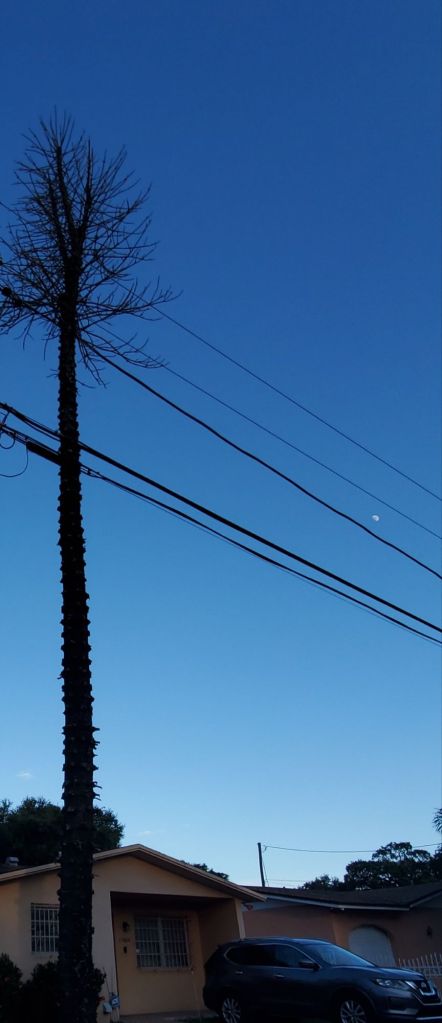
Trees are one of my favorite creations. This one a few blocks from my Airbnb in Miami captured me. I had to drive back by to get a quick photo. It doesn’t do it justice. It looks burnt. I’d like to know it’s story. Whatever it is, the message to me is, “I’m still here.”

#1

No picture or video. Why? It’s what happens when you run without a device.

Yesterday morning the first image of beauty to start my exercise was of a hoverboard rider. We passed one another on opposite sides of Old Bradenton Road around 6:05AM. I don’t even know if he saw me. I heard him before I saw him. I thought he was listening to music. Turns out, he was singing along to it, louder than I could hear it. It was hard to tell what he was saying, but I caught enough to suspect it was a praise song. That’s right. A hoverboarder starting his Saturday on a ride worshipping. How can that not be #1?