8 “Give Me’s” for Waiting

4AM. Not my preferred alarm setting. But you do what you got to do.

I decided what I had to this morning in order to start this day right was to get in a run before having to be in my car by 6:15. After my run around 5:15 while stretching, I found myself taking a longer than usual time to spend some time praying. Very unexpectedly, I got an answer for a prayer I’ve been in for several months, actually most of this year. Maybe that story will come later; but for now, I’m focused on the reality that some prayer answers are a long time coming. That means a lot of waiting.

So it shouldn’t have surprised me that on the same day this answer came an email came to my inbox this afternoon with a prayer entitled “Prayer for the Waiting Time.” It not only was timely, but also affirming.

If you find yourself in waiting time, take your time to read through this prayer by Nicola Slee. These eight requests may be the support you need to carry on, to wait well, and to keep listening.

Give me the resolution to say ‘no’ to the good so that I will be ready to say ‘yes’ to the better.

Give me the courage to keep living in the open-endedness of the future without foreclosing the mysterious work of your Spirit in my haste or fear.

Give me the persistence to stay in the wilderness of unknowing until I am ready to receive your call.

Give me the strength to keep still and keep waiting when all about me is pushing towards movement and activity and choice.

Give me the acceptance to live these days in uneventfulness, simplicity and hiddenness, without craving excitement, distraction, or change.

Give me the grace to live in the emptiness of ‘not doing,’ without the rewards of achievement, fulfillment, or success.

Give me the wisdom to discriminate between my own impatience to move forward and your Spirit’s deep stirring of my spirit when the time is right to move.

Give me the faith to trust in your obscurity, the obedience to stay faithful to your mystery, the courage to keep trust with your inscrutability.

Photo by Şahin Sezer Dinçer on Unsplash
Eternity Peeks

I had forgotten how much I liked playing that Yamaha grand piano. The lower octaves have deep, rich tones that feel human. If it weren’t for the occasion, I could have sat there all afternoon.

The occasion was a memorial service. They had asked for 15-20 minutes of prelude music, mostly hymns. Normal.

What wasn’t normal was no one was in the auditorium at that time. They were all in the lobby. So like on Sunday mornings when the worship team starts a service to 25% of the eventual crowd, I started playing thinking it was a cue. Nope. I pretty much played the entire prelude to an empty audience. Or so I thought.

Truthfully, I was glad it was empty. Back in the day, the situation would have annoyed me. But not on this afternoon. I just relaxed, sort of pretended I was in a studio or living room. Let the songs go wherever they wish. Play a verse here, repeat a chorus however many times I want, move around between octaves, just improvise freely. I think I must have stuck on a medley of “More Love To Thee” and “I Need Thee Every Hour” about five minutes. Wasn’t planned, but certainly flowed. Albeit late, the group gathered, and the service got under way.

Unbeknownst to me, the service was streamed, even the prelude. My friend who put the gathering together texted me that evening to say folks from Georgia appreciated the piano music prior to the service. I had no idea. I’m guessing had I known I might have approached things differently.

How often I’ve missed moments like this because of who’s in the room. Focusing on the wrong person or the wrong motive downgrades everything. So the challenge can be to always play as if the room is empty, at least of humans. Play from the connection that goes beyond the gut to full body, mind, and spirit in order to commune with the Giver of music.

I believe those moments are glimpses of eternity. I wasn’t expecting that glimpse when I sat down at that Yamaha. That’s something beautiful about how God relates. I believe he loves to catch us by surprise, when we aren’t expecting it. Since He placed eternity in our hearts, only He seems to know when and how to give us a peek. When He does, it’s a peek into so much more than an afternoon here on earth.

Cherish the peeks.

Photo by Trac Vu on Unsplash

The Value of Tears

The latest YouVersion reading plan I’m in addresses bitterness. Day 3 of the plan ended with this question:

How can failing to shed bitter tears result in sinful bitterness of heart and life?

Overcoming Bitterness, by Stephen Viars

Can’t say I’ve ever made the connection between not shedding tears and bitterness. Before answering the question, I rephrased the question into a statement:

Failing to shed bitter tears results in sinful bitterness of heart and life.

Viars revisited the stories of David, Mordecai, and Peter to illustrate his thought. When I considered situations from the past that I may still have bitterness about, I wondered, “Maybe I haven’t sufficiently shed tears about them. Now, it seems unnecessary. Yet, it’s worth the encouragement to acknowledge how tears could have served in the past and the value of embracing them in the future to eliminate bitterness growing.”

By the way, to answer his question I flipped it to list three ways tears help us:

  • Tears help us fully grieve.
  • Tears help us find clarity.
  • Tears help us face weakness and sin.

What’s your answer? How do tears help you?

Photo by Louis Galvez on Unsplash

The Awakened Brain (book review)

Last month I came across the work of Dr. Lisa Miller, unaware of her connection to the national institute that accredits the counseling center where I work. Quickly I was up to speed and got a copy of her book The Awakened Brain.

I started reading it during the downtime of Hurricane Idalia, finishing it today. Here is one statistic from the introduction that gives reason for Miller’s work:

A study of more than 67,000 college students across 108 institutions in the United States published in 2019 found that 20% reported that they had engaged in self-harm such as cutting, 24% reported suicidal ideation, and 9% had attempted suicide.

Introduction: Anything Can Be Shown

She defines the awakened brain in the introduction to give you some sense of the foundation she is going to build for this way of approaching life.

The awakened brain is the neural circuitry that allows us to see the world more fully and thus enhance our individual, societal, and global well-being…The awakened brain includes a set of innate perceptual capacities that exist in every person through which we experience love and connection, unity, and a sense of guidance from and dialogue with life.

Introduction: Anything Can Be Shown

In chapter four she makes an interesting observation about heredity and environment. Through research, she’s determined that spirituality isn’t solely determined by environment. A person isn’t limited only by the spiritual environment of their early years; in fact, we are born with spiritual awareness. That is good news for everyone.

A person’s degree of spirituality is determined 29% by heredity and 71% by environment…People at greater risk for mental illness due to their developmental stage actually have the most to gain from spirituality.

Chapter 4, Two Sides of the Same Coin

Woven throughout the book are compelling stories of spiritual journeys, including her own. These stories, including clients as well as business and national leaders, illustrate the transformation of lives who live responding to what life is showing them, particularly when they lean in to spirituality.

What I was witnessing was less that we heal when we impose a more positive meaning on the world, and more that we shift toward health when somehow, and usually through struggle, a bigger meaning is revealed to us…feeling better isn’t just a matter of creating new thoughts, of replacing unhappy ones with happier ones; it’s also about noticing and aligning ourselves with whatever life is showing us.

Chapter 7, When Inner and Outer Align

Admittedly, Dr. Miller’s work has not been easy in the scientific community. In many ways she is countercultural, somewhat blazing a trail to question if the way of American living has been wrong for many years.

We make our best decisions when we integrate our heads, hearts, and life’s guidance, learning to tune into our choices and hurdles as part of our spiritual path…We discover that we are seekers rather than makers of our path.

Chapter 9, The Castle and The Wave

Having lived many years in achieving mode and wondering how to step back from it, chapter 12 gave language to my struggle that is lifegiving. It may not ring true to everyone, but the clearness Dr. Miller makes between the two modes of awareness is my main takeaway from the book. I believe it’s the usage of the two words achieving and awakened.

We all have two modes of awareness available to us at all times: achieving awareness and awakened awareness…Achieving awareness is the perception that our purpose is to organize and control our lives…When we engage our awakened awareness, we make use of different parts of our brain, and we literally see more, integrating information from multiple sources of perception. Instead of seeing ourselves as independent makers of our path, we perceive ourselves as seekers of our path.

Chapter 12, The Two Modes of Awareness

Dr. Miller, of Jewish faith, does not use the language of the New Testament. I suggest she paints a clear picture of the difference between Paul’s teaching regarding walking in the flesh and walking in the spirit. Flesh walkers live for themselves; spirit walkers have their eyes open to the world, ready to put themselves aside for others.

Through awakened attention, we open up more channels of perception. We learn not only to notice but also to draw meaning from what shows up in our lives. We see more, and we’re better able to use what we see.

Chapter 14, Awakened Attention

If you are a believer who questions the place of science in your faith, I encourage you to read this book. If you are an academic who questions the place of spirituality in your life, I encourage you to read this book. Allow Dr. Miller to challenge your brain and your faith. What’s the worst that can happen?

For Their Sake

Thanks for listening. It was the second time I admitted this situation today. My ability to articulate it gives me the opportunity to internalize it. Radical acceptance. I appreciate your question and your willingness to listen. Thank you, friend!

Email I received recently

I thought my question was innocent. But apparently, to them, it wasn’t. Why?

Space. In that moment, they weren’t looking for it, but space was provided for them to put words to their emotions, their current situation, and their understanding. Space is sacred, particularly when it’s for and with the one who needs it.

Seen. In that moment, they were allowed to freely share, receive reflection, and affirmation. Being seen satisfies a natural hunger and may reveal more behind the hunger than previously understood.

Self-awareness. In that moment, they saw their reflection. They saw themselves with integrity and acceptance in a way that said, “It’s okay. I don’t have to necessarily like what I see, but at least I see myself more clearly. Now I have an idea how to respond, how to move forward.”

Got a question you’re not sure to follow a nudge to ask? For their sake, not yours, ask.

Photo by Ben White on Unsplash

Make Them Say “No”

Checked out a podcast episode today entitled “Why Leaders Need to Make Bold Proposals.” J.R. Briggs shares stories how he’s worked through his fear leading to a tendency not ask for what he wants. He’s landed on two questions to ask himself before asking for something that creates angst or fear:

  1. What’s the worst they could say to my request?
  2. Can I handle a “no” to my request?

My version of these two thoughts I’ve shared many times is “What’s the worst that can happen”? If I or the group I’m in considering an ask can handle the worst, why not ask?

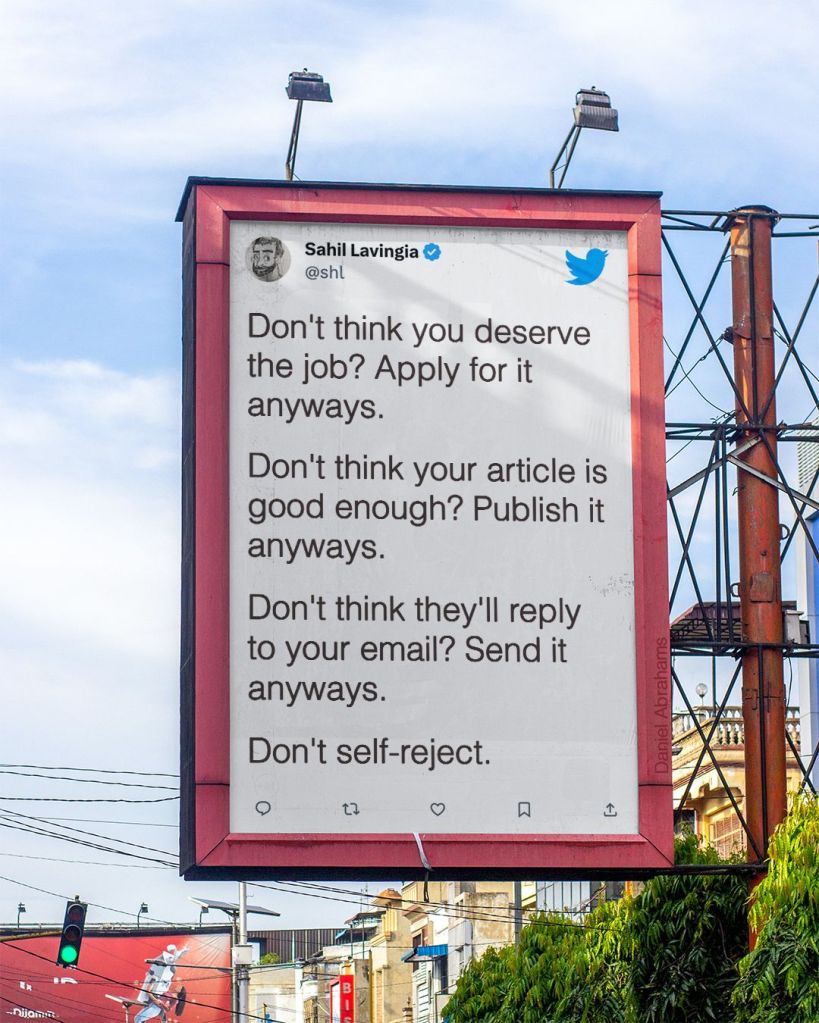
These thoughts are reinforced by this tweet image I saw recently:

I liked the self-rejection line. The mindset I’ve adopted is that the other party has to say no. Don’t say it for them by not asking.

More importantly, don’t say it for yourself. Some of us are really good at saying no to ourselves about the wrong things. The things that are the next step for us, the breakthrough, the healing, the answer we’ve been looking for can naturally have a fear factor attached. The courage for us to accept the no from the other party may be all we need. In these cases, say yes to the courage in order to avoid the missed opportunity of your no.

Family Illustration: Last March our mother turned 85. While celebrating in the Daytona Beach area, we scheduled a family photo session. The photographer commented it was too bad we didn’t take advantage of it being bike week to somehow include a bike in our props. Seed planted. Let’s just say, had we not asked the owner of this bike for a photo op at lunch after our session, we wouldn’t have this memorable photo:

Thank you to our mother and the bike owner for saying yes.

Whose Voice Matters Most

It’s Labor Day weekend here in the U.S. May mean you have more time to think. Here’s a reminder for you: Who God Says You are Matters Most.

In my thinking time already, I reviewed three conversations this week where descriptions were painted about someone. All were offered in constructive ways. Regardless of the intention or the relationship, human evaluations are limited. That’s not the case with God. Here are three reasons why:

Time known…God’s known you from conception…No one’s known you longer. Someone we knew in college may not recognize us today. It’s like that statement some middle-age adults make to a current friend: “If we’d known each other in college, we probably wouldn’t have been friends.” God’s been around for all the years. That history gives him the most information to back up what he says about you.

Depth known…God’s known you from formation…No one’s known you as deeply. The revelations we get from personality assessments make us say, “How did they know that? That’s so accurate.” It was no surprise to God. He wired you. He’s also been part of the ins and outs of life that have continued to form you, to mature you, to change you to the core. He knows you the most deeply, so his words about you carry the most weight.

Relationally known…God knows you by connection…No one’s more connected. Some people wear many hats in our relationship with them (family, boss, friend, neighbor, coworker, etc.). Naturally, we want to lean in to what they say. We long to be known by them. But there are many hats that only God can wear. When we are aware of them all, respect them, honor them, give thanks for them, the magnitude of what he says about us expands. Often, we forget just how much we most want to be known by him, but he cannot know us any more.

During this weekend, find some time to give him space to speak. Tune in to his voice. It matters most.

Photo by Megan Bucknall on Unsplash

Freedom Journeys (book review)

Earlier this year in other readings, I was challenged to consider the Old Testament through the eyes of Judaism. Can’t say I thought much about it prior. So I searched for a book along those lines and landed on this one, published in 2011.

When you hear a familiar story told through a different perspective, you have an opportunity to learn, to broaden your understanding, and I believe most importantly, deepen your connection to others.

Arrogance is not only a moral and spiritual malady. It breeds stupidity. For those who are utterly convinced of their own absolute rightness cannot hear the warnings of others, cannot pay attention to the signals from the world around them, cannot learn from their own mistakes.

Chapter 10, Who Hardened Pharaoh’s Heart

How the authors interpreted biblical and current events through the lens of the Exodus provides a consistent reminder that God is present in every situation. It is a freedom journey that He doesn’t abandon.

God dwells most deeply where the newly free remember their pain with tears, create their future in joy, and carry their vision into every journey of their lives.

Chapter 18, Carrying the Sacred Space

One thing I’ve always appreciated about the Jewish faith is their persistence to remember by storytelling. I appreciate it because I need to be reminded of it, particularly in efforts to know my fellow man better.

It is not enough for a people to become free just once, any more than it is enough for the grain to sprout or the lambs to be born just once. Over and over, year after year, rebirth, regrowth must come again.

Chapter 22, Transforming Our Festivals and Our Lives

My main takeaway from this book is to continue engaging other faiths, cultures, and stories different from mine. It is sacred. It enriches everyone willing to engage.

When Palestinians and Israelis, or American and Iraqis, or Jews and Muslims and Christians join with each other to mourn those who have died at each other’s hands, that weaves a sacred fringe between us.

Chapter 31, Meeting Brings Disaster, and a Cure

An Open Letter to the Walker with the Cane

We first met at the north end of the G.T. Bray baseball field’s parking lot. It was still dark, around 6:30 this morning. We greeted each other as I ran by, probably both assuming that was “one and done.”

After I finished my loop of the south end of the softball fields, I passed you again less than 10 minutes later as we headed to the east entrance of the park. We didn’t speak.

Another 20 minutes had passed when I came upon you again, this time not too far south from our first passing. You had made the entire loop, and I was circling back to leave the park by the west entrance.

As I got closer to you, you moved to your right, sensing someone coming. I thought to myself, “Good for him for keeping a steady pace. It can’t be easy to convince yourself to do another loop when you’re walking a slow pace using a cane.”

As I ran by this third time, we both spoke. I started first.

“Have a good day!”

In almost the same moment you said, “You’re making me feel bad.”

In the moment, I knew what you meant. My quick reply was a feeble effort to encourage you. “You’re doing great!”

Unfortunately, I never got a good look at you. The first passing was in the dark; the other two, I came from behind. Other than you had on a yellow shirt and sporting a head bandana, all I could tell was you were out for an early morning walk through the park, moving at a respectable pace for someone depending on a cane for support.

Had I not been on a tight schedule, I would have stopped to learn more. Have you been injured recently? Did you have surgery and now in rehab? Is this a lifelong challenge for you or just a temporary season of healing? I don’t know. But let me tell you four things I do know.

During my hour-long run, I passed a total of seven other people. Everyone else was walking, with the exception of the lady we both passed sitting on the park bench by the soccer fields. You were one of seven folks up and at it this morning. Whatever it took for you to get up and to the park and on the trail, you outdid thousands of others. That’s something to feel good about.

As for those other walkers, no one else was reliant on a cane. You didn’t let your dependence stigmatize you. You didn’t allow it to be an excuse. You had the determination to do the best you could in your current situation. That’s something to feel good about.

Another reply to your comment that I said to myself on my final half mile was, “Dude. You’re aren’t six feed under. You are not in bed. You are up and moving.” I don’t know what it took for you to be moving that early, but that’s something to feel good about.

The final thing I know is something I’ve told myself many times during runs and especially during races. Whatever someone else is doing that I’m tempted to compare myself to-pace, distance, etc.-it isn’t about what they are doing. It’s about what I’m doing. I know what it took to get to the start line. I’ve got an idea what it’s going to take to cross the finish line. I’m going to stick to what I’m doing. Good on them for what they’re doing.

My guess is you did at least two loops around the park this morning. You started before the sun rose. You did it alone. And you got it done. You, walking with a cane, did more than the average well-bodied person will do today. That’s something to feel good about.

Based on how your started it, odds are the rest of your day was good. Here’s to seeing you in the park again on another good day!

Photo by david Griffiths on Unsplash

10 Endurance Tests

Currently I’m going through a YouVersion reading plan for James 1. The first four days of ten have pretty much focused on this verse:

For you know that when your faith is tested, your endurance has a chance to grow.

James 1:3 NLT

Reading this the other day, it struck me to get specific. For instance, when faith in one area of life is tested it has a chance to grow. To flesh that out, here are ten additions where growth can be experienced by faith testing.

When your faith in your spouse is tested, your endurance as a vow-keeping partner has a chance to grow.

When your faith in your boss is tested, your endurance as a loyal employee has a chance to grow.

When your faith in your children is tested, your endurance as a loving parent has a chance to grow.

When your faith in your parents is tested, your endurance as an honoring child has a chance to grow.

When your faith in your government is tested, your endurance as a contributing citizen has a chance to grow.

When your faith in your company is tested, your endurance as a committed team player has a chance to grow.

When your faith in your church is tested, your endurance as a kingdom-minded citizen has a chance to grow.

When your faith in your investments is tested, your endurance as a focused treasurer has a chance to grow.

When your faith in your friend is tested, your endurance as a reliable presence has a chance to grow.

When your faith in your God is tested, your endurance as an image bearer has a chance to grow.

Photo by Hu Chen on Unsplash