The 6 overlooked words of Numbers 20

Numbers 20 tells a significant story in Moses’ life. After reading it this week, I believe it actually tells two significant stories. One just overshadows the other.

Both stories changed Moses’ future. The one that gets the most focus is his “not trusting in God enough to honor him as holy in the sight of the Israelites” (v.13) by striking the rock rather than speaking to it to produce water. This decision cost him dearly; he didn’t get to enter the Promised Land.

Before that choice, Moses experienced a normal but ugly thing in life, something he couldn’t control. Death.

In the first month the whole Israelite community arrived at the Desert of Zin, and they stayed at Kadesh. There Miriam died and was buried.

Verse 1

Those last six words jumped off the page. I knew his sister died before Moses and his brother Aaron, but I had never put her death as happening in the same chapter as his future-altering choice.

Unfortunately, those six words are all we have. We don’t know anything else. We’re left to wonder.

  • How did Miriam die?
  • Had their relationship healed from the scene in Numbers 12? (By the way, that’s where we find this statement: (Now Moses was a very humble man, more humble than anyone else on the face of the earth.)
  • How much time passed between verse 1 and verse 2 in this chapter?
  • What level of grief did Moses experience after his sister’s death?

Moses’ story has always intrigued me. These questions will go answered, but they should be infused in our interpretation and meditation of his life. 

  • Is it possible grief influenced this meek man to a choice he didn’t see coming?
  • Considering the unique elements of Moses’ early life (being pulled from his family of origin, conflicting allegiances, father/son relationship), certainly they impacted his development and actions, right? 
  • Death had to be a struggle for Moses considering his history of taking it into his own hands, right?

I’m learning this more and more. Rather than judge the action in the moment, we’d show more care and love to consider what led up to it. Particularly when we are in the dark, a place we often find ourselves in biblical stories. 

All the words matter. I’m doing my best to consider them all.

Photo by Ahmed M Elpahwee on Unsplash
Humble Inquiry (book review)

What a first read for 2024! Not sure how I came across it, but Edgar Schein’s Humble Inquiry is both refreshing and challenging. And I read the first edition not realizing there is a second edition. Wonder what I missed?

We cannot hope to understand and work with people from different occupational, professional, and national cultures if we do not know how to ask questions and build relationships that are based on mutual respect and the recognition that others know things that we may need to know in order to get a job done.

Introduction: Creating Positive Relationships and Effective Organizations

Schein contributed over five decades to the field of organizational health, a good portion of that as a MIT professor. His work was/is countercultural to the mindset of Doing and Telling.

Humble Inquiry is the art of drawing someone out, of asking questions to which you do not already know the answer, of building a relationship based on curiosity and interest in the other person.

Introduction

Schein repeatedly describes relationships with these words: trust, interactive, conversational, building, investing, processing, shared value, and mutual. After chapter 1’s focus on defining humility, chapter 2 shares case examples to which Schein keeps referencing through the remaining chapters. These three statements display the chapter’s nuggets:

Don’t assume that the person with the question has asked the right question.

Accessing your ignorance, or allowing curiosity to lead you, is often the best guide to what to ask about.

Humble Inquiry is behavior that comes out of respect and the desire to improve the quality of the conversation by stimulating greater openness and the sharing of task-relevant information.

Chapter 2, Humble Inquiry in Practice-Case Examples

Chapter 4, “The Culture of Do and Tell,” gives the most countercultural challenge, at least to U.S. readers. He believes the main problem standing in the way of better relationships and conversations is our culture that values task accomplishment more than relationship building. A second problem is asking, in general, is less valued that telling. Schein suggests the key to overcome these problems is Here-and-now Humility, described in chapter 1 as admitting dependence on others.

Schein culminates his work well with the last chapter as a “how to.” He makes a helpful acknowledgement that a culture shift requires unlearning and new learning, which result in two types of anxiety he labels survival anxiety and learning anxiety. The courage to face anxiety can result in beautiful relationships that otherwise wouldn’t surface.

A well-timed Humble Inquiry that launches a conversation that leads to a relationship should be thought of as a thing of beauty. Innovations in how we conduct conversations should be treated as art.

Chapter 7, Developing the Attitude of Humble Inquiry

Anyone in leadership will grow personally and relationally by reading Humble Inquiry. I’d also encourage business/executive coaches to read Schein’s book to sharpen themselves and to resource their clients.

Putting Ourselves in the Center

My annual reading of AWE by Paul David Tripp last month was timely. It also was impacted by growth in the last 12 months. I read through a different lens. Result: I continue to appreciate the big idea that checking our awe is valuable.

The first quote that stood out to me in this reading was from chapter 4, “Replacement”:

When we put ourselves in the center of the story, not only do we become rebels against God, we become a danger to ourselves and others.

Is putting ourselves in the center of the story a battle? For everyone. Is the thought that this means rebelling against God and endangering everyone mainstream? Nope. Maybe that’s why everyone battles it.

We don’t have to agree with Tripp. What we can do is challenge our mind and spirit to check our heart when we find ourselves in the center of the story. Is God on my heart’s throne right now? Are any relationships struggling right now? How is my joy and rest?

The second quote that stood out was from chapter 13, “Work”:

If you look to achievement to feel good about your life, to feel secure, or to have a life of meaning and purpose, then you will be dissatisfied with today’s success.

This sounds familiar (check out this post). The buzz of achievement dies. That buzz will not be satisfied by another achievement. Funny how my achievement also puts me in the center of the story.

When we find ourselves in the center of today’s story looking for the next buzz, it’s time for an awe check.

Photo by Austin Neill on Unsplash

2023 Library

For a sixth year I have followed a self-developed reading strategy with the objective to read broader. The goal: read books falling under diverse headings. This strategy is still working for me, particularly this year-the richest year of reading in a while.

For the curious, here is the library of 22 books including avenue of reading:

  • Against the Pollution of the I by Jacques Lusseyran (hoopla)
  • All That I Dread by Linda White (kindle)…the five titles by Linda White in the list are a series of fictional books
  • An Altar in the World by Barbara Brown Taylor (hoopla)…my favorite book on the list
  • The Awakened Brain by Dr. Lisa Miller (hard copy)…most thought-provoking book on the list
  • Awe by Paul David Tripp (kindle)…an annual read
  • Faith Beyond Belief by David Steindl-Rast and Anselm Grun (hoopla)…most engaging book on the list
  • The Fear That Chases Me by Linda White (kindle)
  • Finding God in the Waves by Mike McHargue (hoopla audio)…most compelling book on the list
  • Freedom Journeys: The Tale of Exodus and Wilderness across Millennia by Rabbi Arthur Waskow and Rabbi Phyllis Berman (hoopla)
  • Holy Hygge by Jamie Erickson (hard copy)…the best big idea book on the list
  • Jesus Wept by Bruce Marchiano (hard copy)
  • Learning to Walk in the Dark by Barbara Brown Taylor (hoopla)
  • My Darkest Night by Linda White (kindle)
  • Prayers for Freedom by Bruce Wilkinson (hoopla)
  • Rich in Heaven by Chris Mackey (hoopla)
  • Silence and Beauty by Makoto Fujimara (hoopla)
  • Solo by Stephen Smith and Peter Ivey (kindle)…most practical book on the list
  • South by Ernest Shackleton (hoopla)
  • Toughest People to Love by Chuck DeGroat (hoopla)…most helpful book on the list
  • When Evil Finds Us by Linda White (kindle)
  • Winter Flight by Linda White (kindle)
  • The Wisdom of Your Body Hillary McBride (hoopla)

NOTE: If you’re not familiar with hoopla, check it out: https://www.hoopladigital.com/

5 Steps to Customize Your Own Year-Long Bible Reading Plan on YouVersion

(updated from 1/21/23 post)

A year’s commitment to anything can sound daunting. I imagine that’s the feeling most people have when they consider committing to a 365-day Bible reading plan.

Besides that, most of those plans are designed to take you through the entire Bible. A worthy goal to pursue at least once in life. Yet, the challenge to get that done in a year can be tempting to ditch.

I completed one of those plans once on YouVersion…in about 3 years. See the point.

It took me that long because I choose to take my time. And I like to veer off track. If I want to campout in Jonah longer, I do. If I’m intrigued by a theme in Romans, I’ll take a break from the plan and complete other plans covering that theme…as many as I want as long as I want. Coloring outside the lines.

But the idea of reading a portion of the Bible every day does not mean you have to read the entire Bible in any set amount of time. All it means is placing a priority, developing a rhythm in your day that includes reading the Bible. Whenever you do it, how long you do it, where you do it, that’s entirely up to you. And, for those other rule breakers, what you read is also entirely up to you.

For quite a while, I’ve been using YouVersion reading plans. A nice thing that’s possible is customizing a year-long reading plan. Want to give it a try? Here are five steps.

  1. Determine to Make a Daily Commitment. Pretty obvious, but if you aren’t resolved to it, you won’t make it to December 31st. Sure, you might miss a day here or there. Understandable. Give yourself some grace and think about the fact that odds are you’ve got 5 minutes to give to this commitment and missing it a couple of times doesn’t make you a loser. If you are in, move on to step 2.
  2. Decide on a Theme. There’s a popular trend that’s replacing making New Year’s Resolutions. Instead of setting goals and aspirations, you choose a word that you’d like to guide you for the year. Not sure about that, check out this podcast episode to learn more. I started this in 2020. Each year I’ve utilized it differently, more broadly. This year, that word is what I’m using to customize my Bible reading. My word for 2024 is courage. Know your theme? Move on to step 3.
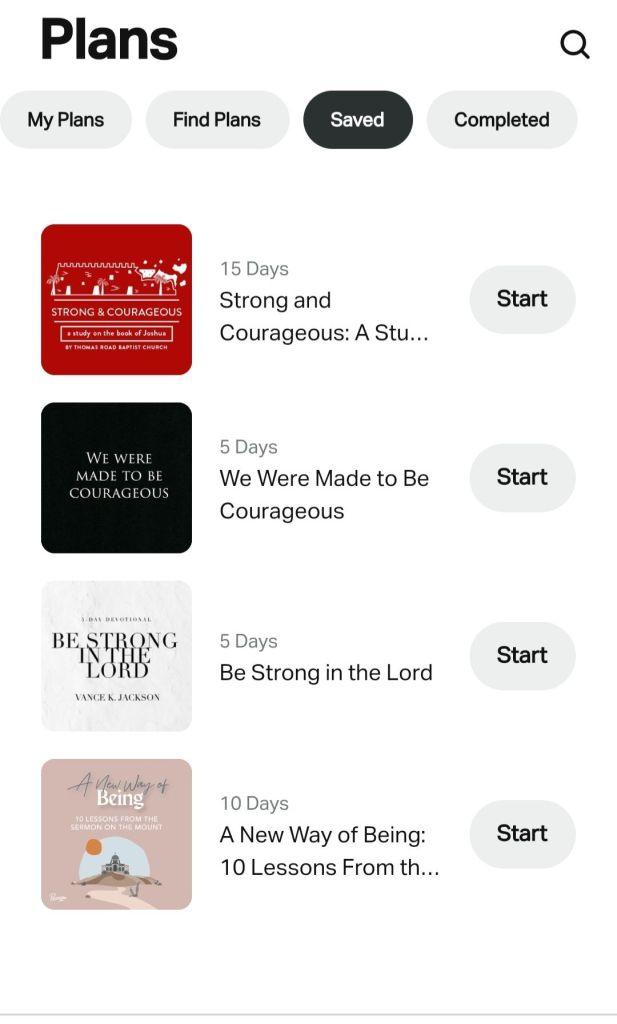
  3. Search Plans. On the YouVersion app (download it now if you haven’t already), you can search for reading plans simply by typing in a word. Most likely, dozens of reading plans are available. You’re ready for step 4.
  4. Save for Later. On each plan description, you have two choices: sample and save for later. Sample allows you to check out any day of the plan. I do that to get an impression if I think I’ll complete it. If I think so, then I save it for later. You don’t have to start the plan when you find it. I’m not worrying about saving enough plans that equal 365 days, by the way. I just saved the ones that looked interesting to me for now. At the moment, I’ve saved enough plans to get me into February (total up the days for each plan to see how many days you’ve already covered). Saved at least one plan? Final step is next.
  5. Follow the Thread. As you read each plan, some verse/story/character will stand out, grab your attention. Take note. Follow that lead to search for other plans to save for later. For instance, since I did my initial plan saving, the book of 1 Peter has gotten my attention. Adding reading plans can feel very fluid and interactive.

That’s it. This approach proved worthwhile and meaningful last year. If it ain’t broke…

13 Quotes from Faith Beyond Belief

Just finished reading another book that’s delivered richness.

It reads like a podcast transcript. When they say a conversation, they mean it. So it’s refreshing in that way.

The 22 chapters feel like episodes. They don’t necessarily connect one to the next, but they definitely weave the thread of faith and spirituality.

Rather than critique or review the book, I choose to share these quotes for your meditation:

“Love your neighbor as yourself” means be aware that you and your neighbor are one.

The Creative Meaning of Life

The answer I would give the agnostic: if you cannot see [accepting unity with God] yet, you don’t have to accept it. Wait until you experience it. It is not a dogmatic principle we want to impose on you. We only want to say that millions of people experience it. You can too. Open yourself to it.

The Epic Discovery of Self

You have a “vibe.” What do you want to transmit? Bitterness, dissatisfaction, loneliness, or understanding, warmth, and love? None of that requires any great achievement. It simply happens in the way I live my life.

A decision in favor of something is also a decision to let go of something.

“Fear not!” means “take courage, and take anxiety as it comes!”

Calling, Courage, and Fear (this chapter alone is worth checking out this book; so much to digest on the subject of anxiety and courage)

When someone says she doesn’t believe in God, I ask: which god don’t you believe in?

On the Temptation to Want to Possess the Truth

Prayer warms what is frozen and hard into living water.

We fulfill God’s will when we forgive on earth as God forgives in heaven.

The “Our Father” and God’s Trustworthiness

Many people are afraid of death because they have not lived. Unlived life is hard to let go. Those who live deliberately can also let go.

On the Mortal and the Eternal

I cannot explain why there is suffering, but I can influence how I meet it.

Suffering and Reconciliation

Humility is the appropriate attitude by which to accept oneself with one’s strengths and weaknesses.

Transformation is the result of a crisis.

Spiritual Growth

Despite all the deviations, we can say that if the church did not exist, our society would be essentially colder.

What is the Christian’s Focus?

Learning to Walk in the Dark (book review)

I enjoy a writer who makes you think, or at least presents something ordinary unordinarily. Barbara Brown Taylor is definitely in this category.

In this second of her books I’ve read she gives you a different approach to thinking about darkness.

One beautiful way she does this is by showing you the value of darkness in biblical stories. She says the night sky was a key player in Abraham’s decision to trust God when he was told to “count the stars.” She spends a great amount of words on Moses’ encounters with God in the dark.

The God of Moses is holy, offering no seat belts or other safety features to those who wish to climb the mountain and enter the dark cloud of divine presence. Those who go assume all risk and give up all claim to reward. Those who return say the dazzling dark inside the cloud is reward enough.

Chapter 2, The Fear of the Lord

As you can imagine, much of the book addresses the emotions that come from fearing the dark. She believes that’s actually an indicator of something going on inside of us.

Our comfort or discomfort with the outer dark is a good barometer of how we feel about the inner kind.

Chapter 3, Hampered by Brilliance

A fascinating approach to her research for the book included cave exploration. With aid from professionals, she spent time sitting in the dark in caves and exploring portions of caves that demanded she address her fears. One takeaway: new life starts in the dark.

Whether it is a seed in the ground, a baby in the womb, or Jesus in the tomb, it starts in the dark.

Chapter 6, Entering the Stone

A spiritual book about darkness is most likely not complete without a chapter on the dark night of the soul. Taylor’s coverage is exhaustive from both sides of the topic as well as from the individual to the communal. The most helpful section was her description of the difference between faith and belief. Sharing about her observations as a college professor, she gives this distinction about questions college students are asking or are being asked:

When I listen to college students talk about faith, beliefs are what interest them most: Do you believe in the virgin birth? Do you believe that Jesus died for your sins? Do you believe that only Christians go to heaven? No one asks, “On what is your heart set?” No one asks, “What powers do you most rely on? What is the hope that gives meaning to your life?” Those are questions of faith, not belief. The answers to them are not written down in any book, and they have a way of shifting in the dark.

Chapter 7, The Dark Night of the Soul

I’ve already suggested this book to a few folks-one running friend who avoids running in the early morning hours, one coaching client who feels distant from God. Whether you are struggling with physical or spiritual darkness, I’d encourage you to give this book a read. See what you learn.

The Unhappiness We Create

Jacques Lusseyran (1924-1971) was a blind author, professor, and leader of the French Resistance in WWII. At age 19, Lusseyran was arrested and spent nearly 15 months in the Nazis’ Buthenwald concentration camp. When the U.S. army arrived, Lusseyran was one of roughly 30 survivors of a transport of 2,000 French citizens.

In this collection of Lusseyran’s essays, he recounts becoming blind at age seven, reactions to societal progression, and observations from Buthenwald.

Essay #1, “The Blind in Society,” is his revelation that after his blindness he became aware of an inner light. Here’s one illustration of his observation of that light:

When I was overcome with sorrow, when I let anger take hold of me, when I envied those who saw, the light immediately decreased. Sometimes it even went out completely. Then I became blind. But this blindness was a state of not loving anymore, of sadness; it was not the loss of one’s eyes.

In the final essay, “Poetry in Buchenwald,” Lusseyran shares the power of poetry. His sharing of poetry with fellow prisoners brought hope and happiness. From that, he had this to say about unhappiness:

Unhappiness comes to each of us because we think ourselves at the center of the world, because we have the miserable conviction that we alone suffer to this point of unbearable intensity. Unhappiness is always to feel oneself imprisoned in one’s own skin, in one’s own brain.

I share these two thoughts to record them for future reference. I also share them in hopes that we move more toward love to eliminate the unhappiness we create in ourselves.

Now I Know Why

Rarely do I regret reading a book. Actually, if I think that’s going to be the case, I don’t finish it. Again, that’s rare.

However, often I finish a book and think, “I’m glad I read it. It’s not for everyone, but maybe there’s someone I’ll be able to share this book with.” That’s exactly what happened today.

The last book I read was Finding God in the Waves by Mike McHargue. Actually, I listened to it through Hoopla on audio. I believe I came across it by reference in another book I read earlier this year, so I put it in my queue.

I hadn’t heard of McHargue. But apparently his writings and podcasts have created a stir. I see why, which is why I know his book isn’t for everyone. But I met Dave today, and it was obvious I had to share this book with him.

Why isn’t important. What’s important is that sometimes we’re fortunate to experience firsthand, and even within days, what God is up to. We can wonder and be curious. Sometimes we see it; sometimes we don’t. I counted it a rich moment to say to Dave, “Now I know why I read that book.”

Photo by kaleb tapp on Unsplash

An Altar in the World, Meditation #6

On recommendation, I recently read An Altar in the World by Barbara Brown Taylor. It’s subtitled A Geography of Faith. In the spirit of that lane, rather than offer a review I’ve selected my top highlights and will offer a meditation post for each one. Here’s the final quote:

Anything can become a spiritual practice once you are willing to approach it that way-once you let it bring you to your knees and show you what is real, including who you really are, who other people are, and how near God can be when you have lost your way.

Chapter 5, The Practice of Getting Lost

Chapter 5 is a ride. Taylor takes something bane like getting lost to illustrate her point that anything can become a spiritual practice.

I can’t say I get lost on purpose, but I understand her point. Getting lost viewed through the lens of “maybe there’s a reason” certainly requires some discipline and regulation. What I have done on purpose is take new streets, driving or running, just to see what’s on them. This past Saturday, in fact.

I had an event to attend downtown Sarasota Friday night. Instead of driving home to West Bradenton afterwards, I booked an Airbnb just south of downtown. Main reason: to run the Ringling Bridge the next morning. It had been too long, so I felt like it was worth it. Of the overall 7.28 miles of the run, besides the bridge, I had never ran any of those streets. I purposefully returned back a different way than I had approached the bridge. The two best sections of the run was by the Bay on Mound then through and around Payne Park.

I agree with Taylor. Growth happens when you lean in to purposefully embrace the unfamiliar. And whether that unfamiliar was planned or not, your peace and trust are revealed. Who couldn’t benefit from that?

Now I’m remembering running on some very unknown streets in 2012. That summer I took my first international trip, to Belarus of all places. The purpose of that trip wasn’t to run or pleasure traveling, but to teach ESL classes through a supporting church. Many disciplines were bundled together on that trip; they still bring me to my knees, show me what is real, who I am, and who other people are. I may never forget running in that country. It was spiritual.

What practice of yours, if looked at differently, could become spiritual? Grilling? Baking? Fishing? Painting? Ask God to show you the way. May you find a new altar in your world.