Pursuing and Exiting Silence

The final segment from this podcast episode transcript to highlight focuses on the value of silence. Opinion: silence should be a love language.

Parker: I’m grateful to the Quaker tradition. I’ve been hanging around with Quakers since I was 35, I guess for 50 years, and I’ve learned a lot from them about the power, the value of silence, which I did not learn in my mainline Protestant upbringing… whenever the minister said in the church, I grew up in the Methodist church, now we’ll have a moment of silence. The organ broke into loud pouring for sixty seconds so that none of us could hear what we were thinking. Which was precisely the point.

Kate: Oh my gosh my son said something like that the other day. He goes, why do you keep, he said it so sweetly, but he was like, why do you keep bringing me to this place where they keep saying listen to God, but everyone’s talking.

Parker: Exactly, oh I like that a lot. Tell your son that’s so good. Exactly. So I learned a lot from the Quakers who don’t worship the silence. They worship in silence, and what they’re doing is listening. And Quakerism has its problems, just like every religious tradition or sect does. But I have seen wonderful things come out of that silence where people kind of touch a bedrock of truths. It emerges in vocal ministry, as Quakers call it. And community starts happening around those deeply held concerns. Because so often when we speak from that place of depth, we’re tapping into the aquifer that feeds all the wells. And it turns out that other people, as they tap in, are feeling that same thing or getting that same message. And then we’re poised to do something that’s real and could well make a difference in the world.

“They worship in silence, and what they’re doing is listening.”

Without question, my spiritual formation is strengthened by the amount of silence I naturally have living alone. In the silence I have been freed to listen which, with proper discipline, leads to worship.

In these last three months, I’ve done less writing and reading. When I heard this part of the conversation, I wondered if that may be attributed to my subconscious (mind/body/spirit) leading me to more silence in response to disaster and heartbreak.

Imagine what’s possible when silence is consciously pursued.

  • Healing
  • Forgiveness
  • Grace
  • Clarity
  • Direction
  • Humility
  • Surrender
  • Joy

Imagine what awaits as one speaks upon exiting silence.

Photo by Nathan Anderson on Unsplash

This Is Us & Phil Wickham

Like many Florida Gulf Coast residents, I left home yesterday. If you took the time to pause when you locked the door, an extraordinary number of thoughts slammed your mind, body, and soul. These thoughts, built on a mix of emotions, will rise to the surface sooner or later, so it’s good to welcome them now, within reason.

Earlier I wrote this phrase in a message, “Not sure what comes next.” I wasn’t expecting the hit to my chest, the jolt to my brain that came with those words. So I paused to sit with them rather than stuffed them.

Two things followed.

One, I was reminded of a This Is Us scene where Randall and Beth played a game they called Worse Case Scenario. In this clip, Randall shares it with their three girls.

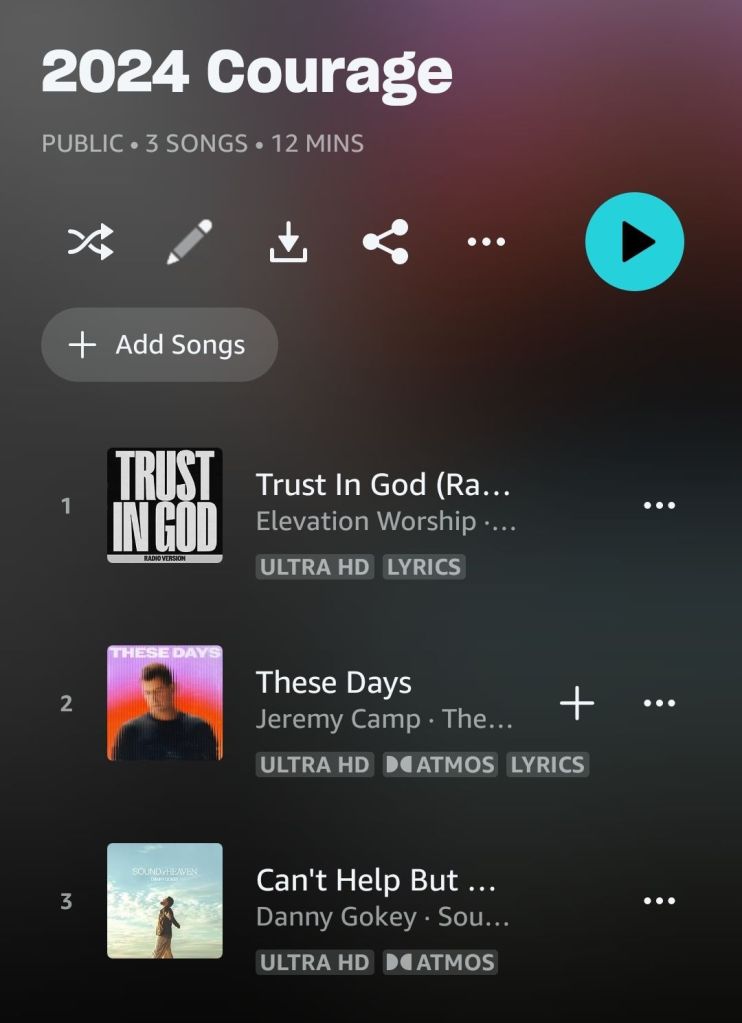
Two, I opened my 2024 playlist based on the word courage. This Phil Wickham song is at the top of the list.

Even in the worse case scenario, the Lord is my Shepherd. His goodness and mercy will follow me all the days of my life. I don’t have to fear; I know He is with me. The table is prepared; the right direction is ahead. All is well is my soul.

Deeper, Stronger Love

About this time last Saturday, I was sitting in the stands of Washington-Grizzly Stadium on the campus of the University of Montana in Missoula waiting for the Zootown Challenge 5k to start. Not too sure how the race would go due to fighting off altitude sickness the last 18 hours, I was anxious to get moving.

When they separated the competitors based on expected pace, I ended up standing by this guy, one of several competitors wearing the same shirt.

I asked, “Tell me about the shirt so many of you are wearing. Are you part of a team?”

“No,” he smiled. “We’re just all here to remember my brother, the guy on our shirts. He died last year. He ran this race the first two years it was put on, so we’re all here to honor him.”

“That’s really amazing. There are a lot of you. How many are there?”

“54. And he’s laughing right now. This is something I never do.”

We chuckled at that thought and ended the short chat with encouragement. Basically, no matter what, we’re going to get this done. The line started moving, and we eventually separated. I passed him once on the course with a nod to keep moving.

Nothing was said about how his brother died. A year later, that wasn’t important to share in a random conversation with a stranger. What was most clear was the brother left behind loved his lost brother and was doing things now because of what he saw and remembers. I’m guessing being in that stadium and running the course was a way for him to say, “I haven’t forgotten you. Odd to say, but I love you probably now more than ever.”

This was fresh in my mind as I had just read these words from Henri Nouwen’s book Life of the Beloved:

I am called to trust that life is a preparation for death as a final act of giving…If love is, indeed, stronger than death, then death has the potential to deepen and strengthen the bonds of love. It was only after Jesus had left his disciples that they were able to grasp what he truly meant to them. But isn’t that true for all who die in love? (Chapter 8, “Given”)

May your loves deepen and strengthen.

Six Steps to Writing Your Laments

I’m guessing if the majority of us were asked if we had anything to lament over we’d have more than one answer.

  • A relationship
  • Religion
  • Politics
  • Finances
  • Physical aches

I’m guessing if the majority of us were asked if we had a proper approach to lamenting we’d struggle to lay it out. Thankfully, Krispin Mayfield has offered some help.

In his book Attached to God, he gives six steps to writing a lament. Why? When we express our most difficult emotions to God, we draw closer to him. Intimacy with God is found in a balance of praise and lament.

In the tradition of the Psalms, here are Mayfield’s six steps:

  1. Tell God something you wish were different in your own life or the world, such as a health condition, difficult relationship, life stress, poverty, or racism.
  2. Tell God what you feel when you think about this issue; additionally, write down any emotions you might feel considering God’s inaction regarding this issue.
  3. Tell about a time in your own life or someone else’s where God intervened.
  4. Ask God to step in and address this suffering.
  5. Tell God you’re confident that your prayer is heard.
  6. Praise or recognize one of God’s attributes or characteristics, based on your past or present experience.

Sharing some of your uncomfortable emotions with God might feel strange. But you can unlock the basement when you’re assured that both God and your faith tradition can hold the parts of your experience. When you are sad, scared, or angry, your emotions aren’t signs of a lack of faith, but rather evidence that you are exactly where you need to be-at home with a God who is waiting to hear your emotions and give you the reassurance you need. (chapter 8, “From Shutdown to Engaged”)

Photo by Joshua Earle on Unsplash

Running from Joppa

Jonah 1:3 CEV
Instead, Jonah ran from the Lord. He went to the seaport of Joppa and found a ship that was going to Spain. So he paid his fare, then got on the ship and sailed away to escape.

Most 4:30AM runs don’t make me think of Old Testament prophets. This morning, I might as well have been boarding a boat bound for Spain.

Never mind the fact that a gradual heavier rain fell over the five miles. The connection was a familiar spirit that I’ve encountered many times over my 56 years. I’ve come to identify it as the Jonah Syndrome (JS). See if these three words sound symptomatic: frustrated, angry, and resentful.

The more I chatted and listened to myself, the more I realized I wasn’t the only one in the conversation. If I’m being honest, I told God I felt pretty justified in these emotions. He didn’t disagree; but he didn’t give freedom to let them be an excuse for any actions for the day.

That’s when I turned. Instead of getting cozy on the boat kidding myself that the approaching storm had nothing to do with me, I found myself running from Joppa, visualizing the rain symbolically washing away the potential actions produced by JS. The request became, “Replace these symptoms with patience, love, and purpose.”

Here’s what I know about Joppa-you have a choice: keep running to escape or reverse course. Thankfully, God welcomes pacing anyone running from Joppa.

Photo by Justin Aikin on Unsplash

Hurrying Is Human

To begin his podcast episode entitled “Quiet Compounding,” Morgan Housel shared this quote by Chinese philosopher Lao Tzu: “Nature is not in a hurry, yet everything is accomplished.” Housel then added these thoughts:

So think about giant sequoias, and advanced organisms, and towering mountain ranges. Nature builds the most jaw-dropping features of the universe, and it does so silently without trying to get attention-where growth is almost never visible right now but is staggering over long periods of time

Because his podcast is about money and finances, you can imagine where he goes from there for the next six minutes (click here to listen). When I heard this, my mind went down the personal growth lane. For that matter, life in general.

Of all the thoughts available to chase, mine went toward the gift this visual offers. Along with our striving for vocational success or relationship health or spiritual depth often comes a dump truck load of impatience. The vision demands speed, the approval starts the countdown, and the comparison creates competition.

Culture loves demands, countdowns, and competition. The countercultural eternity in our hearts draws us to pause, reflect, and look up.

May we grow in our trust that what God is after in every part of our lives will be accomplished at the right time. Rushing is futile. Hurrying is human.

Photo by Patrick Mayor on Unsplash

Redeeming Conditioning

This was the first point in yesterday morning’s sermon: You always find what you’ve been conditioned to find. I was immediately reminded of a blog post from a few years back, “We See What We Look For.”

Being conditioned is certainly a thing, a thing that many are quick to point out about others who are on the opposing side. I often wonder how much we consider our own conditioning.

For example, politically. The deeper in one gets, the more conditioned they become to seeing only one viewpoint and thus responding in defense of it. The conditioning seems impenetrable.

And unfortunately, the same seems to go for spiritually. It’s as if our identity in both of these realms cripples our ability to recognize our personal programmed perceptions and responses that leave our minds and spirits untapped.

I’ll give two examples. A few years ago I answered a question of why I believe God exists by how I believe I’ve experienced His involvement in answering prayer. Two people in the conversation immediately locked eyes and jinxed each other with their reply of, “That’s just positive manifestation.” Wall up. Dialogue over. (If this is new language to you, check out this blog post.)

This past week I was at an event where we were discussing the usage of microphones. I made a comment that I didn’t have a clue came across as judgmental. One person replied gently, “We try not to judge here.” He’s conditioned to protect against judgment; I’m a work in progress of overcoming judgment as a natural response.

May I suggest we all address conditioning in the following ways:

  1. Acknowledge you have been conditioned
  2. Consider the probability that your conditioning needs redeeming
  3. Thank God for his redeeming conditioning work
  4. Offer grace to others who find their conditioning in need of redemption

Photo by Edi Libedinsky on Unsplash

Praise: A Well-Taken Reminder

For the last three weeks I’ve been focused on a question, a personal spiritual dialogue that I’ve shared with a few others. The question could be stated several ways, but what I’m after is an answer that enriches/refreshes relationship with God. Here are variations of the question:

  • Which is more important, focusing on what God does for us or who He is to us?
  • In my experience in the Church, is the focus on what God does or who He is?
  • What do my prayers reflect, a focus on works or on identity?
  • How do believers achieve balance between doing for and with God versus being with and knowing God?

In ways I’ll never be able to explain, the timeliness of reading the right book at the right time surfaced again this afternoon. I recently picked it up off clearance at Books A Million.

In Chapter 4 entitled “Jesus’ Prayer of Praise,” McHenry shared that Richard Foster says adoration has two forms, praise and thanksgiving. Thanksgiving expresses appreciation for what God has done; praise acknowledges who God is.

This struck me through a simple word-praise. I have been contrasting the words adoration and thanksgiving without thought to the word praise. Accepting this teaching that they are really all the same brings some relief to my analytical brain.

That final question in the list above comes from how I’ve been approaching prayer the last three weeks. I’ve leaned more in the adoring lane than the thanking or asking lane-an effort to discipline my focus on relationship. A reminder to praise is well taken.

By the way, in this chapter McHenry shared a terrific list to help us all improve our adoration. Seemed worth sharing.

Working From not For

This is my third and final post reflecting on Dutch Sheets’ The Pleasure of His Company. Chapter 29, “The Connection,” was the highlight for me. Maybe because he references Old Testament characters I’ve been reading about the last few weeks. But I’m pretty sure it’s because he drills down on a topic I’ve been chewing on, again, for the last two weeks. What matters more, who you are or what you do?

That’s not really his intention, but that’s where it goes. And, for the record, he doesn’t really give you an answer. Here are my four highlights for illustration:

  • “At times, the most spiritual thing we can do is the most natural and practical. Work is practical yet very spiritual; feeding hungry people is, as well; nurturing our children is practical, time-consuming, tiring-and very spiritual. Keepin’ it simple is sometimes keepin’ it spiritual.”
  • “To be holy doesn’t mean being separate ‘from sin,’ but rather ‘unto God’…Holiness isn’t sinlessness.”
  • “…strength lies not in the perfection of my outward performance but the connection of my inward heart.”
  • “There’s a vast difference between performing for acceptance and performing from acceptance.

There’s a noticeable difference when a relationship has shifted to from away from for. Sometimes others can see it better than you; sometimes not. If you’re really not sure, the best person to check in with is your Creator. He knows what it means to live from illustrated by instructing Moses to tell everyone, “I AM sent me.”

Go with what He tells you. If He says your offering brings him pleasure, that’s all you need. You’re in good company.

Photo by Jon Tyson on Unsplash

God’s Nature: Lording or Loving?

Sheets continues in the next chapter of The Pleasure of His Company to dig into aspects of our relationship with God. He zeros in on a belief that God’s nature is misunderstood. A misunderstanding of God’s nature would certainly explain why worship can lack passion, be endured, or even resisted.

I don’t believe the problem with most believers’ worship is hypocrisy or insincerity. I think the majority is trying to honor God by giving Him His dues and fulfilling their obligation to Him as the Creator. I doubt if most of them understand, or have even heard, that God is a lover as well as a Lord. And it wasn’t his lording nature that prompted him to create us-He could have made a few billions more angels had that been His desire. It was his loving nature. God is a Father at heart.

Chapter 2, “The Seeker”

This morning I got to talk with a guy at church for the first time and found out he works for a local, family-owned business. Between their six locations, they have over 800 employees. Describing being employed there he said, “You work hard, but it’s like family. We have a hard time finding good employees, but we continue to grow and I love working there.”

He’s describing a work place that isn’t only about lording. We all pretty well can tell the difference between lording and loving. If you come from a faith setting that focuses more on a lording view of God’s nature, it’s probably long overdue for your relationship to take a shift and consider his loving nature.

Photo by Rod Long on Unsplash