Practice, Practice, Practice

Tonight I was reminded of the importance of repeating fundamentals in any discipline to maintain the opportunity to be great, or at least to improve.

Most great accomplishments are the result of doing little things faithfully over a long time.

  • For a pianist, the little things include scales and arpeggios.
  • For a runner, the little things include hydrating and stretching.
  • For a journalist, the little things include listening and questioning.

You have disciplines, whether you see them as that or not. You may have the discipline of being a student, or being a mother, or being an employee, or being a dancer. When we stop to think about all areas of our lives, we maintain many disciplines. Sounds tiring. Hard to maintain.

So what keeps us honed, sharp, improving, growing? Not ignoring the fundamentals. Practice, practice, practice.

You want to be a faithful employee? Show up on time. Meet the deadline. Say thank you.

You want to be a faithful husband? Take your wife out on a date. Ask her what needs to be done around the house. Give her a kiss right now.

You want to be a faithful follower of Christ? Talk with God about other things besides your plate of food. Read His letter to you as often as you can. Talk with others about your faith in God.

We all desire to be great or at least moving in a forward direction. Remember the fundamentals of your discipline. Practice, practice, practice.
13 years of wrong

it ain't over

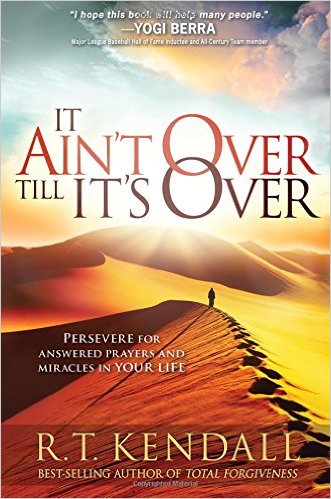
I’m reading “It Ain’t Over till It’s Over” by R.T. Kendall. In chapter 1, he references the story of Abraham, Sarah, and Hagar.

At Sarah’s suggestion, Abraham slept with her handmaid, Hagar, in an effort to make things happen-to make good God’s promise to him. All that was needed, they reasoned, was that the baby be male.

This wording made me think about something for the first time. What was the nine months before Hagar gave birth like for all three of these people? And then, when it was a boy, what was their reaction toward God?

  • During the nine months, “Did we do the right thing?” After the birth, “I guess so. Thank you, God!”
  • During the nine months, “What if it’s a girl?” After the birth, “God, I shouldn’t have doubted you.”
  • During the nine months, “Was this God’s direction or our manipulation?” After the birth, “I guess it doesn’t really matter.”

It wasn’t until 13 years later that they knew they had been wrong. How could this have been avoided? How can we avoid the same path, years of wrong? Suggestions:

  1. Major decisions must be rooted in peace from time spent with God.
  2. Be honest with yourself and God. If you’ve come up with the decision out of weariness or impatience, confess that to God before moving in that direction.
  3. Admit often to God that you trust in His ways and His thoughts, even though you don’t always see or understand them.
  4. “Seek first his kingdom and his righteousness” – check this decision in where it ranks in God’s priorities for your life.
  5. Be ready and “quick to the draw” to own any wrong steps you take. Get back on the path ASAP.

Redeeming Suffering

For those in my circles, they are probably about tired of my latest references to podcasts. It’s much like hearing from someone who’s back from a conference or a vacation. It’s better for you if you experience it yourself.

Sorry for those people, but here’s yet another reference. I heard this quote from Donald Miller talking about what makes a good hero and villain in a story plot. “A hero redeems his suffering while a villain becomes bitter about suffering and seeks vengeance.” The word that grabbed me was “redeemed.” The concept of redeeming suffering is a new one to me.

But think about it. That’s pretty much what heroes do. They make their suffering useful. Batman redeemed his suffering of losing his parents. From other movies, William Wallace (Braveheart) and Maximus Meridius (Gladiator) both redeemed their suffering of losing their wives. One of the most familiar biblical and historical heroes is David. What did he redeem? He redeemed his people from their longtime enemies, the Philistines. These four men made a choice. They chose to redeem their suffering.

Redeem means to make something that is bad or unpleasant better or more acceptable, to buy back something. Suffering is often the result of something bad or unpleasant. Suffering certainly is attached to loss. 

We suffer in our workplace when business slows. We suffer in our families when our parents age. We suffer in our sense of security when bombs explode. We suffer because we live in a broken world. And in our suffering we have a choice. Make the unpleasant better or become bitter, making ourselves unpleasant. Redeem what was lost or cause more loss through our lack of redemption. Be a hero or be a villain.

Truth is, we all know what the right choice is. Truth is, being a villain is easier. Being heroic is hard. Ask Jesus. By the way, when you ask Him, stop to thank Him for your redemption that He gave you through His suffering.