AMC is currently showing Moneyball in its rotation. My world usually stops when it’s on. It brings me joy.
Watching it last night, this scene particularly stood out. Some would say it’s the best scene in the movie. Hard to say. But there is a great line in this scene I’d like to chew on.
“The first guy through the wall, he always gets bloody. Always.”
For those unfamiliar with the movie’s story, this scene is toward the end of the movie. The character Brad Pitt plays is the General Manager for the major league baseball team the Oakland A’s. He’s just led them through a historic season that began a shift in the sport. For that matter, in many sports.
How did he do that? He integrated math and science into the operations of running a baseball team. He was the first to do it. And he paid dearly for it. He got bloody.
In an earlier scene, he is challenged by the guy he brought in to lead this change. When he started traded players that didn’t make sense to the average baseball executive, he was warned that it wouldn’t be popular. This clip is the end of that exchange.
Leaders, one could say if you don’t have some blood on you something’s wrong. “What are we doing here?” If you’re looking at the wall wondering if it’s worth it, check your questions. They may not be the right ones.
Being the first leader through the wall takes courage. Take a few steps back and start running.
What a first read for 2024! Not sure how I came across it, but Edgar Schein’s Humble Inquiry is both refreshing and challenging. And I read the first edition not realizing there is a second edition. Wonder what I missed?
We cannot hope to understand and work with people from different occupational, professional, and national cultures if we do not know how to ask questions and build relationships that are based on mutual respect and the recognition that others know things that we may need to know in order to get a job done.
Introduction: Creating Positive Relationships and Effective Organizations
Schein contributed over five decades to the field of organizational health, a good portion of that as a MIT professor. His work was/is countercultural to the mindset of Doing and Telling.
Humble Inquiry is the art of drawing someone out, of asking questions to which you do not already know the answer, of building a relationship based on curiosity and interest in the other person.
Introduction
Schein repeatedly describes relationships with these words: trust, interactive, conversational, building, investing, processing, shared value, and mutual. After chapter 1’s focus on defining humility, chapter 2 shares case examples to which Schein keeps referencing through the remaining chapters. These three statements display the chapter’s nuggets:
Don’t assume that the person with the question has asked the right question.
Accessing your ignorance, or allowing curiosity to lead you, is often the best guide to what to ask about.
Humble Inquiry is behavior that comes out of respect and the desire to improve the quality of the conversation by stimulating greater openness and the sharing of task-relevant information.
Chapter 2, Humble Inquiry in Practice-Case Examples
Chapter 4, “The Culture of Do and Tell,” gives the most countercultural challenge, at least to U.S. readers. He believes the main problem standing in the way of better relationships and conversations is our culture that values task accomplishment more than relationship building. A second problem is asking, in general, is less valued that telling. Schein suggests the key to overcome these problems is Here-and-now Humility, described in chapter 1 as admitting dependence on others.
Schein culminates his work well with the last chapter as a “how to.” He makes a helpful acknowledgement that a culture shift requires unlearning and new learning, which result in two types of anxiety he labels survival anxiety and learning anxiety. The courage to face anxiety can result in beautiful relationships that otherwise wouldn’t surface.
A well-timed Humble Inquiry that launches a conversation that leads to a relationship should be thought of as a thing of beauty. Innovations in how we conduct conversations should be treated as art.
Chapter 7, Developing the Attitude of Humble Inquiry
Anyone in leadership will grow personally and relationally by reading Humble Inquiry. I’d also encourage business/executive coaches to read Schein’s book to sharpen themselves and to resource their clients.
My annual reading of AWE by Paul David Tripp last month was timely. It also was impacted by growth in the last 12 months. I read through a different lens. Result: I continue to appreciate the big idea that checking our awe is valuable.
The first quote that stood out to me in this reading was from chapter 4, “Replacement”:
When we put ourselves in the center of the story, not only do we become rebels against God, we become a danger to ourselves and others.
Is putting ourselves in the center of the story a battle? For everyone. Is the thought that this means rebelling against God and endangering everyone mainstream? Nope. Maybe that’s why everyone battles it.
We don’t have to agree with Tripp. What we can do is challenge our mind and spirit to check our heart when we find ourselves in the center of the story. Is God on my heart’s throne right now? Are any relationships struggling right now? How is my joy and rest?
The second quote that stood out was from chapter 13, “Work”:
If you look to achievement to feel good about your life, to feel secure, or to have a life of meaning and purpose, then you will be dissatisfied with today’s success.
This sounds familiar (check out this post). The buzz of achievement dies. That buzz will not be satisfied by another achievement. Funny how my achievement also puts me in the center of the story.
When we find ourselves in the center of today’s story looking for the next buzz, it’s time for an awe check.
For a sixth year I have followed a self-developed reading strategy with the objective to read broader. The goal: read books falling under diverse headings. This strategy is still working for me, particularly this year-the richest year of reading in a while.
For the curious, here is the library of 22 books including avenue of reading:
Against the Pollution of the I by Jacques Lusseyran (hoopla)
All That I Dread by Linda White (kindle)…the five titles by Linda White in the list are a series of fictional books
An Altar in the World by Barbara Brown Taylor (hoopla)…my favorite book on the list
The Awakened Brain by Dr. Lisa Miller (hard copy)…most thought-provoking book on the list
Awe by Paul David Tripp (kindle)…an annual read
Faith Beyond Belief by David Steindl-Rast and Anselm Grun (hoopla)…most engaging book on the list
The Fear That Chases Me by Linda White (kindle)
Finding God in the Waves by Mike McHargue (hoopla audio)…most compelling book on the list
Freedom Journeys: The Tale of Exodus and Wilderness across Millennia by Rabbi Arthur Waskow and Rabbi Phyllis Berman (hoopla)
Holy Hygge by Jamie Erickson (hard copy)…the best big idea book on the list
Jesus Wept by Bruce Marchiano (hard copy)
Learning to Walk in the Dark by Barbara Brown Taylor (hoopla)
My Darkest Night by Linda White (kindle)
Prayers for Freedom by Bruce Wilkinson (hoopla)
Rich in Heaven by Chris Mackey (hoopla)
Silence and Beauty by Makoto Fujimara (hoopla)
Solo by Stephen Smith and Peter Ivey (kindle)…most practical book on the list
South by Ernest Shackleton (hoopla)
Toughest People to Love by Chuck DeGroat (hoopla)…most helpful book on the list
Yesterday I posted about developing your own Bible reading plan. As a follow up, I want to share a new podcast with you that I just learned about today.
I follow Pat Lencioni’s podcast At the Table. Listening to the latest episode on my drive to work this morning, they shared about his partnering with Chris Stefanick to start a new podcast entitled 3-Minute Reset. Daily episodes began January 1.
The 3-Minute Reset is a simple, daily discipline focused on spending a moment in thought and prayer, and rediscovering the peace that is always available to us. I checked out the first episode during lunch today. I recommend you check it out also.
A year’s commitment to anything can sound daunting. I imagine that’s the feeling most people have when they consider committing to a 365-day Bible reading plan.
Besides that, most of those plans are designed to take you through the entire Bible. A worthy goal to pursue at least once in life. Yet, the challenge to get that done in a year can be tempting to ditch.
I completed one of those plans once on YouVersion…in about 3 years. See the point.
It took me that long because I choose to take my time. And I like to veer off track. If I want to campout in Jonah longer, I do. If I’m intrigued by a theme in Romans, I’ll take a break from the plan and complete other plans covering that theme…as many as I want as long as I want. Coloring outside the lines.
But the idea of reading a portion of the Bible every day does not mean you have to read the entire Bible in any set amount of time. All it means is placing a priority, developing a rhythm in your day that includes reading the Bible. Whenever you do it, how long you do it, where you do it, that’s entirely up to you. And, for those other rule breakers, what you read is also entirely up to you.
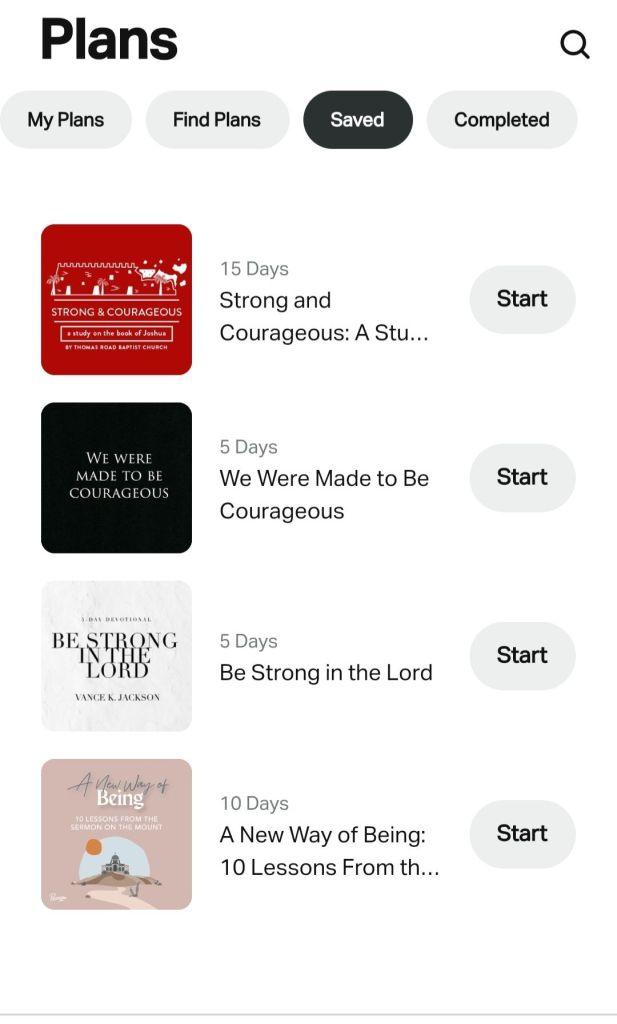
For quite a while, I’ve been using YouVersion reading plans. A nice thing that’s possible is customizing a year-long reading plan. Want to give it a try? Here are five steps.
Determine to Make a Daily Commitment. Pretty obvious, but if you aren’t resolved to it, you won’t make it to December 31st. Sure, you might miss a day here or there. Understandable. Give yourself some grace and think about the fact that odds are you’ve got 5 minutes to give to this commitment and missing it a couple of times doesn’t make you a loser. If you are in, move on to step 2.
Decide on a Theme. There’s a popular trend that’s replacing making New Year’s Resolutions. Instead of setting goals and aspirations, you choose a word that you’d like to guide you for the year. Not sure about that, check out this podcast episode to learn more. I started this in 2020. Each year I’ve utilized it differently, more broadly. This year, that word is what I’m using to customize my Bible reading. My word for 2024 is courage. Know your theme? Move on to step 3.
Search Plans. On the YouVersion app (download it now if you haven’t already), you can search for reading plans simply by typing in a word. Most likely, dozens of reading plans are available. You’re ready for step 4.
Save for Later. On each plan description, you have two choices: sample and save for later. Sample allows you to check out any day of the plan. I do that to get an impression if I think I’ll complete it. If I think so, then I save it for later. You don’t have to start the plan when you find it. I’m not worrying about saving enough plans that equal 365 days, by the way. I just saved the ones that looked interesting to me for now. At the moment, I’ve saved enough plans to get me into February (total up the days for each plan to see how many days you’ve already covered). Saved at least one plan? Final step is next.
Follow the Thread. As you read each plan, some verse/story/character will stand out, grab your attention. Take note. Follow that lead to search for other plans to save for later. For instance, since I did my initial plan saving, the book of 1 Peter has gotten my attention. Adding reading plans can feel very fluid and interactive.
That’s it. This approach proved worthwhile and meaningful last year. If it ain’t broke…
The first year I chose a word for the year was 2020. It’s an exercise I’ve grown to appreciate. If you have yet to consider it, here are a few blog posts about it:
My 2023 word was “rich” for which I created a playlist. At one time the playlist had about 20 songs. Last month as we edged closer to year end, I began deleting songs as a way of keeping focus. And in a fun way, unintentionally, I got down to the top three songs on the list that spoke the most to me along this theme. So I thought I’d share them with you.
To share them, here’s the playlist and videos of each song. Enjoy the richness!
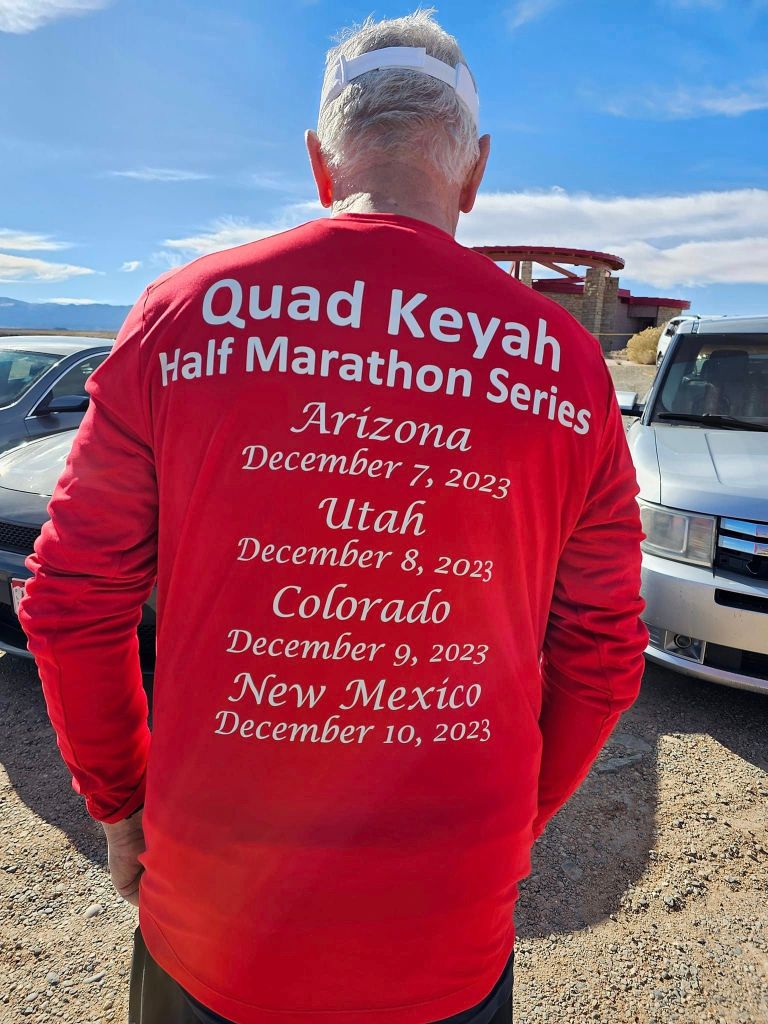
As shared in the previous post, “Easy like Sunday morning” was not playing in my head on the drive back to Albuquerque. I had three things on my mind: Heat. Food. Fluids.
Well, there was a fourth thought going on.
Lesson #6: If no one else cares how long you took to finish, let that be a sign. Caring trumps Competing.
As far back as I can remember I’ve been driven by achievement. Guess that explains why one of my top StrengthsFinder is Achiever. Setting goals and self discipline are second nature for me. Two balancing acts that come with that are competition and perfectionism.
This journey to run a race of any distance in all 50 states has certainly improved that balance. I can set goals all day, but there’s no guarantee of meeting them. And at the end of race day, I’m still learning it’s more about the journey than the finish time.
On Sunday in New Mexico, two runners illustrated this to me. We had been on these courses together for three days. We didn’t share names, but we shared encouraging words. And on the day they recognized I was struggling, they made sure to check in on me. Caring for a fellow runner was more important than competing against them.
On these long runs in unfamiliar places with complete strangers, you learn a lot about yourself and others. I’m grateful to be reminded over and over of the more important things.
Personal achievement is one thing. Loving others and creating community is a better thing.
Sunday came. There were two obvious changes. 1) The start time was 30 minutes earlier. 2) The temperature was 12F, by far the coldest day of the weekend.
I thought I was ready. Sure, I was a little tired from the previous two days, but I’ve been more tired and sore at a start line. I felt like I was layered properly. I believed I had eaten and hydrated well. We were running the same course they had ran on Thursday, which I didn’t run. I had been told, however, that it wasn’t a hard course. My mindset was, “Pace yourself. This shouldn’t be too bad. Do what you got to do and hit the road back to Albuquerque.”
For this course, we first were to run a 5+ mile loop twice in a direction that was new to me. About a mile in it became apparent for the first time that we were gradually running uphill. No canyons on this course like the previous two days. Just straight, but up.
I had thought any concerns about elevation were over. It had not been an issue the entire trip.
It became an issue around mile two. The loop included a turnaround at the top of a hill roughly 2.75 miles in, the highest peak of all 39.3 miles of the weekend. I got there, but it was doing a number on my breathing. Thankfully, to finish this loop was downhill, and I could relax.
I came through the aid station. After getting some fluids, I headed back out for loop two. I knew what to expect. I knew it wasn’t going to be easy. What I didn’t know was my body was shutting down.
Lesson #5: Most likely, there is a way to finish what you started. PIVOT.
It was probably a combination of two things: dehydration and elevation. Hard to tell in the moment. But all the signs were there-at mile 6 of 13.1. Not a good place to be at 12F.
Running the remaining miles wasn’t going to happen. PIVOT #1: Walk/run the rest of the race in order to finish.
I was layered to run in 12F, not walk. PIVOT #2: Keep moving and get to the car for a self-enforced medical timeout.
That was a first. Thankfully, it was an option. Since we ran by the parking lot to finish each loop, I knew all I had to do was get back to my car to warm up and add another layer. That was my focus for the next four miles. Without the hope of a medical timeout, I’m not sure I would have finished that loop allowing myself to experience the coldest walk of my life.
Chances are wherever you find yourself on your journey there is a way to finish it. Yes, there are those times it’s not the best answer. In my 76-race history, that’s only happened twice. Those odds are pretty good.
In the moment when it’s clear it’s time to pivot, don’t hesitate. There are options. Surrender to finding the best one and take it. The medal will still be waiting for you when you cross the finish line. This time it will say, “I hang around Pivoter’s necks the same way. Let’s go take a nap.”
The day before I flew to New Mexico I got a massage. Mike keeps me ready to run.
In our conversation I told him I had prepared for this race series better than I had since 2012. That’s how well I knew I had trained. I set goals and met them all. Nothing left to do but run.
Lesson #4: Prepare the best possible. But accept you can’t control everything.
For example, Race #1, starting temperature, 37F. Race #2, starting temperature, 25F. Race #3, starting temperature, 12F. But hey, no precipitation.
Next: At the start of Saturday’s race they announced a change in the course. Not that I really knew the difference, but still. Running down the side of a steep canyon to start the race was not what I had in mind. But hey, the easier course meant I finished 20 minutes faster than Friday.
Then came Sunday. More on that later. Suffice it to say, it was a day I’ll not soon forget. Pretty sure I’ve never been that cold. But hey, the rental car heater was amazing.
This is life. Prepare the best you can for the test and your nerves rattle your memory. Prepare the best you can for your wedding day and people turn out to be unreliable. Prepare the best you can for retirement and a diagnosis changes everything.
Part of the best preparation is accepting there is no way you can control all things. You can control your preparation. You can also control your response to what you can’t control.
SUGGESTION: Purposefully place yourself in new or uncomfortable situations. Try a new route to work. Try a new recipe with your dinner guests. Go for a run in the rain. Let the kids decide where to go for dinner.
With some practice, 2024 could be the year you accept it’s impossible to control it all.




 John Gregory