Loss Ungrieved

Every loss in life deserves an appropriate season of grieving, whether you’ve lost your favorite person or you’ve lost your favorite pen. Grieving is a way in which we take the emotional upheaval and bring it up to the Lord…If we don’t let emotions up and out before God, those emotions internalize. They give us physical, psychological, and spiritual problems.

-Terry Wardle

Wardle calls these problems ungrieved losses. I heard him say this today in a podcast episode with ChurchPulse Weekly Conversations. It took me a long time to learn this, but I can definitely tell you he’s right.

Sure, we all grieve differently. But grieve we must.

Sure, we all attach in different degrees which determines our level of loss. But lose we do.

I didn’t grow up grieving well. And the biggest opportunity to improve came at age twelve (still growing up) when my father died. And for at least the next twelve years, I needed to let it up and out. The only avenue I took was the piano. I see it now, but I didn’t know it then that the hours I spent at the piano were hours of grieving.

What I know now that I didn’t know then was the sooner you grieve the better, the sooner you allow the emotional upheaval the better. Healing begins. The weight lightens as you name the loss, acknowledge the emotions attached, then invite God into your grief (read this blog post by Joshua Reich).

In the last year, we’ve all lost. Have you considered naming your losses? I encourage you to name them. They may feel obvious and unnecessary to name, but you may be surprised the longer you sit in them the more you have to name. And those internalized emotions will start rising, inching up and out.

Fear. Loneliness. Sadness. Disappointment. Confusion.

Meanwhile God doesn’t move. He stays with you. He begins to touch and heal your wound-that loss ungrieved.

Photo by Yanna Zissiadou on Unsplash

Mountain Notes to Self

Exodus 26:30; 27:8

30 You are to set up the tabernacle according to the plan for it that you have been shown on the mountain.

Construct the altar with boards so that it is hollow. They are to make it just as it was shown to you on the mountain.

Moses had memorable mountain moments with God. These Exodus chapters and others surrounding them narrate life-changing moments for him and his entire nation.

The wording of these two verses gave me pause when I read them today. We dream of mountain-top moments-moments that we fantasize about, wish we could have more of, or possible build our lives around.

If we aren’t careful, mountain-top moments will come and go, and the point of them is lost. The life-giving, life-changing truths may not take root or, worse, are totally missed.

I’d rather not waste the climb. To avoid that tragedy, I made these notes to self:

  • There’s more to receive on the mountain that just a great view.
  • While on the mountain, after I’ve recovered from the climb and taken in the view, listen. And take notes.
  • Before starting the descent off the mountain, submit and commit to the Mountain Maker’s words.

Now Hope (book review)

If you use the Bible reading app YouVersion, here’s a tip you may not know:

Many of the devotional plans are based on books, many written by pastors. Often, this is how I find books that I haven’t heard of and end up reading.

That was the case with the book I just finished, “Now Hope” by Paul De Jong.

This book is very accessible by all readers. I would describe it as a book of 19 devotionals designed to provide “tools to develop a hope-filled and expansive future.”

Although each devotional is good, the best tool of the book is the introduction. De Jong makes clear how foundational hope is to life, particularly the life poised to receive God’s promises. Quoting 1 Corinthians 13, he discusses the links between faith, hope, and love. His point is all three are needed “to reach the finish line and experience God’s promised outcomes.”

The devotional that provides the best mindset for pursuing hope is in Part Two: Hope Confronts Survival with Significance. In Hope Develops Expectation, De Jong outlines four levels of living:

  • simply survive
  • live an average life
  • commit to impact the world
  • influence the world by fully engaging the gifts God gives

Expectation means you’re going to believe for more, turn up earlier, resist giving up, and focus on the God who can. You’re going to be looking for more in every day and in every season. You’re going to be thanking God for the little things. Make a decision in the now to live on the higher ground of greater levels of expectation.

Hope Rising (book review)

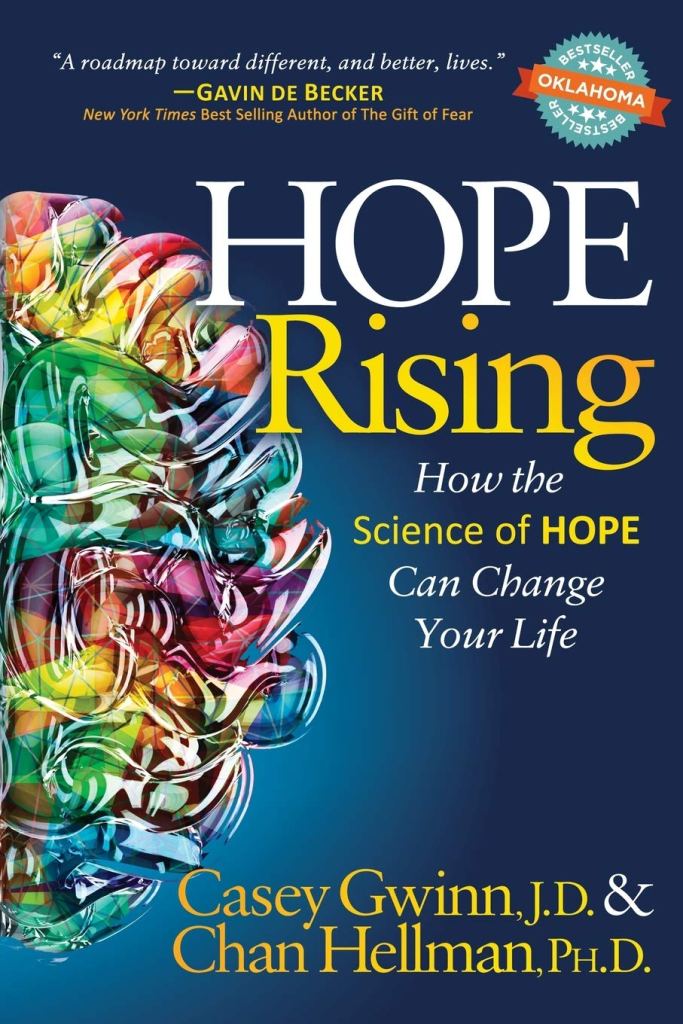
Many years ago while working on a personal values exercise, the word hope surfaced as a personal guide. So it’s no wonder that two connections (work and church) I’ve made in the last year carry that same guide.

And it goes to reason that the book I just finished reading stands out as meaningful. Hope Rising by Casey Gwinn and Chan Hellman hits the mark in explaining much of the challenges our country wrestles with daily. Many people have low hope, and therefore their lives follow down the road to hopelessness.

Hope is a verb involving action and the ability to change the future.

The crust of their objective is to help readers grasp the importance of goals, pathways, and willpower in what they call the science of hope. They recite many research results (there are over 2,000 published studies on hope) that indicate how the concepts move people from low hope to high hope, thus hope rising. The book contains numerous stories of people with low hope working on rising their hope.

We act based on what we believe not based on what we know.

In order to know where you are on the hope scale, they share several examples of domains (academic, health/fitness, family, romantic relationships) where you can assess your hope level. Quite insightful. To take the general evaluation, follow this link to hopescore.org.

They make a believable argument that hope impacts education, work, and health, which certainly impact families and personal growth. This has led them to focus on providing support for children and adults who have experienced trauma in their lives and struggle with hope.

Hope is not a step in life; it is a stance.

Who should read this book?

  • It wouldn’t hurt anyone to read it
  • Anyone who has had any hint of trauma in their life
  • Anyone who works with children
  • Anyone who works with trauma victims
  • Coaches
  • Ministers
  • Counselors/Psychologists
  • Anyone desiring hope to rise

Bring On The Hope!

I’m giving myself a double dose of hope these days in my reading. First, with this book…

Second, with a youversion reading plan by Paul De Jong entitled “Now Hope.”

This quote stood out to me in my reading today:

The level of hope we have today is an indicator of the level of character we’ve developed.

He believes that based on Romans 5:3-4 where Paul wrote that “tribulation produces, perseverance; and perseverance, character; and character, hope.”

We don’t like it, but we know it’s true. So what if we decided to like it? Like spinach. I didn’t like spinach as a kid. Now, I’m a fan. My taste buds have developed.

Given the right time and attention, we can choose to embrace hard times. Rather than run or sulk or wallow, we can declare, “I’m all in for whatever is about to be developed. Bring on the character. Bring on the hope!”

Photo by Paolo Bendandi on Unsplash

In The Middle: Where Healing, Conversation, and Change Happen

Tyler Perry’s acceptance speech resonated with me because his story and language align with an affirmation God gave me last week.

Not everyone is called to be in the middle. One could argue that, so maybe a better way to put it is not everyone is ready to come to the middle.

If you are in the middle, know that your hope isn’t in victories. Your hope can’t be but in one person, the One who put you in the middle. He has lifted you up. Keep pointing people to the One that can lift them up.

Storytelling: Finding Joy

My ongoing search to find podcasts that interest me has recently delivered a gem. The podcast is Being Known Podcast with Curt Thompson and Pepper Sweeney. Here’s their description of their podcast’s purpose:

In a world in which we experience such deep desire and such great grief, we find coursing through all of it our unquenchable longing to be known. But we don’t want to stop there, for we know in our bones and blood that we desire to be known in order for us to create and curate beauty and goodness in the world — together with our friends and, in our best moments, even our enemies — in every domain of life that we occupy.

I just finished listening to episode #4: Story. So many good thoughts-some new and some reminders-about what story is, how we tell ours, and why we need to.

A lot of what I’m doing in life in my storytelling is I’m looking for ways to find joy in a world that I know is not easy to live in. -Curt Thompson

This week I’ve had to find joy in a world not easy to live in. The story told about me, that I told myself, and that I shared with others led me to renewed joy. Thank you, Curt and Pepper, for conversation affirming my joy.

Photo by Dmitry Ratushny on Unsplash

Lessons from “When Mama Can’t Kiss It Better”

Finally finished book #6 for the year.

And did I learn a lot. The challenges this family dealt with due to adopting a child eventually diagnosed with FASD (Fetal Alcohol Spectrum Disorder) and RAD (Reactive Attachment Disorder) are astonishing. How this played out through the adoption, health care, and education systems sheds light on the many challenges of families trying to love and care for their mentally ill children.

This story is a good reminder of three lessons:

You never know what is going on in a stranger’s life. You may witness something you think you understand, but it’s impossible to know the full story.

Media can get it wrong also. Just because the headline says it doesn’t make it true.

Grace goes a long way. Give it as much as you need it.

Pilate Got It Right

I read John 19 this morning, Good Friday. Here are two interesting verses to contrast:

15 They shouted, “Take him away! Take him away! Crucify him!”

Pilate said to them, “Should I crucify your king?”

“We have no king but Caesar!” the chief priests answered.

19 Pilate also had a sign made and put on the cross. It said: Jesus of Nazareth, the King of the Jews.

So many questions. Did the chief priests really mean what they said? Did they really view Caesar as their king? If so, what did they say to the people around them when they spoke about their God, their loyalty to him? Seems contradictory. Feels familiar in 2021 America.

Of course, one could understand from Jesus’ teachings that the chief priests didn’t really get it. When Jesus talked about the kingdom of God, his language and teaching may have even gone over their heads, too. They either didn’t understand it or they rejected it. Either is tragic for them and the people they led. Seems that what we continue to witness happen in religious circles when leaders focus their eyes on the wrong king isn’t anything new.

As a follower of Jesus, to declare allegiance to any created being over their Creator declares citizenship in an earthly kingdom. Some scholars teach that Pilate’s note on his sign wasn’t so much a personal declaration as a statement of charge-that Jesus claimed to be the King of the Jews. Interesting that, regardless of his intent, Pilate-the non-Jew, the one not looking for a Messiah, the one who was simply trying to do justice for the accused man-declared the truth.

May we all on this Good Friday declare that Jesus is King.

Photo by Josh Applegate on Unsplash

This Easter

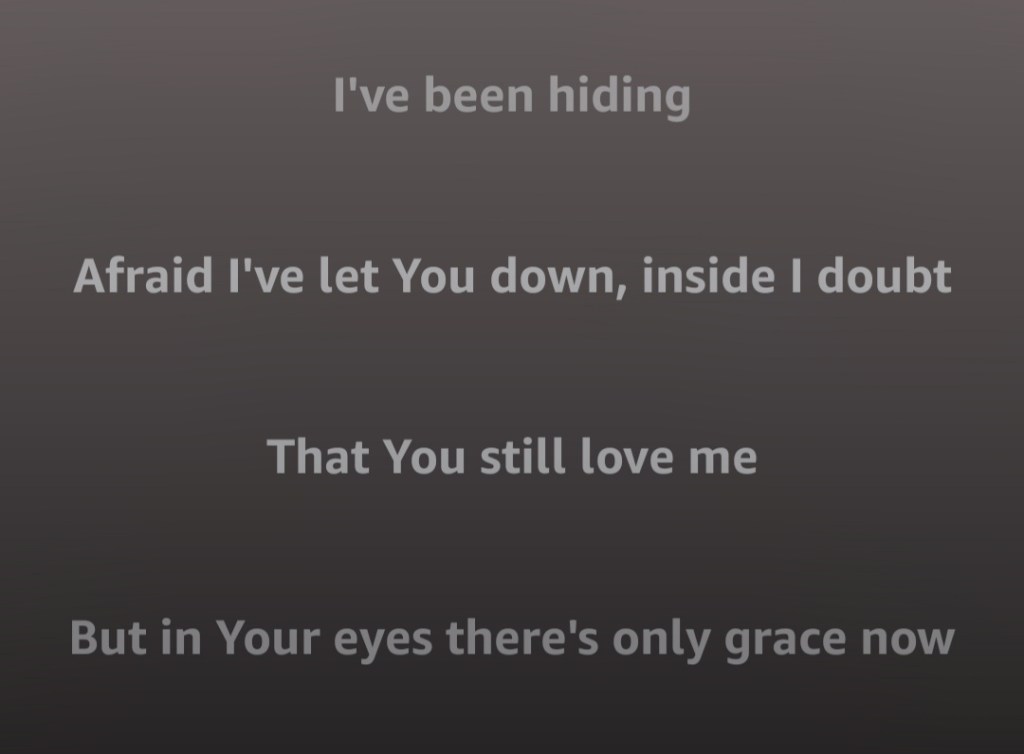
I started this Thursday listening to my Easter playlist. In that, Lauren Daigle’s “How Can It Be” played. These lyrics from verse two stuck in my ears, mind, and heart.

The main reason they stuck is the contrast between the doubting of love and the exchanging of grace. Been on my mind for several weeks now, so these lyrics heard through the lens of Easter stopped me in my morning routine.

That’s what grace does. Makes you pause. Humbles your expectations. Erases your doubts. Brings you back.

May we all pause in humility to be brought back from our wandering through the erasing of our doubts of God’s love this Easter!