The Stairmaster & Integrated Character

I’m halfway through Henry Cloud’s Integrity. It’s been too long since I read it, and I want to get it read before yearend.

Today I read this quote from chapter nine, “Finishing Well”:

The ability to make a move, make the call, face rejection or loss, is a character issue, and if it is missing, results do not happen. Fear of failure, rejection, disapproval, anxiety, unknown outcomes, loss of security, and other fears keep people from achieving the results that they could, if they were not afraid.

People of integrated character do not think of failure that way. They think that if things do not go well, that is another reality that they will deal with and overcome. In a sense, the integrated character never sees failure as an option. These people just see problems to be solved, and they will meet the challenge when it occurs, so “go for it.”

Here’s a simple illustration of this. I’m not running much right now while a left-foot injury heals. So my Planet Fitness craze is the Stairmaster. In response to a couple of challenges and opportunities next year, I’ve decided to push for some new personal records on the Stairmaster. The main record I’m after is time. Until last week, the longest workout I’d done was 35 minutes. Respectable. My new goal is an hour.

I could do it today if I had to. But I’d have to do it at a slower level/pace than I’d like. So my strategy is to add minutes slowly but maintaining high levels. So last Friday night I found a blog post for a 40-minute workout; it was beyond my skill set, so I modified it and went to the gym the next morning with my 36-minute routine ready to “go for it.”

I about died. This is the plan I didn’t succeed:

  • Two minutes starting at level 8 increasing one level every two minutes up to level 13 (12 minutes total). Complete three times.

After the first twelve minutes, I had a pretty clear idea I had overestimated myself. Two more rounds wasn’t going to happen unless I wanted to be the subject of a viral video of what it looks like to be eaten by a Stairmaster. In the end, I ran out of gas at 30 minutes.

I was pretty sure the way to solve my problem was to address my heart rate. I’ve never really concerned myself with it, so I needed to learn about it. According to active.com, it is recommended that you exercise within 55 to 85 percent of your maximum heart rate for at least 20 to 30 minutes to get the best results from aerobic exercise. The MHR (roughly calculated as 220 minus your age) is the upper limit of what your cardiovascular system can handle during physical activity.

Good to know. Why? All along, I’ve been pushing my heart rate way over the recommendation. Using this formula, my heart rate should be between 90-145. On Saturday, I mostly stayed between 155-170. No wonder I ran out of gas.

With a better grip on reality, I went back and boarded the machine yesterday with one goal in mind: monitor my heart rate well in order to get to 36 minutes. Here’s what I ended up achieving:

  • Level 7-2 minutes. Level 8-4 minutes. Level 9-6 minutes. Level 10-8 minutes. Level 11-6 minutes. Level 10-4 minutes. Level 9-6 minutes.

I even had a little left in the tank. As my friend told me, I had some experiential learning. Here’s what I learned:

  1. Knowledge about heart rate on this machine is power for meeting my goal.
  2. Getting there alive is certainly better than not at all.
  3. There is a way to accomplish my goal. Adjust and “go for it.”
  4. The Stairmaster can also integrate character.

The Ruthless Elimination of Hurry (book review)

Love, joy, and peace are at the heart of all Jesus is trying to grow in the soil of your life. And all three are incompatible with hurry.

If that statement intrigues you, welcome to Pastor John Mark Comer’s new book, The Ruthless Elimination of Hurry.img_1006-1

In a world of increasing speed, we all know it’s out of control. What we may not know is how to slow ourselves down in the midst of it. That is what Comer addresses convincingly, humorously, and practically.

Wisdom is born in the quiet, the slow. Wisdom has its own pace…When we uncritically hurry our way through the digital terrain, we make the devil’s job relatively easy.

After defining the problem and offering solutions in parts one and two, Comer offers four practices in part three that will eliminate hurry: silence&solitude, sabbath, simplicity, and slowing.

Mindfulness is simply silence and solitude for a secular society. It’s the same thing, just missing the best part-Jesus.

It is not as though we do not love God – we love God deeply. We just do not know how to sit with God anymore.

Contentment isn’t some Buddhist-like negation of all desire; it’s living in such a way that your unfulfilled desires no longer curb your happiness.

We achieve inner peace when our schedules are aligned with our values.

I’ve recommended several books with a similar theme as Comer’s (The Rest of God, Rhythms of Rest, Awe). Add this to the list. He offers a broader look at the theme with relatable application. I don’t think he’d mind if I suggested you hurry to get this book in your hands.

God’s 2019 Gifts

My Advent devotional this morning focused on this verse:
But Mary was treasuring up all these things in her heart and meditating on them. Luke 2:19 CSB
The devotion challenged that it is important to store up the mountaintop experiences in life in order to recall them for the tough experiences. Mary seemed to realize this at a young age.
In the hardest moments of our lives, we need to remember the victory of Jesus and recall all the ways we’ve seen His goodness. When you experience God’s faithfulness in your life, take a step back and store it up as treasure in your heart. Think of it often. When your toughest days come, like Mary, you will be able to endure. @youversion reading plan
I took this challenge and created an exercise. The exercise was to write down all the gifts God has given me this year. To help me remember, I looked back through my journal (an example of why journaling is a good thing). At completion, my list was twenty deep and filled up the page. That’s a lot of goodness. This exercise could be very encouraging and even worshipful. What gifts has God given you this year? How will you treasure them?

Tackling Pornography

Earlier this year, I challenged my friend Mark Stanifer, a men’s ministry leader, to create content that would help men address a prevalent issue in our culture that we don’t really want to address.  At first, he wasn’t quick to jump on it for many reasons.  But the more we talked about the need it seemed he decided he couldn’t not do it.

So he got to work.  We planned a talk on the subject, and we scheduled an event for men and their teenage sons.  For several reasons we had to cancel the event, mostly due to low response.  It was never said to me, but I’m guessing a major reason was men just couldn’t get their hearts and minds to the place where they’d show up to a talk about this subject.  What was the subject?  Pornography.

Well, now you are probably thinking, “Yep.  Nobody’s going to show up to talk about that.  What were you thinking?”

A conversation I had yesterday answers that question.  A grandmother in our church asked me what resources I knew to share with a newly widowed single mother with a 13-year-old son who has recently started dabbling in pornography.  Think about it.  A middle-school-aged son has lost his dad.  His mother has lost her son’s leader, mentor, counselor, and confidant.  There are so many layers to what that situation means for the two of them.

Because Mark didn’t steer away from creating this needed content, I was grateful to be able to say, “Yes, I have a suggestion.”  That suggestion was for this mom to listen to a two-part series called Tackling Pornography that Mark and his ministry partner released recently.

Here are a couple of takeaways that I encourage you to take from this post:

  1. Tackling something hard or uncomfortable is necessary for personal and community health and growth.  When we have the opportunity to provide answers/encouragement/resources, we do everyone a favor by surrendering to taking the first step.
  2. Pornography doesn’t have to remain in the corner.  If we care about ourselves and others, we must follow the lead of Mark and others to bring it out in the open.  Darkness prevails as long as no one flips the light switch.

Mary’s Sanctification

The title of the day 11 Advent devotional I’m reading was “What’s On The Other Side of Your ‘Yes’?

I’ve thought about the fact that Mary said yes. Rather quickly, by the way (see Luke 1). But this devotional made me think about how, like Mary, our current acceptance is limited to the present. We place our faith in surrendering to what’s in front of us. But we have no idea what’s coming down the road, what’s on the other side. Mary heard what the angel said about the son she would have, but I wonder how much she understood how many yeses were ahead.

  • Yes, I’ll marry a man who’s thought twice.
  • Yes, I’ll run for my son’s life to another country.
  • Yes, I’ll give grace to my son when I don’t understand him.
  • Yes, I’ll let The Father defend his son against the enemy’s lies.
  • Yes, I’ll watch him be crucified.

Each yes was a new challenge, a deeper victory, a fuller revelation.

The teenager who birthed Jesus wasn’t ready to watch him be tortured. She got there through the transformtion of her every yes. A theological word for that tansformation is sanctification. In his book Awe, Paul David Tripp defined sanctification as a process that works the radical transformation of hearts. Mary’s sanctification came through repeated yeses.

What yes is God asking from you right now? What if you said yes for no other reason but to take one more step in your sanctification? Why not see what’s on the other side of your yes?

Known: The Secret to Meaning

(Post #3 in a 4-part series collaboration)

By Shelby Welch (bio below)

Mark Twain is credited with saying, “The two most important days of your life are the day you are born and the day you figure out why.”

When I typed in “Meaning of Life” into Google, it gave me 2,350,000,000 results. It gave me results about books, videos, lectures, and numbers-all these different ways that people have tried to find meaning in their lives. Wikipedia even attempted to give possible answers such as to realize one’s potential, to seek wisdom and knowledge, to do good, to love, to have power-even the ultimate nihilistic answer: life has no meaning.

We see it over and over in media. Children dreaming of what they will do one day. Young adults trying to find what they are supposed to do with their lives. Middle-aged people trying to find purpose after a large upset in their lives. And the elderly scrambling to find meaning before their time on this earth runs out.

I am not guiltless in this pursuit. I have sought meaning to my existence in love, in friendships, in academics, and in achievements. Spoiler alert: they all come up empty. Lovers leave you. Friends betray you. Someone will always outsmart you. Someone will always outscore you.

But this year in my reading I think I may have discovered the secret. In C.S. Lewis’s The Problem of Pain, he points out the ultimate meaning behind Man’s existence. “If He who in Himself can lack nothing chooses to need us, it is because we need to be needed.” Our purpose in life is not that which we can give God but that we may be loved because we are His. Oh, how freeing it is to know that the merit of my life is not based on what I can achieve but on what my God has done for me.

Psalm 139:17 reads, “How precious are your thoughts about me, O God. They cannot be numbered!” Lewis calls it “the Intolerable Compliment.” That the God of all the Universe would choose to love Man, the one creature that is continually rejecting him; that he gives us the opportunity to love him back. That is the purpose of life. That we are known and loved by our Creator.

Thank you, Father God. Thank you for all that You have created and all that You do in our lives. Remind us of our purpose when we become anxious and weary, when we become tired and downtrodden, when we become weak and insecure. Remind us that our purpose is not in being the best parent in the world, not in being the highest-ranking employee, not in achieving all the accomplishments our peers have, and not in the relationships we choose to form. But that our purpose is to be known and loved by You. May we spend the rest of our lives learning to love You more.

Amen.


Blogger Bio: Shelby serves the animals and clients of Bishop Animal Shelter. She and her husband Frank met while studying at Florida Southern College and were married November 12, 2016. Shelby has swam with sharks.

Suffering: A Story To Share, Accept, and Embrace

Came across this tweet yesterday from a soon-to-be-released book by author K.J. Ramsey:

I wonder how much less anguish we would experience in suffering if the church treated suffering like a story to tell rather than a secret to keep until it passes.

Then this morning our pastor, while focusing on Jesus’ coming to experience human life, categorized suffering into three types:

  1. Suffering we can avoid
  2. Suffering we cannot avoid
  3. Suffering we must not avoid

Both of these thoughts need sharing and dialoguing.

There is power is sharing how our choices led us to suffering we could have avoided. Our focus can be directed to the truth of scripture and the forgiving, unconditional love Jesus came to bring.

There is healing in accepting how circumstances out of our control don’t go unnoticed by God. Our focus can be directed to his sovereignty and the relatability Jesus has to offer.

There is strength in embracing how running from something we don’t want may keep us from what we need. Our focus can be directed on God’s promises and the model of endurance and commitment Jesus completed through his resurrection.

Known: God’s Great Encouragement

(Post #2 in a 4-part series collaboration)

By Frank Welch (bio below)

When I was a teenager, I was pretty confident. I had the great blessing of growing up in a Christian home with my mom, dad, and little brother. There was a lot of love in our house; and I had great friends who also cared for me. But best of all, I knew my Savior Jesus Christ, and that He loved me more than I could ever imagine. During this time in my life, it felt natural to really enjoy just being alive.

However, as I got older and started my adult life I started to see the world a different way. My family is still very loving and I still have incredible friends, but there are a lot more people in the world than just them. There are people across the world who are suffering and dealing with persecution for their faith. There are also people in the world committing a lot of evil.

There are times when I struggle with the darkness in the world. Please do not think too highly of me, but I do not get mad at God for it. It is when I see the way other humans treat each other that I feel a deep sorrow in my being.

Of course, none of this is a secret to God. He knows that I can get discouraged when I see the evil things people do to each other around the world, and even in the city where I live. And when I do, He shows up and helps me find my joy and my confidence again. This is how I know God knows me. He pulls me out of the dark times in my life and guides me back into His light and fills me with a hope that comes from who He is.

One of the best examples that has happened to me recently in life is that I used to struggle with negative thoughts that dragged me down and almost depressed me. To get through that, God guided me to memorize scriptures that give me hope, such as Romans 5:5, 12:12; John 12:46, and Matthew 5:14.

He also led me to create a list of phrases that I say every morning so I start the day in a mentally healthy way. This idea came from a video I watched about a pastor who does this same thing. So, the idea is not originally mine, but it greatly blesses me. Some of these phrases include: “Christ is stronger in me then the wrong desires that are in me,” “I am blessed beyond measure because the Holy Spirit lives in me,” and “The world will be different and better because I served Jesus today.”

God knows I need His love and His encouragement to get through life. He also knows just when to give the encouragement I need. Without God’s encouragement in my life, I do not know how I would have made it to where I am today.


Blogger Bio: Frank serves the students of First Baptist Bradenton. He and his wife Shelby met while studying at Florida Southern College and were married November 12, 2016. Frank can talk all things Marvel.

Why the Eighth Day?

In his message today, our pastor read this verse:

When the eight days were completed for his circumcision, he was named Jesus  — the name given by the angel before he was conceived. -Luke 2:21

His message had nothing to do with expounding on the significance of circumcision, but a question came to my mind: Why eight days?

So I looked it up, and here’s part of one incredibly interesting article I came across on apologeticspress.org:

Genesis 17:12, God specifically directed Abraham to circumcise newborn males on the eighth day. Why the eighth day? In 1935, professor H. Dam proposed the name “vitamin K” for the factor in foods that helped prevent hemorrhaging in baby chicks. We now know vitamin K is responsible for the production (by the liver) of the element known as prothrombin. If vitamin K is deficient, there will be a prothrombin deficiency and hemorrhaging may occur. Oddly, it is only on the fifth through the seventh days of the newborn male’s life that vitamin K (produced by bacteria in the intestinal tract) is present in adequate quantities. Vitamin K, coupled with prothrombin, causes blood coagulation, which is important in any surgical procedure. Holt and McIntosh, in their classic work, Holt Pediatrics, observed that a newborn infant has “peculiar susceptibility to bleeding between the second and fifth days of life…. Hemorrhages at this time, though often inconsequential, are sometimes extensive; they may produce serious damage to internal organs, especially to the brain, and cause death from shock and exsanguination” (1953, pp. 125-126). Obviously, then, if vitamin K is not produced in sufficient quantities until days five through seven, it would be wise to postpone any surgery until some time after that. But why did God specify day eight?

On the eighth day, the amount of prothrombin present actually is elevated above one-hundred percent of normal—and is the only day in the male’s life in which this will be the case under normal conditions. If surgery is to be performed, day eight is the perfect day to do it. Vitamin K and prothrombin levels are at their peak. The chart below, patterned after one published by S.I. McMillen, M.D., in his book, None of These Diseases, portrays this in graphic form.

Dr. McMillen observed:

We should commend the many hundreds of workers who labored at great expense over a number of years to discover that the safest day to perform circumcision is the eighth. Yet, as we congratulate medical science for this recent finding, we can almost hear the leaves of the Bible rustling. They would like to remind us that four thousand years ago, when God initiated circumcision with Abraham….

Abraham did not pick the eighth day after many centuries of trial-and-error experiments. Neither he nor any of his company from the ancient city of Ur in the Chaldees ever had been circumcised. It was a day picked by the Creator of vitamin K (1984, p. 93).

Moses’ information, as recorded in Genesis 17:12, not only was scientifically accurate, but was years ahead of its time. How did Moses have access to such information? The answer, of course, is provided by the apostle Paul in 2 Timothy 3:16—“Every scripture is inspired of God.”

Boom!

To read the entire article, follow this link.

As If You Were There

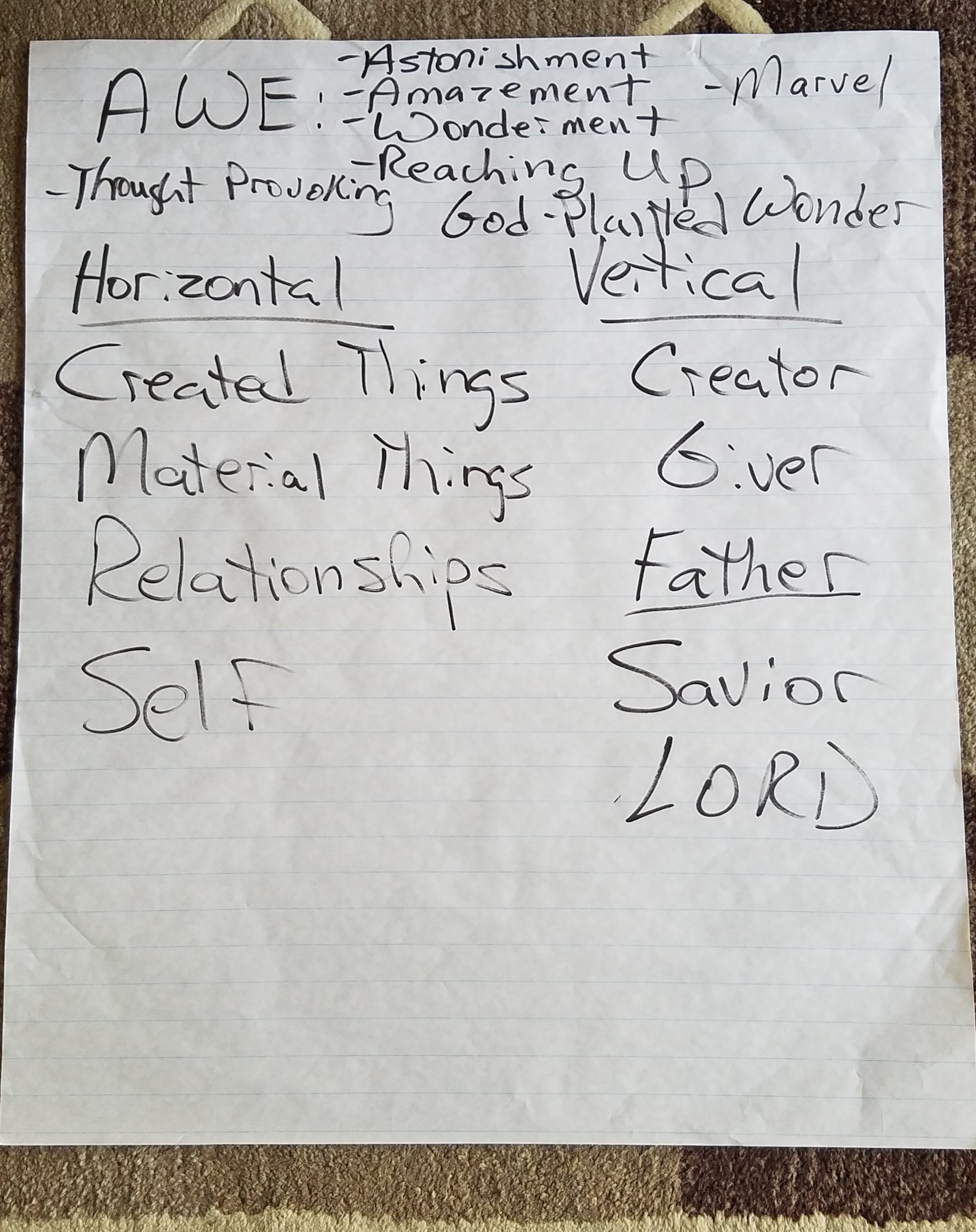
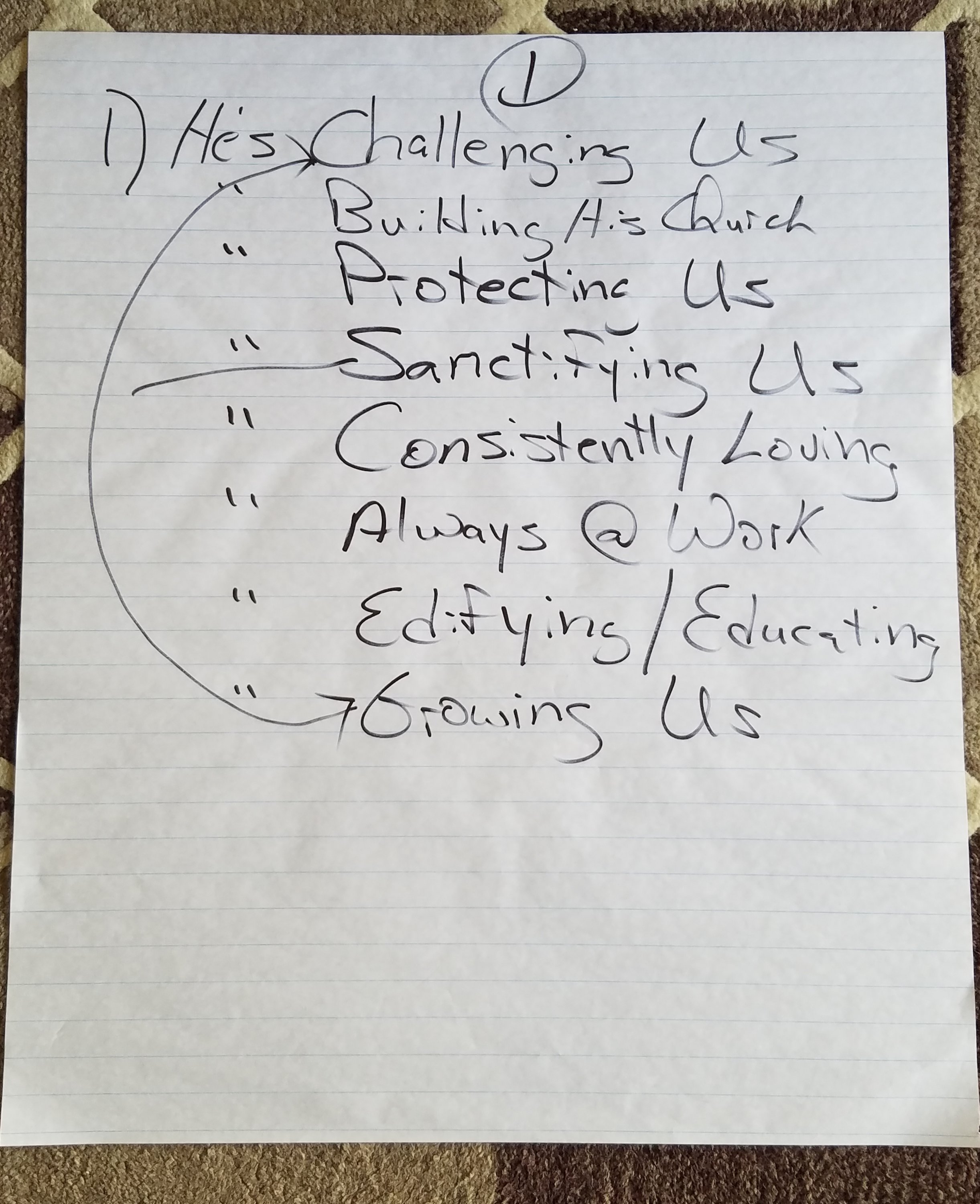
Our Life Group finished a 4-week study last night of Paul David Tripp’s book Awe. Before I discard the easel notepad sheets, I thought I’d share our discussion notes. This will be a refresher if you’ve read the book. If you haven’t read it, these notes may make you feel as if you were there with us and entice you to get a copy. Who knows? Maybe you could get a group together to do a similar study.

From Chapters 1-2 (Humanity and War)

From Chapters 4-5 (Replacement and Amnesia)

From Chapters 7-8 (Complaint and Materialism)

From Chapters 9-10 (Growth and Worldview)