Testing Google

From my front door to the office is 18 miles. Depending on the time of day you drive it, it can take anywhere from 33 minutes to over an hour. I’ve experienced the shortest, the longest, and all the in-betweens.

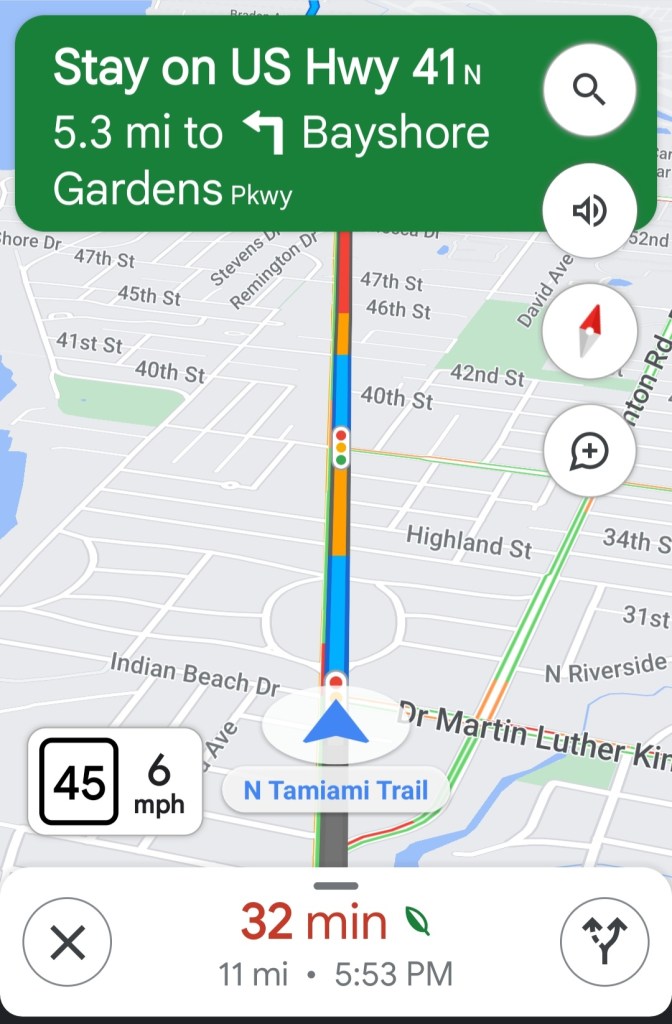
I typed 33 minutes because at this moment that’s the estimated drive time according to Google maps. I use it quite often in order to find the best route, particularly when my drive is at peak traffic times. That usually means driving home in the afternoon. Here’s a screen shot from my drive this past Tuesday.

I may be the only person (pretty sure I’m not) who looks at that ETA time (5:53) and says to myself, “I better at least get there by that time, or even better, beat it. Game On!” A little motivation and self-competition isn’t bad, right?

What I’ve found is they’re not bad until I create an emotional expectation. And that emotion can turn into thoughts like, “What the heck with these lights? Come ‘on, Manatee County! Fix these lights!” or “People, drive with purpose. Why are we driving 33MPH in a 45MPH zone? Get off my road! I’m on the clock, here!”

On my less emotionally competitive drives, I decide to pay attention and see what I can learn or enjoy. On Tuesday I decided to test Google rather than rant at the lights or other drivers. Often on the drive at any given time Google gives me options. Each option designates the difference of my remaining drive time by reading something like “2 minutes slower” or “Similar ETA.” But unless I look at the map, I have no idea all the options that I have mid-drive. On this 18-mile drive, there are dozens of options. I can ignore them and just follow the original route demanding that it live up to its promise to get me there the fastest, or I can consider other options may not be the fastest but could bring some other unexpected benefit worth the alternate route.

The test basically became how many minutes are lost if I ignore Google and go whatever route I want. Google’s directions aren’t the law; they are suggestions. And on this drive, I ignored them several times, probably three, just choosing whatever option I felt like. The end result-I arrived at the same time Google predicted, 5:53.

There are several possible takeaways from this scene. Go with whatever comes first. But mine is, I have options. Any man-made or man-given map uses the best data available. That doesn’t demand it be followed mindlessly. On the flipside, God’s map doesn’t always make sense or align with the best data nor sit well with my expectations. And that’s where I’ve learned the value of surrendering to options.

Google isn’t God. No other map reigns over his; they don’t have his data. His route will have me arriving at whatever time is best but only in the mind and spirit possible by choosing his option. It’s worth the test.

“But” Problem #2

(A series on lessons learned from running this year)

The second first-time experience this summer was less concerning but equally worth learning.

Two weeks after the shower incident, I let another “but” lead me to another result even more frustrating on a personal level.

I wanted to get in a 12-miler with two friends. The challenge was, they wanted to run early. Really early. Like 4AM early. They do this all the time; me, never.

So not only was I going to get up and run 12 miles in Florida humidity with my crazy friends, I was also going to pretend to be a morning person.

Unfortunately for me, not only that night but also the night before I got less than six hours of sleep. One night might be okay; two, not a recipe for a successful 12-mile run.

The alarm sounded at 3. And I said to myself, “Why am I doing this? But I want to get in 12 miles. Just have fun with it.”

True to our form, we actually started at 3:40AM. We were up; might as well hit the pavement.

I knew I was in trouble after the first mile. I learned several summers ago that my first mile on a long run needed to be easy. Something like a 10:30 pace. There was no doubt we were running faster than that. When I looked at my watch, we’d ran mile 1 in 9:26.

So not only was I pretending to be a morning person, I was also pretending this pace was doable. I told myself, “Just relax. Back off when you can. Stay with it.” And I did, as every mile got even faster.

In December, that’s fine. This wasn’t December. It was 75 degrees, hours before the sun decided to wake up.

At the mile 6 stop, I knew I had to tap out. Pretending gave way to reality. Twelve wasn’t going to happen. Too fast…too tired…too humid…too early. They went on to get in six more while I did two slower miles to get back to my car. Eight miles done; four miles short of the target.

On the drive home, it hit me. I hadn’t been pretending. I had been lying to myself. All the “buts” of why this was a good idea and that I could get in 12 miles hid the truth. I don’t run at 4AM. I don’t run long runs in humidity at a 9:15 pace. I missed my target because I lied to myself about who I am.

Lesson #2: “Buts” lead to lies. Lies lead to unrealized potential and missed targets.

Photo by Pawel Czerwinski on Unsplash

“But” Problem #1

(A series on lessons learned from running this year)

I’m sure I’ve made it clear before, but I’m okay repeating myself.

Running in the Florida summer is dreadful. This summer, however, I did much better than any summer prior. But that doesn’t mean all went well. Looking back, two particular days stand out…and they’ve got clear takeaways, both having to do with self talk where a “but” led to a problem.

Both happened on Saturdays. Both happened when I drove to run with friends in a running club. Both involved first-time experiences.

The first Saturday experience happened actually back at home after the run. That morning I decided to add a few miles for my long run of the week. And, surprisingly, I managed the run quite well. In fact, I was feeling pretty good about myself. So good, in fact, that I veered away from my normal recovery routine.

My Saturday long run routine is pretty well set.

  • Hit the pavement by 6
  • Minimum 8 miles
  • Recovery starts with a banana and water
  • Stretching while running an Epsom salt bath
  • More water and half a bagel while letting the salt do its thing
  • Shower
  • More fluid and food
  • Nap usually follows within an hour or two, if possible

On this Saturday, I broke routine. I was feeling so good, so surprisingly good, that I let a “but” lead me to break routine. And it led to a personal violation.

“I can’t believe how well I feel. I killed that run. Normally I drink more water while in the bath, but I’m feeling quite good. No water today. I’m mean, it’s only like 8-10 ounces. What’s that matter?”

Did I mention the bath is as hot as I can make it? Which means even more sweating. Which I don’t mind at all…until it’s time to stand up to shower. And this time, my body had something to say.

My body decided it had had enough. And the first-time experience was finding myself waking up on the shower floor not long after wondering, “What is the deal with my head?”

The problem with this scene was I ignored what I knew was wise, common sense, and established. I allowed my mind to accept a problematic “but.”

Lesson #1: “Buts” lead to violations. Violations lead to fetal positions in the shower.

Photo by Karim Ghantous on Unsplash

Fathered By God (review)

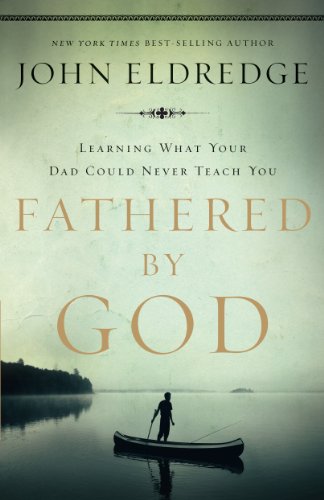
I took a friend’s recommendation and read John Eldredge’s Fathered By God this week. Much better than I expected.

My friend suggested it for several reasons, but I believe he was prompted by our conversation about men’s seasons of life. There are several authors who’ve taken on this subject. Fathered By God is Eldredge’s take, and it’s worth reading.

The enemy’s one central purpose-to separate us from the Father.

Chapter 3, Boyhood

Guys, you should read it for yourself to see if you agree. But here’s the list of the six stages he walks you through:

  1. Boyhood
  2. Cowboy
  3. Warrior
  4. Lover
  5. King
  6. Sage

The problem of self-identity is not just a problem for the young. It is a problem all the time.

Chapter 8, Sage

For me, the best takeaways were from the last three stages. Not rocket science due to my age. Of those three chapters, King captured me the most. Here are three quotes from the chapter:

I remember Dallas Willard saying once that he believes the whole history of God and man recounted in the Bible is the story of God wanting to entrust men with his power, and men not being able to handle it.

Becoming a king is something we accept only as an act of obedience. The posture of the heart in a mature man is reluctance to take the throne but willing to do it on behalf of others.

One of the big lies of the king stage is the idea that now you ought to know enough to operate out of your own resources. Not true. You will be faced with new challenges, bigger challenges, and the stakes are much higher.

Chapter 7, King

It’s doubtful you’ll agree with everything Eldredge writes, but I’m guessing we’d all agree on this one:

At nearly every stage of our masculine journey, something in us needs to be dismantled and something needs to be healed.

Chapter 9, Let Us Be Intentional

If you’re curious about these stages or you are in need of dismantling or healing, give this book a chance. I’m glad I did.

What Does She See?

On Monday, the Bradenton Police Department’s Facebook page shared this photo taken during a badge pinning ceremony for the 5th grade safety patrol from Sea Breeze Elementary. And it made me pause.

For those who don’t live in Bradenton or within a mile of this school like I do, the officer in this photo is Bradenton Chief of Police Bevan. She’s doing what I’ve seen her do on a few occasions and when we met. She’s looking this 5th grader in the eyes and taking in the person she’s shaking hands with. The look says something without words. If nothing else, those words are, “I see you.” But I’m curious what exactly does she see? And what does she hope this student is seeing in return?

No question in my mind this 5th grader is seeing something. Her age seems unimportant. In this second, she’s hearing and seeing something that could stay with her much of her life. The look on her face made me pause and ask, “What does she see? What is bringing that look of responding without words?”

Rather than suggest what those answers are, I’ll leave you to chew on it. Whatever the answers are, they bring joy. Joy to the Chief of Police. Joy to the Safety Patrol member. Joy to the photographer. Joy to this observer.

May they both continue to see and give joy!

1 in 117,000,000,000

While praying today, a question came to my mind. How many people have ever lived? Googled it and found some researched answers. Here’s a link to one of them: How Many Humans Have Ever Lived? (visualcapitalist.com)

In the couple of articles I read, it’s agreed the number is over 100 Billion, fluctuating between 105 and 117. I could go in lots of various directions from here, but I’ll land only on this additional stat: that means roughly 7% of all of human history is alive right now.

This question came to me during a personal communion prayer as I thought about the scriptural teaching that Jesus died for all of humanity, past/present/future. One and done. The teaching states beyond his blanket sacrifice he knows each and every one of those he died for. It’s mind-blowing to think about knowing 7 billion people personally enough to count the hairs on their head, at the same moment in time. Add to it the remaining 93% of those who have lived…not to mention those yet to live.

I fear at times Christians get so caught up in their relationship with God that they forget they aren’t the only ones. We cross the line, if we aren’t careful, into genie world. “He loved me enough to die for me and promised to give me what I ask for. How Great is That!”

This question and its answer humbled my heart, filled me with awe, and deepened my love. There are no bounds to God’s love. Yes, he loves me. He also loves the other 117,000,000,000.

An Open Letter to 22E Dad on Southwest Flight 1477

I had decided for this flight I wanted an aisle seat.  Seat 22D by you and your wife was the first one I came to, so I took it.  Immediately I wondered if I’d made a bad choice. 

You even gave me a “Are you sure” look.  I failed to consider what may transpire during the 2hr 45m flight with your child you were holding.  But I decided to embrace it and build a connection. 

“First flight?”

“Yeah.  He’s three months old.”

“Congratulations!  First child?”

“Yes.”

“That’s a big deal.”

“Yes, it is.”

That 18-word interchange said a lot.  The smile on your face and the light in your eyes said more.  But you had much more to say without words the rest of the flight.

To start the flight, “Junior” (I never asked you his name) was asleep.  The sharp tone of the captain’s voice changed that.  It wasn’t long before he started letting you know it was diaper time.  Your wife wondered which restroom had a changing table.  Not only did you get the answer from the attendant-you did the deed yourself.

While you and Junior were gone, your wife got his mid-flight bottle ready, which he seemed to expect the second you returned.  Without hesitation, you took the bottle and met his expectation.  Then you burped him.  Then you rocked him in various ways until he checked back in to dreamland.

Back in dreamland

Dad, I don’t fly a lot-two or three times a year.  And I can’t say I’ve ever sat beside a couple with a baby.  So the sample size is small.  But I’m going to go out on a limb and say, “You’re not normal.”  I would say, “Think about it,” but the proof says you already did.

You intentionally sat in the middle seat, which put you on bathroom duty and gave your wife as much privacy as possible.  You did these things all without a spirit of having lost a bet or it was “your turn.”

Dad, I’d like to think I’m wrong, but I’m guessing the reason this is noteworthy to me is I don’t believe the average dad thinks ahead like that. And even if they do, I’m also going to guess the joy you had isn’t the emotion the average dad would have knowing diaper and bottle duty is part of the flight plan.

This is what your actions said to me. More importantly to be considered is what your actions said to your wife and your son. Dad, I congratulate you even more for how you are starting your fathering and husbandry journey. Sure, not every plane ride will go this well. There will plenty husband/father rides that you’ll be tempted to be average, maybe even below average. On those days, pause to look back on this one. Remember the honor you gave, the love you expressed, and the joy you received in return. My guess is you have an above average dad. For everyone’s sake, but especially your family’s generations to come after “Junior,” keep up this great start and may other dads follow your lead.

P.S. Thank you for making 22D an above average choice.

Barking at the Fence

Earlier this year, my friend Mark invited me to regularly cohost his podcast, The Next Man Up. We’re roughly 20 episodes in, and he hasn’t fired me.

In the middle of recording an episode about Angry White Males, I remembered a reel I’d seen recently that seemed relevant to our conversation. The video showed the behavior of two dogs on opposite sides of a fence. Check it out:

The episode topic surfaced because of a college course based on it. Our conversation led us down several roads. All the roads circled around this truth: everyone deals with anger. It’s not just men, and it’s not just white folks. All God’s children have moments of anger…which can turn into seasons…which can turn into years. The question we wrestled with is “How do we deal with it so that it doesn’t become a college course title?”

Plenty of answers exist for that question. I’m going to do something that might anger you and answer it with two other questions: 1) What fuels your anger and 2) What are you going to do with it.

I’ve been asking myself that first question for two years. And yes, it’s taking me that long to get to the real answer. Why? At first I was doing what most of us do-looking at what I wanted it to be rather than digging deep in my soul to discover what it actually was. It’s a lot easier to bark at the fence. Removing the fences we erect to keep us safe and comfortable forces us to see more of what God sees-the sacredness of his creation, including those on the other side.

What led me to start asking question one was when I was asked question two. I was barking about folks on the other side of the fence when a trusted voice asked, “What are you going to do with your anger, John?” They had stopped listening for what had happened to me and who did it. They removed that fence and asked me to see what they saw, a man caressing his anger. My erected fence was gone with one question.

Stop and consider what anger does to you. How does it impact your gut? What does it do to your emotional health? How does anger manifest in your body?

Ready to stop barking?

Start tearing down the fence. Ask God to open your eyes to what he sees.

Feel the blessing of finding your answers to the fuel. Embrace the healing when your anger is replaced by beauty.

Photo by Francesco Ungaro on Unsplash

Coughing Up Your Underwear

This past week has been full of stories. They range from brokenness and sorrow to joy and hope. That’s exactly what was in the room one morning this past week when I heard this story.

The storyteller was mostly wanting to express appreciation for those who served her before Hurricane Ian arrived. But her story ended up vividly painting how others had been served by her generosity which started by an invitation.

She evacuated. When she returned, many of her neighbors were without electricity and water and had been for a week. In her efforts to serve them, it crossed her mind that humans feel better when they feel fresh. Practically, that means we feel fresh when we have showered and when we can put on clean clothes. Carrying that thought, she decided to invite her neighbors to use her shower and hand over their laundry.

She didn’t mean to be funny, but the way she described her neighbors response made me chuckle. Taking up the offer to shower is one thing, but handing over your laundry creates angst. Knowing your neighbor is going to see your underwear crinkles the brow. Her words were, “They had to cough up their underwear.”

That imagery still puts a smile on my face. Many tangents to consider with that portrait, but I’ll follow the hint she gave. Her neighbors were in a needy position; her invitation came with a choice. And the one thing that could keep them from feeling fresh was pride. Which would they choose?

We experience tremendous freedom when we hand over our pride. Being seen just as we are requires vulnerability. Fear leads us to think that absolutely no one will still love me after they learn what I’ve been hiding, what I did or what happened to me, what I think, or what I feel. Fear has programmed us to expect shame or rejection when the truth is we most likely will receive understanding and comfort.

These thoughts led me to a song I came across recently by Land of Color. It’s also an invitation. The imaginary isn’t about laundry or underwear but the familiar scene of what’s possible when we allow the Jordan to wash over us. I believe both are freeing.

Come on down and know it’s okay to cough up what’s keeping you from knowing peace and freedom.

P.S. Whistling is also freeing. Give it a try.

Photo by Peter Aschoff on Unsplash