That time Jesus said, “None of your business.”

They could not have looked like promising revolutionary material. That they should see themselves as deliverers of Israel was ludicrous. Their grasp of the meaning of Christ’s death and resurrection was still tenuous and their perception of their future confused.

What was going to happen on the political scene? What role would they play? Seated among the young olive trees they asked him: “Do you plan to restore Israel’s sovereignty?” Many eyes were turned on him.

“None of your business” was the effect of his retort. “That’s God the Father’s affair. He currently organizes the political scene. Your job will be to bear witness to me not only here, but in broadening circles throughout the earth” (see Acts 1:4-8).

Chapter 4, On Being a Signpost, of The Fight by John White

These three paragraphs start White’s chapter teaching on what it means to bear witness. This “none of your business” interpretation is of verse 7 where Jesus is quoted, “It is not for you to know times or seasons that the Father has fixed by his own authority.”

As I read this, I was reminded of Jeremiah’s letter to the exiles in Jeremiah 29. The receivers of his message were not unlike those hearing Jesus’ message in Acts 1. They had a lot of questions. In their confusion and reaction they were tempted to believe and pursue just about anything, including doing what made sense for self-preservation without yielding to the all-knowing and all-powerful work of God.

American Christians would do well to listen to Jeremiah and Jesus. Our actions and words too often sound like we’ve got it all figured out, like we haven’t really heard what was said. Too often, the voice of God is hushed by our demands and declarations, in essence telling him how to do his job. Too often, we ignore the truth that it’s none of our business.

Thank You, Tim Mackie!

Last June I shared a post about starting a monthly “remembering” practice. This morning in my remembering, I chose to listen to a podcast episode about the Passover.

The episode is from the Exploring My Strange Bible Podcast. Exploring My Strange Bible is Tim Mackie’s personal podcast, produced by BibleProject. It’s an anthology of Tim’s lectures, sermons, and classroom teachings collected over 10 years.

I’ve only listened to a few episodes. What I have found so far is worth sharing. Mackie accomplishes his mission of exploring the Bible for everyone-those who’ve explored it for years and those who’ve just started or aren’t sure why they should.

For this episode, I’m guessing 90% of listeners will learn something that will enhance their next “remembering” opportunity. I know I did.

Today I remembered through the lens of those closest to Jesus sharing Passover with him. Thank you, Tim Mackie, for enhancing and deepening my remembering.

Shame Nation (book review)

After reading Curt Thompson’s The Soul of Shame, I determined to find other books on the topic of shame. I found several and chose to read Shame Nation by Sue Scheff next. What I thought I was going to learn and what I ended up learning were not the same, to my advantage.

The title implied one thing in my mind. By the time I got into chapter two, I realized Scheff’s focus was on the epidemic of online hate. Through the first five chapters of section one “The Rise of Shame Nation,” Scheff gives great detail to exemplify exactly what’s at stake when it comes to digital shame. Some of it I knew, but I quickly learned I didn’t know enough. That section alone is worth the read. In the following three chapters of section two “Preventing and Surviving an Onslaught,” Scheff gives all of us much needed wisdom that could curb disasters and literally saves lives.

Your online behavior should be the best reflection of who you are off-line, but so many of us don’t live up to that ideal.

Chapter 3, I Can’t Believe They Posted That!

But what I found most helpful was the final section, “Beyond the Shaming.” Scheff gives several illustrations of people who’ve taken their online shaming experience and turned in into purpose, action, and healing for themselves, their community, and beyond. An amazing resource listing at the end of the book contains 40 examples, the majority I had never heard of. The ones that stood out to me include…

The results of online shame and hate hit home in April in our area when a 12-year-old died by suicide due to cyberbullying. After leading a response to a request to equip parents against bullying of their students, I’m convinced we cannot talk about this epidemic enough. Scheff has given parents, educators, counselors, and community leaders more than enough knowledge to respond to and change their community from one of shame and hate to one of kindness and compassion. I encourage you to add this book to your library.

Google Result 40,900,001

I just googled the word journaling and got 40,900,000 results. Guess another result can’t hurt.

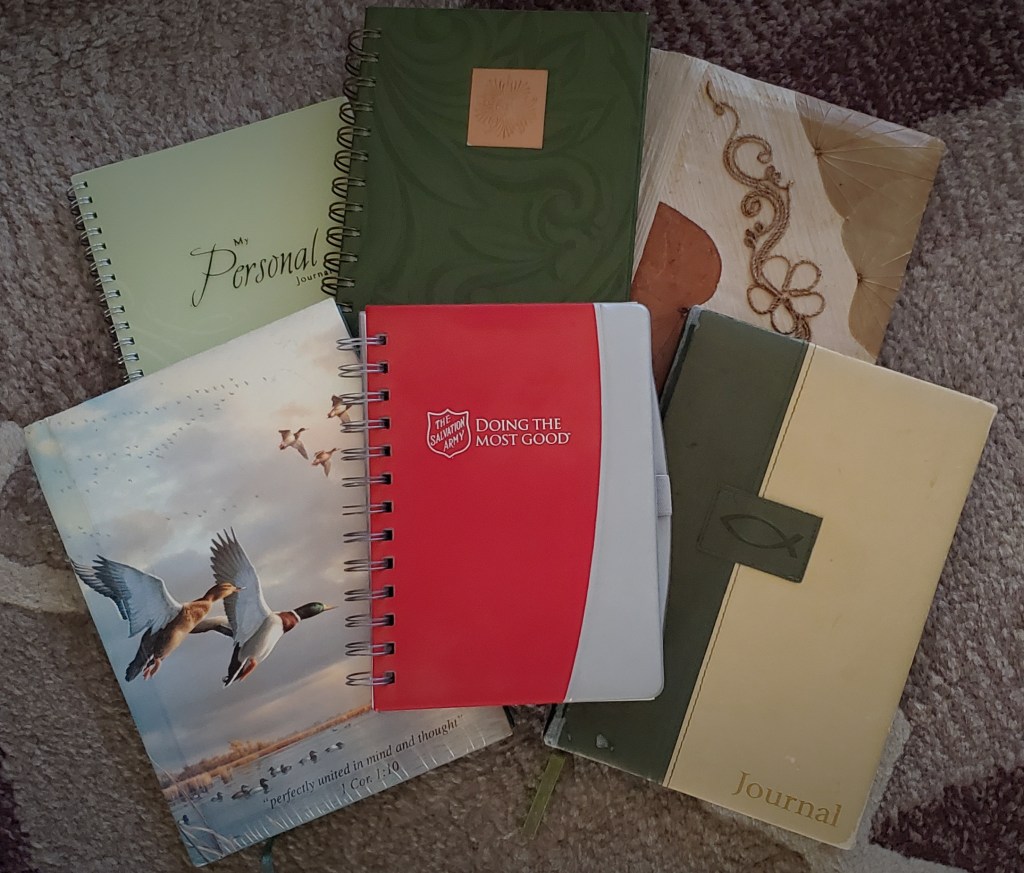
These six journals contain my entries from Dec. ’99 to March ’12

In an effort to keep shrinking my library, I discarded six journals today. Hard to do? Not really, particularly since they are more than a decade old. And as tempting as it is for me to flip through the pages, instead I dwelt on the value of what was on the pages versus the exact words.

If you journal, you know the value. If you don’t journal, well there are 40 million web results to consider its value. As for my experience, here’s why I value journaling.

  1. Spiritual. This one is first for a reason. In those six journals, my guess is 95% of the content was from the discipline of journaling while engaging scripture reading. During that time frame, I mostly used the acronym SOAP, written about in The Divine Mentor by Wayne Cordeiro, to complete my journaling discipline. My engagement with God and the Bible took on new depth through the words penned on those pages. Pretty sure there’s not a price tag I could put on that.
  2. Emotional. A lot happened in those twelve years including working at three different churches in various roles, moving to a new city, completing a four-year masters degree, handing off a successful piano competition, becoming an intentional runner, and many other personal and family experiences. Allowing pen and paper to process the emotions of such events is beneficial to the one journaling and to those in their world. The value that is most surprising is how those emotions surface more quickly and more healthily due to the writing discipline.
  3. Mental. As one who believes our minds should be in constant growth, the discipline of journaling is a tool that aids that growth. When united with spiritual and emotional focuses, my mind is transformed. After twelve years of journaling, I know things I didn’t know before, I know things I didn’t know I needed to know, and I deepened my value of knowing both of those things.

How I journal, how often I journal, and how it impacts me continues to evolve. That’s reason enough to keep journaling.

Five Traits of The Daily Warrior

Warriors. They’ve been on my mind today.

Put aside imagery of soldiers, battlefields, or tanks. Sure, those fit the bill. But I’m thinking about other images.

Before I share more, here’s a question: Who in your daily life belongs in your dictionary as the best model of your definition of a warrior?

One of your parents? Another family member?

Maybe a boss, or even a janitor?

Whoever they are, my guess is the list that follows describes them.

  1. They are loyal when others wouldn’t be.
  2. They would rather not receive recognition.
  3. They not only understand trust, they demand it.
  4. They don’t shy from “hard.”
  5. They masterfully connect timing and discerning.

We recognize someone’s “warriorhood” at various times, sooner with one than another, more obvious in one than another. I’m thinking of two warriors that I had the pleasure to engage today. One of them I’ve known for twelve years; it took me a while to see it. The other one I just met last year; it was pretty clear immediately.

Here are three challenges for you:

First Challenge: whoever your daily warrior is, Tell Them.

If it helps, rip the page out of the dictionary and staple their picture to it. They actually may like that even better.

Second Challenge: Thank God for them.

If it helps, use this blog post as a model and write your own in a journal. God may like that even better.

Third Challenge: Declare your “Warriorhood.”

If it helps, find a spot of dirt or sand. Draw a circle and scribe the word “warrior” inside. Step inside the circle. Ask God to affirm your declaration. You might like that even better.

Photo by Patrick Hendry on Unsplash

The Hard Choice

Graduation season 2022 is over. Lots of celebration for accomplishments years in the making.

In his remarks a few week ago to our recent intern graduates, our executive director acknowledged that they had earned the reward for making the hard choice. The choice to do more. The choice to shift direction. The choice to make a difference. The choice to endure.

As I listened to his remarks, it crossed my mind that it’s easy to celebrate crossing the finish line of a hard choice journey. Typically there are friends and family eager to join the party and drink in the joy. Lots of excitement. Lots of cheer. But those moments do not reflect the majority of the journey after making the choice until lifting the glass.

Probably none of those people were awake at 2AM while you finished that paper. Probably no one brought you coffee and patted you on the back and whispered, “Hang in there.” Only you know the full emotional, physical, mental scope of your entire journey.

Many of life’s journeys tell a similar story. The 45-year marriage. The 52-year career. The all-life parenting.

How many times in that decade-long career did you have to make a hard choice that few, if any, people acknowledged? Which year in your marriage did you make the most important choice that strengthened your relationship? Who knew about it? And I imagine the majority of parenting feels like daily hard choices. Accurate?

In those moments where there’s no one cheering you on, you’re faced with possible doubts. It’s normal to wonder, “Is this worth it? Why does each step get tougher? Does anyone see what I’m putting myself through?” Try not to overreact to these thoughts. They are linked to many things-fatigue, loneliness, uncertainty, fear, growth, to name a few.

Maybe you’re having that doubting moment today. It’s July, the summer after your freshman university year. Anyone cheering you on while you work that summer job? Probably not. Do you give up and say it’s just too hard? Before you answer that, here are two suggestions.

Tell someone that you need some cheering on. Whoever just came to mind that is capable of doing that without hesitation, send them a text or give them a call. Ask and most likely you’ll receive.

After that, find someone that you can cheer on. Seriously, don’t wait for them to ask. Think, look, observe. Whose path did you cross today that looks like they are doubting their hard choice? Send them a text. Give them a call. Whisper a “Hang in There.”

I believe hard choices can be celebrated multiple times, not just after crossing the finish line. If for no other reasons, to make sure the dream is fed, the choice is affirmed, and the joy is realized.

Hang in There!

Photo by Marc Kleen on Unsplash

The Soul Of Shame (book review)

I first mentioned Dr. Curt Thompson’s blog Being Known over a year ago in this post: https://johngregoryjr.com/2021/04/25/storytelling-finding-joy/. After listening to the majority of the episodes and hearing references to his books, I finally got around to reading one. Thanks to hoopla, I just finished The Soul of Shame.

Like the podcast, this book is one to be revisited. Like the podcast, it’s not over your head. Like the podcast, it breathes life into its consumer.

We become what we pay attention to.

Chapter 2, How Shame Targets the Mind

If my highlights are an indicator, apparently my attention got stronger as I moved from chapter to chapter. The first four chapters build the case for the universality of shame’s reach. Then starting with chapter five, Thompson explains shame’s role in the biblical narrative, how it impacts our own narrative, and the remedies that produce redemption.

Honest vulnerability is the key to both healing shame-and its inevitably anticipated hellish outcome of abandonment-and preventing it from taking further root in our relationships and culture…To be human is to be vulnerable…God is vulnerable in the sense that he is open to wounding. Open to pain. Open to rejection. Open to death.

Chapters 5 & 6

Thompson declares that shame pushes us into isolation to keep us from pursuing being human, being vulnerable. To counter shame’s work, Thompson encourages us to understand our cloud of witnesses (Hebrews 11-12), pursue nurturing communities, and renew our vocational creativity.

We will not be rid of shame this side of the new heaven and earth; rather, we grow in our awareness of shame in order to scorn it…There is no more significant place for us to counteract shame than in those venues where we spend most of our waking hours. In these places we are called to be agents for creating goodness and beauty, but these are the very places where shame is more than willing to do its most effective work.

Chapters 7 & 8

A word to the church: Thompson believes “the family of God is the crucible in which we learn what real family is about and in which the what and how of education is ideally imprinted into our souls, transforming both our life in our biological families as well as all that we learn about our world and our place in it.” The church gets the opportunity to help people choose between shame and love.

I encourage you, especially if you are in a place of influence and leadership, to read The Soul Of Shame. Shame won’t like you for it. Your soul will.

“Listen, God” (Part 2)

The next day I was still thinking about the previous day’s all-day conversation and referenced it in a conversation with a former coworker.

While we discussed it, God shared a final word. Adding to his direction to get my eyes off myself, he pointed out, “John, you know how you don’t like to hear people talking over each other and are frustrated when you catch yourself doing it? How about you practice that with me, too?”

He had the final word. Graciously, it was a question. And my “Listen, God” posture was altered.

Left me wondering what a “Listen, God” posture sounds/feels/looks like. Not too hard to imagine, really. Probably sounds similar to a Christmas morning temper tantrum from a six-year-old who just finished opening more gifts than they know what to do with. Probably feels similar to the tightness in a hair stylist’s chest whose client berates them because their work doesn’t match the picture from the magazine. Probably looks like the adult child rolling their eyes at their aging parent whose short-term memory loss has them repeating the same question three times in five minutes.

How God manages to keep a “You’re my son in whom I’m well pleased” posture is beyond my comprehension. That posture transforms mine from “Listen and do what I say” to “I’m glad you’re here. What would you like to talk about?”

Photo by Heike Mintel on Unsplash

“Listen, God” (Part 1)

One night this week, I woke from a dream and felt like I was mid-conversation with God. Not necessarily thrilled at the timing, I engaged for another hour and a half before going back to sleep.

When my body said, “You’re done sleeping,” our conversation picked back up and kept going throughout the day. I shared this with four different people. And pretty much each one of them asked me what God was saying. At that point, I admitted I was doing most of the talking. My tone was very much, “Listen, God. Here’s the deal. I need some things today. And I’m not going to hold back in telling you what they are.”

I got very specific with what I wanted from him before the day ended. I mean really specific. Guess what…I didn’t get anything I asked for. Instead, I got better things, things I really needed.

As I saw what I was receiving, in God-like fashion, He gave me more than I asked for. And when I gave him a chance to speak, this is what he said: “Get your eyes off yourself, John. Can you see that I heard you? Can you see what I’m giving you?”

He really is a good Father. He receives my tone, demands, and attempts to “ask and receive.” Then he responds with loving correction and gifts that show he’s everything he promises to be.

Photo by Social Income on Unsplash

God Has Competition

Here’s a common question I’ve been asked over the years: “I don’t seem to hear from God like many people say they do. Why?”

There could be several answers to that question, but allow me to answer it with a question: “What other voices in your life is God competing against?”

I believe God desires to speak to us, to communicate with us constantly. When we stop to consider who else desires to speak to us, it’s rather eye-opening, explains how important it is to lend our ear to the voices that matter.

To answer the “what other voices” question, here’s a suggestion. Get out a piece of paper or open a digital notetaking app. Make these three headings at the top: Spiritual, Physical, Digital. Then start listing the voices attempting to speak into your life under each heading.

Be brutally honest. For example, don’t avoid listing all spiritual voices that desire to speak into your life. To deny the existence and working of demonic forces actually shows they are ahead of you. Acknowledging their existence provides a means for God to speak to you as your protector and defender.

As for the physical heading, focus on human relationships. Again, be brutally honest. Include the good and the bad voices that have some level of authority in your life. List them all. This list should be pretty lengthy if you consider them all. By the way, go ahead and list yourself. You probably listen to you more than anyone else.

That third category, digital, may seem weird to consider. Basically, all things visual and audio are speaking into our lives simply by their presence. From TV to movies to apps to music to texts to emails to blogs to videos, list them all.

Finished yet? What’s that list look like? How does that help frame God’s competition?

What I have found in my listening for God is the need to silence his competition.

The fewer voices speaking the better odds He will be heard.

The fewer voices speaking the louder His voice seems.

The fewer voices speaking the easier to attune to the one that matters most.

Photo by Hasan Almasi on Unsplash