Kids Know More About Joy

Got to spend five hours with lovely Emerlyn on Tuesday. The featured picture is us reading together-her attempt to stay occupied and avoid napping. It worked.

On my drive the next morning, I heard this exchange between Kate Bowler and guest Nikki Grimes on “Everything Happens“:

Kate: Yeah, Nikki, I feel like I could hear your heartbeat when you talk about joy. It really sustains you. Do you think kids know more about joy than other people? Because I have this sense about the way that it’s connected to noticing and gratitude and hope and delight. Like these are all things kids are particularly good at. I just wonder if some of that—the particularity of kids’ ability to notice and be grateful and to be in the details—makes them maybe more… I think so.

Nikki: Oh, they really can hone in on things in a way that we don’t. If you really want to see something or you want to see it a new way, look through a child’s eyes. They’re always noticing things that adults miss.

Emerlyn is a noticer. A busy railroad track lies earshot from her Rara’s and Pop’s home. Each time the passing trains “chooed,” her head would shoot up, eyes would widen as she echoed, “Choo!”

So yes, Kate, kids are better at joy than their adult people. They don’t seem to know not to be. Everything hasn’t been normalized or discounted or experienced. As Emerlyn’s Rara described, she lives in awe and wonder.

On this Thanksgiving day, find the youngest person you can and spend more time with them than you planned. Tap into joy. Notice along with them.

May gratitude, hope, and delight reign your day.
Sealing Hope for ’25

Recently gave my Kindle away. Just lying around, it was time to give it a new home.

When I was looking through the library I had built on it before deactivating it, there was one book that I knew I’d want to find a way to keep. GOOD NEWS: It’s on Hoopla!

If you’ve been following this blog for any amount of time, this book will most likely sound familiar. Why? Because since 2016 I’ve read it every year. I just finished the ’24 reading. It may be the last time I hold to an annual commitment to read it. No doubt, I glean relevant takeaways each time I read it. And, interestingly, with each reading, I also observe personal growth based on the lens of my reading and my responses.

Paul David Tripp’s Awe is the book. This reading, chapters 7, 10, and 13 received the most highlights. Chapter 10, “Worldview,” is always a great reminder of how to look at current circumstances:

Your idea of God will never be either accurate or stable if you’ve arrived at it by trying to figure out what he is doing in the situations in your life…when you wear the glasses of Isaiah 40 you can understand yourself, others, meaning and purpose, right and wrong, identity, morality history, and the future properly.

Chapter 13, “Work,” I’ve blogged about before. What stood out today was Tripp’s many references to rest, which is my word for 2025.

Success is not about accruing power but about resting in God’s power…Awe of God teaches me that, by grace, my life of work can now be an expression of rest and not worry.

Chapter 7, “Complaint,” is consistently corrective, which oddly can be encouraging. The meat of the chapter discusses five questions that Tripp says steal or seal our hope; Tripp believes we answer these questions every day:

  • Is God good?
  • Will God do what he promised?
  • Is God in control?
  • Does God have the needed power?
  • Does God care about me?

I encourage you to sit with these questions this week. They may renew your awe for what’s happened in ’24. They may seal your hope for what’s going to happen in ’25.

Photo by Kelly Sikkema on Unsplash

Putting Ourselves in the Center

My annual reading of AWE by Paul David Tripp last month was timely. It also was impacted by growth in the last 12 months. I read through a different lens. Result: I continue to appreciate the big idea that checking our awe is valuable.

The first quote that stood out to me in this reading was from chapter 4, “Replacement”:

When we put ourselves in the center of the story, not only do we become rebels against God, we become a danger to ourselves and others.

Is putting ourselves in the center of the story a battle? For everyone. Is the thought that this means rebelling against God and endangering everyone mainstream? Nope. Maybe that’s why everyone battles it.

We don’t have to agree with Tripp. What we can do is challenge our mind and spirit to check our heart when we find ourselves in the center of the story. Is God on my heart’s throne right now? Are any relationships struggling right now? How is my joy and rest?

The second quote that stood out was from chapter 13, “Work”:

If you look to achievement to feel good about your life, to feel secure, or to have a life of meaning and purpose, then you will be dissatisfied with today’s success.

This sounds familiar (check out this post). The buzz of achievement dies. That buzz will not be satisfied by another achievement. Funny how my achievement also puts me in the center of the story.

When we find ourselves in the center of today’s story looking for the next buzz, it’s time for an awe check.

Photo by Austin Neill on Unsplash

What is a Miracle?

“We see miracles in our work all the time.”

I immediately made a note to chew on that one after hearing it from a colleague.

Did they really mean to use the word miracle? Or did they just mean change, transformation, growth? Doesn’t a miracle mean the impossible happened, something unexplainable, maybe even supernatural?

Those answers vary for many reasons: education, faith, philosophy, convictions, science. Traditions seem to dictate one’s definition. For those who prefer black and white, these provide what they need. I’m wondering if there’s more, more that would prompt someone to say they see miracles all the time.

In reading the New Testament, you cannot help but think of miracles as being something visible, something physically observable. Blind eyes healed. Leprosy cleansed. Dead raised.

Not having experienced it myself, I wonder what else happened to the blind man when he suddenly could see. Was the miracle only about his vision? How could this event not encompass all of his being-spiritual, emotional, mental? The healing miraculously altered all of him.

That thought suggests miracles can start in other areas for humans other than their bodies. Should we not consider unexplainable transformations to one’s spirit or mind also miraculous? Just because we cannot physically observe and identify the change does not disqualify it as miraculous.

An even broader conviction embedded in my colleague’s statement is that miracles are routine. Can this be taken too far? Sure. But it’s highly possible we created beings eventually lower our awe of routine miracles provided for us every day of our lives.

Are miracles confined to the extraordinary? Seems to me the rising sun contains miraculous elements. How often are they declared?

And maybe that’s the answer to the question. The answer isn’t found in a black and white definition. It’s found in genuine awe that every day contains happenings which I have no explanation for, things that I could not produce, things that touch the whole of how God created us.

Each one is a miracle. When I stop and consider them, the classification of the work lessens in importance to the one behind it.

It’s possible the answer to what is a miracle is that it’s the wrong question. What if we replace it with this one: What does a miracle say about its source?

Photo by Federico Respini on Unsplash

Mary’s Sanctification

The title of the day 11 Advent devotional I’m reading was “What’s On The Other Side of Your ‘Yes’?

I’ve thought about the fact that Mary said yes. Rather quickly, by the way (see Luke 1). But this devotional made me think about how, like Mary, our current acceptance is limited to the present. We place our faith in surrendering to what’s in front of us. But we have no idea what’s coming down the road, what’s on the other side. Mary heard what the angel said about the son she would have, but I wonder how much she understood how many yeses were ahead.

  • Yes, I’ll marry a man who’s thought twice.
  • Yes, I’ll run for my son’s life to another country.
  • Yes, I’ll give grace to my son when I don’t understand him.
  • Yes, I’ll let The Father defend his son against the enemy’s lies.
  • Yes, I’ll watch him be crucified.

Each yes was a new challenge, a deeper victory, a fuller revelation.

The teenager who birthed Jesus wasn’t ready to watch him be tortured. She got there through the transformtion of her every yes. A theological word for that tansformation is sanctification. In his book Awe, Paul David Tripp defined sanctification as a process that works the radical transformation of hearts. Mary’s sanctification came through repeated yeses.

What yes is God asking from you right now? What if you said yes for no other reason but to take one more step in your sanctification? Why not see what’s on the other side of your yes?

As If You Were There

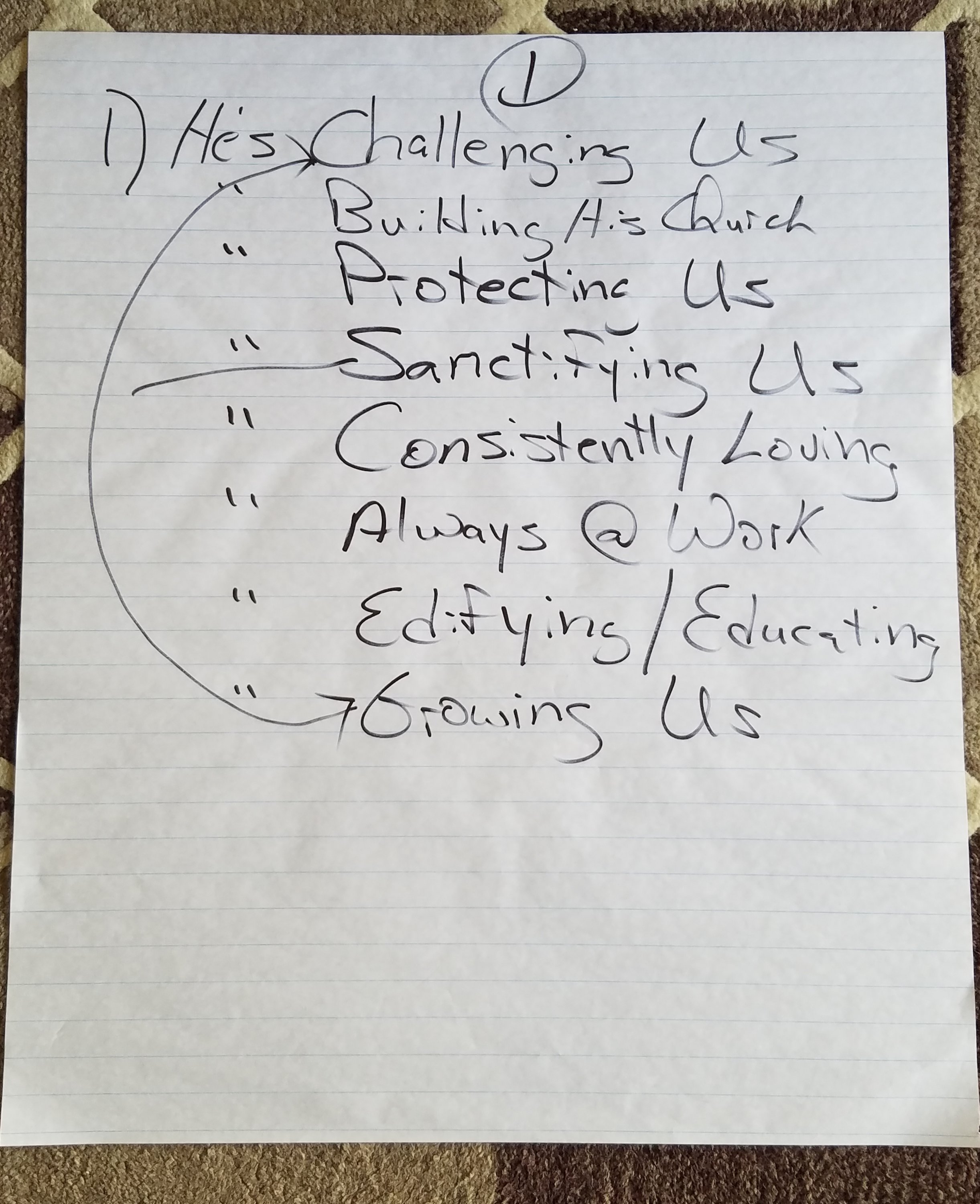
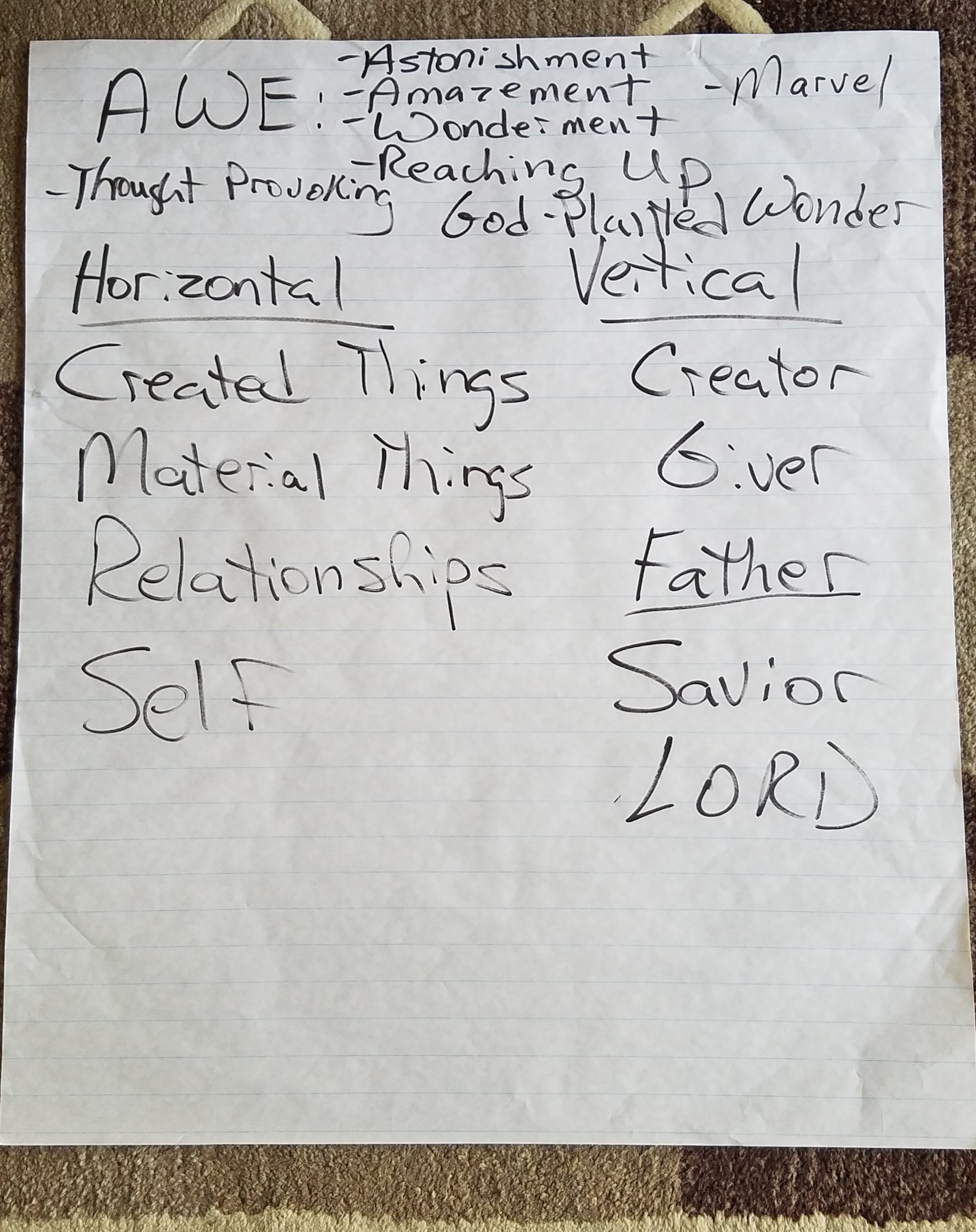
Our Life Group finished a 4-week study last night of Paul David Tripp’s book Awe. Before I discard the easel notepad sheets, I thought I’d share our discussion notes. This will be a refresher if you’ve read the book. If you haven’t read it, these notes may make you feel as if you were there with us and entice you to get a copy. Who knows? Maybe you could get a group together to do a similar study.

From Chapters 1-2 (Humanity and War)

From Chapters 4-5 (Replacement and Amnesia)

From Chapters 7-8 (Complaint and Materialism)

From Chapters 9-10 (Growth and Worldview)

An Appointment to Remember

I have a memory problem. Not the kind where I find my lost glasses on my face or miss an appointment that’s been on my calendar for months…at least not today.

My memory problem is more about what I’m not doing than what I’m forgetting. In his book Awe, Paul David Tripp talks about the importance of remembering. Specifically, he stresses the value of intentionally pausing to remember well. What does well mean? Remembering well means looking back to notice, honor, commemorate, or celebrate the important moments, the growth experienced, or the grace received. I agree with Tripp, but apparently not enough.

I noticed this yesterday. While working through a strategic plan, I got amped about doing something that I, at first, didn’t think I had done very much. After taking time to look back and notice, I remembered I had actually done it multiple times. And had liked doing it. Without taking the time to remember well, that plan would have not developed into a better one.

Remembering well takes work. That sounds dreadful, but it doesn’t have to be. And it certainly doesn’t have to be a problem. With focus and desire for progress, a good look back may be exactly what’s needed. 

What’s the answer to my problem? Instead of worrying about remembering an appointment, maybe I should be making an appointment to remember.

A Good Week

If awe is a longing, then embedded in that longing is the cry for a destination. And if awe requires a destination, then every moment of awe in this life merely prepares us for the incalculable awe that is to come. You just can’t write a book about awe and not talk about eternity. Perhaps we can find no more real and present argument for heaven in the angst that we all carry in the face of the temporary and dissatisfying awes of the present. Whether we know it or not, the awe of every human being-that desire to be amazed, blown away, moved, and satisfied-is actually a universal craving to see God face-to-face. All the awesome things in creation point me to the awesome God who created and holds them together, and his presence is the destination where my hunger will finally be satisfied. God designed this present world to stimulate us so we would hunger for another world. On the other side, we won’t need the fingers of creation pointing us to God’s awesome glory because we will see that glory face-to-face and dwell in the light and heat of its sun forever and ever. We will finally stand in the actual presence of God, and we will bask in heart-satisfied awe, never to long again.


This paragraph comes from the epilogue of Awe, a book I first blogged about in 2016. I just finished my annual reading of it. I committed to read it annually to renew my awe. But I also read it this week in order to consider developing and offering a study of it for groups at my church. If you attend First Baptist Bradenton, stay tuned.

While reading the epilogue, I also couldn’t help but think about Frank (see post from May entitled Serving Frank). We celebrated his life yesterday. His longing is over. His heart is satisfied, never to long again. 

It’s been a good week.

2017 Library

Throughout 2017 you’ve read posts referencing books I’ve read. Below is the library, in order which I read them. You’ll notice several books about coaching, which was required reading for classes I took during the year. Something else I noted this year on the list for the first time-whether I read the book on kindle (13) or hard copy (10). Something for the curious to know and chew on.

God is in the Manger, Dietrich Bonhoeffer (hard copy)

The Salvation of Souls, Jonathan Edwards (hard copy)

Christian Coaching, Gary Collins (hard copy)

Co-Active Coaching, Henry Kimsey-House, Karen Kimsey-House, Phillip Sandahl, Laura Whitworth (hard copy)

Becoming a Professional Life Coach, Patick Williams, Diane S. Menendez (hard copy)

The Next Level, Scott Wilson (hard copy)

The God-Shaped Brain, Timothy Jennings (kindle)

The Critical Journey, Janet Hagberg, Robert Guelich (kindle)

Brain Savvy Leaders, Charles Stone (kindle)

The Phenomenon, Rick Ankiel and Tim Brown (hard copy)

The Myth of Equality, Ken Wytsma (hard copy)

Business for the Glory of God, Wayne Grudem (kindle)

Business by the Book, Larry Burkett (kindle)

The E myth Revisited, Michael Gerber (kindle)

1,000 Churches, Ed Stetzer and Daniel Im (hard copy)

How to Become a Rainmaker, Jeffrey J. Fox (kindle)

This Is Your Brain on Sports, L. Jon Wertheim and Sam Sommers (hard copy)

Awe, Paul David Tripp (kindle)

Law and Ethics in Coaching, Patrick Williams and Sharon K. Anderson (kindle)

Ethics & Risk Management for Christian Coaches, Michael J. Marx (kindle)

Effective Group Coaching, Jennifer J. Britton (kindle)

Rhythms of Rest, Shelly Miller (kindle)

The Rest of God, Mark Buchanan (kindle)

Sabbatical: The Saturday After

It was a good month. A very good month. Memorable in many ways. I was asked Thursday what was the best highlight. I gave an answer, but I could give you a different answer if you asked me today.

Rather than do highlights, here is the end of my journal entry from 10/30:

The lessons I take away from this month are:

  1. Grace is so needed in this world. I need to give more of it.
  2. People are very lonely in this world. I can offer them hope through my obedience to serve and to give my time, talents, and respect. 
  3. God has what people need in this world. They can find it through various methods-church, community, music, dance, family, books, new friendships, similar connections, and jobs where they can love people. 
  4. There is much to be in awe of in this world. But it shouldn’t replace my awe for the one responsible for all of it. 

For a bonus thought, I’ll share this note from my morning run today. In my first few miles, I wasn’t necessarily feeling it. I thought 7.5 may do it today, although I needed to do more. However, the more I ran the better my legs felt making me think double digit miles were possible after all (I was wearing Alabama socks…gotta be it). I ended up getting just over 10 done and felt good following. It reminded me of Sabbatical race #3 in Dover. 

Here’s the deal: our minds are a tool. They can beat us up or tear us down. Controlling the self talk in our head determines if we’ll finish strong or finish at all. 

Bottom line: Own Your Mind.

Photos to illustrate: 

Following mile 1 in Dover. Thought: “How will these next 12 miles go?”


Finish Line in Dover. Thought: “Thanks, God. We owned those last miles.”