When the Body Says No (Book Review, Pt. 2)

After reading the bulk of Mate’s research and arguments, I was ready to take in the final three chapters, particularly #17 and #19.
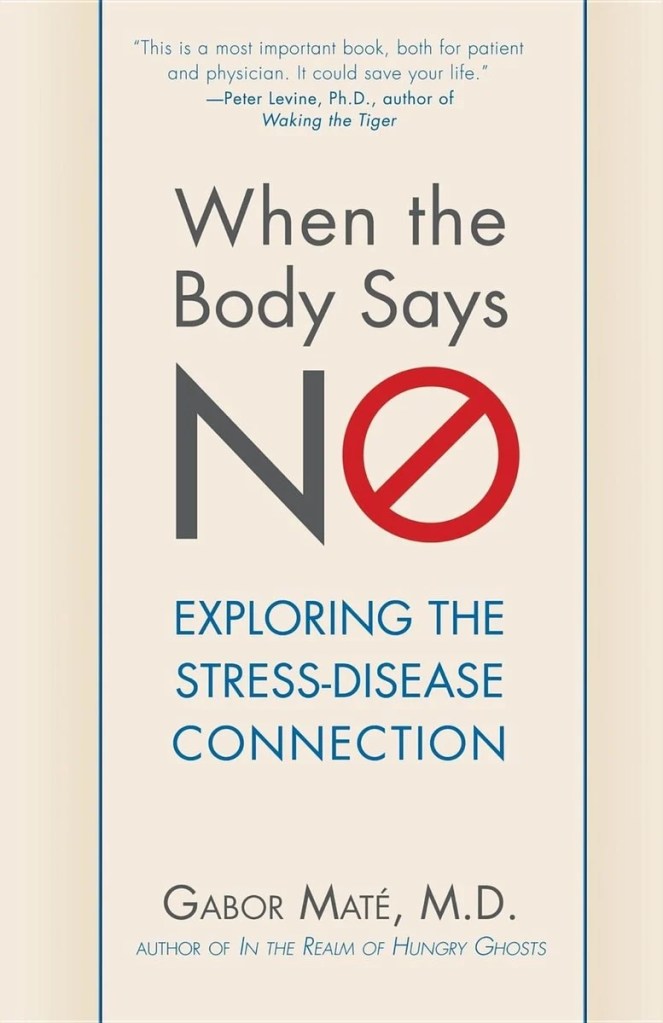
Chapter 17 is entitled “The Biology of Belief,” coined from Dr. Bruce Lipton. Dr. Lipton defines the biology of belief as the process where early experiences condition the body’s stance toward the world and determine the person’s unconscious beliefs about themselves in relationship to the world. Mate shares eight of these unconscious beliefs that control behaviors of defense or growth. He ends the chapter encouraging anyone overloaded with stress induced by these beliefs.

If we would heal, it is essential to begin the painfully incremental task of reversing the biology of belief we adopted very early in life. Whatever external treatment is administered, the healing agent lies within. The internal milieu must be changed. To find health, and to know it fully, necessitates a quest, a journey to the centre of our own biology of belief. That means rethinking and recognizing–re-cognizing: literally, to “know again”–our lives.

For those who may resist this last quote because it sounds void of spirituality, Dr. Mate addresses that in chapter 19, “The Seven A’s of Healing.” Although I have to say, “knowing again” sounds very salvific.

The final A of healing Mate describes is affirmation. Following his outline of the importance of creativity and connectivity, he wraps up the book with this:

Many people have done psychological work without ever opening to their own spiritual needs. Others have looked for healing only in the spiritual ways-in the search of God or universal Self-without every realizing the importance of finding and developing the personal self. Health rests on three pillars: the body, the psyche, and the spiritual connection. To ignore any one of them is to invite imbalance and dis-ease.

May rest and balance be yours.

Attached to God (book review)

Last Fall I read Krispin Mayfield’s Attached to God.

I wrote one post about a lament exercise he outlined, but I never offered my thoughts about the whole book once I finished. Today, I finished rereading it. Time to share.

I’m a little obsessed.

My hunch is that anyone wishing to understand or improve their relationships with humans and with God would also believe Mayfield delivers on the subtitle’s promise of a practical guide. His effort to breakdown attachment science then connect it to one’s relational experience with God produces clarity and hope for any breakdown to be restored.

Of all my highlights, here are three to whet your appetite.

Distance happens in all relationships. (Chapter 1, “The Still Face of God”)

A friend of mine recently made a self awareness by saying, “I guess I live in a fantasy world.” I’d say that’s true for many professing Christians in regards to their beliefs about how close they are expected to feel to God at all times. Mayfield argues human relationship with God is like our other relationships-distance happens.

I was in my 30s before I fully accepting this truth. Many close friends moved and distance happened. It’s normal. That doesn’t provide comfort or easy acceptance, just normalcy. Learning how to respond to distance in a secure way is worth the effort, for you and for the relationship.

Information doesn’t change your beliefs, experience does. (Chapter 4, “Shutdown Spirituality”)

When religious folks get their head around this one, attachment shifts. And it’s a struggle. Why? We are programmed that attending church or a study group is the sole means of establishing beliefs. Any transparent pastor or counselor would most likely agree with Mayfield. They’ve seen how experiences affirm or alter beliefs, in their own lives and in those they serve.

From my experience, this has definitely played out the last 15 years for me. Traveling to other countries, visiting other denominational churches, and dialoguing with Christians on the other side of all kinds of aisles has made me check my beliefs. And yes, some have changed.

In any authentic relationship, there’s room for real talk. (Chapter 10, “The Risk of Trust”)

When people describe what the younger generations are looking for in their attachment to religion and God, the word authentic comes up regularly. I believe age doesn’t matter; we all hunger for it. This 57-year-old does.

RECOMMENDATION: For all your attachment seasons, secure or insecure in any relationships including God, this book deserves space in your library.