Hello Darkness, My Old Friend (book review)

First, I want to think my friend Megan for gifting this book to me. And I’m going to regift it as suggested.

You’re not alone if the name Sanford Greenberg is new to you. After reading his memoir, I suggest taking the time to get to know him.
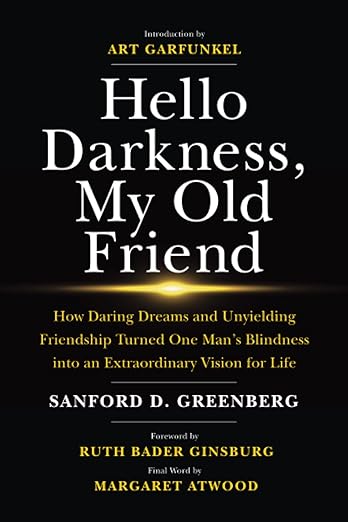
His life is triumphant in numerous ways, most notably the journey of taking the tragedy of going blind and living life to the fullest in spite of it. How he accomplished finishing college and going after other degrees is one thing. But continuing to dream big and go hard in all areas is equally inspiring.

Knowing I’m regifting the book, I didn’t do any highlighting. Out of many elaborative thoughts and quotes, I’d like to share just one from chapter 14, “The Start of Something Big.”

I was bitten by some kind of bug. Once someone gets his or her resolve up and running, and gets it focused in a direction, it is hard to put on the brakes. In a word, there is momentum. Also, aggressive work habits form. For us blind people, it is especially hard to hold back because we are always concerned about security. Like those who survived and prospered long after the Great Depression but could never shake the habit of stockpiling food and cash for a rainy day, we never feel comfortable, in our guts, about sitting back and saying ‘Okay, that’s it. I’ve done enough.’

Sitting back. It seems to be an art form of sorts. Or at least some form of discipline that some do naturally and others work hard to pursue.

Security. It seems to be more and more pursued yet less and less attained.

Greenberg’s journey of learning to sit back and where to find security led him to this conclusion: “The only worthwhile things in the world are people and ideas.” These drove him to an extraordinary life that may have only been possible due to overcoming tragedy, striving for the light.

I’m richer for having read Sanford Greenberg’s memoir. I’m glad we met.

If it’s doubtful you’ll read it, enrich yourself by watching this video about his lifelong friendship with Art Garfunkel.

And There Was Light (book review)

Last year I came across Jacques Lusseyran’s story by reading a collection of his essays. Before I left on my Christmas road trip last week while looking for an audio book to listen to, I was thrilled to find Lusseyran’s memoir, And There Was Light. What a story to listen to during this season of the year!

In my 2024 Library posting that you’ll find tomorrow, I’ve called this book the most thought-provoking book I read this year. Here are five reasons:

  • Lusseyran convinces you he can see light despite being blind
  • Lusseyran and his young friends lead a significant Nazi resistance in France
  • Lusseyran shows you the power of words, both spoken and written
  • Lusseyran reminds you of the strength of the human spirit whose foundation is faith in God
  • Lusseyran proves odds can be broken

There are so many quotes worth noting from this memoir. That’s one downfall to listening to it-unable to highlight them. However, I’d encourage you to listen to it rather than read it. Andre Gregory’s narration draws you into the world of a blind child who grows into a hero, a choice he made so all would be drawn to the light.

If you are a lover of history, check out this book.

If you enjoy World War II stories, check out this book.

If you are clueless like I was about the French resistance, check out this book.

If you wish to better understand the world of the blind, check out this book.

If you wish to shine light into the dark, check out this book.

The Unhappiness We Create

Jacques Lusseyran (1924-1971) was a blind author, professor, and leader of the French Resistance in WWII. At age 19, Lusseyran was arrested and spent nearly 15 months in the Nazis’ Buthenwald concentration camp. When the U.S. army arrived, Lusseyran was one of roughly 30 survivors of a transport of 2,000 French citizens.

In this collection of Lusseyran’s essays, he recounts becoming blind at age seven, reactions to societal progression, and observations from Buthenwald.

Essay #1, “The Blind in Society,” is his revelation that after his blindness he became aware of an inner light. Here’s one illustration of his observation of that light:

When I was overcome with sorrow, when I let anger take hold of me, when I envied those who saw, the light immediately decreased. Sometimes it even went out completely. Then I became blind. But this blindness was a state of not loving anymore, of sadness; it was not the loss of one’s eyes.

In the final essay, “Poetry in Buchenwald,” Lusseyran shares the power of poetry. His sharing of poetry with fellow prisoners brought hope and happiness. From that, he had this to say about unhappiness:

Unhappiness comes to each of us because we think ourselves at the center of the world, because we have the miserable conviction that we alone suffer to this point of unbearable intensity. Unhappiness is always to feel oneself imprisoned in one’s own skin, in one’s own brain.

I share these two thoughts to record them for future reference. I also share them in hopes that we move more toward love to eliminate the unhappiness we create in ourselves.