Waiting, Choosing, and Giving Up

“To wait with openness and trust is an enormously radical attitude toward life.  It is choosing to hope that something is happening for us that is far beyond our own imaginings.  It is giving up control over our future and letting God define our life.”  Henri J. M. Nouwen

I’m guessing this is an ongoing discipline for everyone. Sometimes we wait well. Sometimes we choose well. Sometimes we give up well. We live in the ebbs and flows.

That last phrase, “letting God define our life,” is another way of describing my word for 2025 – Rest.

No other picture best captures how it’s played out than this.

I’m eager to play, create, commune, and gather the fruits of waiting, choosing, and giving up.

Doors

(At the end of February, I shared a few posts about Jesus’ statement “I Am the Door.” Here’s another one by my friend, guest blogger Mark Stanifer.)

I came across the image in this post during a season of transition. It mirrored exactly what I was feeling—standing in an empty room with only doors in every direction. No furniture. No guidance. Only choices.

That year, my word was co-operate. And the message became clear: this wasn’t about finding the one “right” door. It was an invitation to move, to trust, to co-operate with what God was doing in me.

I had recently left a corporate America role after 20 years. It was a massive shift. I wanted clarity, direction before moving—instead, I had doors. And silence. No signs. No indication of what was behind the doors. Simply doors awaiting my move. 

At first, I felt stuck. Fear kept me frozen in place—fear of making the wrong move, of wasting time, of choosing poorly. I told myself I was being careful or wise, but really, I was just afraid. And that fear masked itself as waiting on God, when in reality, He was waiting on me.

What shifted for me was this: God didn’t want me to wait for answers. He wanted me to walk in partnership with Him. The movement itself was the point. So I began opening doors to see what was on the other side. 

The movement did not lead to immediate results. Some doors were dead ends. Some were locked. Some simply lead me back to the same room. But the benefit was more than the results. It was in the movement itself. Because I learned that He wasn’t waiting behind a specific door—He was walking through each one with me. And, eventually I opened a door that lead to a whole new room to explore.

In John 10, Jesus says, “I am the door.” That line has stayed with me. He doesn’t just point to the way forward—He is the way forward. He is the door, the First Door.

The door, I’ve realized, isn’t the destination. It’s the turning point. It marks the moment of trust. And it’s the threshold through which partnership begins—both with Jesus and with who He wants me to become.

This journey has been deeply personal. It’s not about replicating someone else’s story or steps. The doors in front of me are mine to open. And what they lead to—growth, challenge, disappointment, doubts, pruning, joy—is uniquely tied to who I’m becoming. As you face and open your doors, your learning will likely be different. 

Here’s what I’ve learned:

  • Don’t wait for the perfect door. Choose one and walk through it.
  • Courage is choosing in spite of the fear.
  • The wisdom comes from the choosing, not the waiting.
  • God isn’t waiting on the other side. He’s walking through each door with me.
  • The door is part of the growth. That’s where the pruning happens so I can bear more fruit.
  • This is a partnership. We’re co-creating my future, as I co-operate with how He’s at work in me.

Jesus said He came to give us life to the full. That life begins by first walking through Him—He is the First Door. The only way to true life is through Jesus. Once we’ve stepped through Him, we can trust He’s with us through every other door we open, no matter what’s on the other side.

A Generosity Story: How a Single Mom Benefitted from the Sale of an Office Building

Starting Point: The Zenith building in downtown Sarasota sells for $24 Million in January.

Generosity Step #1: The Zenith decides to give away thousands of dollar’s worth of furniture and equipment in the 12-story building to area nonprofits. Two of our staff make a visit and claim tables and chairs valued at $8,000.

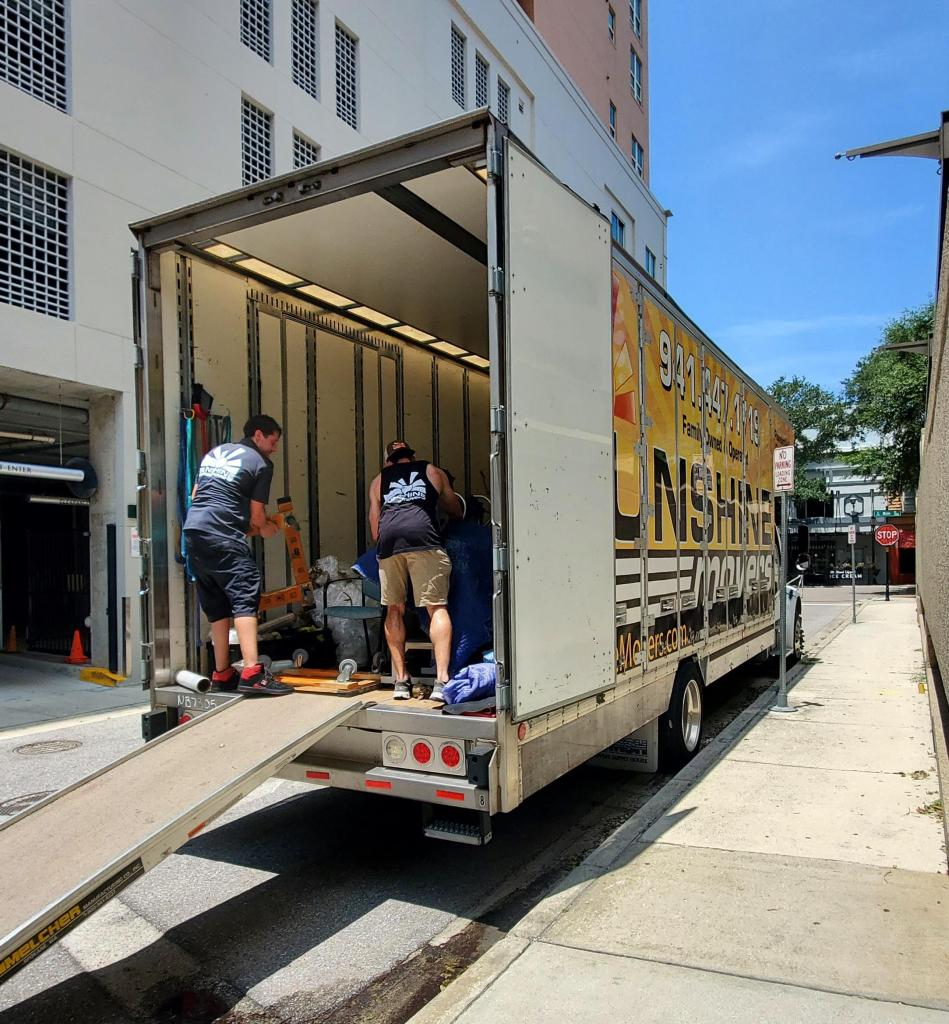
Generosity Step #2: Sunshine Movers, who donates their time/truck/employees to assist nonprofits, picks up the donated furniture from The Zenith and delivers it to our administration office.

Generosity Step #3: Rather than discard the gently used furniture in our counseling offices The Zenith donations replaced, we look for another nonprofit to donate them to. Six days later we respond to a Facebook post sharing the need for furniture for an apartment for a single mom and her child.

Generosity Step #4: Two staff members of Hope City Church that partners with our Center offer their time and trucks to deliver the furniture to the nonprofit. Tonight, this apartment now has a couch, loveseat, and five accessory chairs.

It took several decisions made by several people to keep the generosity going long enough that a mother and her daughter feel more at home, feel comfort, feel cared for, feel loved, and feel seen.

Generosity starts with one decision. It also ends with one decision. Let’s keep making the right one.

When I Know What I Don’t Want to Know

Following my last post, everyone lives in a perpetual state of not knowing what they don’t know. Inside of that bubble comes moments when we learn something we’d rather not know. Is it just me, or do those things make you wish you could unlearn them? And, doesn’t it seem like it’s happening more and more, almost daily?

Seven chapters later in Joshua, I’m guessing Caleb could relate with these two questions. His conversation with Joshua was 45 years after learning something very costly. It cost many men he knew their lives. Caleb was promised he wasn’t included in that result, yet he lived with knowing so much that I imagine he struggled knowing.

Knowledge brings choices. I prefer that thought over the thought that knowledge is power. Both can be true; but looking through Caleb’s 45-year hindsight, I lean toward his model of making righteous choices versus abusing bestowed power with his knowledge.

CHOICE #1: Knowledge doesn’t make you king.

Caleb may have been tempted to envy Joshua or to disrespect his predecessor, Moses. He didn’t, I believe, because he made the choice not to pursue a physical position of authority just like he didn’t assume one in his spiritual life. Caleb was not the king of his life. His choice led him down a long, hard, unchosen path resulting in generational blessings no other man with his knowledge received.

CHOICE #2: Knowledge doesn’t dictate direction.

Realistically, Caleb could have taking a direction in an attempt to act on what he knew. Yet, year after year after year, he chose to submit to a direction that must have seemed avoidable and sorrowful. What kept that choice in tact was a promise, a promise that sustained and grew his strength around each turn to his final destination.

CHOICE #3: Knowledge does offer servanthood.

Another guess I have about Caleb is that he viewed life as a gift. Life didn’t owe him. It didn’t owe him power or guarantee him ease. This view of life molded him into a servant. He allowed it. He welcomed it. He embraced it. That’s why 45 years later he reaped a servant’s reward.

When we know what we don’t want to know, may be all be drawn to Caleb’s choices. For the long haul. For everyone’s future. For the promised land. For the Promise Keeper.

Photo by Caleb Jones on Unsplash

Four Corners Quad Keyah Series Lesson #1

December 8-10 was another three-in-a-row race trip to check off three western states: Utah, Colorado, and New Mexico. Texting with a friend about it, I mentioned I have lessons from the trip. I’ve come up with six that I’ll share in separate posts.

Number 1: Single lane running paths test all the fruits of the spirit, in addition to grace.

Truth be told, I didn’t conduct major research about the courses. I read what was posted on the race series website, which was pretty basic. So imagine my surprise when on the first course right out of the gate we were basically running single file down a rocky, windy path into a canyon. WAKE UP CALL! What in the world have I signed up for?

These Florida legs weren’t trained for this. But more challenging was the mind game going on when I realized I was trapped behind runners whether I wanted to be or not. There was no safe, nice, respectful way around slower runners, better yet, walkers who had no intention of running. That’s a recipe for frustration.

And this was mile 1 of a three-day, 39.3-mile journey. Let the self-talk begin.

In this case, the self-talk was mostly in the line of, “Pace yourself…You’ve got miles to go…Does it really matter how long it takes?…Surely the whole course can’t be like this, right?”

Thankfully, no. The course was a loop course. To complete the half marathon, you had to run the course 3 1/2 times. So after the first loop, you knew what to expect. For me that meant, “Now I can relax.”

First loop challenge: Keep my frustration in check and don’t take it out on anyone. How did I achieve that? I literally had to think less about myself and more about those around me. Were I to be a jerk, selfish, or impatient would cause someone serious injury due to the rocky, steep, windy path we were navigating.

We’ve all been there. Stuck. Frustrated. Surprised. Stressed. How in the world did I get in this position? In those moments, on those paths, we have the choice to look out for those around us or to be all about ourselves. Choice 1: Lean in to how we want others to treat us (follow the Spirit’s lead); Choice 2: Be self-absorbed demanding everyone to get out of our way (ignore the Spirit’s lead).

Choice number one results in everyone staying safe, feeling respected, and enjoying the journey. Choice number two, somebody’s getting hurt-probably a lot of some bodies.

I’ve seen enough and made enough wrong choosing. Thankfully, on this Friday morning in Utah, we all made the right choice. We passed the test and got the medal to show for it.

The Hard Choice

Graduation season 2022 is over. Lots of celebration for accomplishments years in the making.

In his remarks a few week ago to our recent intern graduates, our executive director acknowledged that they had earned the reward for making the hard choice. The choice to do more. The choice to shift direction. The choice to make a difference. The choice to endure.

As I listened to his remarks, it crossed my mind that it’s easy to celebrate crossing the finish line of a hard choice journey. Typically there are friends and family eager to join the party and drink in the joy. Lots of excitement. Lots of cheer. But those moments do not reflect the majority of the journey after making the choice until lifting the glass.

Probably none of those people were awake at 2AM while you finished that paper. Probably no one brought you coffee and patted you on the back and whispered, “Hang in there.” Only you know the full emotional, physical, mental scope of your entire journey.

Many of life’s journeys tell a similar story. The 45-year marriage. The 52-year career. The all-life parenting.

How many times in that decade-long career did you have to make a hard choice that few, if any, people acknowledged? Which year in your marriage did you make the most important choice that strengthened your relationship? Who knew about it? And I imagine the majority of parenting feels like daily hard choices. Accurate?

In those moments where there’s no one cheering you on, you’re faced with possible doubts. It’s normal to wonder, “Is this worth it? Why does each step get tougher? Does anyone see what I’m putting myself through?” Try not to overreact to these thoughts. They are linked to many things-fatigue, loneliness, uncertainty, fear, growth, to name a few.

Maybe you’re having that doubting moment today. It’s July, the summer after your freshman university year. Anyone cheering you on while you work that summer job? Probably not. Do you give up and say it’s just too hard? Before you answer that, here are two suggestions.

Tell someone that you need some cheering on. Whoever just came to mind that is capable of doing that without hesitation, send them a text or give them a call. Ask and most likely you’ll receive.

After that, find someone that you can cheer on. Seriously, don’t wait for them to ask. Think, look, observe. Whose path did you cross today that looks like they are doubting their hard choice? Send them a text. Give them a call. Whisper a “Hang in There.”

I believe hard choices can be celebrated multiple times, not just after crossing the finish line. If for no other reasons, to make sure the dream is fed, the choice is affirmed, and the joy is realized.

Hang in There!

Photo by Marc Kleen on Unsplash

Race Day is Coming…Ready?

Yesterday my run was a 6-mile route I created last Summer. It mostly runs east and west, as you can see here:

At the mile 1 turnaround, I noticed something. I had been running with the wind to my back, which meant for the next three miles it was now in my face. Made me stop (I didn’t actually stop running) and think…and this is where my mind went the next three miles.

Some windy days are worse than others. On those worse days, like this past Sunday when gusts were 20+MPH, I run as much as possible in the crosswind. Of course, you always have the choice to say, “No thanks. I’m not even lacing up.”

Ultimately, you need to run into the wind. Why? Because Race Day is Coming!

All the training weeks before race day you can do whatever you want in choosing to deal with the elements. But come race day, it’s out of your hands. There’s no opting out. The course is already laid out, and the elements are not in any human’s hands. Race Day is here. You have to deal with it.

Runner or not, we all have race days.

  • Newly engaged…race day is coming
  • Newly pregnant…race day is coming
  • Final child about to graduate…race day is coming
  • Mid-life career change approaching…race day is coming
  • Anticipating retirement…race day is coming

These race days, if you’re living life well, you see coming and can do your best to make the right training choices. There are some race days you don’t see coming. Like 100MPH wind race days. If you are a “This Is Us” fan, this week you saw Beth and Randall have to deal with a major Race Day with their 17-year-old. All race days, known and unknown, come, and you don’t have a choice but to deal with the elements.

So what do we do? Sure, most training days and race days are mild. Enjoy them to the fullest. On those “unmild” days, recognize you have choices. If you want to be ready for race day, you’ve got to be willing to run into the wind occasionally. When that’s not your best option, it’s okay to slow the pace or claim it as rest day.

Be wise. Race day is coming.

Groaning (Part 3)

In Parts 1 & 2, I shared that we are all born groaning and how that viewpoint can encourage grace giving to ourselves and to one another.

That grace choice isn’t always natural. In fact, it goes against our groaning nature. Left to our instincts, we reach for anything to ease our groaning without considering the impacts of that reaching. Grace isn’t natural.

So back to those four verses that started this series, when you finish reading the rest of that chapter, which I’ll include at the bottom of this post, you see how hope and grace are made possible. They are both made possible by a supernatural grace choice-a choice only explained by love.

God saw his creation groaning. He was there for the first groan. And in that moment, he offered grace. He made a plan. He made a choice-the only choice available to stop the groaning. He chose to enter the groaning, to embrace it in order to crush it.

Chilling. There isn’t a human groan God didn’t feel and now doesn’t remember. He saw them and chose to experience them in order to redeem them…forever.

As you read the rest of this chapter, pause after each verse. Consider a prayer of thanks between each verse. Voice a prayer of adoration, of worship, of awe, of victory because you do not groan alone.

Romans 8:26-39

26 In the same way, the Spirit helps us in our weakness. We do not know what we ought to pray for, but the Spirit himself intercedes for us through wordless groans. 27 And he who searches our hearts knows the mind of the Spirit, because the Spirit intercedes for God’s people in accordance with the will of God.

28 And we know that in all things God works for the good of those who love him, who[a] have been called according to his purpose. 29 For those God foreknew he also predestined to be conformed to the image of his Son, that he might be the firstborn among many brothers and sisters. 30 And those he predestined, he also called; those he called, he also justified; those he justified, he also glorified.

31 What, then, shall we say in response to these things? If God is for us, who can be against us? 32 He who did not spare his own Son, but gave him up for us all—how will he not also, along with him, graciously give us all things? 33 Who will bring any charge against those whom God has chosen? It is God who justifies. 34 Who then is the one who condemns? No one. Christ Jesus who died—more than that, who was raised to life—is at the right hand of God and is also interceding for us. 35 Who shall separate us from the love of Christ? Shall trouble or hardship or persecution or famine or nakedness or danger or sword? 36 As it is written:

“For your sake we face death all day long;
    we are considered as sheep to be slaughtered.”[b]

37 No, in all these things we are more than conquerors through him who loved us. 38 For I am convinced that neither death nor life, neither angels nor demons,[c] neither the present nor the future, nor any powers, 39 neither height nor depth, nor anything else in all creation, will be able to separate us from the love of God that is in Christ Jesus our Lord.

Photo by Pinakeen Bhatt on Unsplash

God of My 20’s: 2 Things I Would Tell Myself

(Post #10 in a collaborative series)

Guest Blogger Eric Vorhies

The things that the 35-year-old Eric would tell the 20-something Eric would need a TLDR (too long didn’t read) section. Don’t go to college unless you have to, travel before having kids, don’t eat too many gummies (they will lead to cavities), learn more about leadership, manage your time better with routine and discipline, stop eating dessert after every meal, etc. There are specific reasons for each of these, and for the ones that I did not share. BUT the problem is that the 20-something Eric wouldn’t have really heard these nuggets of wisdom. He was too sure of himself. So, I have narrowed it down to two things that I wish I could tell myself when I was 10, 15, 18, 21, 25, 27, even yesterday: choose your treasure wisely and stop seeing the world in a binary way.

The Treasure We Choose

Jesus tells a parable in Mt 13: 44-46 about people finding something valuable and doing whatever it takes to obtain it. Elsewhere, the Bible tells us that where our treasure is, there our heart will be. Look…the Bible has a lot to say about treasure. So much so, I think I got lost in the things that I treasured. Now, I didn’t treasure ridiculous things. I like movies, playing frisbee, hanging out with friends, and sleeping in…you know, the normal stuff. Those things are important to me; but when I consider the value that my treasure had, it feels empty.

Before you think I am crazy, let me explain. Friendships are good. Relaxing is good. Exercise is good. What I did wrong is nuanced. I regret making those things the goal in and of themselves. When relaxing or friendship becomes the goal, I subtly shifted from serving God to serving myself. Subsequently, those things are then viewed from a self-serving perspective.

Something needed to shift. That’s when I realized just because we treasure something doesn’t mean it has value. To find treasures of value, we have to pursue God to discover what He values and treasure those things. When we do, everything else becomes a by-product of that pursuit. For instance, the more I pursue God, the more I understand His grace and His love for people. Therefore, I serve at my church, I lead a small group, I foster kids, I push myself to become a better parent and husband. And all the while, I have found more peace and patience, deeper friendships, stronger relationships, and a faith that comes from God because I have reached the end of my rope so many times that I have nothing else to do except trust in Him.

So, I would tell myself to treasure things that have real value, relentlessly pursue them, and learn how to merge what you are naturally passionate about with that pursuit.

There Are Two Kinds Of People In This World

Yes/no. Black/white. Right/wrong. True/false. Iphone/android. Are there really only two options for everything? I used to think that in very mathematical terms. If I put in the right information into a solid equation, then I can predict the outcome. If it failed, then I had a bad equation or didn’t have the right information. A better understanding of the variables and their relationships was the solution to the world’s problems. The thing is…the world is messy. It’s messy in such a way that it shouldn’t always be seen as a problem to be solved, but rather a tension to be managed.

Can’t find the perfect person to date? The perfect church? Your dream job? Well, that’s because they don’t exist. That’s a problem you can’t solve. So you manage the tension. I have learned this is the most deeply personal and profound way that I could. Here’s the truncated version: We fostered a teenager. It was amazing for 1.5 yrs. After getting guardianship, she developed mental disorders. I became a parent of a child I never thought I would have. In a nutshell, I have quit judging other parents…and people in general.

That’s what having kids does to a person. See a frazzled woman with a stain on her shirt — yeah, she could be just some unhinged woman, but she’s likely just a mom. Some guy sleeping in church…of course he could be bored out of his mind, or maybe he didn’t get any sleep because his 5-year-old climbed in his bed and was repeatedly kicking him throughout the entire night.

The world is messy. People are suffering and hurting. Some of them do not have the tools or capacity to know how to respond. So, rather than turning from the mess and complexity, the 20-something Eric needs to embrace it. But not as a problem to solve, but as a tension to manage. A tension that will never go away. But it can get better. And when it gets worse, that’s okay too, because I can always get better also.

TLDR

I get it. 20-something Eric would not have listened well through this either. So, the bullet points:

  • Treasure the things that God says have value
  • The world’s messiness isn’t something to be solved but a tension to be managed

Hopefully, the words of 40-something Eric will be more like, “always have ice cream with your pie,” or “it’s ok that you bought that tool for that thing that you never actually fixed because your neighbor got a lot of use out of it.” I just pray to God that these two are burned into my character at this point. Otherwise, I will make some easily avoidable mistakes.

Covid-19 Update: I wrote this before the pandemic. I have learned some new things, but I will spare you…except for this one last one: Wisdom is a depreciating asset. I am glad to have re-read this today because it reminded me to look at the season I am in now with a fresh perspective. So, be open to re-learning something that you already knew.

The “Bad Ear”

Listening isn’t always something we want to do. I’ve become fascinated by our capacity for hearing in recent years. Now in my 60s, I am losing capacity to hear in one ear. It comes in handy when I’m being told something I really don’t want to hear. It’s convenient when I need a good excuse to miss a deadline or just prefer not to have definite instructions for something I might not want to do. It doesn’t mean I can’t hear at all in the “bad ear,” I just sometimes can’t tell you what the words are. I might hear sounds, muffled words and intonations. To hear the words, I must turn my face and my good ear to the speaking voice. That makes it, for me, a metaphor for spirituality – we turn our face so we can hear again. We turn our face in a new direction so the words have meaning and are not merely sounds.

This is a quote from a book I just started reading entitled A Spirituality of Listening.

I appreciate the metaphor. If I’m going to hear what God is saying to me, it’s vital that my face and my ears are turned in his direction. What might keep my face and ears turned away?

  • Inconvenience
  • Resistance
  • Stubbornness
  • Pride
  • Comfort
  • All sorts of fears and lies that the enemy would rather I choose to listen to

So in order to listen, I have to turn my face and ears by choosing humility, surrendering control, trusting truth, embracing discomfort, and recalling God’s ways are indeed best.

Here’s to better and deeper listening!