Who Else

This is a newer worship song by Gateway Worship

Lyrics

I am an instrument of exaltation
And I was born to lift Your name above all names
You hear the melody of all creation
But there’s a song of praise that only I can bring

Who else is worthy? Who else is worthy?
There is no one, only You, Jesus
Who else is worthy? Who else is worthy?
There is no one, only You, Jesus

You are the infinite God of the ages
Yet You chose to make my heart Your dwelling place
You healed my brokenness, showed me Your glory
So I have songs of thanks not even angels sing

Lamb of God, anointed one
Who was and is and is to come
Seated on the throne above
Holy, Holy
Righteous one who shed His blood
You proved to us the Father’s love
Jesus Christ be lifted up
Holy, Holy

Source: LyricFind

Songwriters: Abbie Gamboa / Josiah Funderburk / Zac Rowe

Who Else lyrics © Capitol CMG Publishing

Let Them Release First

I don’t recall where or who I heard say this about hugs, but it has stuck with me.

To be a great hugger, let them release first.

Those of us who are not naturally big on hugging no matter the reason can, however, practice being great at hugging.

Got some practice yesterday after church.

One of the men who got baptized crossed my path after the service. We’ve hardly spoken in the past. Just some eye contact and short head nods while I’m playing the keyboard and he’s within spitting distance in the audience.

When he saw me coming, he came in for a hug. The Spirit whispered, “Hang on ’til he’s done.”

We didn’t say much. The embrace was plenty.

God shows his glory all day long. Even in hugs.

Photo by Alex Gallegos on Unsplash

Seen Too Much

You’ve seen too much to do nothing

In the beauty

In the brutal

In the church

In the margins

In friend’s lives

In families

In the loving

In the hurting

In the calling

In the yelling

In the blessing

In the cursing

In the welcoming

In the dismissing

In the running

In the crawling

In the dying

In the living

You’ve seen too much to do nothing

(For deeper understanding, view this message by Pastor Matt Cote)

Valley/Highland/Grace Friends

I’ve written about friends in previous posts. Nose hair friends. 21st Century friends. Even three types of hard times friends. This morning a new thought bloomed based on the song in this video.

I first heard this song after being pointed to it by a nose hair friend going through hard times. It’s on my 2025 Rest Playlist, which I started my day with today. Because friendship was on my mind, I listened to this song with a different ear and heart.

Here’s the thought that surfaced:

Some friends are better valley friends; some friends are better highlands friends.

I can hear some head scratching. “John, true friends, real friends don’t care about valleys and highlands. They’re in it for all of it.” Heard. But let me tell you my experience.

Back in the early-90s while in my 20s, I had a group of friends that got together often to play card games. Anywhere from 4-6 of us. We were friends mostly through work and church. Some were married, some single. We were very much highlands friends.

Eventually we all parted ways as relationships go, yet we tried to keep in touch. And then, one of the couples got a divorce. In that moment, we were challenged.

I had never experienced friends getting a divorce. For that matter, I’d never experienced anyone divorcing that was close to me. It was foreign territory. An unknown valley that I was more observing than experiencing. And as much as I tried, it was just awkward. The result? These days we’d call it ghosting. I felt a lot of guilt about it.

Forward five years, another couple of church friends got divorced. This time, I knew better, and I was the valley friend they needed. I had grown in what it meant to be a friend through the valley. That experience led me to go back to my first divorced friend and acknowledge I could have been a better friend through his valley.

Here I sit almost thirty years later, and it’s like I’m the opposite-better valley friend than highland friend. And when I listened to this song this morning with my friend evaluator hat on, it was a call to grace.

Grace for myself. Sure, I’d like to be the ideal friend regardless of the space. When I believe I’m not, grant myself grace to grow in whichever land my friend is walking.

Grace for my friends. Sure, I’d like them to be ideal friends regardless of my space. When I’m tempted to say they aren’t, grant them grace to grow in the land I’m walking.

Maybe the lesson isn’t as much about valley and highland friends. It’s about grace granting, to others and to myself. “All the same.”

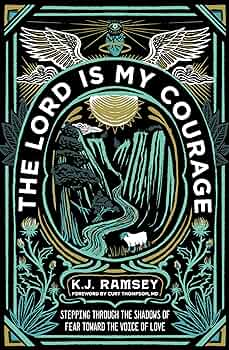
The Lord Is My Courage (book review)

I don’t recall what I thought I was going to get from K.J. Ramsey’s book The Lord Is My Courage. But here’s what I know I got:

  • New Language
  • Deeper Understanding
  • Fresh Appreciation

Ramsey’s approach to this subject is 1/4 part self-therapy, 1/4 part reader-therapy, 1/4 part church culture review, and 1/4 scripture exposition. That’s a lot. For her. And for the reader.

David, who wrote both Psalm 27 and Psalm 23, knew what it was like to have an enemy, knew how it felt to be afraid, and knew how much it hurt to wonder if you are heard.

Chapter 5, “He Makes Me Lie Down”

For this response, I took my time. Like a good meal, it’s better to pace yourself. The two chapters worth savoring the most were Chapters 5 and 20.

Chapter 5 includes nuggets rooted in a distinction of translation. Some scholars prefer a translation of the Greek to read “he settles me down” instead of “he makes me lie down.” Is that a big deal? To K.J., yes. “I thought God was a shepherd who made me lie down.  I needed to encounter God as a shepherd who settled me down.”

These kinds of bites are served throughout the book. The one I enjoyed the most was this one from chapter 20.

In John 16, Jesus is telling us, Peace is found only in my presence. And I will not leave you alone.

And then Jesus says to “take heart,” which can also be translated as “have courage,” telling us that our future is secure because he has already overcome the world.

Fear is just courage’s preamble. When we practice remembering that the Spirit of Christ is our companion, fear simply becomes one more prompt to pay attention to the voice and presence of Love. Fear doesn’t have to be an enemy to conquer. It can be a place to be companioned by Love.

Ramsey definitely follows the theme of the book, folded creatively in each chapter. Here are five illustrations:

  • “Courage is the practice of risking to trust that we have a Good Shepherd who is with us always-no matter what.”
  • “Courage is resisting the hurried pace of modern life and embracing the slower rhythm our bodies need to regulate and rise.”
  • “It takes courage to quit doing things for God to commune with God.”
  • “Courage is choosing to commune with someone who has already chosen to be with us.”
  • “Courage is simply the choice to be found.”

Is this book for you? If you enjoy the Psalms, yes. If you appreciate the integration of scripture and psychology, yes. If you are struggling with current or past church experiences, yes. If you like brain food, yes. If you could use a fresh look at who God is, yes. Chances are, yes.

Heartbroken…There…I Said It

“How are you doing?”

It’s an ordinary, everyday question. But some people have a knack for asking it more like, “No, really. How are you doing?”

I’ve got more than my share of them. Over the last four days, three of them pried. I skirted one, dumped on the other, and indulged the last one.

It wasn’t until listening to the end of the podcast episode I posted about yesterday that the one word to describe how I’m doing surfaced. And it’s one I have never used for myself. I’ve felt and experienced it, just never declared it to be a current condition.

Heartbroken.

Kate: If we think of ourselves as a very sad but also kind of broken in certain parts person, it can feel like, well, that’s not the person who is going to be able to help very much, do very much. We’re already consumed by all the things that have made our lives difficult or tragic in the first place. We are already too aware of the fact that we are living inside of like crosscurrents of things we can’t fix. Kids with intractable problems. Parents with intractable problems. Jobs with intractable problems. But you and I both agree that there’s something weird that happens to the broken hearted, is that there’s like, a kind of an inside-out-ness that happens that can make us maybe exactly the right people to live in unfinished times.

Parker: I think so. This level of engagement, either in politics or in personal and communal life seems to me to require the kind of opening that can comes through broken heartedness. Absolutely. So just as you said, I’ve thought a lot about the fact that there are two ways for the heart to break. It can shatter into shards and just lie useless on the floor, never to be put back together again. Or you can exercise your heart on a daily basis by taking in the little losses, the little deaths, you know, those things that are feel hard to absorb, the news that’s hard to absorb, take it and let it exercise that muscle the way a runner exercises muscles so they won’t snap under stress, and the heart has a chance then to become so supple that it will break open into largeness rather than apart in into shards. And, you know, the most trustworthy people in my life are people who have known broken heartedness, and those who have known it in depths. Those are the people I can go to and say, and tell it the way it is for me. And then, and in the process, experience healing. They don’t have answers for me anymore than I have answers for them. But we can have a conversation rooted in broken heartedness and honesty about that experience that goes somewhere humanly, right?

In my inside-out-ness, I have to say I’ve probably been heartbroken for years without acknowledging it. The recent storms and reactions to the election have brought me to this awareness that I’m oddly thankful for.

I ask myself what’s this about. I didn’t personally experience loss from any of the three hurricanes. Nor did I personally lose a bid for public office. What’s there to be brokenhearted about?

The answer may seem obvious to you, but it’s not always been obvious to me. My Enneagram 1, Myers Briggs ISTJ self tends to be pretty cut and dry. But not recently. At least not these last three months.

I’m leaning into the belief that loving your neighbor as yourself means seeing ourselves as one. When the community hurts, you hurt. When the community loses, you lose. When any portion of the country cries and mourns, you cry and mourn.

The years of brokenheartedness I’m most aware of has to do with my personal church history. To see the church in the middle of the polarization of the country these last five years continues to cut deep. This last week, my heart jolted, even collapsed, as one side hurries to make false biblical comparisons while the other huddles in fear and shock. It’s war. And it’s heartbreaking.

On my run this morning I asked myself two questions: 1) How long do I allow myself to be heartbroken over these two things that personally don’t impact me? 2) What am I doing about this status?

I answered the first one with more questions:

  • Is there a formula? Like, three times the amount of time it takes for all the debris to disappear.
  • Isn’t there more to recovery than just removing and repairing the visible damage?
  • Feels like there’s grief everywhere, right? How long does that take?
  • God’s probably been heartbroken over the Church for longer than I’ve been alive. Where does that leave me?
  • Feels like heartbreak is part of life, and I’m just now owning it. Or at least on behalf of my neighbor. I’ve missed it for a long time, right?

As for question two, my best answer for my spirit was this: Don’t Rush.

  • Don’t Rush to Retort
  • Don’t Rush to Judge
  • Don’t Rush to Wholeness
  • Don’t Rush to Solutions
  • Don’t Rush to Fix
  • Don’t Rush to Start the Day
  • Don’t Rush to Comfort

To the one I skirted, I’m heartbroken. There. I said it.

Cover photo credit: https://www.instagram.com/theoriginalrtpix?igsh=MTkydWQ1MG9qMnJiaA==
Praise: A Well-Taken Reminder

For the last three weeks I’ve been focused on a question, a personal spiritual dialogue that I’ve shared with a few others. The question could be stated several ways, but what I’m after is an answer that enriches/refreshes relationship with God. Here are variations of the question:

  • Which is more important, focusing on what God does for us or who He is to us?
  • In my experience in the Church, is the focus on what God does or who He is?
  • What do my prayers reflect, a focus on works or on identity?
  • How do believers achieve balance between doing for and with God versus being with and knowing God?

In ways I’ll never be able to explain, the timeliness of reading the right book at the right time surfaced again this afternoon. I recently picked it up off clearance at Books A Million.

In Chapter 4 entitled “Jesus’ Prayer of Praise,” McHenry shared that Richard Foster says adoration has two forms, praise and thanksgiving. Thanksgiving expresses appreciation for what God has done; praise acknowledges who God is.

This struck me through a simple word-praise. I have been contrasting the words adoration and thanksgiving without thought to the word praise. Accepting this teaching that they are really all the same brings some relief to my analytical brain.

That final question in the list above comes from how I’ve been approaching prayer the last three weeks. I’ve leaned more in the adoring lane than the thanking or asking lane-an effort to discipline my focus on relationship. A reminder to praise is well taken.

By the way, in this chapter McHenry shared a terrific list to help us all improve our adoration. Seemed worth sharing.

21st Century Friends

I woke up this morning smiling. I got to spend 3 hours with a 21st century friend last night. Let me explain.

We met in 2016 by way of the land of phone conference calls. He lives in Ohio; I live in Florida. We took some coaching classes together and have pursued friendship since. What other century has afforded humans such interaction? Thus, a 21st century friend. Which leads me to think about the guy I wrote about in my last blog post.

We met by Zoom. He lives in Wisconsin. Odds are you’ve never heard of what he does. He is a Virtual Reality pastor for his church. No kidding. I kept saying to him, “This isn’t why we’re talking, but I have so many questions.” No other century has imagined humans going to church virtually. Which leads me to think about conversations I had earlier this week with a friend in Jordan.

We met…wait for it…in person. Six years ago I traveled to Jordan twice with a few folks from our church to provide services for Iranian and Syrian refugees. That’s where I met Homero, who by the way is Brazilian. On that trip I was introduced to What’sApp. I had no choice in order to connect with our airport shuttle driver; that was her means of communicating. So since then, Homero and I occasionally connect from wherever he is in the world through means of an app. What other century has allowed instantaneous conversation with anyone anywhere in the world? Which brings me back to last night with my Ohio friend.

We were on a walk towards ice cream after eating dinner on St. Armands Circle. We were passing a store, guessing by the window display, was some kind of gift shop. But a sign by the door included ice cream and baklava. I said, “Hey, I have to go in here. I’ve never seen this place.” I ended up walking out with more Turkish baked goods than one human should purchase. More about that later.

Come to find out, the sales clerk encouraging my baked goods splurge just arrived in the U.S. three months ago from Turkey. “I came to America to get my PhD in climate change and to reap the benefits of what’s possible here so I can return home to help my country.” He shared his story in pretty good English. Imagine our shock when he said he didn’t speak English when he left Turkey. To explain his amazing 3-month-English-speaking capacity, he said, “I watch YouTube.”

Thinking about all four of these connections makes me smile. Here’s to the 21st century, and all the friends it affords!

An Altar in the World, Meditation #2

On recommendation, I recently read An Altar in the World by Barbara Brown Taylor. It’s subtitled A Geography of Faith. In the spirit of that lane, rather than offer a review I’ve selected my top highlights and will offer a meditation post for each one. Here’s quote #2:

Human beings may separate things into as many piles as we wish-separating spirit from flesh, sacred from secular, church from world. But we should not be surprised when God does not recognize the distinctions we make between the two.

Chapter 1, The Practice of Waking Up to God

Taylor’s quote comes at the end of the chapter where she has offered the teaching that God can show up in any space or through any means he chooses. In that moment, we have the opportunity to erect an altar-take note and mark that spot where God revealed himself. Her biblical example is Jacob’s reaction to the ladder dream. Because he knew he had encountered God, he paused and created a marker of significance.

Makes me think of Paul David Tripp’s teaching about two-drawer living. God doesn’t instruct us to live two separate lives-one for him and one for ourselves. Everything belongs in one drawer. The challenge is to view more and more of life as an encounter with him, a journey with him, an alertness that he’s always here.

Case in point: Sunday after church I had three hours to kill before attending an event in another town. I decided to google a new place to eat, try something different. I ended up at Blu’ Island Bistro. When I pulled in the parking lot, I wasn’t quite sure. But I said to myself, “Trust the reviews.”

It’s not a big place, but it has charm. I immediately felt it when I walked through the door. And here’s the thing: IT NEVER STOPPED.

Besides the quick seating, the perfect plate portion, the excellent tacos, and almost just right sweet tea, no one, and I mean no one, lacked joy. Not a customer. Not an employee. Everyone seemed happy to be there. I literally said to myself, “I should tell my pastor that I found the restaurant that feels like church.”

I stopped counting how many servers checked on me. I believe it was six. That’s a little crazy. And I don’t mean annoying crazy. I mean “thank you for your care” crazy.

I didn’t just encounter God between 10:00 and 11:00AM Sunday morning. I encountered him at the restaurant, then at the beach, then at the ice cream shop, and then at the event. How? I was looking for him. And the altar I erected? I gave the restaurant a Google review, I’m posting this blog, and I thanked God for putting everything in one pile.

Photo by Jack B on Unsplash

Weeds in the Shadows

In my efforts to look up these days, something caught my eye today as I walked by this church steeple. Do you see it?

Looks like they’ve been growing for a while. Probably hasn’t caught too many people’s eyes…yet. It is on the other side from the road view. And the roofline of the building behind them also keeps them hidden. Do you see them?

My first question was a pretty obvious one: How in the world are those weeds growing there? Something like 30 feet off the ground, on a dirtless structure. Weird.

My next question was more reflective: How many steeples have weeds growing in their shadow that aren’t being addressed? In this case, I’m thinking about all kinds of things.

  • Accountability of leadership
  • Protection for members
  • Factions forming over nonspiritual concerns
  • Workaholic pastors
  • Financial mismanagement
  • Emotional imbalances

Of course, this thought could be asked about all social units, corporations, and communities.

Weeds aren’t hard to identify or address. This requires two basic routines: observant eyes and willing hands.

Observant eyes are aware that weeds grow and aren’t surprised when they see them. Without willing hands to address the weeds, the weeds keep growing, they go unaddressed. Willing hands define those who know that the weeds must be addressed and aren’t afraid to do so, the sooner the better.

Which are you, the observant eyes or the willing hands?

What’s being done about the weeds in the shadows in your family, in your city, in your business, in your church, in your own heart?