The Wisdom of Stability, Part 1-Roots of Love (book review)

Reading while traveling last weekend I gained a broader definition for stability thanks to Jonathan Wilson-Hartgrove. His book, The Wisdom of Stability, affirmed and challenged me, leaving me with this evaluation-I’m decently stable, but there’s always need for growth.

It’s important to point out what Hartgrove is addressing. He’s not talking about the need for emotional regulation or mental wellness. In simple terms, he shares a message of valuing staying put, committing to less wandering, and acknowledging “there comes a time to set seeking aside,” as Kathleen Norris states in her foreword.

Example: I overheard someone this morning describing the makeup of three fantasy football leagues they’re active in. One is made up of college friends; another is made up of childhood friends. Possibly without intention, this person is practicing stability in a way that many of us aren’t.

To practice stability is to learn to love both a place and its people. -Chapter 4, “Roots of Love”

Hartgrove uses trees to explain in chapter four. His analogy rings true, especially for those living where I do. Last year’s hurricane season wreaked havoc. Ask those who live where I moved in April. The community lost over a third of its trees. Why? Their roots couldn’t withstand the winds.

The chapter title, “Roots of Love,” comes from a thought by Benedictine Anselm of Canterbury, a twelfth-century monk who compared a restless monk to a tree. “If he often moves from place to place at his own whim, or remaining in one place is frequently agitated by hatred of it, he never achieves stability with roots of love.”

One temptation in the face of agitation is to flee (more about temptations in part two). Hartgrove challenges us to accept this goes against one reason we were made-to intimately share life with our landscape and its people.

How else can we learn the attention that is needed to really know a community? How else would we ever gain the patience that is required to care for a place over time?

Friday, I chose to go inside Chick-fil-A for lunch rather than hurry through the drivethrough. Not many other customers made the same choice, so the hostess had few people to chat up. She chose me as her customer to get to know. She asked a pretty standard question for non-Floridians, “Did you grow up in Florida?” I have to honestly answer that with a no. But when I say I’ve lived in Florida since 1986 and in this area since 2002, the reply is usually something like, “Well, you might as well have.”

More than once my seeking has tempted me to move on.

More than once, I’m reminded that God is wiser than me. With his wisdom comes stability, and with that stability comes wisdom.
Pursuing and Exiting Silence

The final segment from this podcast episode transcript to highlight focuses on the value of silence. Opinion: silence should be a love language.

Parker: I’m grateful to the Quaker tradition. I’ve been hanging around with Quakers since I was 35, I guess for 50 years, and I’ve learned a lot from them about the power, the value of silence, which I did not learn in my mainline Protestant upbringing… whenever the minister said in the church, I grew up in the Methodist church, now we’ll have a moment of silence. The organ broke into loud pouring for sixty seconds so that none of us could hear what we were thinking. Which was precisely the point.

Kate: Oh my gosh my son said something like that the other day. He goes, why do you keep, he said it so sweetly, but he was like, why do you keep bringing me to this place where they keep saying listen to God, but everyone’s talking.

Parker: Exactly, oh I like that a lot. Tell your son that’s so good. Exactly. So I learned a lot from the Quakers who don’t worship the silence. They worship in silence, and what they’re doing is listening. And Quakerism has its problems, just like every religious tradition or sect does. But I have seen wonderful things come out of that silence where people kind of touch a bedrock of truths. It emerges in vocal ministry, as Quakers call it. And community starts happening around those deeply held concerns. Because so often when we speak from that place of depth, we’re tapping into the aquifer that feeds all the wells. And it turns out that other people, as they tap in, are feeling that same thing or getting that same message. And then we’re poised to do something that’s real and could well make a difference in the world.

“They worship in silence, and what they’re doing is listening.”

Without question, my spiritual formation is strengthened by the amount of silence I naturally have living alone. In the silence I have been freed to listen which, with proper discipline, leads to worship.

In these last three months, I’ve done less writing and reading. When I heard this part of the conversation, I wondered if that may be attributed to my subconscious (mind/body/spirit) leading me to more silence in response to disaster and heartbreak.

Imagine what’s possible when silence is consciously pursued.

  • Healing
  • Forgiveness
  • Grace
  • Clarity
  • Direction
  • Humility
  • Surrender
  • Joy

Imagine what awaits as one speaks upon exiting silence.

Photo by Nathan Anderson on Unsplash

Behind the Curtain: 3 Questions Organizations Must Ask (Post #2)

I grew up a PK. For those outside of church world, PK stands for preacher’s kid.

In addition to growing up in a preacher’s home, I also spent over 20 years serving on church staffs. There are many interesting dynamics to being on a church staff, but I believe one of the keys to organizational health behind the curtain has to be relationships.

In my dad’s day, the prevailing thought was pastors didn’t make friends in their churches. I hear that thought, but I never accepted it for myself. More and more, this seems to be the choice. Reality is, either way you live, it’s going to come with some challenges. But that’s true about all relationships, right?

Building on the first question about values to ensure your public persona matches your behind-the-curtain private one, it seems you must answer this question about your team: How are you building community in your organization?

Community is all about relationships. A healthy community invests in one another, cares for one another, listens to one another, trusts one another, celebrates one another, challenges one another, and commits to one another. If any of these actions are what you claim to do for your customers, it has to be going on in your team also. Community requires intention. It has to be pursued.

Leaders, to engage this question further, here are four more questions for your team to discuss:

  • In our hiring process, how much attention is given to community health?
  • What have we done in the last six months to build community?
  • How well does our team pursue community by growing in understanding one another?
  • Who’s really in charge of the community behind the curtain?

May your community behind the curtain shine in front of it.

Photo by Windows on Unsplash

Saving Lives: We All Can

Recently in a class I was facilitating, two references to suicidal ideation were unexpectedly mentioned. The first one was definitely out of nowhere for me and the rest of the class.

The main topic of that night’s class was finding peace in your beliefs. Naturally, the first presenter of three on the night’s program was a pastor. While he was speaking, a participant shared this in the chat (Zoom meeting):

I just want to let you know that you saved my life when I found you on tiktok.

The second reference to the possible loss of life was shared by the second presenter, a church attendee sharing their story in finding a church home. Part of this story included suicide consideration-this after serving on several church staffs, by the way.

After hearing these personal stories from two people who could easily no longer be on earth, a connection crossed my mind. The theme of the class was finding peace. These two had a season where they were searching for peace. In that season of lacking peace, their lives were at risk.

CONNECTION: Lack of peace is life threatening.

I shared that connection with the class and then offered this encouragement to everyone. Whatever you have offering peace to any community (family, neighborhood, work, church, city), your offering saves lives. It’s not only the pastor who brings peace by preaching or aiding someone in securing their personal beliefs. It’s also the teacher who asks the student about the bruise. It’s the law enforcement officer who delivers good news. It’s the grocery shopper who commends the cashier. It’s the neighbor who offers to mow the yard. It’s anyone who takes time to notice and inquires when they sense a lack of peace.

Any effort to bring, restore, support, or provide peace is life saving. For them. For you. For us.

“Blessed are the peacemakers, for they will be called the children of God.”

Matthew 5:9

Child of God, how did you make peace this week? Congratulations! You saved life.

Photo by Priscilla Du Preez 🇨🇦 on Unsplash

Four Corners Quad Keyah Series Lesson #6

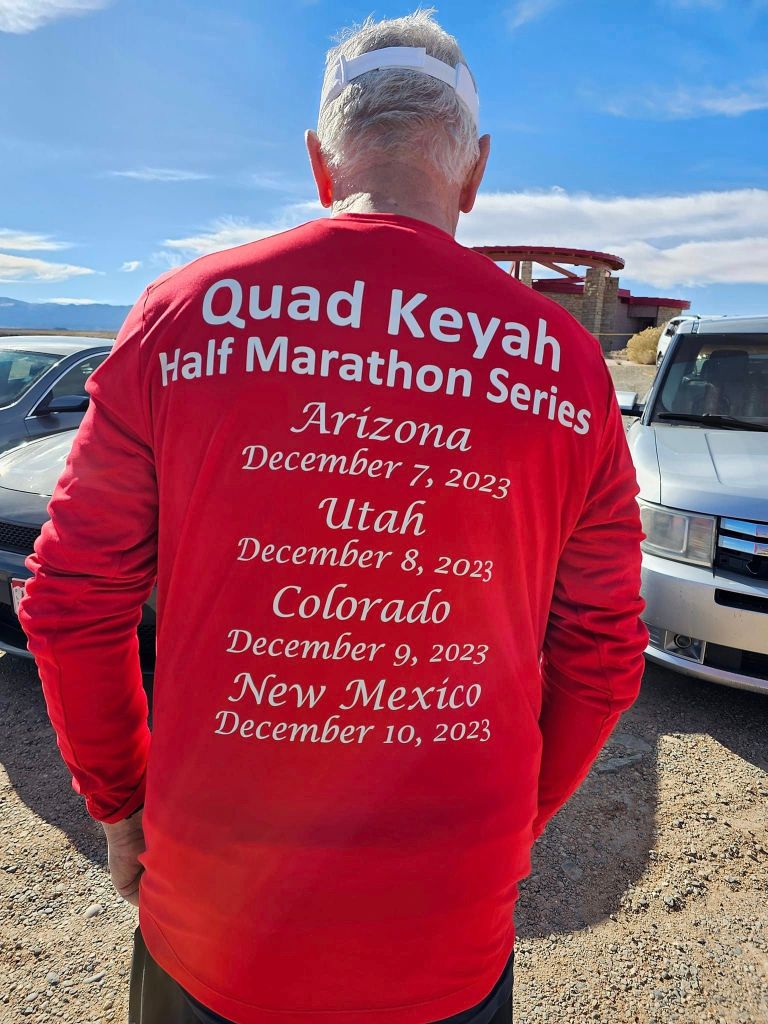
As shared in the previous post, “Easy like Sunday morning” was not playing in my head on the drive back to Albuquerque. I had three things on my mind: Heat. Food. Fluids.

Well, there was a fourth thought going on. 

Lesson #6: If no one else cares how long you took to finish, let that be a sign. Caring trumps Competing.

As far back as I can remember I’ve been driven by achievement. Guess that explains why one of my top StrengthsFinder is Achiever. Setting goals and self discipline are second nature for me. Two balancing acts that come with that are competition and perfectionism.

This journey to run a race of any distance in all 50 states has certainly improved that balance. I can set goals all day, but there’s no guarantee of meeting them. And at the end of race day, I’m still learning it’s more about the journey than the finish time.

On Sunday in New Mexico, two runners illustrated this to me. We had been on these courses together for three days. We didn’t share names, but we shared encouraging words. And on the day they recognized I was struggling, they made sure to check in on me. Caring for a fellow runner was more important than competing against them.

On these long runs in unfamiliar places with complete strangers, you learn a lot about yourself and others. I’m grateful to be reminded over and over of the more important things. 

Personal achievement is one thing. Loving others and creating community is a better thing.

You’ve Got Ink

A couple of weeks ago the devotional read during our staff meeting asked an interesting question: How do you view a pen that has ran out of ink?

The obvious answer is it’s no longer useful. File 13. A pen without ink is useless, right?

True. But another view gives us a more life-giving response. In an inanimate way, what if we viewed that pen as having given all it had? Yes, it ran out. But what if instead of only discarding it since it no longer can give what it once did we acknowledged all that it did faithfully give.

An alternate perspective from a simple life routine. Appreciate the pen for what it did instead of what it no longer can.

Pretty sure I’ve blogged about this before, but it brings to mind our need to maintain balance between being filled and pouring out. Unlike the pen, we don’t want to completely deplete ourselves. To serve community well requires all of us to pour out, which requires us to steward how we are being filled. It is a constant process. With great attention, it is a thing of beauty.

So let’s check ourselves. Right now as you read this, how much “ink” do you have left? Where/how/when do you best get refilled? Which parts of that does your calendar contain between now and Monday?

One more thing. Most likely you’ve been doing quite a bit of pouring out this month-a lot of ink has been flowing. Take a moment to remember where it flowed, what that did for you/others/God, and the story that ink wrote because you allowed it to flow.

TAKEAWAY: You’ve got ink to steward. Be Filled & Pour.

Photo by Laura Chouette on Unsplash

Every Gift Matters

This weekend I’ve observed two different scenarios where donation amounts were either given in the moment or were remembered from the past. Both provided an important reminder: Every Gift Matters.

Friday during the match challenge for our nonprofit counseling center’s fundraising luncheon, multiple donation amounts were announced ranging from $20 to $1,500. Bet you can guess which got the loudest applause. The “oo’s” and “ah’s” squinted my face. It’s natural to celebrate the big splash. Yet, who’s to say the $20 donor didn’t make the biggest splash they could.

This morning in his sermon, my pastor shared financial miracles from the church’s six-year history. The range again was wide-$4,000 to $250,000. No “ooing” and “ahing” from the crowd. But he made his point. The amount isn’t the key. It’s the provider of the gift; in the church’s viewpoint, that’s God.

These two moments offer a couple of significant challenges:

  1. Celebrate all the gifts. Behind each one is a person, a person who took a step-a step of sacrifice, of obedience, of community, of love. Every step matters.
  2. God and his child know the sacrificial level. The amount isn’t what pleases God; the sweet aroma that God enjoys is a gift that says, “You own it all. You matter more than everything.”

Photo by Rob Laughter on Unsplash

What Does She See?

On Monday, the Bradenton Police Department’s Facebook page shared this photo taken during a badge pinning ceremony for the 5th grade safety patrol from Sea Breeze Elementary. And it made me pause.

For those who don’t live in Bradenton or within a mile of this school like I do, the officer in this photo is Bradenton Chief of Police Bevan. She’s doing what I’ve seen her do on a few occasions and when we met. She’s looking this 5th grader in the eyes and taking in the person she’s shaking hands with. The look says something without words. If nothing else, those words are, “I see you.” But I’m curious what exactly does she see? And what does she hope this student is seeing in return?

No question in my mind this 5th grader is seeing something. Her age seems unimportant. In this second, she’s hearing and seeing something that could stay with her much of her life. The look on her face made me pause and ask, “What does she see? What is bringing that look of responding without words?”

Rather than suggest what those answers are, I’ll leave you to chew on it. Whatever the answers are, they bring joy. Joy to the Chief of Police. Joy to the Safety Patrol member. Joy to the photographer. Joy to this observer.

May they both continue to see and give joy!

Shame Nation (book review)

After reading Curt Thompson’s The Soul of Shame, I determined to find other books on the topic of shame. I found several and chose to read Shame Nation by Sue Scheff next. What I thought I was going to learn and what I ended up learning were not the same, to my advantage.

The title implied one thing in my mind. By the time I got into chapter two, I realized Scheff’s focus was on the epidemic of online hate. Through the first five chapters of section one “The Rise of Shame Nation,” Scheff gives great detail to exemplify exactly what’s at stake when it comes to digital shame. Some of it I knew, but I quickly learned I didn’t know enough. That section alone is worth the read. In the following three chapters of section two “Preventing and Surviving an Onslaught,” Scheff gives all of us much needed wisdom that could curb disasters and literally saves lives.

Your online behavior should be the best reflection of who you are off-line, but so many of us don’t live up to that ideal.

Chapter 3, I Can’t Believe They Posted That!

But what I found most helpful was the final section, “Beyond the Shaming.” Scheff gives several illustrations of people who’ve taken their online shaming experience and turned in into purpose, action, and healing for themselves, their community, and beyond. An amazing resource listing at the end of the book contains 40 examples, the majority I had never heard of. The ones that stood out to me include…

The results of online shame and hate hit home in April in our area when a 12-year-old died by suicide due to cyberbullying. After leading a response to a request to equip parents against bullying of their students, I’m convinced we cannot talk about this epidemic enough. Scheff has given parents, educators, counselors, and community leaders more than enough knowledge to respond to and change their community from one of shame and hate to one of kindness and compassion. I encourage you to add this book to your library.

I-35 Lesson #1

This past weekend included many firsts. Seven of them were…

  • Flying Southwest out of Sarasota
  • Visiting Kansas City, St. Joseph, and Des Moines
  • Renting a Truck
  • Buying a Garmin watch
  • Touring the Glore Psychiatric Museum
  • Running a full marathon one day and running a half marathon the following day
  • Driving I-35

These firsts were part of attempting the I-35 Challenge: Run in Kansas City on Saturday then run in Des Moines on Sunday. Looking back on this trip, I have takeaways that I wasn’t even looking for, not expecting, didn’t know was coming. I’m calling these the 1-35 Lessons.

I-35 LESSON #1: Inspiration comes in many forms.

If you’ve never ran a race or had the chance to be a spectator, I encourage you to make it a goal. Whether it’s in person or virtually, you’ll see things that make you turn your head, raise your eyebrow, clap your hands, maybe even shed a tear. If you look long enough, pretty good chance you’ll find inspiration. For example…

In Des Moines, there was a team of runners who stood out because they were wearing red. But the real reason they stood out was because they were all pushing a wheelchair carrying a disabled person. That’s no joke. They are called My Team Triumph. Check out their mission from their website.

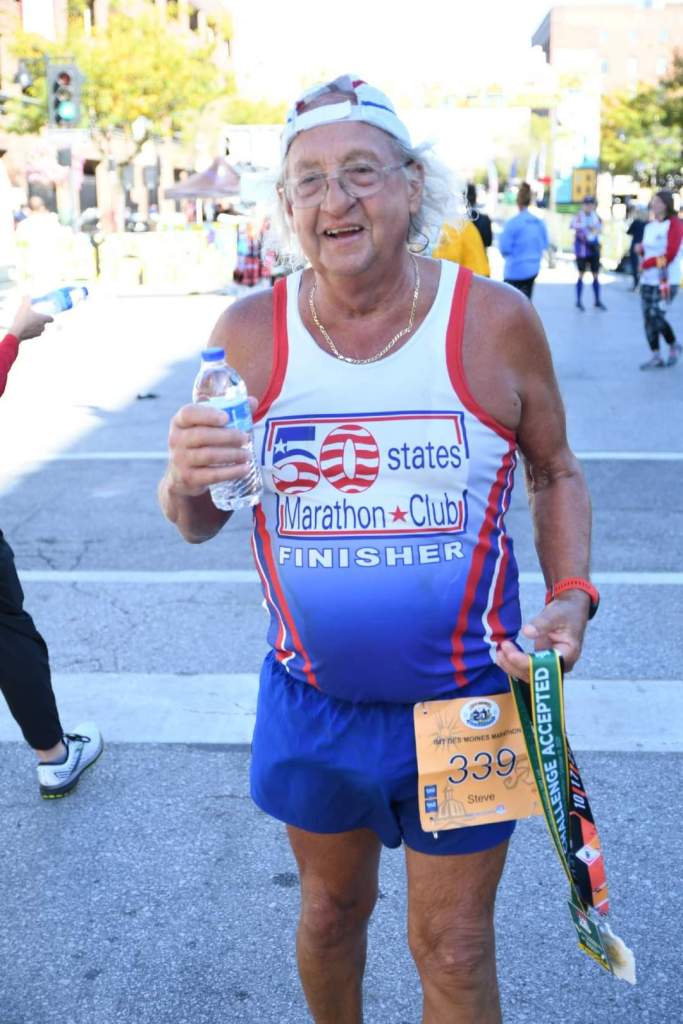
Then there’s this guy. I passed him during the race, but didn’t know his story until hearing him talk about his hobby of running when we happened to be on the same flight the next day. Take a guess how many marathons he’s ran. If you guessed 10…nope. 100…not even close. Try over 700.

These images and others will be in my mind for a long time. These runners showed up. They didn’t settle. And if they had supporters like mine following them virtually and freaking out from home, they didn’t disappoint.

Lesson: Inspiration is around us every day. Take time to reflect, acknowledge, and follow. It may lead you to many firsts of your own.

Crossing the start line in Des Moines…26.2 down, 13.1 to go