Fully Alive (book review)

I was intrigued enough by The Dignity Index (link to prior post) that I found Timothy Shriver’s book, Fully Alive, on audible. I had no idea what I was in for.

There are so many takeaways. Certainly makes me wish I had a hard copy.

But I’ll narrow down my takeaways under three headings:

  1. Fully Alive is a ten+hour history lesson. The lesson includes the Kennedy family history, highlighting the impact of Rosemary’s challenges. The lesson tells the story behind the founding and development of the Special Olympics. Many other lessons are found; but the one most prevalent is the dignity of all humans and the history of all cultures determining if and how they would recognize every person’s worth.
  2. Fully Alive is a look at the whole of a man. Shriver’s transparency about his maturation, his privilege, his spirituality, and his determination are refreshing. His words inspired me to continue efforts to grow in relationships and purpose. They accomplished the promise to paint a picture of what matters most.
  3. Fully Alive is a spotlight on the human spirit. You are introduced to many examples of this spirit. I’m drawn to three of the Special Olympic athletes: Loretta, Donald, and Daniel. Their spirits are depicted as full of grit, presence, and courage. They overcame many barriers resulting in fearless victory in the face of rejection, misdiagnosis, and death. Their stories, their lives depict what Shriver wants us to pursue, living fully.

Listening to this book during this last month was cathartic. I needed it, but was not aware it would come from listening to this book. If your spirit is in need of revival, you might find it in this book. It’s worth a try.

Let’s Talk

Started listening to a new audio book, In the Shelter by Padraig O Tuama. In chapter one he asked an interesting question about prayer, one I’ve not heard worded this way before. “Where is it that we are when we pray?”

It’s a different way to challenge one’s emotional and mental approach to prayer.

We are often in many places. We are saying to ourselves, “I should be somewhere else,” or, “I should be someone else,” or “I am not where I say I am.” In prayer, to begin where you are not is a poor beginning.

To begin where you are may take courage or compromise or painful truth telling; whatever it takes, it’s wise to begin there. The only place to begin is where I am.

Not where you want or feel you ought to be. This could mean rather than naming your present state-confused, frustrated, hurt, angry, lonely, unhappy, etc.-you ask for where you want to be or where you feel it is your duty to be-fulfilled, joyful, connected, healed, satisfied, understood, peaceful, etc.

Not in many places. We can often pray about what has happened, what we fear is going to happen rather than what is happening in this moment. We can be drawn to focus on the past or the future to the point that the present is ignored, maybe even avoided. The result that we aren’t even intending can be distance, even creating space for drifting to begin.

I believe what he’s encouraging is twofold. One is raw honesty. The other is naked vulnerability.

Prayer that is honest and vulnerable, not pious or fake, says to God, “I’m here. I believe you are too. Let’s talk.”

Photo by Fallon Michael on Unsplash

Doors

(At the end of February, I shared a few posts about Jesus’ statement “I Am the Door.” Here’s another one by my friend, guest blogger Mark Stanifer.)

I came across the image in this post during a season of transition. It mirrored exactly what I was feeling—standing in an empty room with only doors in every direction. No furniture. No guidance. Only choices.

That year, my word was co-operate. And the message became clear: this wasn’t about finding the one “right” door. It was an invitation to move, to trust, to co-operate with what God was doing in me.

I had recently left a corporate America role after 20 years. It was a massive shift. I wanted clarity, direction before moving—instead, I had doors. And silence. No signs. No indication of what was behind the doors. Simply doors awaiting my move. 

At first, I felt stuck. Fear kept me frozen in place—fear of making the wrong move, of wasting time, of choosing poorly. I told myself I was being careful or wise, but really, I was just afraid. And that fear masked itself as waiting on God, when in reality, He was waiting on me.

What shifted for me was this: God didn’t want me to wait for answers. He wanted me to walk in partnership with Him. The movement itself was the point. So I began opening doors to see what was on the other side. 

The movement did not lead to immediate results. Some doors were dead ends. Some were locked. Some simply lead me back to the same room. But the benefit was more than the results. It was in the movement itself. Because I learned that He wasn’t waiting behind a specific door—He was walking through each one with me. And, eventually I opened a door that lead to a whole new room to explore.

In John 10, Jesus says, “I am the door.” That line has stayed with me. He doesn’t just point to the way forward—He is the way forward. He is the door, the First Door.

The door, I’ve realized, isn’t the destination. It’s the turning point. It marks the moment of trust. And it’s the threshold through which partnership begins—both with Jesus and with who He wants me to become.

This journey has been deeply personal. It’s not about replicating someone else’s story or steps. The doors in front of me are mine to open. And what they lead to—growth, challenge, disappointment, doubts, pruning, joy—is uniquely tied to who I’m becoming. As you face and open your doors, your learning will likely be different. 

Here’s what I’ve learned:

  • Don’t wait for the perfect door. Choose one and walk through it.
  • Courage is choosing in spite of the fear.
  • The wisdom comes from the choosing, not the waiting.
  • God isn’t waiting on the other side. He’s walking through each door with me.
  • The door is part of the growth. That’s where the pruning happens so I can bear more fruit.
  • This is a partnership. We’re co-creating my future, as I co-operate with how He’s at work in me.

Jesus said He came to give us life to the full. That life begins by first walking through Him—He is the First Door. The only way to true life is through Jesus. Once we’ve stepped through Him, we can trust He’s with us through every other door we open, no matter what’s on the other side.

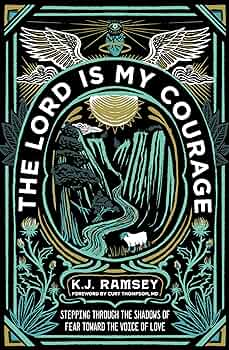
The Lord Is My Courage (book review)

I don’t recall what I thought I was going to get from K.J. Ramsey’s book The Lord Is My Courage. But here’s what I know I got:

  • New Language
  • Deeper Understanding
  • Fresh Appreciation

Ramsey’s approach to this subject is 1/4 part self-therapy, 1/4 part reader-therapy, 1/4 part church culture review, and 1/4 scripture exposition. That’s a lot. For her. And for the reader.

David, who wrote both Psalm 27 and Psalm 23, knew what it was like to have an enemy, knew how it felt to be afraid, and knew how much it hurt to wonder if you are heard.

Chapter 5, “He Makes Me Lie Down”

For this response, I took my time. Like a good meal, it’s better to pace yourself. The two chapters worth savoring the most were Chapters 5 and 20.

Chapter 5 includes nuggets rooted in a distinction of translation. Some scholars prefer a translation of the Greek to read “he settles me down” instead of “he makes me lie down.” Is that a big deal? To K.J., yes. “I thought God was a shepherd who made me lie down.  I needed to encounter God as a shepherd who settled me down.”

These kinds of bites are served throughout the book. The one I enjoyed the most was this one from chapter 20.

In John 16, Jesus is telling us, Peace is found only in my presence. And I will not leave you alone.

And then Jesus says to “take heart,” which can also be translated as “have courage,” telling us that our future is secure because he has already overcome the world.

Fear is just courage’s preamble. When we practice remembering that the Spirit of Christ is our companion, fear simply becomes one more prompt to pay attention to the voice and presence of Love. Fear doesn’t have to be an enemy to conquer. It can be a place to be companioned by Love.

Ramsey definitely follows the theme of the book, folded creatively in each chapter. Here are five illustrations:

  • “Courage is the practice of risking to trust that we have a Good Shepherd who is with us always-no matter what.”
  • “Courage is resisting the hurried pace of modern life and embracing the slower rhythm our bodies need to regulate and rise.”
  • “It takes courage to quit doing things for God to commune with God.”
  • “Courage is choosing to commune with someone who has already chosen to be with us.”
  • “Courage is simply the choice to be found.”

Is this book for you? If you enjoy the Psalms, yes. If you appreciate the integration of scripture and psychology, yes. If you are struggling with current or past church experiences, yes. If you like brain food, yes. If you could use a fresh look at who God is, yes. Chances are, yes.

Top 3 2024 Word of the Year Songs

The first year I chose a word for the year was 2020. It’s an exercise I’ve grown to appreciate. If you have yet to consider it, here are a few blog posts about it:

https://mountainmodernlife.com/word-of-the-year/

https://www.fillingthejars.com/word-for-the-year/

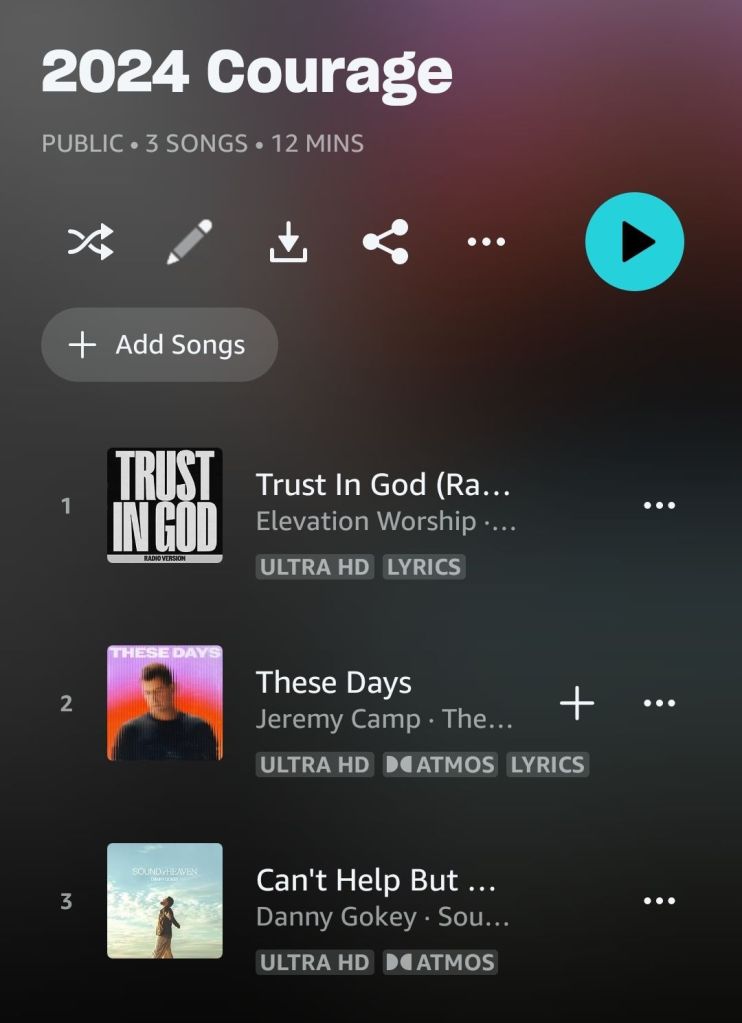
My 2024 word was “courage” for which I created a playlist. At one time the playlist had over 20 songs. Last month as we edged closer to year end, I began deleting songs as a way of keeping focus. And in a fun way, unintentionally, I got down to the top three songs on the list that spoke the most to me along this theme. So I thought I’d share them with you.

To share them, here’s the playlist and videos of each song. Take Courage!

5 Steps to Customize Your Own Year-Long Bible Reading Plan on YouVersion

(updated from 1/21/23 post)

A year’s commitment to anything can sound daunting. I imagine that’s the feeling most people have when they consider committing to a 365-day Bible reading plan.

Besides that, most of those plans are designed to take you through the entire Bible. A worthy goal to pursue at least once in life. Yet, the challenge to get that done in a year can be tempting to ditch.

I completed one of those plans once on YouVersion…in about 3 years. See the point.

It took me that long because I choose to take my time. And I like to veer off track. If I want to campout in Jonah longer, I do. If I’m intrigued by a theme in Romans, I’ll take a break from the plan and complete other plans covering that theme…as many as I want as long as I want. Coloring outside the lines.

But the idea of reading a portion of the Bible every day does not mean you have to read the entire Bible in any set amount of time. All it means is placing a priority, developing a rhythm in your day that includes reading the Bible. Whenever you do it, how long you do it, where you do it, that’s entirely up to you. And, for those other rule breakers, what you read is also entirely up to you.

For quite a while, I’ve been using YouVersion reading plans. A nice thing that’s possible is customizing a year-long reading plan. Want to give it a try? Here are five steps.

  1. Determine to Make a Daily Commitment. Pretty obvious, but if you aren’t resolved to it, you won’t make it to December 31st. Sure, you might miss a day here or there. Understandable. Give yourself some grace and think about the fact that odds are you’ve got 5 minutes to give to this commitment and missing it a couple of times doesn’t make you a loser. If you are in, move on to step 2.
  2. Decide on a Theme. There’s a popular trend that’s replacing making New Year’s Resolutions. Instead of setting goals and aspirations, you choose a word that you’d like to guide you for the year. Not sure about that, check out this podcast episode to learn more. I started this in 2020. Each year I’ve utilized it differently, more broadly. This year, that word is what I’m using to customize my Bible reading. My word for 2024 is courage. Know your theme? Move on to step 3.
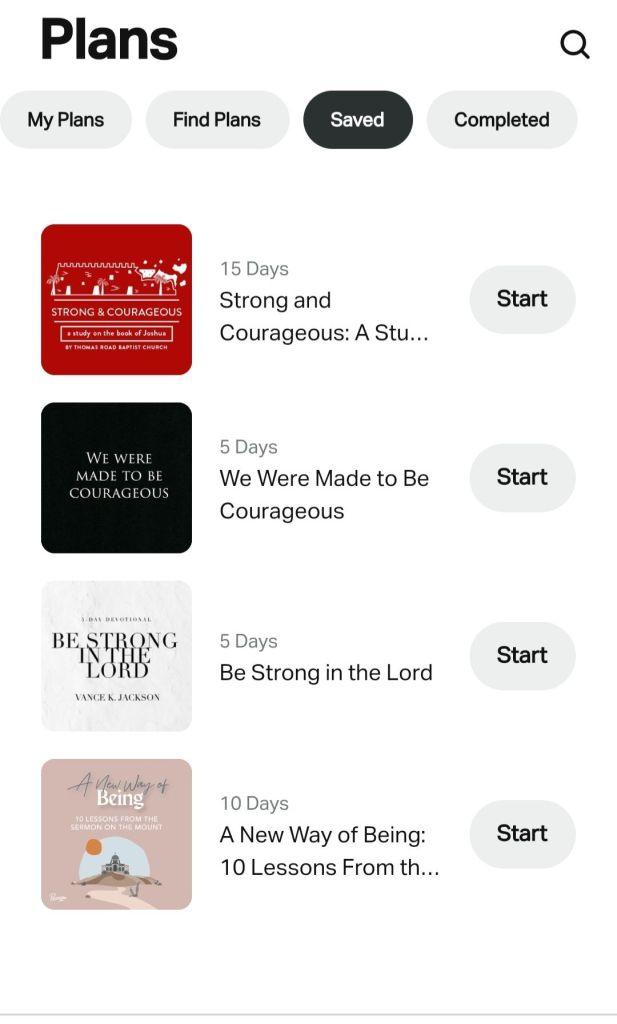
  3. Search Plans. On the YouVersion app (download it now if you haven’t already), you can search for reading plans simply by typing in a word. Most likely, dozens of reading plans are available. You’re ready for step 4.
  4. Save for Later. On each plan description, you have two choices: sample and save for later. Sample allows you to check out any day of the plan. I do that to get an impression if I think I’ll complete it. If I think so, then I save it for later. You don’t have to start the plan when you find it. I’m not worrying about saving enough plans that equal 365 days, by the way. I just saved the ones that looked interesting to me for now. At the moment, I’ve saved enough plans to get me into February (total up the days for each plan to see how many days you’ve already covered). Saved at least one plan? Final step is next.
  5. Follow the Thread. As you read each plan, some verse/story/character will stand out, grab your attention. Take note. Follow that lead to search for other plans to save for later. For instance, since I did my initial plan saving, the book of 1 Peter has gotten my attention. Adding reading plans can feel very fluid and interactive.

That’s it. This approach proved worthwhile and meaningful last year. If it ain’t broke…

Make Them Say “No”

Checked out a podcast episode today entitled “Why Leaders Need to Make Bold Proposals.” J.R. Briggs shares stories how he’s worked through his fear leading to a tendency not ask for what he wants. He’s landed on two questions to ask himself before asking for something that creates angst or fear:

  1. What’s the worst they could say to my request?
  2. Can I handle a “no” to my request?

My version of these two thoughts I’ve shared many times is “What’s the worst that can happen”? If I or the group I’m in considering an ask can handle the worst, why not ask?

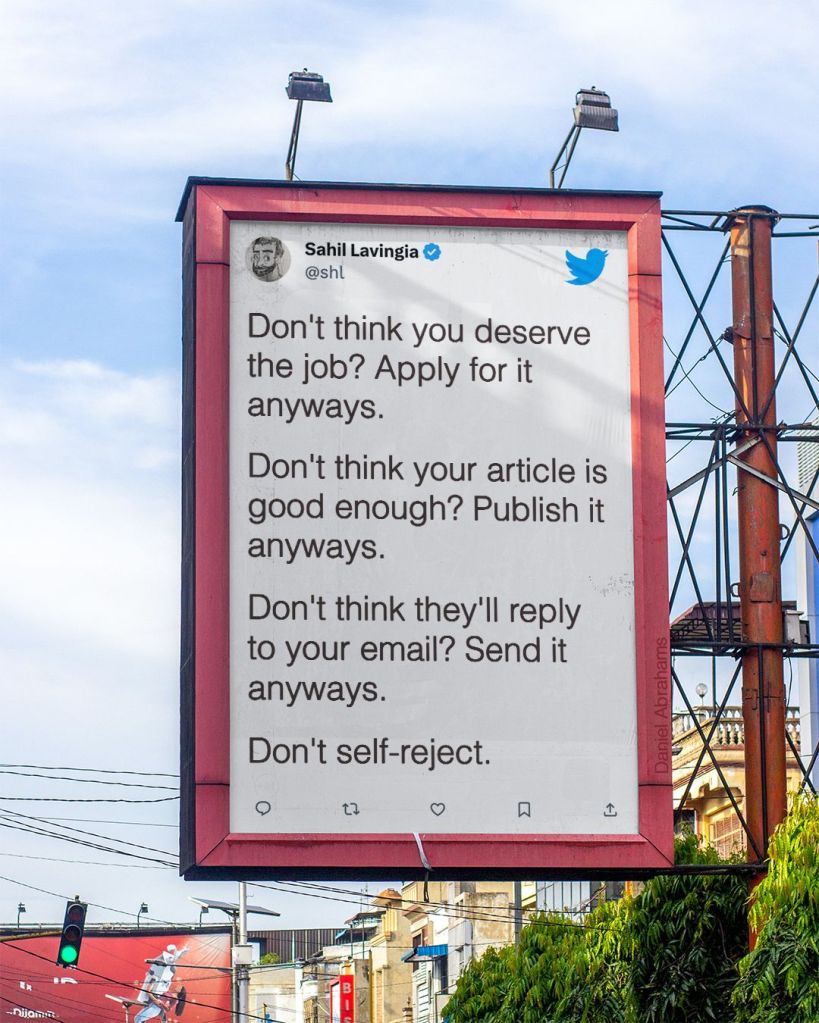
These thoughts are reinforced by this tweet image I saw recently:

I liked the self-rejection line. The mindset I’ve adopted is that the other party has to say no. Don’t say it for them by not asking.

More importantly, don’t say it for yourself. Some of us are really good at saying no to ourselves about the wrong things. The things that are the next step for us, the breakthrough, the healing, the answer we’ve been looking for can naturally have a fear factor attached. The courage for us to accept the no from the other party may be all we need. In these cases, say yes to the courage in order to avoid the missed opportunity of your no.

Family Illustration: Last March our mother turned 85. While celebrating in the Daytona Beach area, we scheduled a family photo session. The photographer commented it was too bad we didn’t take advantage of it being bike week to somehow include a bike in our props. Seed planted. Let’s just say, had we not asked the owner of this bike for a photo op at lunch after our session, we wouldn’t have this memorable photo:

Thank you to our mother and the bike owner for saying yes.

“No Thanks, Well-Meaner”

This afternoon I had one of those “Huh…I never thought of it that way” moments.

I was describing to someone why it’s never worked out for me to pursue a particular job. Over the years many folks have encouraged me to pursue it, and I even came relatively close to it once. As I was telling this story, these words came out of my mouth: “It just never felt right. You know, sorta like trying on Saul’s armor.”

I stopped talking for a second to let that sink in, more for me than the guy listening. In my head I said, “That’s a perfect analogy. Can’t believe I’ve not made that connection before.”

If you don’t know that reference by the way, or need a refresh, check out 1 Samuel 17. It’s the David & Goliath narrative. Well-meaning Saul outfits shepherd boy David in his own armor. No go. David knew well enough that it wasn’t going to work. He took it all off, and we know how the story ends.

Suppose David ignored “well enough.” Suppose he caved because that’s King Saul. How do you question the king, that you just met? “Who do you think you are?” Suppose he allowed the natural to get in the way of the supernatural. We’d have a whole different story end.

Truth is, many relationships start by well-meaners that knew well enough. Many jobs begin that were never the right fit. Hindsight tells us that, but imagine what’s possible when courage undergirds one’s mindset and convictions so that well enough writes the story.

When we are in tune with God and with our own mind and body, we know well enough. And it’s really just a split second between anyone’s well meaning and our well enough that determines how the story ends.

In preparation for that split second, what if we chose this conviction? “I’m not here in the king’s name. I’m not even here in my name. I’m here in the name of the same God as David’s. Well-meaners, thanks, but no. In this moment, in this battle, in this decision, God’s well enough fits just fine.”

Photo by Nik Shuliahin 💛💙 on Unsplash

Courage Musts

Since he had turned his back upon the fight his fears had been wondrously magnified. Death about to thrust him between the shoulder blades was far more dreadful than death about to smite him between the eyes. When he thought of it later, he conceived the impression that it is better to view the appalling than to be merely within hearing. The noises of the battle were like stones; he believed himself liable to be crushed.

The Red Badge of Courage, chapter 6

To experience victory, hard must be faced.

To defeat fears, eyes must gaze forward.

To minimize dread, fight must be embraced.

To remain steadfast, battle must be accepted.

To resist surrender, better must be pursued.

To foster courage, will must be resolved.

Photo by Kat J on Unsplash

6 Lessons from the Blind Runner


The pic above is a screenshot of the results from the race I ran in PA yesterday. If you know me at all, you know I can analyze the heck out of a list like this. Don’t get me started. Actually, it’s too late anyway…did that hours ago.

Before you focus on my name and placement, let your mind look over the rest of the results. One detail that glares at you is that finishers 2&3 crossed the finish line at the same time. Not unusual in the running world, particularly in smaller, local races. Usually that means family members or running friends ran together, literally-they stayed together, and probably chatted, the entire course length. Not my thing, but it is a lot of people’s.

But without being there yesterday, you wouldn’t know there is more to Adam and Brandon’s story than they ran a race together. And I can’t say I know a whole lot more than that since I didn’t talk to them. But I did watch them. I simply had to. Why? Because one of them wasn’t going to start, let alone finish, without the other one. Brandon was blind, and Adam was his guide.

In a much bigger race I once saw such a team at the start line, but I never saw them on the course after we started. This second opportunity was different. Because of the layout of the course, we passed each other twice. In all, I had four chances to watch them do their thing. And do it they did.

So instead of just analyzing these results yesterday, I thought about what I could learn from these two men. Apparently, quite a bit. Pause and think about them separately. What would it take for you, 17 years old and blind, to attempt to run a half marathon? And if you can see, what would it take for you to guide a blind runner any distance, let alone 13.1 miles? Again, I didn’t talk to them, so I’m guessing what the answers are to these questions.

For the rest of this post, here are the lessons I take away from putting myself in Brandon’s shoes-which seems incredibly assuming.

  • Trust

This has to be the most important thing they both have in their work together. Adam doesn’t have a chance if Brandon doesn’t put his trust in him.

  • Courage

Maybe Brandon’s not seen his entire life and only knows what he knows, but how else can you define his willingness to step up to the start line without declaring courage. I met another runner running his first half yesterday, and he needed some courage. But he could see and was old enough to be Brandon’s dad. Courage was on full display.

  • Joy

Brandon’s face before, during, and after the race exuded joy. Fear, not present. Doubt, defeated. He even ran a recovery mile or so afterwards with that same joyful countenance.

  • Fulfillment

Brandon knew he belonged with everyone else. He experienced the same fulfillment as all finishers do when they cross that line. He did not have to feel or think less than.

  • Exemplify

If I were to ask Brandon what he hopes others learn from seeing him run, I’d put money on his answer being something like, “I hope they see what’s possible. I hope they learn to trust, have courage, pursue joy, and know fulfillment.” (Ok…those are my words, but you get the point.)

  • Normalcy

We are all normal as God created us. Embrace it. Be the normal God made you to be.

To be honest, in life we’re all blind runners. Wouldn’t you agree? So let’s thank God for all the Brandons who show up in our lives to remind us.