Last Fall I read Krispin Mayfield’s Attached to God.
I wrote one post about a lament exercise he outlined, but I never offered my thoughts about the whole book once I finished. Today, I finished rereading it. Time to share.
I’m a little obsessed.
My hunch is that anyone wishing to understand or improve their relationships with humans and with God would also believe Mayfield delivers on the subtitle’s promise of a practical guide. His effort to breakdown attachment science then connect it to one’s relational experience with God produces clarity and hope for any breakdown to be restored.
Of all my highlights, here are three to whet your appetite.
Distance happens in all relationships. (Chapter 1, “The Still Face of God”)
A friend of mine recently made a self awareness by saying, “I guess I live in a fantasy world.” I’d say that’s true for many professing Christians in regards to their beliefs about how close they are expected to feel to God at all times. Mayfield argues human relationship with God is like our other relationships-distance happens.
I was in my 30s before I fully accepting this truth. Many close friends moved and distance happened. It’s normal. That doesn’t provide comfort or easy acceptance, just normalcy. Learning how to respond to distance in a secure way is worth the effort, for you and for the relationship.
Information doesn’t change your beliefs, experience does. (Chapter 4, “Shutdown Spirituality”)
When religious folks get their head around this one, attachment shifts. And it’s a struggle. Why? We are programmed that attending church or a study group is the sole means of establishing beliefs. Any transparent pastor or counselor would most likely agree with Mayfield. They’ve seen how experiences affirm or alter beliefs, in their own lives and in those they serve.
From my experience, this has definitely played out the last 15 years for me. Traveling to other countries, visiting other denominational churches, and dialoguing with Christians on the other side of all kinds of aisles has made me check my beliefs. And yes, some have changed.
In any authentic relationship, there’s room for real talk. (Chapter 10, “The Risk of Trust”)
When people describe what the younger generations are looking for in their attachment to religion and God, the word authentic comes up regularly. I believe age doesn’t matter; we all hunger for it. This 57-year-old does.
RECOMMENDATION: For all your attachment seasons, secure or insecure in any relationships including God, this book deserves space in your library.
After reading The Lord is My Courage on hoopla, a related title was suggested which I decided to read because of the unique promise. That promise was a look at this poem from the basis of the author’s years as a keeper of sheep. It did not disappoint.
An overall takeaway is just how near death sheep can be unless their shepherd relentlessly cares for them. Keller explains that David’s poem actually addresses all four seasons in a year of a sheep’s life and what is necessary for the sheep to “not want.”
The strange thing about sheep is that because of their very makeup it is almost possible for them to be made to lie down unless four requirements are met…They are free of all fear, free from friction, free of pests, and free from hunger. (Chapter 3, “He Makes Me Lie Down in Green Pastures”)
In that same chapter he explains that a flock that is restless, discontented, always agitated, and disturbed never does well. Sound familiar? The value of being made to lie down is to our benefit.
The most vivid image Keller paints comes in chapter five, “He Restores My Soul.” He draws a parallel between another familiar David passage in Psalm 42:11, “Why are you downcast, O my soul? Why so disturbed within me? Put your hope in God…”
Only those acquainted with sheep and their habits understand the significance of a “cast” sheep or a “cast down” sheep.
This is an old English shepherd’s term for a sheep that has turned over on its back and cannot get up again by itself.
A cast sheep is a very pathetic sight. Lying on its back, its feet in the air, it flays away frantically struggling to stand up, without success. Sometimes it will bleat a little for help, but generally it lies there lashing about in frightened frustration.
If the owner does not arrive on the scene within a reasonably short time, the sheep will die…Nothing seems to so arouse his constant care and diligent attention to the flock as the fact that even the largest, fattest, strongest, and sometimes healthiest sheep can become cast and be a casualty.
He goes on to describe what’s required when he finds a cast ewe, which includes rubbing limbs to restore circulation after picking her up one or more times until she regains equilibrium and starts to walk steadily and surely.
One final noteworthy thought is this one from chapter 7, “Even Though I Walk Through the Valley.” Keller shares that this is a turn in the poem not only from the viewpoint but also in the season being described, how summer and autumn look for the shepherd and his flock. Keller explains David’s firsthand experience by making this statement: “Never did he take his flock where he had not already been before.”
If you find yourself today in search of freedom, or lying on your back flaying, or walking through the valley, rest assured your shepherd is with you. He has what you need. He’s watching over you. I encourage you to find a way to read this book to let those truths grow roots in your heart, mind, and soul.
Finished listening to Seeing with the Eyes of the Heart today. One of the last discussion points centered on the reality we all encounter of facing aloneness.
Adyashanti stated he believed almost no one understood Jesus, making him one of the most alone figures in spiritual literature. To explain what he meant, his reply included these thoughts about aloneness.
Engaging spirituality in an authentic way will bring us to encountering our aloneness many, many, many times…Ironically the greatest feeling of belonging comes through these deep and profound encounters with our aloneness. It’s so paradoxical that our greatest sense of belonging comes by going through those doorways of aloneness…We almost always try to do end runs around aloneness, finding surrogates for the experience of aloneness rather than really meeting it…We’re all one. That’s a really great and nice thing. But we all are simultaneously very unique expressions of the one. We all have our very unique journey that is not exactly like anyone else’s…Aloneness, in the ends, leads through the door not only to connectedness but a kind of spiritual autonomy.
I relate.
There is an aloneness on the journey of making your faith yours, not anyone else’s. Think of any faith decision you’ve made to this point that was lifechanging or formative. It came down to you making that choice by yourself. Those decisions, those moments rooted you, grounded you, expanded the territory of your faith, and girded your faith in such a way that it no longer relied on another person’s faith.
Yet, because of that, you now have the strength, the maturity, or the allure to those in your faith community that draws people to inquire how you got it. And the connectedness is more about the kingdom than you. Your aloneness that you walked through, whether you wanted to or not, brightens your image of God. It’s attractive while also preparatory for your next round of aloneness.
These thoughts remind me of this quote:
“Here is the world. Beautiful and terrible things will happen. Don’t be afraid.” -Frederick Buechner, Beyond Words
Beautiful and terrible await you in aloneness. Don’t be afraid.
Roughly a third of the way in, Adyashanti asked to address the topic of forgiveness. His thoughts were striking.
At one level I think the greatest forgiveness is when we really see that there’s no need for forgiveness because everything is inherently, consistently forgiven. It’s human beings that decide we are sort of God’s arbitrators of who can and cannot be forgiven, and it disconnects us from the experience of the way forgiveness works in the universe.
No need for forgiveness seems utopian. Yet, his reasoning is captivating. He’s not saying there is no literal need for forgiveness. He’s suggesting we must task ourselves to learn how it works, first from God and then between humans.
Some of Jesus’ last words on the cross were “Forgive them for they know not what they do,” referring to the people who put him there. If you are on the cross and you can forgive the people who put you there, that’s a pretty big forgiveness. You’re forgiving hate, and you’re forgiving violence…there’s a great teaching in that. If he couldn’t have forgiven them, he could have never been free from them. He would have been trapped in their hate because he couldn’t forgive their hate. He would have been trapped in their violence because he couldn’t forgive their violence…Ignorance can take some pretty violent forms…Most people are pretty much doing what they can do. What they are doing is an exact reflection of the state of their consciousness.
The striking image of these thoughts is being trapped. Couple that with being trapped in hate or violence with the foundation being the other person’s ignorance, forgiveness not only seems possible but desirable.
If we have no forgiveness, our participation in the world is seared with anger and hate, even if we are working with something that is very necessary and good. This motivation seems to come from fear rather than love.
May our searing be exposed. May love overcome our fear.
Hullabaloo is not a party I enjoy. So forgive me if I’m eight years late to The Shack conversation (referring to the movie; 18 years since the book publication).
My free evening in Las Vegas was not going to be about hullabaloo either. So I turned on the TV for the first time in four days to see what I could find to watch. Up popped The Shack. It was time.
Papa (Octavia Spencer) and Mack Phillips (Sam Worthington) in “The Shack.” (Photo Credit: Jake Giles Netter)
As the story unfolded, I was drawn to all the one liners; so I started this draft to share the ones that got my attention the most. Here are those four.
“Don’t forget we love each other.”
Nan, the wife, said this to Mack, her husband. He was withdrawn, and she wanted to find a way to reach him. This was a good reminder for those who are tempted to isolate when dealing with pain. Remember that people love you…and that you love them.
“Love always leaves a mark.”
God said this to Mack. Mack was expressing doubt and lack of trust in God’s love due to all the pain in his life. He learned that he was judging God, blinding him from just how much God loved him and everyone in his life, even the ones who had hurt him. This line was God expressing the extent of his love for Mack.
“You have no idea how much I’m doing right now.”
Mac was trying to make a joke about what God was doing. And his judgment brought this response. What a reminder! Our finite minds find it hard to comprehend exactly what all is going on in the universe and God’s part in it. Our humility grows when we consider the magnitude of that work.
“Does what I do really matter?”
This was Mack’s question toward the end of the movie. It caught my attention because it somewhat seemed to come out of left field. Yet, anyone floundering in their pain would most likely eventually ask this question. Purpose has a way of healing wounds.
Yes, one could dislike the movie and the book for theological reasons. Being late to the party, I’m choosing to listen and grow, one line at a time.
Finished listening to Steven Charleston’s Ladder to the Light this afternoon. I’m fairly certain I checked it out after following a reference in Becoming Rooted.
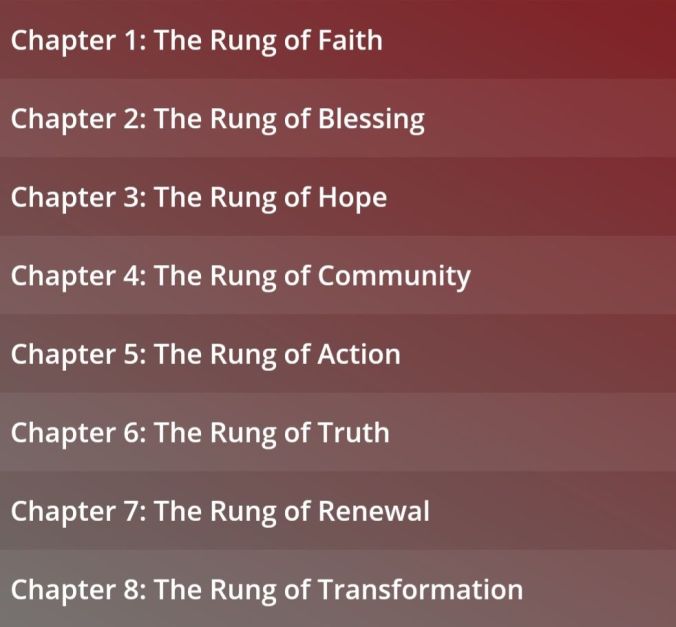
Charleston’s ladder analogy is the crux of the book, seen by these chapter titles:
Charleston’s explanation of a kiva lays the foundation for why and how the darkness we experience should and can be addressed. A gradual ascent on each rung takes you out of the darkness and into the light.
Charleston’s theology is a mix of various religions, but its basis is Christianity. What I found most connecting for anyone of any religion is his constant contrast between the darkness and the light. We may not all agree on what falls in the category of dark, but hopefully we all could agree on the need to climb out of it.
The authors of both of these books have broadened my faith through their meditations, convictions, and actions based on their faith. I believe you could find the same by reading or listening to these works.
FYI, Charleston posts daily spiritual reflections on his facebook page. Follow this link.
I don’t recall what I thought I was going to get from K.J. Ramsey’s book The Lord Is My Courage. But here’s what I know I got:
New Language
Deeper Understanding
Fresh Appreciation
Ramsey’s approach to this subject is 1/4 part self-therapy, 1/4 part reader-therapy, 1/4 part church culture review, and 1/4 scripture exposition. That’s a lot. For her. And for the reader.
David, who wrote both Psalm 27 and Psalm 23, knew what it was like to have an enemy, knew how it felt to be afraid, and knew how much it hurt to wonder if you are heard.
Chapter 5, “He Makes Me Lie Down”
For this response, I took my time. Like a good meal, it’s better to pace yourself. The two chapters worth savoring the most were Chapters 5 and 20.
Chapter 5 includes nuggets rooted in a distinction of translation. Some scholars prefer a translation of the Greek to read “he settles me down” instead of “he makes me lie down.” Is that a big deal? To K.J., yes. “I thought God was a shepherd who made me lie down. I needed to encounter God as a shepherd who settled me down.”
These kinds of bites are served throughout the book. The one I enjoyed the most was this one from chapter 20.
In John 16, Jesus is telling us, Peace is found only in my presence. And I will not leave you alone.
And then Jesus says to “take heart,” which can also be translated as “have courage,” telling us that our future is secure because he has already overcome the world.
Fear is just courage’s preamble. When we practice remembering that the Spirit of Christ is our companion, fear simply becomes one more prompt to pay attention to the voice and presence of Love. Fear doesn’t have to be an enemy to conquer. It can be a place to be companioned by Love.
Ramsey definitely follows the theme of the book, folded creatively in each chapter. Here are five illustrations:
“Courage is the practice of risking to trust that we have a Good Shepherd who is with us always-no matter what.”
“Courage is resisting the hurried pace of modern life and embracing the slower rhythm our bodies need to regulate and rise.”
“It takes courage to quit doing things for God to commune with God.”
“Courage is choosing to commune with someone who has already chosen to be with us.”
“Courage is simply the choice to be found.”
Is this book for you? If you enjoy the Psalms, yes. If you appreciate the integration of scripture and psychology, yes. If you are struggling with current or past church experiences, yes. If you like brain food, yes. If you could use a fresh look at who God is, yes. Chances are, yes.
Last year I came across Jacques Lusseyran’s story by reading a collection of his essays. Before I left on my Christmas road trip last week while looking for an audio book to listen to, I was thrilled to find Lusseyran’s memoir, And There Was Light. What a story to listen to during this season of the year!
In my 2024 Library posting that you’ll find tomorrow, I’ve called this book the most thought-provoking book I read this year. Here are five reasons:
Lusseyran convinces you he can see light despite being blind
Lusseyran shows you the power of words, both spoken and written
Lusseyran reminds you of the strength of the human spirit whose foundation is faith in God
Lusseyran proves odds can be broken
There are so many quotes worth noting from this memoir. That’s one downfall to listening to it-unable to highlight them. However, I’d encourage you to listen to it rather than read it. Andre Gregory’s narration draws you into the world of a blind child who grows into a hero, a choice he made so all would be drawn to the light.
If you are a lover of history, check out this book.
If you enjoy World War II stories, check out this book.
If you are clueless like I was about the French resistance, check out this book.
If you wish to better understand the world of the blind, check out this book.
If you wish to shine light into the dark, check out this book.
I’ve had fences on my mind. Apparently, they have permanent residence and need to be managed.
This is my way of understanding a season I’ve recently emerged from, a season I always seem to have a foot in. I call it the what’s next season. That question keeps a firm grip on my brain, if I let it. And that’s where the fences come in.
Sometimes I recognize it; sometimes I don’t. The temptation to look over the fence. The temptation isn’t necessarily about looking for greener grass. It’s more like, “What’s over there? If it looks good, should I find a way over there? Should I be looking for a gate? Looking at the field I’m in, there’s probably a better one on the other side of part of this fence, right? I just got to keep looking. Seek and find.”
While chewing on these questions this week during a prayer moment, a connection was made that made me say, “Well that’s interesting.” The connection was to a verse from Ecclesiastes, a book containing a look at forever fences. Here’s that verse:
He has made everything appropriate in its time. He has also set eternity in their heart, without the possibility that mankind will find out the work which God has done from the beginning even to the end. -Ecclesiastes 3:11 NASB
Oddly, my mind relaxed. The connection: Because eternity is placed in my heart, I am always going to be tempted to look over the fence. And I’m not alone in that. Every human asks, “What’s next? Is this it? There’s got to be more, right?” We ask it in different ways, seek the answers from different sources, but we ask the same questions.
The lessons that seem to be on repeat during a what’s next season are 1) Embrace Now and 2) Balance Anticipation. As I thought about these lessons, another uplifting passage came to mind. It’s from an equally encouraging chapter, this time from the New Testament. Hebrews 11 contains a roster of fellow fence gawkers who are described as sharing another top of mind focus. Check out verses 13-16:
13 All these people were still living by faith when they died. They didn’t receive the things God had promised. They only saw them and welcomed them from a long way off. They openly said that they were outsiders and strangers on earth. 14 People who say things like that show that they are looking for a country of their own. 15 What if they had been thinking of the country they had left? Then they could have returned to it. 16 Instead, they longed for a better country. They wanted a heavenly one. So God is pleased when they call him their God. In fact, he has prepared a city for them.
You see why fences have been on mind? It’s actually good stuff. At the end of it, I find myself in excellent company, both in the past and the present. I say the present because these thoughts led me to three songs that I gravitate toward when eternity is on my mind.
So at the close of this month, this week, this Thanksgiving weekend, I encourage you to take 11 minutes, stare at the eternal fence, and listen to these fellow “longers for a better country.”