Beautiful & Terrible

More than once recently, authors I’m reading have shared this quote:

“Here is the world. Beautiful and terrible things will happen. Don’t be afraid.” -Frederick Buechner

The West

The East

The Middle East

Beautiful Waterfalls

Terrible Floods

Beautiful Mountains

Terrible Mudslides

Beautiful Creatures

Terrible Beasts

Beautiful Hearts

Terrible Wounds

Beautiful Words

Terrible Twists

Beautiful Creations

Terrible Destruction

While climbing the mountain, don’t be afraid of falling and miss the view…don’t be afraid of lifting your head long enough to absorb the beauty.

Whenever we’ve experienced beauty, simultaneously, others close by and around the world have endured terrible. It’s challenging to accept this reality. It can be confusing and difficult to hear or to heed the well-intentioned phrase, “Don’t be afraid.”

Maybe that’s why in the 1300’s, a different phrase was offered. A phrase of hope. A more positive nudge to action. “Take heart.” “Take heart” implies finding the strength and courage to face challenges, while “don’t be afraid” can sometimes feel like a dismissive or even a command to suppress natural emotions. “Take heart” encourages an active response to difficult situations, suggesting that we can find the inner resources to overcome obstacles. 

Rather than huddling in siloed fear, we can take heart by openly and collectively assembling in courage.

Rather than douse our minds with worry, we can take heart and ease our spirits with truth.

Rather than suppress our bodies into paralysis, we can take heart to walk, dare run with purposeful action.

After viewing beauty, may your eyes use that filter to interpret the terrible. In the world’s attempt to steal your heart, may you surround yourself with every resource needed to respond, “This heart is mine. It’s not for your taking.”

Take heart as you engage our beautiful and terrible world.

Photo by Artyom Kabajev on Unsplash
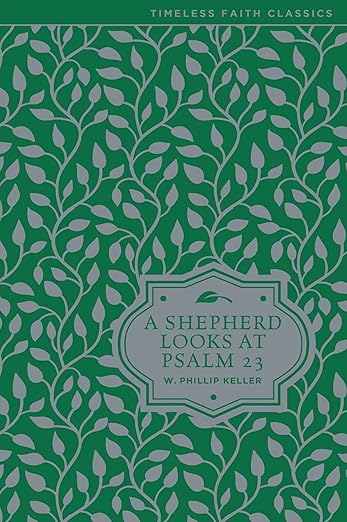
A Shepherd Looks at Psalm 23 (book review)

After reading The Lord is My Courage on hoopla, a related title was suggested which I decided to read because of the unique promise. That promise was a look at this poem from the basis of the author’s years as a keeper of sheep. It did not disappoint.

An overall takeaway is just how near death sheep can be unless their shepherd relentlessly cares for them. Keller explains that David’s poem actually addresses all four seasons in a year of a sheep’s life and what is necessary for the sheep to “not want.”

The strange thing about sheep is that because of their very makeup it is almost possible for them to be made to lie down unless four requirements are met…They are free of all fear, free from friction, free of pests, and free from hunger. (Chapter 3, “He Makes Me Lie Down in Green Pastures”)

In that same chapter he explains that a flock that is restless, discontented, always agitated, and disturbed never does well. Sound familiar? The value of being made to lie down is to our benefit.

The most vivid image Keller paints comes in chapter five, “He Restores My Soul.” He draws a parallel between another familiar David passage in Psalm 42:11, “Why are you downcast, O my soul? Why so disturbed within me? Put your hope in God…”

Only those acquainted with sheep and their habits understand the significance of a “cast” sheep or a “cast down” sheep.

This is an old English shepherd’s term for a sheep that has turned over on its back and cannot get up again by itself.

A cast sheep is a very pathetic sight. Lying on its back, its feet in the air, it flays away frantically struggling to stand up, without success. Sometimes it will bleat a little for help, but generally it lies there lashing about in frightened frustration.

If the owner does not arrive on the scene within a reasonably short time, the sheep will die…Nothing seems to so arouse his constant care and diligent attention to the flock as the fact that even the largest, fattest, strongest, and sometimes healthiest sheep can become cast and be a casualty.

He goes on to describe what’s required when he finds a cast ewe, which includes rubbing limbs to restore circulation after picking her up one or more times until she regains equilibrium and starts to walk steadily and surely.

One final noteworthy thought is this one from chapter 7, “Even Though I Walk Through the Valley.” Keller shares that this is a turn in the poem not only from the viewpoint but also in the season being described, how summer and autumn look for the shepherd and his flock. Keller explains David’s firsthand experience by making this statement: “Never did he take his flock where he had not already been before.”

If you find yourself today in search of freedom, or lying on your back flaying, or walking through the valley, rest assured your shepherd is with you. He has what you need. He’s watching over you. I encourage you to find a way to read this book to let those truths grow roots in your heart, mind, and soul.

Photo by Peter Hoogmoed on Unsplash

The New Home (Green Light) Odyssey: The Right Agent

I closed on a new home April 28th and within 24 hours was completely moved in. That’s the short version. The long version includes many right decisions that I eventually started calling “going through the green lights” that I continued to experience.

The decision to move began in December simply by responding to a “for rent” sign. I wasn’t really sure about renting, but it was almost too good to be true. A .2 mile trip to work. After checking it out, the green light read “Move, but buy instead of rent.” The odyssey began.

I didn’t have a timeline other than sometime in 2025, ideally the first half. I now drove five days a week to Sarasota versus three, so the sooner the better, and before the summer heat.

I started a relationship with Zillow. I thought I knew where I’d be most comfortable in Sarasota, so I started following listings in that area. I found quickly that the possibilities widened to areas I had previously ruled out.

Zillow isn’t stupid. Floods of emails suck you in and can foster obsession. One trick that got me moving further on the journey was open house notifications. I finally broke down and went through the next green light: “It’s just an open house.  Go and see what that location and price point feels like.”

That decision to go to a March 2nd open house led to an unexpected green light: “Here’s the agent you are going to work with.”

Funny. I didn’t know I was looking for one. I wasn’t in a hurry. I thought I had plenty of time.

Don’t get me wrong. No one forced me through that green light. But it was a little too obvious. My coming to that open house and them being the agent at that showing was supposed to happen. I wasn’t forced; but when the light is green, I’ve learned to keep moving.

Fear or uncertainty can cause us to not proceed down a path that we weren’t expecting or may not think we are ready for. This part of the home buying journey reminded me of two main things about God and his children:

  • He’s always at work preparing us for what he has in store for us.
  • He knows the desires of our heart and excitedly wants to fulfill them.

If you are sitting at a green light, take heart. It’s safe to move forward.

Photo by Mark König on Unsplash

3 Thoughts on Forgiveness

I’m in the middle of listening to Seeing With the Eyes of the Heart.

Roughly a third of the way in, Adyashanti asked to address the topic of forgiveness. His thoughts were striking.

At one level I think the greatest forgiveness is when we really see that there’s no need for forgiveness because everything is inherently, consistently forgiven. It’s human beings that decide we are sort of God’s arbitrators of who can and cannot be forgiven, and it disconnects us from the experience of the way forgiveness works in the universe.

No need for forgiveness seems utopian. Yet, his reasoning is captivating. He’s not saying there is no literal need for forgiveness. He’s suggesting we must task ourselves to learn how it works, first from God and then between humans.

Some of Jesus’ last words on the cross were “Forgive them for they know not what they do,” referring to the people who put him there. If you are on the cross and you can forgive the people who put you there, that’s a pretty big forgiveness. You’re forgiving hate, and you’re forgiving violence…there’s a great teaching in that. If he couldn’t have forgiven them, he could have never been free from them. He would have been trapped in their hate because he couldn’t forgive their hate. He would have been trapped in their violence because he couldn’t forgive their violence…Ignorance can take some pretty violent forms…Most people are pretty much doing what they can do. What they are doing is an exact reflection of the state of their consciousness.

The striking image of these thoughts is being trapped. Couple that with being trapped in hate or violence with the foundation being the other person’s ignorance, forgiveness not only seems possible but desirable.

If we have no forgiveness, our participation in the world is seared with anger and hate, even if we are working with something that is very necessary and good. This motivation seems to come from fear rather than love.

May our searing be exposed. May love overcome our fear.

Doors

(At the end of February, I shared a few posts about Jesus’ statement “I Am the Door.” Here’s another one by my friend, guest blogger Mark Stanifer.)

I came across the image in this post during a season of transition. It mirrored exactly what I was feeling—standing in an empty room with only doors in every direction. No furniture. No guidance. Only choices.

That year, my word was co-operate. And the message became clear: this wasn’t about finding the one “right” door. It was an invitation to move, to trust, to co-operate with what God was doing in me.

I had recently left a corporate America role after 20 years. It was a massive shift. I wanted clarity, direction before moving—instead, I had doors. And silence. No signs. No indication of what was behind the doors. Simply doors awaiting my move. 

At first, I felt stuck. Fear kept me frozen in place—fear of making the wrong move, of wasting time, of choosing poorly. I told myself I was being careful or wise, but really, I was just afraid. And that fear masked itself as waiting on God, when in reality, He was waiting on me.

What shifted for me was this: God didn’t want me to wait for answers. He wanted me to walk in partnership with Him. The movement itself was the point. So I began opening doors to see what was on the other side. 

The movement did not lead to immediate results. Some doors were dead ends. Some were locked. Some simply lead me back to the same room. But the benefit was more than the results. It was in the movement itself. Because I learned that He wasn’t waiting behind a specific door—He was walking through each one with me. And, eventually I opened a door that lead to a whole new room to explore.

In John 10, Jesus says, “I am the door.” That line has stayed with me. He doesn’t just point to the way forward—He is the way forward. He is the door, the First Door.

The door, I’ve realized, isn’t the destination. It’s the turning point. It marks the moment of trust. And it’s the threshold through which partnership begins—both with Jesus and with who He wants me to become.

This journey has been deeply personal. It’s not about replicating someone else’s story or steps. The doors in front of me are mine to open. And what they lead to—growth, challenge, disappointment, doubts, pruning, joy—is uniquely tied to who I’m becoming. As you face and open your doors, your learning will likely be different. 

Here’s what I’ve learned:

  • Don’t wait for the perfect door. Choose one and walk through it.
  • Courage is choosing in spite of the fear.
  • The wisdom comes from the choosing, not the waiting.
  • God isn’t waiting on the other side. He’s walking through each door with me.
  • The door is part of the growth. That’s where the pruning happens so I can bear more fruit.
  • This is a partnership. We’re co-creating my future, as I co-operate with how He’s at work in me.

Jesus said He came to give us life to the full. That life begins by first walking through Him—He is the First Door. The only way to true life is through Jesus. Once we’ve stepped through Him, we can trust He’s with us through every other door we open, no matter what’s on the other side.

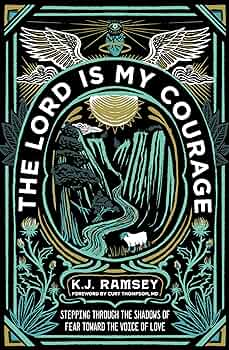
The Lord Is My Courage (book review)

I don’t recall what I thought I was going to get from K.J. Ramsey’s book The Lord Is My Courage. But here’s what I know I got:

  • New Language
  • Deeper Understanding
  • Fresh Appreciation

Ramsey’s approach to this subject is 1/4 part self-therapy, 1/4 part reader-therapy, 1/4 part church culture review, and 1/4 scripture exposition. That’s a lot. For her. And for the reader.

David, who wrote both Psalm 27 and Psalm 23, knew what it was like to have an enemy, knew how it felt to be afraid, and knew how much it hurt to wonder if you are heard.

Chapter 5, “He Makes Me Lie Down”

For this response, I took my time. Like a good meal, it’s better to pace yourself. The two chapters worth savoring the most were Chapters 5 and 20.

Chapter 5 includes nuggets rooted in a distinction of translation. Some scholars prefer a translation of the Greek to read “he settles me down” instead of “he makes me lie down.” Is that a big deal? To K.J., yes. “I thought God was a shepherd who made me lie down.  I needed to encounter God as a shepherd who settled me down.”

These kinds of bites are served throughout the book. The one I enjoyed the most was this one from chapter 20.

In John 16, Jesus is telling us, Peace is found only in my presence. And I will not leave you alone.

And then Jesus says to “take heart,” which can also be translated as “have courage,” telling us that our future is secure because he has already overcome the world.

Fear is just courage’s preamble. When we practice remembering that the Spirit of Christ is our companion, fear simply becomes one more prompt to pay attention to the voice and presence of Love. Fear doesn’t have to be an enemy to conquer. It can be a place to be companioned by Love.

Ramsey definitely follows the theme of the book, folded creatively in each chapter. Here are five illustrations:

  • “Courage is the practice of risking to trust that we have a Good Shepherd who is with us always-no matter what.”
  • “Courage is resisting the hurried pace of modern life and embracing the slower rhythm our bodies need to regulate and rise.”
  • “It takes courage to quit doing things for God to commune with God.”
  • “Courage is choosing to commune with someone who has already chosen to be with us.”
  • “Courage is simply the choice to be found.”

Is this book for you? If you enjoy the Psalms, yes. If you appreciate the integration of scripture and psychology, yes. If you are struggling with current or past church experiences, yes. If you like brain food, yes. If you could use a fresh look at who God is, yes. Chances are, yes.

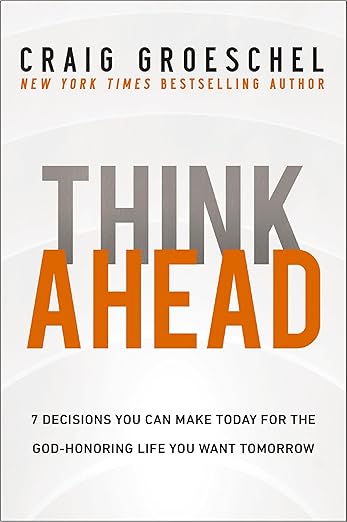
Think Ahead (book review)

Books aren’t like movies. Some movies you can watch over and over (at the top of my list, Moneyball). There are few books I’ve read that I thought to myself, “I would read this over and over.” Actually, outside of The Bible, I’ve only said that about a couple of books.

ALERT: Craig Groeschel‘s latest book Think Ahead makes the list.

What constitutes a book being re-readable? Well, compare that to the benefits of regular exercise. You do it because it’s good for you-you need it to improve your quality of life.

There you go. I believe there are books worth reading more than once because they improve quality of life. That’s the top criteria.

Similarly like regular exercise, there are books that reading it once isn’t enough. Going to the gym only on January 1st annually isn’t enough. There must be multiple visits. Only once doesn’t cut it. Some books have the level of content that you know when you read it, “I’m going to need this again down the road.”

To be honest, the big idea of Think Ahead comes pretty naturally to me. That idea is the power of pre-deciding. In his epilogue, Groeschel says this about that power:

  • Pre-deciding reduces the number of decisions to make.
  • Pre-deciding reduces the fear of deciding wrong.
  • Pre-deciding prevents emotion from taking over.

Whether pre-deciding is a natural way of living for you or not, here’s the deal: no one is perfect. Decision-making can become overwhelming in unforeseen circumstances. Some decisions are harder than others urging paralyzing fear. In either of these scenarios, emotions can lead us astray.

After one read in 2024, I’m pretty sure Think Ahead deserves a second read. And if it is going to improve my life quality, I guess I’m pre-deciding-Think Ahead is on the list to read for 2025.

Bruised

For a while now, part of my weekends is listening to the latest episode of 20 The Countdown Magazine.

The song at #7 this week has been on the countdown for 27 weeks. That says something.

The lyric that said something to me this morning was “I’m bruised but I’m not destroyed.” Based on 2 Corinthians 4:9, it seems like a relatable image to how many people in our community feel today.

I suppose it depends on their definitions of bruised and destroyed.

By the dictionary, bruised means damaged or wounded by or as if by being struck; destroyed means put an end to the existence of (something), defeat (someone) utterly, ruin (someone) emotionally or spiritually.

It’s hard for me to imagine most don’t feel bruised. It’s easy to imagine that many do feel destroyed.

I can’t say I align completely with the mindset behind this song. But I do hope for everyone, whether feeling bruised or destroyed, they will find peace that where they find themselves today is not the end. Fear and shame do not have to reign. Keep calling out from your woundedness. Healing and restoration await.

Learning to Walk in the Dark (book review)

I enjoy a writer who makes you think, or at least presents something ordinary unordinarily. Barbara Brown Taylor is definitely in this category.

In this second of her books I’ve read she gives you a different approach to thinking about darkness.

One beautiful way she does this is by showing you the value of darkness in biblical stories. She says the night sky was a key player in Abraham’s decision to trust God when he was told to “count the stars.” She spends a great amount of words on Moses’ encounters with God in the dark.

The God of Moses is holy, offering no seat belts or other safety features to those who wish to climb the mountain and enter the dark cloud of divine presence. Those who go assume all risk and give up all claim to reward. Those who return say the dazzling dark inside the cloud is reward enough.

Chapter 2, The Fear of the Lord

As you can imagine, much of the book addresses the emotions that come from fearing the dark. She believes that’s actually an indicator of something going on inside of us.

Our comfort or discomfort with the outer dark is a good barometer of how we feel about the inner kind.

Chapter 3, Hampered by Brilliance

A fascinating approach to her research for the book included cave exploration. With aid from professionals, she spent time sitting in the dark in caves and exploring portions of caves that demanded she address her fears. One takeaway: new life starts in the dark.

Whether it is a seed in the ground, a baby in the womb, or Jesus in the tomb, it starts in the dark.

Chapter 6, Entering the Stone

A spiritual book about darkness is most likely not complete without a chapter on the dark night of the soul. Taylor’s coverage is exhaustive from both sides of the topic as well as from the individual to the communal. The most helpful section was her description of the difference between faith and belief. Sharing about her observations as a college professor, she gives this distinction about questions college students are asking or are being asked:

When I listen to college students talk about faith, beliefs are what interest them most: Do you believe in the virgin birth? Do you believe that Jesus died for your sins? Do you believe that only Christians go to heaven? No one asks, “On what is your heart set?” No one asks, “What powers do you most rely on? What is the hope that gives meaning to your life?” Those are questions of faith, not belief. The answers to them are not written down in any book, and they have a way of shifting in the dark.

Chapter 7, The Dark Night of the Soul

I’ve already suggested this book to a few folks-one running friend who avoids running in the early morning hours, one coaching client who feels distant from God. Whether you are struggling with physical or spiritual darkness, I’d encourage you to give this book a read. See what you learn.

An Altar in the World, Meditation #1

On recommendation, I recently read An Altar in the World by Barbara Brown Taylor. It’s subtitled A Geography of Faith. In the spirit of that lane, rather than offer a review I’ve selected my top highlights and will offer a meditation post for each one. Here’s quote #1:

Faith sometimes looks like a blunt refusal to stop speaking into the divine silence.

Chapter 10, The Practice of Feeling Pain

In the face of betrayal, keep speaking.

In the face of confusion, keep speaking.

In the face of loss, keep speaking.

When fear says, “No one cares,” refuse to listen.

When doubt says, “No one’s listening,” refuse to isolate.

When impatience says, “No one’s responding,” refuse to self-muzzle.

There is a time to be blunt.

There is a time to be persistent.

There is a time to be verbose.

If God is silent, might it be because he wants to keep hearing from you?

If God is silent, might it be because he’s respecting your need to process?

If God is silent, might it be because he’s taking a moment to appreciate your faith?

Photo by Harli Marten on Unsplash