Hello Darkness, My Old Friend (book review)

First, I want to think my friend Megan for gifting this book to me. And I’m going to regift it as suggested.

You’re not alone if the name Sanford Greenberg is new to you. After reading his memoir, I suggest taking the time to get to know him.
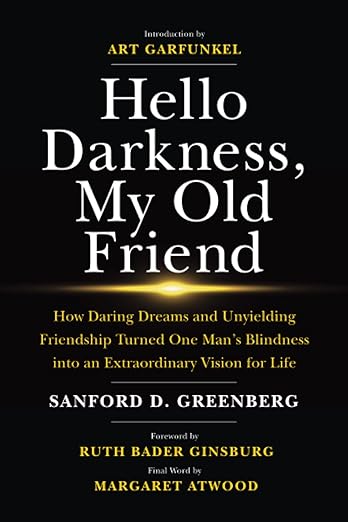
His life is triumphant in numerous ways, most notably the journey of taking the tragedy of going blind and living life to the fullest in spite of it. How he accomplished finishing college and going after other degrees is one thing. But continuing to dream big and go hard in all areas is equally inspiring.

Knowing I’m regifting the book, I didn’t do any highlighting. Out of many elaborative thoughts and quotes, I’d like to share just one from chapter 14, “The Start of Something Big.”

I was bitten by some kind of bug. Once someone gets his or her resolve up and running, and gets it focused in a direction, it is hard to put on the brakes. In a word, there is momentum. Also, aggressive work habits form. For us blind people, it is especially hard to hold back because we are always concerned about security. Like those who survived and prospered long after the Great Depression but could never shake the habit of stockpiling food and cash for a rainy day, we never feel comfortable, in our guts, about sitting back and saying ‘Okay, that’s it. I’ve done enough.’

Sitting back. It seems to be an art form of sorts. Or at least some form of discipline that some do naturally and others work hard to pursue.

Security. It seems to be more and more pursued yet less and less attained.

Greenberg’s journey of learning to sit back and where to find security led him to this conclusion: “The only worthwhile things in the world are people and ideas.” These drove him to an extraordinary life that may have only been possible due to overcoming tragedy, striving for the light.

I’m richer for having read Sanford Greenberg’s memoir. I’m glad we met.

If it’s doubtful you’ll read it, enrich yourself by watching this video about his lifelong friendship with Art Garfunkel.

Nose Hair Friends

I came home the other day from an outing. During my get comfy routine, I recalled a moment earlier when a team member had pointed out something was on my face.

I went to look in the mirror. Sure enough, there was nothing to see where he had me wipe away the snack crumb. BUT, what I saw in the mirror was more disturbing. One obvious nose hair longer than acceptable in my right nostril. I immediately thought, “Why didn’t he point that out, too?”

You may ask, “John, who does that…point out long nose hairs?” I asked myself that same question, and thus this blog entry.

It’s a test. What level of friendship does it take for a friend to point out something wrong with their friend’s appearance? Does it even take a level of friendship? When it comes to nose hairs, I’m convinced it does. 

I say this because of experience. I recall two nose hair conversations in my 30s. One with a friend and his wife. She and I told him he needed to address his two growing bushes. He whined that it wasn’t comfortable. But guess what, he agreed. Why? Because two valued people were looking out for him. The other conversation was with a roommate. We had all kinds of conversations that only close friends do.

Why am I bothering with this thought? One, because it makes me chuckle. Two, I find it an interesting friend test. Who are the friends in your life that will talk about nose hair, yours or theirs? Whoever they are, keep ’em. They are few and far between and worth any uncomfortableness.

DARE: Call or text a friend to say, “Thank you for being my nose hair friend!”

Photo by Braydon Anderson on Unsplash

A Lesson on Friendship from My Shortest Friendship

Friendships have been the subject of several conversations lately. It’s given me food for thought. But first, a running story.

Running in Naperville, IL., last October, race two of the weekend, we were somewhere around mile 7 of the half marathon. I had just taken a left turn on Ewing St and came upon a pack of runners. They were keeping a good pace which I decided to stick with for a while.

“You look strong,” one of the younger female runners said.

I was a little thrown. My awkward response was, “Thanks.”

She looked at me like, “Seriously. Good job.”

I don’t talk much with other runners during a race, but I decided to engage. I told her I’d ran a half the day before in WI, on my quest to run a race in all 50 states, so I was happy to be doing decently. For her to encourage me about how I was doing was a boost. She seemed to get a boost from a guy who could probably be her father sharing his journey.

We ran probably less than a mile together to the next aid station. I stopped for a drink, and she moved on. She was in my sight for most of the remaining miles. When I crossed the finish line, I found her. We congratulated each other. Our short relationship was over.

I may never forget her. In a small time window, she modeled friendship in numerous ways. The result: now I’m making an effort to be that friend on the race course. No, I’m not a chatter box. But in the right moment, when it looks like someone could use a racing friend, I’m trying to be that friend.

On the clock of our lives, it would be nice to have friends who stick with us for the entire journey, all the miles of our lives. But that’s not how it happens. For reasons of all sorts of nature, friends come and go. We come and go in their lives, vice versa. Some stay for a few miles; others stay for way more than the average. We develop a great pace together, we encourage one another, we do life together for as long as we can.

It’s sad when friends go. Sometimes we get to say meaningful goodbyes. Often times, we miss it; we didn’t see the end coming, and we are left with a loss that, if we allow it, could sideline us for a long time.

Today, my focus is on two things.

The first is to be grateful for those who are running with me right now. Receive all the friendship has to provide.

The second is to be the friend I wish to have. Gift all the friendship has to bless.

A Minister Myth

There’s a leadership philosophy that ministers and other leaders are often encouraged to adopt. I believe it’s a myth. I’ll go a step further to say it’s not biblical; in fact, an argument could be made to the opposite.

This philosophy, which I’ve never heard spoken on in any seminar nor was it taught in any of my seminary classes, goes something like this: Pastors can’t have, shouldn’t pursue, and must avoid friendships in the church. If you’ve never heard that before, read that again. And stop and meditate for a moment about it.

One commentary note I come to is this: No wonder ministers find themselves in unhealthy places. For whatever reason, they ignore the “one anothers” of scripture, miss the example of Jesus, then find themselves isolated in a kingdom of one wondering where everyone else is.

I’ve observed everyone else is enjoying and learning to embrace the benefits of the kingdom. In the kingdom of heaven, the citizens receive both encouragement and challenge to be like Jesus. While on earth, he intimately lived this out with his disciples. And it appears his relationship with three of them was a deeper level-one would probably call them friends.

I can’t imagine the last 23 years of my life had I lived by this philosophy. Do I get exemption because I’m single? May I say for all the single people, “Wake Up!” Your marital status doesn’t automatically determine your friendship need. All kingdom dwellers need other dwellers to encourage and challenge them. We all need friends.

Today, thank God for your cheerleaders, your encouragers, your challengers. Pastors and leaders, if these people are scarce in your life, what are you willing to do about it? Your isolated kingdom lacks. Take a step toward the life of your Redeemer. Pursue friendships. Live in the blessing of Jesus’ hope for all kingdom dwellers (John 17).

Henry Cloud’s Integrity

In 2006, Dr. Henry Cloud published what I believe to be his best book entitled Integrity

His objective is to connect the dots for how integrity and character work day to day. To do that, he outlines six character traits that enable talents and abilities to get their desired results:

  1. Creating and maintaining trust
  2. Seeing and facing reality
  3. Working in a way that brings results
  4. Embracing negative realities and solving them
  5. Causing growth and increase
  6. Achieving transcendence and meaning in life

It’s rich. I finished re-reading it last night. Yes, it’s one of those books. Here’s proof:

  • Underdevelopment leaves a gap between where we are at any given moment and where we need to be. That gap is our need and opportunity for growth.
  • Dysfunction is when an effort toward making something better makes it worse. That is when we are in trouble. And both a lack of integration and a lack of development can do that.
  • We trust people who we think hear us, understand us, and are able to empathize with our realities as well as their own.
  • Research has for decades proven that you can help desperate people immensely by giving them no answers at all, and only giving them empathy.
  • If you want to leave the best wake possible, leave behind a trail of people who have experienced your being “for them.”
  • Wise people are “cautious in friendship,” as the proverb says. They seek to get to know a person clearly, as a person truly is, before they hire him, marry him, become partners with him, or divorce him, fire him, or not go forward with him.
  • It behooves all of us to be working on whatever unresolved pain we are walking around with, lest some issue in “reality” tap into it and overcome our ability to make good decisions.
  • Secure identity is about who a person is, not what he does or what his results are.
  • People oriented toward growth want others to grow as well as themselves.
  • The immature character asks life to meet his demands. But the mature character meets the demands of life.
  • The one question that hovers above all others in importance for a person’s functioning in life is “Are you God, or not?”

They Don’t Have To

I got a call today from a friend looking for a reference for his friend. He flew states away to help his friend who is in crisis. He illustrated this truth about friendship-you do what you don’t have to.

A friend doesn’t have to tell you the hard truth.

A friend doesn’t have to go to bat for you.

A friend doesn’t have to give you their time.

A friend doesn’t have to offer you help.

A friend doesn’t have to sacrifice for you.

A friend doesn’t have to go the extra mile.

A friend doesn’t have to do for you what you aren’t capable of doing for yourself.

A friend doesn’t have to care about your future, your success, or your wellbeing.

A friend doesn’t have to choose to be your friend.

But because they do what they don’t have to, you can call them friend. 

Who in your life does what they don’t have to for you? Thank God for them. Thank them for them.

Quiet (book review)

My guess is most readers of my blog have not read Susan Cain’s book Quiet. My encouragement is that you should.

Her book first came on my radar in 2012 when I heard her interviewed briefly about it at a Catalyst conference. I was intrigued but didn’t reach for it until now. Too bad I didn’t read it earlier.

Why? Because she helps you get it-the differences between extroverts and introverts. She helps you embrace your introversion, if you are one. And she helps the extrovert understand you. Yes, that’s possible. She even gives you insights into those people who appear to be one but are really the other. You’re intrigued now, aren’t you?

So who should read this book?

  1. Anyone who suspects they are introverted but aren’t sure
  2. Anyone who knows they’re introverted and struggle with it
  3. Anyone who lives with an introvert
  4. Anyone who works for or leads introverts
  5. Anyone who wonders why they are drawn to have introverted friends

Whoever you are, bear in mind that appearance is not reality. Some people act like extroverts, but the effort costs them in energy, authenticity, and even physical health. Others seem aloof or self-contained, but their inner landscapes are rich and full of drama. So the next time you see a person with a composed face and a soft voice, remember that inside her mind she might be solving an equation, composing a sonnet, designing a hat. She might, that is, be deploying the powers of quiet. P266

This is one of those books to not only read but add to your library. Power Up!

Miracle in the Andes (book review)

I’ve been obsessed with this book while listening to it. So much so that when disc 7 wasn’t listenable because of scratches, I checked out the book today in order to read what I missed. (NOTE: Manatee County Library rocks! Not only did they bring the book from another branch to the branch closer to me to pick up, but they also called to let me know it was ready. BOOM!)

Nando Parrado is one of sixteen survivors of a 1972 plane crash in the Argentine Andes Mountains. Another book, Alive, was written and made into a movie in the 90s. I’ve never heard of this story, so I was riveted by it. My riveting is a credit to Parrado’s storytelling and personal account of the survivor’s ordeal.

If you enjoy true stories that make you think and marvel, you should read Parrado’s book. You’ll be satisfied. But what you’ll hopefully also receive are some life lessons to model. He gives you plenty. These 72 days gave more than 72 lessons. The survivors continue to live them out. Read it and see what you could live out.