Flying Through the Clouds

The last leg of my trip from Sarasota to Bakersfield, California, yesterday started in Phoenix. I had been watching the weather forecast for weeks, curious what to expect for the race tomorrow. So I knew it had been rainy that morning and was supposed to be clearing. When the pilot said he expected the last part of the ride to be bumpy, I nodded.

Sure enough, about 20 minutes before landing the clear skies gave way to a blanket of clouds. I decided I’d watch the decent through my window-seat view.

For quite a while we flew just above the clouds. That’s all you could see beneath the plane. I was waiting to see when the pilot decided to dive. When he did, I looked at my watch.

It was roughly six minutes later when the plane was beneath the clouds, the blanket shadowing Bakersfield.

I wondered what goes through a pilot’s mind before and during a decent into such coverage. If I could, I wanted to ask the pilot to give me one word to describe what he felt during that six minutes flying through the clouds.

Often we feel like that. Those six minutes could literally be six weeks, months, years, or decades. The possible one-word list is long:

  • Unsettled
  • Edgy
  • Heavy
  • Antsy
  • Lost
  • Tired
  • Frustrated
  • Guarded

The truth I was reminded of watching out that window is this: God doesn’t change.

During that twenty minutes while experiencing the beauty above the clouds, the uncertainty through the clouds, and the darkness under the clouds, my location and my experience didn’t impact Him. Our relationship remained the same every second.

Wherever you find yourself in relation to the clouds, hold on to this truth. The clouds were created. Their Creator is not drained or threatened by them. He remains the same above, through, and under.

Photo by Johannes Mändle on Unsplash

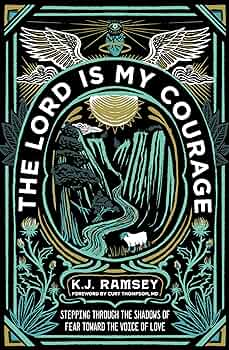
The Lord Is My Courage (book review)

I don’t recall what I thought I was going to get from K.J. Ramsey’s book The Lord Is My Courage. But here’s what I know I got:

  • New Language
  • Deeper Understanding
  • Fresh Appreciation

Ramsey’s approach to this subject is 1/4 part self-therapy, 1/4 part reader-therapy, 1/4 part church culture review, and 1/4 scripture exposition. That’s a lot. For her. And for the reader.

David, who wrote both Psalm 27 and Psalm 23, knew what it was like to have an enemy, knew how it felt to be afraid, and knew how much it hurt to wonder if you are heard.

Chapter 5, “He Makes Me Lie Down”

For this response, I took my time. Like a good meal, it’s better to pace yourself. The two chapters worth savoring the most were Chapters 5 and 20.

Chapter 5 includes nuggets rooted in a distinction of translation. Some scholars prefer a translation of the Greek to read “he settles me down” instead of “he makes me lie down.” Is that a big deal? To K.J., yes. “I thought God was a shepherd who made me lie down.  I needed to encounter God as a shepherd who settled me down.”

These kinds of bites are served throughout the book. The one I enjoyed the most was this one from chapter 20.

In John 16, Jesus is telling us, Peace is found only in my presence. And I will not leave you alone.

And then Jesus says to “take heart,” which can also be translated as “have courage,” telling us that our future is secure because he has already overcome the world.

Fear is just courage’s preamble. When we practice remembering that the Spirit of Christ is our companion, fear simply becomes one more prompt to pay attention to the voice and presence of Love. Fear doesn’t have to be an enemy to conquer. It can be a place to be companioned by Love.

Ramsey definitely follows the theme of the book, folded creatively in each chapter. Here are five illustrations:

  • “Courage is the practice of risking to trust that we have a Good Shepherd who is with us always-no matter what.”
  • “Courage is resisting the hurried pace of modern life and embracing the slower rhythm our bodies need to regulate and rise.”
  • “It takes courage to quit doing things for God to commune with God.”
  • “Courage is choosing to commune with someone who has already chosen to be with us.”
  • “Courage is simply the choice to be found.”

Is this book for you? If you enjoy the Psalms, yes. If you appreciate the integration of scripture and psychology, yes. If you are struggling with current or past church experiences, yes. If you like brain food, yes. If you could use a fresh look at who God is, yes. Chances are, yes.

Sealing Hope for ’25

Recently gave my Kindle away. Just lying around, it was time to give it a new home.

When I was looking through the library I had built on it before deactivating it, there was one book that I knew I’d want to find a way to keep. GOOD NEWS: It’s on Hoopla!

If you’ve been following this blog for any amount of time, this book will most likely sound familiar. Why? Because since 2016 I’ve read it every year. I just finished the ’24 reading. It may be the last time I hold to an annual commitment to read it. No doubt, I glean relevant takeaways each time I read it. And, interestingly, with each reading, I also observe personal growth based on the lens of my reading and my responses.

Paul David Tripp’s Awe is the book. This reading, chapters 7, 10, and 13 received the most highlights. Chapter 10, “Worldview,” is always a great reminder of how to look at current circumstances:

Your idea of God will never be either accurate or stable if you’ve arrived at it by trying to figure out what he is doing in the situations in your life…when you wear the glasses of Isaiah 40 you can understand yourself, others, meaning and purpose, right and wrong, identity, morality history, and the future properly.

Chapter 13, “Work,” I’ve blogged about before. What stood out today was Tripp’s many references to rest, which is my word for 2025.

Success is not about accruing power but about resting in God’s power…Awe of God teaches me that, by grace, my life of work can now be an expression of rest and not worry.

Chapter 7, “Complaint,” is consistently corrective, which oddly can be encouraging. The meat of the chapter discusses five questions that Tripp says steal or seal our hope; Tripp believes we answer these questions every day:

  • Is God good?
  • Will God do what he promised?
  • Is God in control?
  • Does God have the needed power?
  • Does God care about me?

I encourage you to sit with these questions this week. They may renew your awe for what’s happened in ’24. They may seal your hope for what’s going to happen in ’25.

Photo by Kelly Sikkema on Unsplash

What? We’ve Been Fasting?

Chances are, if you grew up in church, you can count on one hand the number of sermons you’ve heard that mentioned fasting. Church folk like their food, right?

Chances are most likely even higher that any mention of fasting didn’t reference Isaiah 58. That’s what crossed my mind this morning when I read it as part of a Thanksgiving-themed devotional plan. Check out verses 6-12.

Isaiah 58:6-12 NIV
[6] “Is not this the kind of fasting I have chosen: to loose the chains of injustice and untie the cords of the yoke, to set the oppressed free and break every yoke? [7] Is it not to share your food with the hungry and to provide the poor wanderer with shelter— when you see the naked, to clothe them, and not to turn away from your own flesh and blood? [8] Then your light will break forth like the dawn, and your healing will quickly appear; then your righteousness will go before you, and the glory of the Lord will be your rear guard. [9] Then you will call, and the Lord will answer; you will cry for help, and he will say: Here am I. “If you do away with the yoke of oppression, with the pointing finger and malicious talk, [10] and if you spend yourselves in behalf of the hungry and satisfy the needs of the oppressed, then your light will rise in the darkness, and your night will become like the noonday. [11] The Lord will guide you always; he will satisfy your needs in a sun-scorched land and will strengthen your frame. You will be like a well-watered garden, like a spring whose waters never fail. [12] Your people will rebuild the ancient ruins and will raise up the age-old foundations; you will be called Repairer of Broken Walls, Restorer of Streets with Dwellings.

If you’ve been involved in anything mentioned in this passage, SURPRISE! You’ve been fasting.

  • Loosing the chains of injustice = FASTING
  • Feeding the hungry = FASTING
  • Sheltering the poor = FASTING
  • Clothing the naked = FASTING
  • Not turning from your family = FASTING
  • Doing away with finger pointing and malicious talk = FASTING

As we’ve watched many of these actions in our community these last few months, we didn’t use the word fasting to describe them. Two words I did hear were light and healing. If you take this passage to be a promise, imagine what’s coming because of the fasting. Not only will this fasting result in literal repairs of walls and restoration of streets and homes, but it will also shine light and nurture healing as God replies to our cries by saying, “Here I Am.”

Photo by jean wimmerlin on Unsplash

Bruised

For a while now, part of my weekends is listening to the latest episode of 20 The Countdown Magazine.

The song at #7 this week has been on the countdown for 27 weeks. That says something.

The lyric that said something to me this morning was “I’m bruised but I’m not destroyed.” Based on 2 Corinthians 4:9, it seems like a relatable image to how many people in our community feel today.

I suppose it depends on their definitions of bruised and destroyed.

By the dictionary, bruised means damaged or wounded by or as if by being struck; destroyed means put an end to the existence of (something), defeat (someone) utterly, ruin (someone) emotionally or spiritually.

It’s hard for me to imagine most don’t feel bruised. It’s easy to imagine that many do feel destroyed.

I can’t say I align completely with the mindset behind this song. But I do hope for everyone, whether feeling bruised or destroyed, they will find peace that where they find themselves today is not the end. Fear and shame do not have to reign. Keep calling out from your woundedness. Healing and restoration await.

As You Live and Move and Breathe

Came across a song new to me today that voiced a prayer of personal need. Before sharing it, do you know or remember this one?

Matt Maher gave us this song 11 years ago, a prayer declaring an awareness and desperation regarding needing God. There are moments in life where this prayer song matches our spirit. In those moments, I believe God is like a father, thankful his child trusts their need with him.

The song I found today is also a prayer song about need, but the declaration isn’t a cry for help. Instead, the song is a declaration of belief in God’s ability to meet needs and, therefore, a desire to stay close to him. Why? Because he knows what we need. That “because” leaves the lyricist to declare something about himself. He wants everything he does and says to lead him back to the one who knows what he needs.

Two songs about human need. Two songs voicing a prayer of faith. Wherever your faith is today regarding your needs, chances are one of these songs captures it.

As you live and move and breathe, sing along. He’s listening.

Redeeming Conditioning

This was the first point in yesterday morning’s sermon: You always find what you’ve been conditioned to find. I was immediately reminded of a blog post from a few years back, “We See What We Look For.”

Being conditioned is certainly a thing, a thing that many are quick to point out about others who are on the opposing side. I often wonder how much we consider our own conditioning.

For example, politically. The deeper in one gets, the more conditioned they become to seeing only one viewpoint and thus responding in defense of it. The conditioning seems impenetrable.

And unfortunately, the same seems to go for spiritually. It’s as if our identity in both of these realms cripples our ability to recognize our personal programmed perceptions and responses that leave our minds and spirits untapped.

I’ll give two examples. A few years ago I answered a question of why I believe God exists by how I believe I’ve experienced His involvement in answering prayer. Two people in the conversation immediately locked eyes and jinxed each other with their reply of, “That’s just positive manifestation.” Wall up. Dialogue over. (If this is new language to you, check out this blog post.)

This past week I was at an event where we were discussing the usage of microphones. I made a comment that I didn’t have a clue came across as judgmental. One person replied gently, “We try not to judge here.” He’s conditioned to protect against judgment; I’m a work in progress of overcoming judgment as a natural response.

May I suggest we all address conditioning in the following ways:

  1. Acknowledge you have been conditioned
  2. Consider the probability that your conditioning needs redeeming
  3. Thank God for his redeeming conditioning work
  4. Offer grace to others who find their conditioning in need of redemption

Photo by Edi Libedinsky on Unsplash

Praise: A Well-Taken Reminder

For the last three weeks I’ve been focused on a question, a personal spiritual dialogue that I’ve shared with a few others. The question could be stated several ways, but what I’m after is an answer that enriches/refreshes relationship with God. Here are variations of the question:

  • Which is more important, focusing on what God does for us or who He is to us?
  • In my experience in the Church, is the focus on what God does or who He is?
  • What do my prayers reflect, a focus on works or on identity?
  • How do believers achieve balance between doing for and with God versus being with and knowing God?

In ways I’ll never be able to explain, the timeliness of reading the right book at the right time surfaced again this afternoon. I recently picked it up off clearance at Books A Million.

In Chapter 4 entitled “Jesus’ Prayer of Praise,” McHenry shared that Richard Foster says adoration has two forms, praise and thanksgiving. Thanksgiving expresses appreciation for what God has done; praise acknowledges who God is.

This struck me through a simple word-praise. I have been contrasting the words adoration and thanksgiving without thought to the word praise. Accepting this teaching that they are really all the same brings some relief to my analytical brain.

That final question in the list above comes from how I’ve been approaching prayer the last three weeks. I’ve leaned more in the adoring lane than the thanking or asking lane-an effort to discipline my focus on relationship. A reminder to praise is well taken.

By the way, in this chapter McHenry shared a terrific list to help us all improve our adoration. Seemed worth sharing.

God’s Nature: Lording or Loving?

Sheets continues in the next chapter of The Pleasure of His Company to dig into aspects of our relationship with God. He zeros in on a belief that God’s nature is misunderstood. A misunderstanding of God’s nature would certainly explain why worship can lack passion, be endured, or even resisted.

I don’t believe the problem with most believers’ worship is hypocrisy or insincerity. I think the majority is trying to honor God by giving Him His dues and fulfilling their obligation to Him as the Creator. I doubt if most of them understand, or have even heard, that God is a lover as well as a Lord. And it wasn’t his lording nature that prompted him to create us-He could have made a few billions more angels had that been His desire. It was his loving nature. God is a Father at heart.

Chapter 2, “The Seeker”

This morning I got to talk with a guy at church for the first time and found out he works for a local, family-owned business. Between their six locations, they have over 800 employees. Describing being employed there he said, “You work hard, but it’s like family. We have a hard time finding good employees, but we continue to grow and I love working there.”

He’s describing a work place that isn’t only about lording. We all pretty well can tell the difference between lording and loving. If you come from a faith setting that focuses more on a lording view of God’s nature, it’s probably long overdue for your relationship to take a shift and consider his loving nature.

Photo by Rod Long on Unsplash

Tall Order God

In a recent interview, a pastoral candidate described what he was hoping for as “a tall order.” I replied, “I’m pretty sure God can handle tall orders.” Not that He’s obligated to any human’s orders, but He’s more than capable to fill them.

You got a current tall order?

  • Selling a house
  • Repairing a relationship
  • Getting out of debt
  • Forgiving yourself

Whatever it is, consider these talking points in your prayers the rest of this week:

  • Recall and thank God for filling your previous tall orders
  • Align your will with His
  • Ask him to do it again

Photo by Andrew Jenkins on Unsplash