“Why Not” > “What If”

I’ve worked part-time for the last two years for Chemistry Staffing as a candidate interviewer. If I thought I knew anything about interviewing before then, I learned quickly I had more to learn.

In a recent staff meeting, the leadership team shared a mindset shift that I completely found refreshing and certainly gracious. Already leaning this direction, the alignment was immediate.

Mindset Shift: “Why Not” ➝ “What If” 

Moving away from disqualifying too quickly and leaning into curiosity:

Old posture: New posture

“Why not move this person forward?” “What if this could work?”

Examples:

  • Experience: “He only has 6 years, not 10.” → What if his 6 years included higher complexity than average?
  • Education: “She doesn’t have a master’s.” → What if her teaching and theology are stronger than most grads?
  • Age: “He’s 32; we wanted 40+.” (pick the age, vice versa) → What if he brings energy and innovation beyond his years? What if she has plenty left in the tank?
  • Compensation: “They’re at $75k; we can’t afford them.” → What if they’d take less for the right fit?

Key takeaway: Stay open-handed in early conversations. Gather more information. Avoid prematurely filtering out strong potential fits.

How this is an improvement:

  • Less transactional > more relational
  • Less arrogant > more humble
  • Less rigid > more flexible
  • Less closed > more open
  • Less judgmental > more gracious
  • Less about the interviewer > more about the interviewee

CHALLENGE: Put yourself in both seats. What’s your current mindset? What shifts would you like to pursue?

Photo by Mina Rad on Unsplash

Valley/Highland/Grace Friends

I’ve written about friends in previous posts. Nose hair friends. 21st Century friends. Even three types of hard times friends. This morning a new thought bloomed based on the song in this video.

I first heard this song after being pointed to it by a nose hair friend going through hard times. It’s on my 2025 Rest Playlist, which I started my day with today. Because friendship was on my mind, I listened to this song with a different ear and heart.

Here’s the thought that surfaced:

Some friends are better valley friends; some friends are better highlands friends.

I can hear some head scratching. “John, true friends, real friends don’t care about valleys and highlands. They’re in it for all of it.” Heard. But let me tell you my experience.

Back in the early-90s while in my 20s, I had a group of friends that got together often to play card games. Anywhere from 4-6 of us. We were friends mostly through work and church. Some were married, some single. We were very much highlands friends.

Eventually we all parted ways as relationships go, yet we tried to keep in touch. And then, one of the couples got a divorce. In that moment, we were challenged.

I had never experienced friends getting a divorce. For that matter, I’d never experienced anyone divorcing that was close to me. It was foreign territory. An unknown valley that I was more observing than experiencing. And as much as I tried, it was just awkward. The result? These days we’d call it ghosting. I felt a lot of guilt about it.

Forward five years, another couple of church friends got divorced. This time, I knew better, and I was the valley friend they needed. I had grown in what it meant to be a friend through the valley. That experience led me to go back to my first divorced friend and acknowledge I could have been a better friend through his valley.

Here I sit almost thirty years later, and it’s like I’m the opposite-better valley friend than highland friend. And when I listened to this song this morning with my friend evaluator hat on, it was a call to grace.

Grace for myself. Sure, I’d like to be the ideal friend regardless of the space. When I believe I’m not, grant myself grace to grow in whichever land my friend is walking.

Grace for my friends. Sure, I’d like them to be ideal friends regardless of my space. When I’m tempted to say they aren’t, grant them grace to grow in the land I’m walking.

Maybe the lesson isn’t as much about valley and highland friends. It’s about grace granting, to others and to myself. “All the same.”

Gracists

Last month I had a conversation that left me with a feeling I didn’t want and, for sure, didn’t see coming. A few weeks later while attending a community event one speaker mentioned moral injury. And that feeling suddenly had a name. Check out this video to learn more about it.

This incident led me to intentionally choose to read several YouVersion devotional plans addressing the topic of racism. One of those was based on David Anderson’s book Gracism. Day 3 of that plan was very helpful, so I want to share this segment from that devotional:

From 1 Corinthians 12, I have identified eight principles or sayings that can guide us as we develop as gracists. These sayings lead us to actions that we can engage in to build bridges across the deepest divides of color, class, and culture. As you meditate on these verses, look for each of the eight sayings listed below.

  1. I will lift you up. “Special honor” means lifting up the humble among us.
  2. I will cover you. “Special modesty” means protecting the most vulnerable among us from embarrassment.
  3. I will share with you. “No special treatment” means refusing to accept special treatment if it is at the detriment of others who need it.
  4. I will honor you. “Greater honor” means God, as a gracist, has given greater honor to the humble.
  5. I will stand with you. “No division” means when the majority helps the minority, and the stronger helps the weaker (gracism), it keeps us from division within the body (an opposite view than normal).
  6. I will consider you. “Equal concern” means having a heart as big for our neighbors as we do for ourselves.
  7. I will celebrate with you. “Rejoices with it” means when the humble, or less honorable, are helped, we are to rejoice with them.
  8. I will heal with you. “Suffers with it” means empathizing with the pain of another and walking empathetically with the injured party.

To connect with that day of the plan, follow this link: Gracism: The Art of Inclusion – Day 3 of 5

Here’s to our collective development as Gracists.

When I Don’t Know What I Don’t Know

One of the more liberating understandings I came to appreciate years ago was that there are times I don’t know what I don’t know. Well, maybe at first it wasn’t liberating. Probably more frustrating…until grace stepped in.

This came to mind recently when I read Joshua 7. Talk about a frustrated leader. Joshua was deep in it. Here’s how he voiced it to God:

Then Joshua said, “Oh no, Lord God! Why did you ever bring this people across the Jordan? Was it to hand us over to the power of the Amorites, to destroy us? If only we had been prepared to live on the other side of the Jordan! Please forgive me, Lord. What can I say now that Israel has retreated before its enemies? The Canaanites and the whole population of the land will hear of it. They will surround us and make our name disappear from the earth. What will you do about your great name then?”

In this moment, Joshua had no idea what Achan had done. In all reality, it’s possible he didn’t even know Achan. Think about it. A man he may not have known was the reason behind his questioning, pleading, and speculating. Joshua didn’t know what he didn’t know.

These type of scenarios can be an opportunity to hit pause. Before finger pointing at God or spraying the mirror with the “why’s, what are you doing’s, or what will happen’s,” some additional questions are available that usher in curiosity and temper impatience.

  • What am I missing?
  • What don’t I know that would be helpful to explore discovering?
  • Is it possible I’m in the ripple of someone else’s wave?
  • What do I believe about God’s character, and how does it fit with my current reaction and posture?

Those kind of questions change prayers, create stillness, and offer a seat beside restorative waters. When and if I need to know what I don’t know, it will come. This is a moment for grace…and there’s plenty available.

Photo by Danny Froese on Unsplash

Family Grace

Today I was privileged to attend the celebration of life for a friend’s husband who passed last year. Due to COVID concerns, the family put off holding a gathering until now. I had only met her husband once that I recall, so I was attending purely to support her. I have found that when I attend such gatherings without much history with the deceased I actually walk away with more to think about. No exception today.

The top thing that struck me was an admittance from the youngest son. In his sharing about his dad, he spoke transparently stating that they hadn’t always had the greatest relationship. He said he didn’t want to go on about that. Instead he said this:

As an adult I’ve come to realize that parents are people to. My dad was a person. We all mess up.

He then went on to tell terrific stories of how he relied on his dad in many ways and will miss his being there to give advice and fix his mistakes. He gave a terrific image of how he remembered feeling like his dad would be behind him watching him do something and sensing that his dad wished he could wrapped his arms around his sides in order to fix what he wasn’t doing right. He said he imagines that his dad is still doing that.

This husband/father/friend was loved. And it appears he was loved because he accepted everyone’s humanity including his own. Could that be the answer to a tight family? Each one receives and shares grace out of their acceptance of their humanity?

As I listened to this son laugh and cry talking about his dad, this passage came to mind:

As a father has compassion on his children, so the Lord has compassion on those who fear him; for he knows how we are formed, he remembers that we are dust. The life of mortals is like grass, they flourish like a flower of the field; the wind blows over it and it is gone, and its place remembers it no more. But from everlasting to everlasting the Lord’s love is with those who fear him, and his righteousness with their children’s children-with those who keep his covenant and remember to obey his precepts.

Psalm 103:13-18

May families remember that they are dust.

May families receive and share grace.

May families bask in the everlasting to everlasting love of the Lord.

Photo by Brett Jordan on Unsplash

Groaning (Part 3)

In Parts 1 & 2, I shared that we are all born groaning and how that viewpoint can encourage grace giving to ourselves and to one another.

That grace choice isn’t always natural. In fact, it goes against our groaning nature. Left to our instincts, we reach for anything to ease our groaning without considering the impacts of that reaching. Grace isn’t natural.

So back to those four verses that started this series, when you finish reading the rest of that chapter, which I’ll include at the bottom of this post, you see how hope and grace are made possible. They are both made possible by a supernatural grace choice-a choice only explained by love.

God saw his creation groaning. He was there for the first groan. And in that moment, he offered grace. He made a plan. He made a choice-the only choice available to stop the groaning. He chose to enter the groaning, to embrace it in order to crush it.

Chilling. There isn’t a human groan God didn’t feel and now doesn’t remember. He saw them and chose to experience them in order to redeem them…forever.

As you read the rest of this chapter, pause after each verse. Consider a prayer of thanks between each verse. Voice a prayer of adoration, of worship, of awe, of victory because you do not groan alone.

Romans 8:26-39

26 In the same way, the Spirit helps us in our weakness. We do not know what we ought to pray for, but the Spirit himself intercedes for us through wordless groans. 27 And he who searches our hearts knows the mind of the Spirit, because the Spirit intercedes for God’s people in accordance with the will of God.

28 And we know that in all things God works for the good of those who love him, who[a] have been called according to his purpose. 29 For those God foreknew he also predestined to be conformed to the image of his Son, that he might be the firstborn among many brothers and sisters. 30 And those he predestined, he also called; those he called, he also justified; those he justified, he also glorified.

31 What, then, shall we say in response to these things? If God is for us, who can be against us? 32 He who did not spare his own Son, but gave him up for us all—how will he not also, along with him, graciously give us all things? 33 Who will bring any charge against those whom God has chosen? It is God who justifies. 34 Who then is the one who condemns? No one. Christ Jesus who died—more than that, who was raised to life—is at the right hand of God and is also interceding for us. 35 Who shall separate us from the love of Christ? Shall trouble or hardship or persecution or famine or nakedness or danger or sword? 36 As it is written:

“For your sake we face death all day long;
    we are considered as sheep to be slaughtered.”[b]

37 No, in all these things we are more than conquerors through him who loved us. 38 For I am convinced that neither death nor life, neither angels nor demons,[c] neither the present nor the future, nor any powers, 39 neither height nor depth, nor anything else in all creation, will be able to separate us from the love of God that is in Christ Jesus our Lord.

Photo by Pinakeen Bhatt on Unsplash

Groaning (Part 2)

This morning in his message my pastor shared a story about some friends who have a young daughter. Around the age of two, she was diagnosed with multiple food allergies. As they were dealing with that reality, other diagnoses came taking them down a very uncertain and unpredictable path. His purpose for sharing their story was to illustrate that their shared journey through uncertainty brought them closer to each other and to God.

Theirs is a story of groaning. As parents, they groan. As children of God, they groan. As spouses, they groan. When they choose to groan together, recognize each other’s groaning, they are actively choosing to draw closer together.

Sounds perfectly natural for a couple to do. But you and I both know, that’s not what all couples do. Not all relationships survive such trials. And when you examine similar challenges that a larger group is facing together, the possible response scenarios are multiplied.

  • How might responses be chosen if the challenges were seen as “the whole creation groaning”? (See Part 1)
  • How might we listen to one another if we viewed other’s words as groaning prayers?
  • What if we shared groanings without trying to win?
  • What rewards would be received if at least once we chose to listen to another’s groans without demanding they hear ours?

Most likely, all the answers to these questions have a common thread-choosing grace. Grace says, “I hear you. I see you. I’m willing to listen to you. Your groans matter. You are allowed to groan however you want, how loud you want, about whatever you want.”

We are all born groaners. We all have the opportunity to become gracious groaners.

Who is a gracious groaner?

  • That person that you know is in pain, but they refuse to suck the life out of the room.
  • That person that shares their groans along with the lessons they are learning, the questions they are asking, and the hope they have anchored.
  • That person that understands everyone around them also groans and offers the grace they desire to receive.

How did that person nurture such grace? Most likely, they admired someone else with it. Or even better, they grew from being gifted undeserved grace in return for their lack of grace. They received the benefit of shared grace.

More about that in Part 3.

Photo by Nathan Dumlao on Unsplash

Groaning (Part 1)

22 We know that the whole creation has been groaning as in the pains of childbirth right up to the present time. 23 Not only so, but we ourselves, who have the firstfruits of the Spirit, groan inwardly as we wait eagerly for our adoption to sonship, the redemption of our bodies. 24 For in this hope we were saved. But hope that is seen is no hope at all. Who hopes for what they already have? 25 But if we hope for what we do not yet have, we wait for it patiently.

These verses precede one of the most quoted verses from the New Testament. Back to that later.

Recently I’ve been meditating on this passage, particularly focusing on the groaning references. In the past I’ve always focused on two elements of this teaching by Paul (hint to where these verses are found).

  1. Creation is groaning. So the challenges of our physical world-storms, fires, droughts, etc.-illustrate this.
  2. The next two verses that follow (familiar verses about prayer) mention wordless groans through which the Holy Spirit intercedes for us. Praying is groaning.

I’ve taken a third focus lately that has brought further peace and clarity to a believer’s identity. And the focus follows this thought pattern:

All of Creation is Groaning

>Humans are part of Creation

>Humans are Groaning

Strange as it may sound, I find freedom in that truth. Not necessarily comfort or satisfaction. But this different view of our status brings deeper understanding. I’ll put it in three points:

  1. We’re all born groaning
  2. Shared groaning births grace
  3. God chose to enter our groaning

Growing up in the church, I’ve heard “we’re all born sinners” all my life. I’ve never heard anyone say, “We’re all born groaners.” All of my being is groaning. My spirit groans. My mind groans. My body groans. I was born this way. And there’s nothing I can do about that.

Although that’s true, I can do at least two things according to these two verses. First, I can wait eagerly for the groaning to end. In other words, rather than sulk over my status I can look forward to what’s ahead in eternity. Second, I can foster hope. Yes, my groaning spirit and mind and body produce stuff I don’t like; but I have the option to choose to humble all of myself to the Holy Spirit who gives me hope by being with me in that groaning.

I was born groaning and continue. It explains much. But there’s more. Stay tuned for Part 2 & 3.

Photo by Felipe Palacio on Unsplash

Lessons from “When Mama Can’t Kiss It Better”

Finally finished book #6 for the year.

And did I learn a lot. The challenges this family dealt with due to adopting a child eventually diagnosed with FASD (Fetal Alcohol Spectrum Disorder) and RAD (Reactive Attachment Disorder) are astonishing. How this played out through the adoption, health care, and education systems sheds light on the many challenges of families trying to love and care for their mentally ill children.

This story is a good reminder of three lessons:

You never know what is going on in a stranger’s life. You may witness something you think you understand, but it’s impossible to know the full story.

Media can get it wrong also. Just because the headline says it doesn’t make it true.

Grace goes a long way. Give it as much as you need it.

This Easter

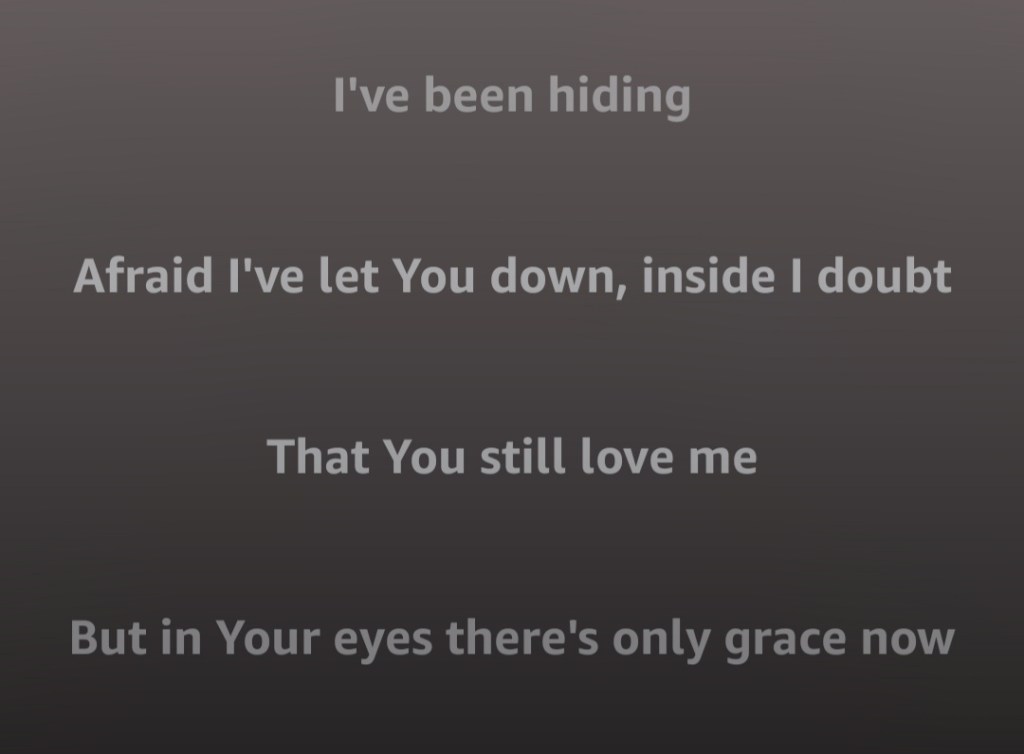
I started this Thursday listening to my Easter playlist. In that, Lauren Daigle’s “How Can It Be” played. These lyrics from verse two stuck in my ears, mind, and heart.

The main reason they stuck is the contrast between the doubting of love and the exchanging of grace. Been on my mind for several weeks now, so these lyrics heard through the lens of Easter stopped me in my morning routine.

That’s what grace does. Makes you pause. Humbles your expectations. Erases your doubts. Brings you back.

May we all pause in humility to be brought back from our wandering through the erasing of our doubts of God’s love this Easter!