Why Do You Stay?

I summarized an interview candidate this week saying, “He knows how to stay.”

He’s been at the same employer over 16 years and worn a couple of hats. He’s looking to leave for a couple of reasons, none of which have anything to do with his employer. Good personal reasons.

This interaction reminded me of one of Travis Bradberry’s tips for retaining employees. See this post and the image below.
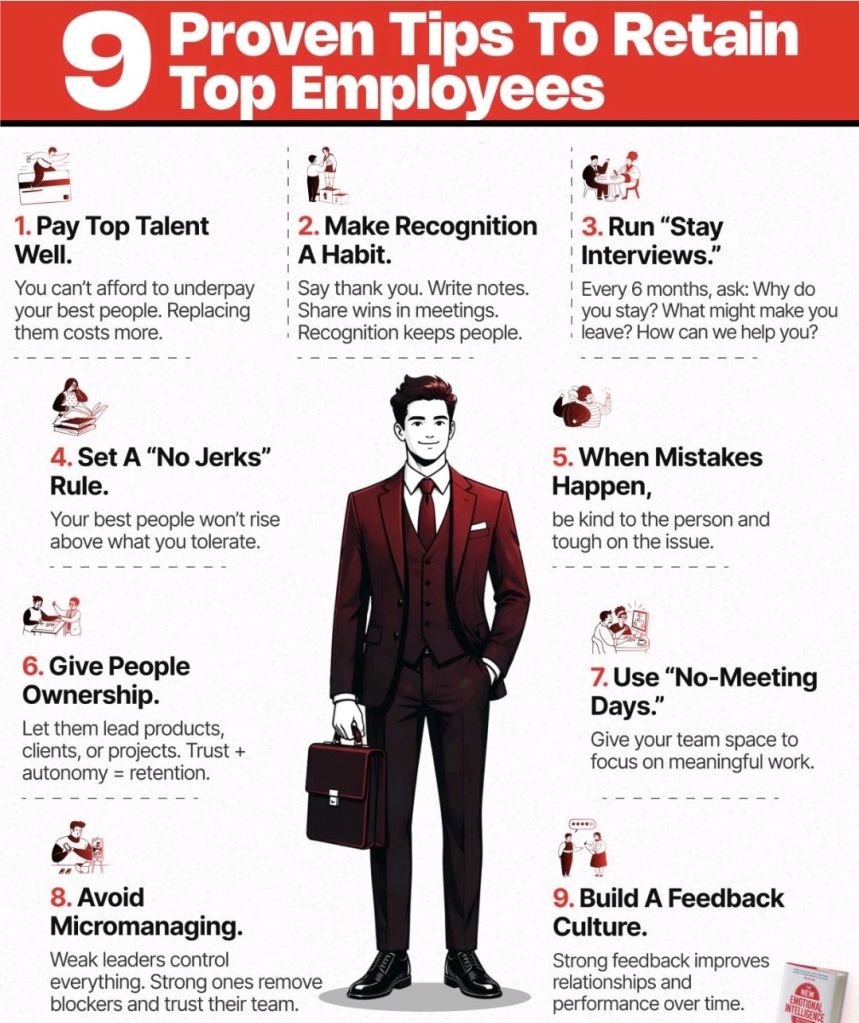
I love tip #3. A board member recently made a similar suggestion regarding conducting annual reviews, but he didn’t have a name for it. Stay interviews captures it.

Some might say this appears too vulnerable, for either party. That mindset is most likely what Bradberry is saying may cost a company a top employee.

I’ve known the answer to why I’ve stayed in positions that others scratched their heads while asking, “Why do you stay?” Those “others” didn’t include my boss, of course. But my boss also didn’t take the time to be vulnerable. And guess what? I eventually left.

Your top people, for that matter all your people, desire to be seen and heard. Most likely, they would rather not leave. They would rather have the tough conversation. Chances are it won’t be near as tough as perceived and definitely not as regretful as having to find their replacement.

We’re almost six months into 2026. Time to schedule some stay interviews.

“Why Not” > “What If”

I’ve worked part-time for the last two years for Chemistry Staffing as a candidate interviewer. If I thought I knew anything about interviewing before then, I learned quickly I had more to learn.

In a recent staff meeting, the leadership team shared a mindset shift that I completely found refreshing and certainly gracious. Already leaning this direction, the alignment was immediate.

Mindset Shift: “Why Not” ➝ “What If” 

Moving away from disqualifying too quickly and leaning into curiosity:

Old posture: New posture

“Why not move this person forward?” “What if this could work?”

Examples:

  • Experience: “He only has 6 years, not 10.” → What if his 6 years included higher complexity than average?
  • Education: “She doesn’t have a master’s.” → What if her teaching and theology are stronger than most grads?
  • Age: “He’s 32; we wanted 40+.” (pick the age, vice versa) → What if he brings energy and innovation beyond his years? What if she has plenty left in the tank?
  • Compensation: “They’re at $75k; we can’t afford them.” → What if they’d take less for the right fit?

Key takeaway: Stay open-handed in early conversations. Gather more information. Avoid prematurely filtering out strong potential fits.

How this is an improvement:

  • Less transactional > more relational
  • Less arrogant > more humble
  • Less rigid > more flexible
  • Less closed > more open
  • Less judgmental > more gracious
  • Less about the interviewer > more about the interviewee

CHALLENGE: Put yourself in both seats. What’s your current mindset? What shifts would you like to pursue?

Photo by Mina Rad on Unsplash

SURPRISE!

Monday, I was waiting for an interviewee to enter our Zoom meeting. I already had an opinion of how it would go, yet I knew that wasn’t a good mindset as an interviewer.

I decided prayer was a good option while I waited. The main request I voiced was to have an open mind.

Twenty-eight minutes later I voiced a second prayer admitting to God and the interviewee that I was surprised by our conversation. The first thing I remember saying was, “Thank you for being a God that surprises us.”

After I closed the meeting, I wondered why that is. Why am I surprised when God gives me what I ask for?

There are many possible answers for that question. One may be correct for one instance and another for another.

In this case, I tend to think I was surprised how quickly God showed me I was wrong, and it actually brought me joy. Doesn’t quite sound normal.

Surprise!

Photo by Xavi Cabrera on Unsplash