Alone Yet Connected

Finished listening to Seeing with the Eyes of the Heart today. One of the last discussion points centered on the reality we all encounter of facing aloneness.

Adyashanti stated he believed almost no one understood Jesus, making him one of the most alone figures in spiritual literature. To explain what he meant, his reply included these thoughts about aloneness.

Engaging spirituality in an authentic way will bring us to encountering our aloneness many, many, many times…Ironically the greatest feeling of belonging comes through these deep and profound encounters with our aloneness. It’s so paradoxical that our greatest sense of belonging comes by going through those doorways of aloneness…We almost always try to do end runs around aloneness, finding surrogates for the experience of aloneness rather than really meeting it…We’re all one. That’s a really great and nice thing. But we all are simultaneously very unique expressions of the one. We all have our very unique journey that is not exactly like anyone else’s…Aloneness, in the ends, leads through the door not only to connectedness but a kind of spiritual autonomy.

I relate.

There is an aloneness on the journey of making your faith yours, not anyone else’s. Think of any faith decision you’ve made to this point that was lifechanging or formative. It came down to you making that choice by yourself. Those decisions, those moments rooted you, grounded you, expanded the territory of your faith, and girded your faith in such a way that it no longer relied on another person’s faith.

Yet, because of that, you now have the strength, the maturity, or the allure to those in your faith community that draws people to inquire how you got it. And the connectedness is more about the kingdom than you. Your aloneness that you walked through, whether you wanted to or not, brightens your image of God. It’s attractive while also preparatory for your next round of aloneness.

These thoughts remind me of this quote:

“Here is the world. Beautiful and terrible things will happen. Don’t be afraid.”  -Frederick Buechner, Beyond Words

Beautiful and terrible await you in aloneness. Don’t be afraid.

Photo by Matt Le on Unsplash

3 Thoughts on Forgiveness

I’m in the middle of listening to Seeing With the Eyes of the Heart.

Roughly a third of the way in, Adyashanti asked to address the topic of forgiveness. His thoughts were striking.

At one level I think the greatest forgiveness is when we really see that there’s no need for forgiveness because everything is inherently, consistently forgiven. It’s human beings that decide we are sort of God’s arbitrators of who can and cannot be forgiven, and it disconnects us from the experience of the way forgiveness works in the universe.

No need for forgiveness seems utopian. Yet, his reasoning is captivating. He’s not saying there is no literal need for forgiveness. He’s suggesting we must task ourselves to learn how it works, first from God and then between humans.

Some of Jesus’ last words on the cross were “Forgive them for they know not what they do,” referring to the people who put him there. If you are on the cross and you can forgive the people who put you there, that’s a pretty big forgiveness. You’re forgiving hate, and you’re forgiving violence…there’s a great teaching in that. If he couldn’t have forgiven them, he could have never been free from them. He would have been trapped in their hate because he couldn’t forgive their hate. He would have been trapped in their violence because he couldn’t forgive their violence…Ignorance can take some pretty violent forms…Most people are pretty much doing what they can do. What they are doing is an exact reflection of the state of their consciousness.

The striking image of these thoughts is being trapped. Couple that with being trapped in hate or violence with the foundation being the other person’s ignorance, forgiveness not only seems possible but desirable.

If we have no forgiveness, our participation in the world is seared with anger and hate, even if we are working with something that is very necessary and good. This motivation seems to come from fear rather than love.

May our searing be exposed. May love overcome our fear.

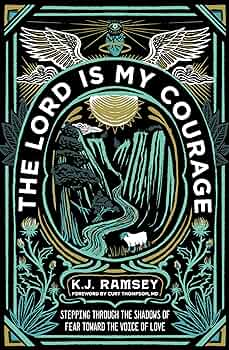
The Lord Is My Courage (book review)

I don’t recall what I thought I was going to get from K.J. Ramsey’s book The Lord Is My Courage. But here’s what I know I got:

  • New Language
  • Deeper Understanding
  • Fresh Appreciation

Ramsey’s approach to this subject is 1/4 part self-therapy, 1/4 part reader-therapy, 1/4 part church culture review, and 1/4 scripture exposition. That’s a lot. For her. And for the reader.

David, who wrote both Psalm 27 and Psalm 23, knew what it was like to have an enemy, knew how it felt to be afraid, and knew how much it hurt to wonder if you are heard.

Chapter 5, “He Makes Me Lie Down”

For this response, I took my time. Like a good meal, it’s better to pace yourself. The two chapters worth savoring the most were Chapters 5 and 20.

Chapter 5 includes nuggets rooted in a distinction of translation. Some scholars prefer a translation of the Greek to read “he settles me down” instead of “he makes me lie down.” Is that a big deal? To K.J., yes. “I thought God was a shepherd who made me lie down.  I needed to encounter God as a shepherd who settled me down.”

These kinds of bites are served throughout the book. The one I enjoyed the most was this one from chapter 20.

In John 16, Jesus is telling us, Peace is found only in my presence. And I will not leave you alone.

And then Jesus says to “take heart,” which can also be translated as “have courage,” telling us that our future is secure because he has already overcome the world.

Fear is just courage’s preamble. When we practice remembering that the Spirit of Christ is our companion, fear simply becomes one more prompt to pay attention to the voice and presence of Love. Fear doesn’t have to be an enemy to conquer. It can be a place to be companioned by Love.

Ramsey definitely follows the theme of the book, folded creatively in each chapter. Here are five illustrations:

  • “Courage is the practice of risking to trust that we have a Good Shepherd who is with us always-no matter what.”
  • “Courage is resisting the hurried pace of modern life and embracing the slower rhythm our bodies need to regulate and rise.”
  • “It takes courage to quit doing things for God to commune with God.”
  • “Courage is choosing to commune with someone who has already chosen to be with us.”
  • “Courage is simply the choice to be found.”

Is this book for you? If you enjoy the Psalms, yes. If you appreciate the integration of scripture and psychology, yes. If you are struggling with current or past church experiences, yes. If you like brain food, yes. If you could use a fresh look at who God is, yes. Chances are, yes.

More Compassion, Less Outrage

I learned this morning that I have a temptation. Devotion #18 in Skye Jethani’s book revealed it.


I relate to Jethani. I don’t share sufficient outrage for some people. Does that mean I don’t get outraged? No. Actually, here’s my temptation-getting outraged at other’s outrage. That’s just as unacceptable. And can be equally exhausting.

When I imagine how Jesus would respond these days, I’m guessing it would be the same as how we read in the Gospels. Did he get outraged? Yes. But he didn’t live outraged. His moments of exhaustion resulted from living from compassion, not anger. Had he lived any other way, he would have never made it to the cross. I’m thankful he never gave in to any temptation, particularly this one.

What’s exhausting us? I pray it’s more compassion than outrage.

Jesus’ Lifestyle

If you want to experience the life of Jesus, you have to adopt the lifestyle of Jesus.

In prepping for a talk, this John Mark Comer quote from The Ruthless Elimination of Hurry made the notes.


If you were to make a list that described Jesus’ lifestyle, what would you include? I made a list of five. Here they are with scripture that illustrate them.

  1. For his Father. “If you keep my commands you will remain in my love, just as I have kept my Father’s commands and remain in his love.” John 15:10
  2. Balance. “And Jesus increased in wisdom and stature, and in favor with God and with people.” Luke 2:52
  3. Prayer.  “Immediately he made his disciples get into the boat and go ahead of him to the other side, to Bethsaida, while he dismissed the crowd. After he said goodbye to them, he went away to the mountain to pray.” Mark 6:45-46
  4. Non-materialistic. “So don’t worry, saying, ‘What will we eat?’ Or ‘What will we drink?’ Or ‘What will we wear?’ For the Gentiles eagerly seek all these things, and your heavenly father knows that you need them. But seek first the kingdom of God and his righteousness, and all these things will be provided for you.” Matthew 6:31-33
  5. People. “When he saw the crowds, he felt compassion for them, because they were distressed and dejected, like sheep without a shepherd.” Matthew 9:36

What else would you add? Consider completing this for a devotional exercise and reply with your thoughts.

Why the Eighth Day?

In his message today, our pastor read this verse:

When the eight days were completed for his circumcision, he was named Jesus  — the name given by the angel before he was conceived. -Luke 2:21

His message had nothing to do with expounding on the significance of circumcision, but a question came to my mind: Why eight days?

So I looked it up, and here’s part of one incredibly interesting article I came across on apologeticspress.org:

Genesis 17:12, God specifically directed Abraham to circumcise newborn males on the eighth day. Why the eighth day? In 1935, professor H. Dam proposed the name “vitamin K” for the factor in foods that helped prevent hemorrhaging in baby chicks. We now know vitamin K is responsible for the production (by the liver) of the element known as prothrombin. If vitamin K is deficient, there will be a prothrombin deficiency and hemorrhaging may occur. Oddly, it is only on the fifth through the seventh days of the newborn male’s life that vitamin K (produced by bacteria in the intestinal tract) is present in adequate quantities. Vitamin K, coupled with prothrombin, causes blood coagulation, which is important in any surgical procedure. Holt and McIntosh, in their classic work, Holt Pediatrics, observed that a newborn infant has “peculiar susceptibility to bleeding between the second and fifth days of life…. Hemorrhages at this time, though often inconsequential, are sometimes extensive; they may produce serious damage to internal organs, especially to the brain, and cause death from shock and exsanguination” (1953, pp. 125-126). Obviously, then, if vitamin K is not produced in sufficient quantities until days five through seven, it would be wise to postpone any surgery until some time after that. But why did God specify day eight?

On the eighth day, the amount of prothrombin present actually is elevated above one-hundred percent of normal—and is the only day in the male’s life in which this will be the case under normal conditions. If surgery is to be performed, day eight is the perfect day to do it. Vitamin K and prothrombin levels are at their peak. The chart below, patterned after one published by S.I. McMillen, M.D., in his book, None of These Diseases, portrays this in graphic form.

Dr. McMillen observed:

We should commend the many hundreds of workers who labored at great expense over a number of years to discover that the safest day to perform circumcision is the eighth. Yet, as we congratulate medical science for this recent finding, we can almost hear the leaves of the Bible rustling. They would like to remind us that four thousand years ago, when God initiated circumcision with Abraham….

Abraham did not pick the eighth day after many centuries of trial-and-error experiments. Neither he nor any of his company from the ancient city of Ur in the Chaldees ever had been circumcised. It was a day picked by the Creator of vitamin K (1984, p. 93).

Moses’ information, as recorded in Genesis 17:12, not only was scientifically accurate, but was years ahead of its time. How did Moses have access to such information? The answer, of course, is provided by the apostle Paul in 2 Timothy 3:16—“Every scripture is inspired of God.”

Boom!

To read the entire article, follow this link.