Journaling For Beginners, Part 3: Three Imagining Questions

In the last week, I heard another pre-determined set of questions that take a different approach to reflective journaling. They came from chapter three, “Hello To the Imagination,” in Padraig O Tauma’s In the Shelter.

  • How would you describe today?
  • Have you seen anything interesting on the way?
  • Is it working?

What I like about this set of questions is their openness. They create reflection that is deeper and broader, not solely focused on what happened after the alarm sounded.

Asking yourself to think about what you saw interesting is a different way of remembering. It’s not asking you to judge. Basically, what caught your attention, what made you curious. Feels like neuroplasticity in action.

Yes, the vagueness of “it” in question three is intentional. You get to decide what “it” is. You might need more than a page for that one occasionally.

Personally, I don’t see myself using this set of questions regularly. But they make a great tool, one I’ve chosen to add to the box.

Photo by Ahmet Yüksek ✪ on Unsplash

Journaling for Beginners, Part 1: Focus on Wins

In the last month, two younger men have asked how to start journaling. Love it. Speaks to many things about their approach to life and their desire to grow.

When I said something akin to, “There’s no right way to journal; you’ll figure out what works best for you,” they both pretty much responded, “Not helpful.”

To be helpful, I shared this approach that I started in January after reading Dan Sullivan and Dr. Benjamin Hardy‘s The Gap and The Gain: The High Achiever’s Guide to Happiness, Confidence, and Success. Bottom line: Focus on Daily Wins.

The exercise is simple. At the end of the day, within the hour before going to bed, write down three wins from the day. This effort has many possible positive outcomes: better sleep, grateful mindset, acknowledging progress, and fostering happiness.

To increase your gain more, a deeper step is to write down three wins to achieve the next day. No more than three. This focus has the potential to improve setting priorities and increasing productivity.

No matter your age or season of life, I’m guessing trying this approach to journaling for the next month could be fruitful, maybe even life changing. After 15 years of this practice, here’s how Dan Sullivan describes its impact:

I go to bed feeling excited about the next day. I wake up the next morning excited. Oftentimes, what happens is I have wins bigger than the three I had imagined the night before.

If you’re struggling in your journaling discipline, give this focus a try. You are already winning. Take note.

Photo by Kelly Sikkema on Unsplash

Honoring Tiny Achievements

Along with back to blogging, I’ve renewed listening to podcast episodes. If I were so inclined, I’d post on a regular basis responses to these episodes. But rather than burden myself with that task, I most often choose to point you to them. But not this time. This episode is too rich. Here’s the first of three responses to a timely episode of Everything Happens.

In Kate‘s conversation with Parker Palmer entitled Standing in the Gap, he shares a twist on journaling worth exploring. Rather than narrow it down, here’s the portion of the transcript for you to hear Parker’s description:

I was talking with this therapist who said, what I want you to do in the midst of this despair you have about being nothing and nobody and of no use, a worm, I want you to start keeping a journal. And I just, you know, drew whatever energy I could and did the fair imitation of a depressed blow up which isn’t a real blow up because you just don’t have the energy for a real blow up. But I said, are you out of your mind? I can’t write a sentence. I can’t read a page. I get lost in the very act of trying to articulate a thought or absorb it sort from the outside. He said, well, I’m not talking about a lengthy discursive journal. I’m talking about a journal of tiny achievements. And I said, what does that mean? And he said, well, for example, you told me that you were finally able to get up at 10:30 this morning, having spent most of the night and morning just in a darkened bedroom hiding under the covers. He says, write that down in the journal. You also you also told me that today you were able to get out on your bike, which is your preferred mode of exercise, because you don’t have to talk to anybody when you’re on a bike. And in this state, you’re incapable of even a simple conversation with a neighbor. You were able to ride your bike for ten minutes. Write it down. Tomorrow, start a new page with a new date. What you’re going to find, if you are faithful to this simple, this journal of tiny achievements, you’re going to find that you’re getting up a little earlier from time to time. You’re going to find that you’re riding your bike a little longer from time to time. The day’s going to come when things are going to start feeling a little more normal from time to time. The pattern of depression is sawtooth. It’s sometimes better, sometimes worse, day in and day out. Now, I was a guy for whom an achievement was writing a new book, selling 100,000 copies, getting great reviews, being invited to give talks and workshops all over the country. That’s how I spent 40 plus years of my life. These didn’t seem like achievements at all. But I today, to this day, in good mental health and in times when things are a little dark, I have recalibrated my sense of what an achievement is, and I embrace myself over much smaller achievements. And at age 85, when I probably don’t have another book in me and I don’t have a lot of post-COVID travel in me, this is probably as important as it was to honor my tiny achievements as it was when I was in deep depression. It’s a tool. And for me, it worked.

Parker has journeyed through several bouts of clinical depression. This suggestion from his therapist has turned into a life-changing, long-lasting practice. He called it a tool. That it is.

I’d also call it a blessing. Why? My last conversation with my spiritual director resulted in my awareness of needing to revive a gratitude exercise I’d abandoned. It’s a tool that helps keep me focused on the best things. It’s grounding. That’s a blessing. I imagine acknowledging tiny achievements also a blessing. Often times, my statements of gratitude seem tiny as well. But boy do they offer recalibration. Seriously, sometimes it’s good to just be grateful for toothpaste and soap. Tiny things usher in humility.

Thank you, Parker Palmer, for encouraging me to not only be grateful for tiny things, but to also honor tiny achievements.

So here we go from the first half of my Sunday:

  • Stopping to get gas before the light came on
  • Retrieving a shopping cart out of the Winn Dixie parking lot bushes so the buggy guy had one less to corral
  • Saving over 30% on groceries (A big shoutout to the inventor of BOGOs…huge achievement)
  • Out of bed after the first alarm…no snooze button today
  • Posting for a second day in a row
  • Not giving in to the temptation to respond to divisive Facebook posts

I encourage you to utilize Parker’s tool before the end of the day. May you find value and peace in your honoring.

Photo by Markus Spiske on Unsplash
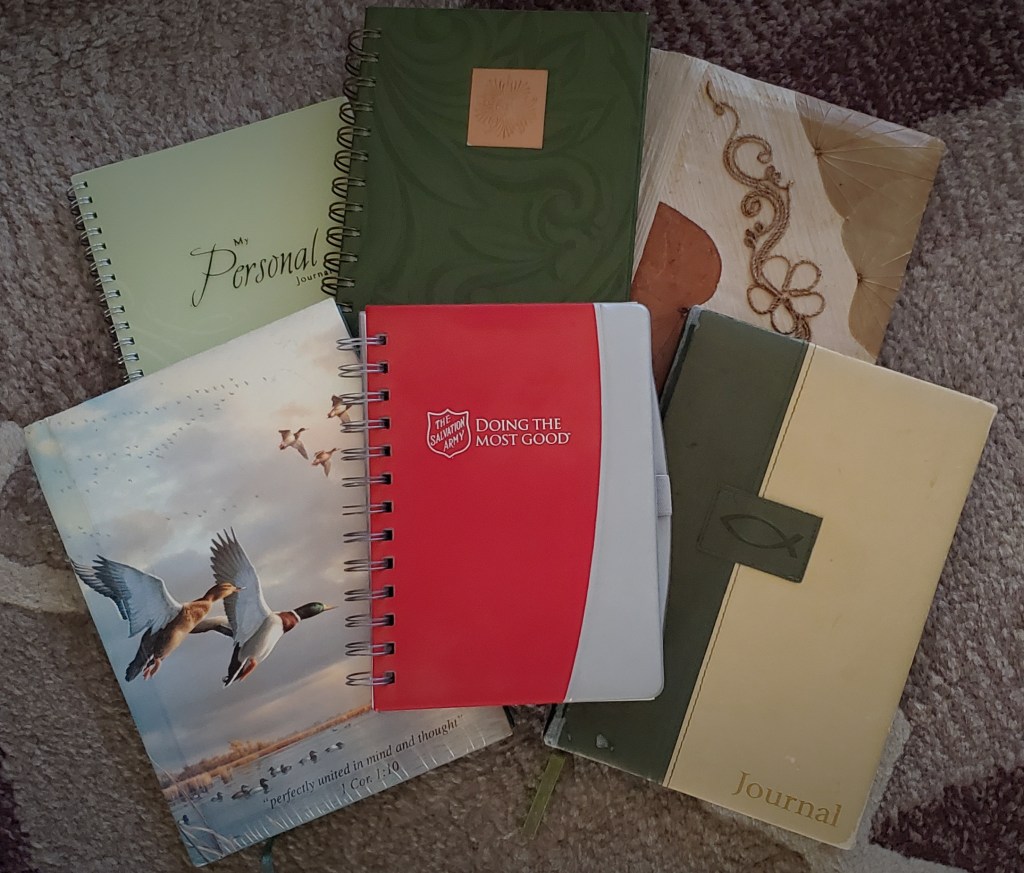
Two Tips for Journaling

Finished the last page of my current journal this morning. Always produces more thoughts and musings. Figured I’d share two of them for other journalers out there.

Question #1: Do I really need to keep them forever?

A few years ago a coaching client revealed they had every journal they’d ever written. So when they revealed how attached they were to them and expressed their bondage to the past, we went down the road of determining what might be healthier when it comes to keeping old journals. After they did some purging, they genuinely felt free from some of their past.

I since have developed a boundary of only keeping journals from the past five years. That’s my healthy mark. If you have never thought about this, it’s worth pondering. It’s possible there’s some freedom available for your heart, mind, and spirit.

Question #2: How often should I look back?

It’s another question based on what’s healthy for you. I took a few minutes this morning to purge and remember. The timing that seems right for my looking back is roughly twice a year. What I noticed this morning were two interesting emotions. Some entries still resonated strongly, strong enough to keep for future remembrance. Other entries that seemed intense when they were experienced were easy to release.

I have no idea how other journalers approach purging and remembering. If you have reflections to share, please do. Or maybe chew on it in your next entry. Either way, may your journaling continue to bring you health and freedom.

Google Result 40,900,001

I just googled the word journaling and got 40,900,000 results. Guess another result can’t hurt.

These six journals contain my entries from Dec. ’99 to March ’12

In an effort to keep shrinking my library, I discarded six journals today. Hard to do? Not really, particularly since they are more than a decade old. And as tempting as it is for me to flip through the pages, instead I dwelt on the value of what was on the pages versus the exact words.

If you journal, you know the value. If you don’t journal, well there are 40 million web results to consider its value. As for my experience, here’s why I value journaling.

  1. Spiritual. This one is first for a reason. In those six journals, my guess is 95% of the content was from the discipline of journaling while engaging scripture reading. During that time frame, I mostly used the acronym SOAP, written about in The Divine Mentor by Wayne Cordeiro, to complete my journaling discipline. My engagement with God and the Bible took on new depth through the words penned on those pages. Pretty sure there’s not a price tag I could put on that.
  2. Emotional. A lot happened in those twelve years including working at three different churches in various roles, moving to a new city, completing a four-year masters degree, handing off a successful piano competition, becoming an intentional runner, and many other personal and family experiences. Allowing pen and paper to process the emotions of such events is beneficial to the one journaling and to those in their world. The value that is most surprising is how those emotions surface more quickly and more healthily due to the writing discipline.
  3. Mental. As one who believes our minds should be in constant growth, the discipline of journaling is a tool that aids that growth. When united with spiritual and emotional focuses, my mind is transformed. After twelve years of journaling, I know things I didn’t know before, I know things I didn’t know I needed to know, and I deepened my value of knowing both of those things.

How I journal, how often I journal, and how it impacts me continues to evolve. That’s reason enough to keep journaling.

We See What We Look For

Recently a friend gave me a copy of Michael Hyatt’s Full Focus journal. So I’ve taken the challenge to complete it’s 90-day design.

The journal page for today had a portion of this quote by author John Lubbock:

What we do see depends mainly on what we look for… In the same field the farmer will notice the crop, the geologists the fossils, botanists the flowers, artists the colouring, sportmen the cover for the game. Though we may all look at the same things, it does not all follow that we should see them.”

― John Lubbock, The Beauties of Nature and the Wonders of the World We Live in

I instantly narrowed that down to this thought: We see what we look for.

How we view what we see is very dependent on what we are looking for. For example, when we read current events or listen to the news, we have biases that filter what we read and hear. How often do we evaluate those filters? How often do we assess if those filters really are ours or are they residual from other influences? Do we ever alter what we are looking for?

As a suggestion, here is a list that I started in my journal to illustrate what I mean. As you read it, consider how such a list in your journal would read.

  • We see God when we look for him
  • We see enemies when we look for them
  • We see offense when we look for it
  • We see opportunity when we look for it
  • We see solutions when we look for them
  • We see danger when we look for it
  • We see rejection when we look for it
  • We see grace when we look for it
  • We see humility when we look for it
  • We see strength when we look for it
  • We see courage when we look for it
  • We see unity when we look for it
  • We see love when we look for it

What are you looking for today? This week? This holiday season?

God’s 2019 Gifts

My Advent devotional this morning focused on this verse:
But Mary was treasuring up all these things in her heart and meditating on them. Luke 2:19 CSB
The devotion challenged that it is important to store up the mountaintop experiences in life in order to recall them for the tough experiences. Mary seemed to realize this at a young age.
In the hardest moments of our lives, we need to remember the victory of Jesus and recall all the ways we’ve seen His goodness. When you experience God’s faithfulness in your life, take a step back and store it up as treasure in your heart. Think of it often. When your toughest days come, like Mary, you will be able to endure. @youversion reading plan
I took this challenge and created an exercise. The exercise was to write down all the gifts God has given me this year. To help me remember, I looked back through my journal (an example of why journaling is a good thing). At completion, my list was twenty deep and filled up the page. That’s a lot of goodness. This exercise could be very encouraging and even worshipful. What gifts has God given you this year? How will you treasure them?

Heard

(Final post in a 5-part series collaboration)

In the first four posts of this series, my guests have shared how they hear from God. Here’s a recap with a link to their post:

Dawn: worship, prayer, personal devotions, preaching, meditation, relationships

Bob: putting God first, asking Him to speak, aligning priorities, talking about him with others

Erin: peace from God after season of prayer, Spirit conviction, through others

Aaron: vision from within (words, peace), scripture

Before I answer the question, I believe it’s helpful to answer another question: What might be keeping me from hearing God’s voice? I believe that can be answered with this word-Noise. God is always present and available, but it’s quite possible he can’t be heard over all the other noise. And if I’m honest with myself, all that noise is entirely within my control.

“If I’m moving at an insane pace and there is no room in my life for quiet, I will miss God’s voice.” –Lance Witt, Replenish

So if I earnestly want to hear from God, I have to control the noise. And what that most likely means is tuning it out. Tuning out:

  • Distractions like social media
  • Voices contrary to godly dialogue (in my own head, lies from the enemy, subtleties in media/entertainment, misguided thinking or content from well-meaning people)
  • By slowing down
  • By scheduling quiet

Once I’ve handled the noise, then I’m ready to tune in to hear from God. Dawn, Bob, Erin, and Aaron have told us how they tune in. Here are five ways I tune in:

  1. Community. As an introvert, a community of one sounds fine to me. But I’ve learned that I rob myself and tune out the voice of God when I resist being in community. So my community consists of small groups from church, routine meet ups with like-minded men, being coached, and engaging in Sunday services by expecting to receive a personal message from God to me.
  2. Journaling. I’m not legalistic about it, but often journaling is a helpful exercise during or after reading scripture. When a thought or challenge surfaces that needs some exploring, that’s what guides how I approach my journal entry. Sometimes it looks like a paraphrase of what I read, putting into my own words or applying it to a current situation. Sometimes it ends up being a written prayer. Sometimes it’s bullet points. Sometimes it’s an outline for future teaching use. If you haven’t tried it and would like some direction, I suggest reading The Divine Mentor by  Wayne Cordeiro. Journaling has the potential of opening up an avenue of conversation that otherwise may not happen.
  3. Prayer. In order to hear from God, prayer should be viewed as an ongoing dialogue, a two-way conversation.  You might say a paraphrase of “pray without ceasing” would be “never hang up the phone.”
  4. Asking and Expecting. Similar to dinner conversation or an email thread, the dialogue of prayer should include more than input from one party. For my part of the conversation, I try to include questions that require an answer only God could give, such as:
    • “How did I do with that interaction with my coworker today?”
    • “What are you trying to say to me through that verse that just came to mind?”
    • “What encouraging words do you want me to share with the grocery cashier?” Ask the question and wait for the answer. He’ll answer the email when it’s time. Or it may wait until the next meal. That’s part of recognizing his sovereignty.  But it’s up to my end of the conversation to ask the question.
  5. Responding. Since all believers are indwelt by the Holy Spirit, there is little doubt that he speaks to us. I have found that one of the best ways to tune in is to simply respond when he speaks. Much like a child who has been called to dinner or given any other direction from their parent, a respectful, “Heard,” helps both parties know they are connected.  And a “Thank you” can’t hurt either.

So what’s your answer? How do you hear from God? A DJ on thejoyfm Tuesday said he got a message from God through feeding his fish. One thing is true-God’s ability to be heard is unlimited. We five writers would like to hear how God is heard by you.

Building Trust

This quote came from my @youversion devotion this morning:

“My perspective of every situation will either encourage or dishearten my trust in God.”

I believe that. So to put it to a test, here’s a simple exercise I started as a journal entry. You might give it a try also.

Make two headings on the page: Dishearten & Encourage

Under dishearten, write a perspective that clearly lacks trust in God.  Maybe something like, “God doesn’t care.”

Then under encourage, write the perspective that counters this statement. Possibly, “God is always at work.”

So far I’ve written four competing perspectives on my page. I’m going to review it daily and add to it throughout the week.  The goal-build trust instead of sabotage it.

What exercise might help you build your trust in God?

When Has God Spoken to You (Journal Exercise Suggestion)

The back was too tight to do a morning run this morning (that’s what stretching and treadmill runs later in the day are for); so instead, God and I had a longer than usual conversation.

During the conversation I got a pretty clear message of something I am to do this week. Receiving that message made me ask this question, “If I made a list of the ‘big, writing-on-the-wall’ messages I’ve gotten from God in my life, what would that include?” 

Seemed like a good exercise, so I did it before I left for the office. As it turns out, in 30 years of adult living, I’d say I’ve received nine such messages. To be clear, “Be nice to idiots is not a ‘big’ message.” The daily messages we receive from the Holy Spirit are nothing more than atuning ourselves to communicating with Him regularly. A big message is something like, “Change your career path,” “I promise you if you’ll stop saying ‘no’ to me about this direction you’ll be 100% satisfied,” or “You’ve been waiting for the green light. Here it is.”

You might call these markers. Markers are specific times or places in our lives where significant things happen. Sure, your wedding day, your child’s birthday, and other physical events are markers. This intentional, spiritual exercise makes you think about your conversations-with-God markers. They can remind you who has been for you, where he has been with you, and what he has done through you.

So what are you waiting for? Get a blank page in front of you. Answer the question. You never know; another “big” message might be ready to get marked.