3 Losses Worth Counting

I resumed listening to Everything Happens this week after referring it to a friend. Always superb.

At the end of episode 8, season 15, Kate made this statement:

The places we come from, the people we love, the losses we carry, they shape us. They shape how we endure, how we hope, how we begin again.

“The losses we carry” struck me. I imagine because that describes some of my experience the last six months. These losses caught me by surprise-I didn’t see them coming. Well, sorta, but not in the way they came.

As I thought about them, a curious thought crossed my mind. “What if, in the effort of naming things, I counted my losses?” It wasn’t a “cut my losses and move on” thought. Rather, it was, “I believe there could be some value in reviewing them, determining what may have caused them, and defining the lessons learned.”

Somewhat like Seph Schlueter’s song Counting My Blessings, but the opposite.

Through this lens, here are three losses that have shaped my year that I’m happy to count:

Losing what I didn’t need-trust in the wrong people. Losing trust is always hard. I’ll go out on a limb to say that’s universal. But however long it takes, we can endure, find hope, and begin again. It took me a couple of months this time. And one key to endurance was leaning in to those who’ve proven they are the right people to trust.

Losing what I’d misplaced-hope in the wrong object. This one is on me. And it’s pretty universal also. We often find ourselves falling for what we can see becoming the object of our hope. If you can see it, it can become your hope bank. But when the wakeup alarm sounds, I see it as a notice to run back to the right object of hope and begin again.

Losing unhealthy emotions-anger for what can’t change. These emotions are everywhere, continuously on display, even celebrated. Exhausting. Disruptive. Gap-widening. They are not to be endured. They can be acknowledged, then I’ve found it best to begin again by working toward the grace to forgive myself for choosing them and averting my mind, heart, and body to gaze, consume, and maybe even fake healthy emotions until they take root and restore hope.

Loss seems harder and harder while aging. Maybe the lack of counting them is to blame. Here’s to better balance. Count it all.

Photo by Hisham Yahya on Unsplash

Single At Heart: Psychologically Rich Living

While traveling a few weeks ago, I read one of the more interesting books for my year.

I intentionally sought out a book on this topic for various reasons, mostly due to observing challenges of recent divorcees and contentment struggles of younger singles. This book did not disappoint.

DePaulo’s approach is thorough, very direct, and heavily researched. You feel like you are listening to an authority on the topic of single living.

Her research led her to this label for those who have come to the conclusion they really aren’t interested in being coupled; they are content in their heart to remain single. To determine one’s level of being single at heart, she developed a 15-question questionnaire. You can find it on this link: https://belladepaulo.com/2019/10/single-at-heart-tell-me-about-your-life-in-your-own-words/

I want to highlight two thoughts in this post and one to follow, although there are many more worthwhile nuggets. The first highlight comes from social research referenced in chapter 1. This study asked people in nine nations to describe their ideal life choosing between three options-happy, meaningful, or psychologically rich.

On their deathbeds, a person who led a happy life might say, “I had fun!” whereas a person who had a meaningful life would think, I made a difference! The parting thoughts of the person who led a psychologically rich life would be, What a journey!

DePaulo determined the psychological richness of single at heart people is the most distinctive, even if they also experienced happiness and meaningfulness. I not only found this insightful, but completely agree.

Following this discussion, she then approached the value of authenticity of single at heart people. Acknowledging anyone of any relationship status can live authentically, she added this insight:

People who are single at heart, though, who are bucking powerful social norms, are especially likely to think deeply about who they really are and what they really want.

These thoughts jumpstart the book. They lay the foundation for what I believe could be excellent dialogue for people of all relationship statuses whose outcome could be psychologically rich living.

Listening to Isaac

Two and a half hours. That’s how long my wait was last Saturday morning from arriving at the Bismarck, North Dakota airport until the first of three flights heading home from vacation.

When you look at the photo above, you see four black chairs by the wall of windows. That’s where I chose to sit and wait. That’s where I met Isaac.

After the first 30 minutes, he moved to the chair beside me to accommodate a couple that walked up. I felt the need to start the small talk. Genuinely curious about his hoodie, I said, “The colors of your hoodie intrigue me.”

The rest of the conversation was mostly him telling me his story. About his marriage, their daughter, the challenge to bring them to America from the Philippines, his learning to walk again following a hospital stay, his struggles about making the right decision, being brought up Catholic, and his resistance to believe in just about anything due to imposters.

Somewhere in the middle he said, “I have no idea why I’m telling you all this.”

When the words ran out, he thanked me for listening and heading to the security line.

Something told me he needed to talk. Not make a decision. Not get advice. Not make a new friend. Just let it out.

Two strangers connected, around ten minutes. Over the colors of a hoodie. And life.

Seen Too Much

You’ve seen too much to do nothing

In the beauty

In the brutal

In the church

In the margins

In friend’s lives

In families

In the loving

In the hurting

In the calling

In the yelling

In the blessing

In the cursing

In the welcoming

In the dismissing

In the running

In the crawling

In the dying

In the living

You’ve seen too much to do nothing

(For deeper understanding, view this message by Pastor Matt Cote)

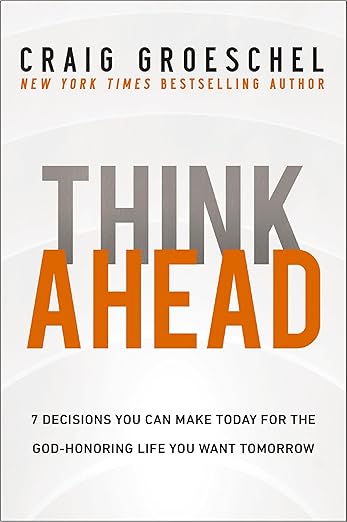
Think Ahead (book review)

Books aren’t like movies. Some movies you can watch over and over (at the top of my list, Moneyball). There are few books I’ve read that I thought to myself, “I would read this over and over.” Actually, outside of The Bible, I’ve only said that about a couple of books.

ALERT: Craig Groeschel‘s latest book Think Ahead makes the list.

What constitutes a book being re-readable? Well, compare that to the benefits of regular exercise. You do it because it’s good for you-you need it to improve your quality of life.

There you go. I believe there are books worth reading more than once because they improve quality of life. That’s the top criteria.

Similarly like regular exercise, there are books that reading it once isn’t enough. Going to the gym only on January 1st annually isn’t enough. There must be multiple visits. Only once doesn’t cut it. Some books have the level of content that you know when you read it, “I’m going to need this again down the road.”

To be honest, the big idea of Think Ahead comes pretty naturally to me. That idea is the power of pre-deciding. In his epilogue, Groeschel says this about that power:

  • Pre-deciding reduces the number of decisions to make.
  • Pre-deciding reduces the fear of deciding wrong.
  • Pre-deciding prevents emotion from taking over.

Whether pre-deciding is a natural way of living for you or not, here’s the deal: no one is perfect. Decision-making can become overwhelming in unforeseen circumstances. Some decisions are harder than others urging paralyzing fear. In either of these scenarios, emotions can lead us astray.

After one read in 2024, I’m pretty sure Think Ahead deserves a second read. And if it is going to improve my life quality, I guess I’m pre-deciding-Think Ahead is on the list to read for 2025.

Heartbroken…There…I Said It

“How are you doing?”

It’s an ordinary, everyday question. But some people have a knack for asking it more like, “No, really. How are you doing?”

I’ve got more than my share of them. Over the last four days, three of them pried. I skirted one, dumped on the other, and indulged the last one.

It wasn’t until listening to the end of the podcast episode I posted about yesterday that the one word to describe how I’m doing surfaced. And it’s one I have never used for myself. I’ve felt and experienced it, just never declared it to be a current condition.

Heartbroken.

Kate: If we think of ourselves as a very sad but also kind of broken in certain parts person, it can feel like, well, that’s not the person who is going to be able to help very much, do very much. We’re already consumed by all the things that have made our lives difficult or tragic in the first place. We are already too aware of the fact that we are living inside of like crosscurrents of things we can’t fix. Kids with intractable problems. Parents with intractable problems. Jobs with intractable problems. But you and I both agree that there’s something weird that happens to the broken hearted, is that there’s like, a kind of an inside-out-ness that happens that can make us maybe exactly the right people to live in unfinished times.

Parker: I think so. This level of engagement, either in politics or in personal and communal life seems to me to require the kind of opening that can comes through broken heartedness. Absolutely. So just as you said, I’ve thought a lot about the fact that there are two ways for the heart to break. It can shatter into shards and just lie useless on the floor, never to be put back together again. Or you can exercise your heart on a daily basis by taking in the little losses, the little deaths, you know, those things that are feel hard to absorb, the news that’s hard to absorb, take it and let it exercise that muscle the way a runner exercises muscles so they won’t snap under stress, and the heart has a chance then to become so supple that it will break open into largeness rather than apart in into shards. And, you know, the most trustworthy people in my life are people who have known broken heartedness, and those who have known it in depths. Those are the people I can go to and say, and tell it the way it is for me. And then, and in the process, experience healing. They don’t have answers for me anymore than I have answers for them. But we can have a conversation rooted in broken heartedness and honesty about that experience that goes somewhere humanly, right?

In my inside-out-ness, I have to say I’ve probably been heartbroken for years without acknowledging it. The recent storms and reactions to the election have brought me to this awareness that I’m oddly thankful for.

I ask myself what’s this about. I didn’t personally experience loss from any of the three hurricanes. Nor did I personally lose a bid for public office. What’s there to be brokenhearted about?

The answer may seem obvious to you, but it’s not always been obvious to me. My Enneagram 1, Myers Briggs ISTJ self tends to be pretty cut and dry. But not recently. At least not these last three months.

I’m leaning into the belief that loving your neighbor as yourself means seeing ourselves as one. When the community hurts, you hurt. When the community loses, you lose. When any portion of the country cries and mourns, you cry and mourn.

The years of brokenheartedness I’m most aware of has to do with my personal church history. To see the church in the middle of the polarization of the country these last five years continues to cut deep. This last week, my heart jolted, even collapsed, as one side hurries to make false biblical comparisons while the other huddles in fear and shock. It’s war. And it’s heartbreaking.

On my run this morning I asked myself two questions: 1) How long do I allow myself to be heartbroken over these two things that personally don’t impact me? 2) What am I doing about this status?

I answered the first one with more questions:

  • Is there a formula? Like, three times the amount of time it takes for all the debris to disappear.
  • Isn’t there more to recovery than just removing and repairing the visible damage?
  • Feels like there’s grief everywhere, right? How long does that take?
  • God’s probably been heartbroken over the Church for longer than I’ve been alive. Where does that leave me?
  • Feels like heartbreak is part of life, and I’m just now owning it. Or at least on behalf of my neighbor. I’ve missed it for a long time, right?

As for question two, my best answer for my spirit was this: Don’t Rush.

  • Don’t Rush to Retort
  • Don’t Rush to Judge
  • Don’t Rush to Wholeness
  • Don’t Rush to Solutions
  • Don’t Rush to Fix
  • Don’t Rush to Start the Day
  • Don’t Rush to Comfort

To the one I skirted, I’m heartbroken. There. I said it.

Cover photo credit: https://www.instagram.com/theoriginalrtpix?igsh=MTkydWQ1MG9qMnJiaA==

DONE

When I tuned into the Olympics yesterday afternoon, a wrestling match was on. Wrestling is definitely one of those watch-only-every-four-years sports. So I left it there. And then this happened.

The wrestler had just won the gold medal. But it wasn’t his first. It was his fifth…in the same event…over five Olympics! He’s the first to do that. INCREDIBLE!

After celebrating, he went to the center of the mat, took off his shoes, and left them there as the sign of his retirement. Read more about him, Cuban wrestler Mijain Lopez, here.

One could have several takeaways from this scene. I’ve landed on two.

One, it’s a great goal to be able to say, “It’s done. I finished what I set out to do.”

Two, it’s a sign of a healthy mind to say, “I’m done with this part of life. I did my best. It’s time to go after my next best.”

Got any DONE goals? What will it require for you to say, “I did my best”?

When I Know What I Don’t Want to Know

Following my last post, everyone lives in a perpetual state of not knowing what they don’t know. Inside of that bubble comes moments when we learn something we’d rather not know. Is it just me, or do those things make you wish you could unlearn them? And, doesn’t it seem like it’s happening more and more, almost daily?

Seven chapters later in Joshua, I’m guessing Caleb could relate with these two questions. His conversation with Joshua was 45 years after learning something very costly. It cost many men he knew their lives. Caleb was promised he wasn’t included in that result, yet he lived with knowing so much that I imagine he struggled knowing.

Knowledge brings choices. I prefer that thought over the thought that knowledge is power. Both can be true; but looking through Caleb’s 45-year hindsight, I lean toward his model of making righteous choices versus abusing bestowed power with his knowledge.

CHOICE #1: Knowledge doesn’t make you king.

Caleb may have been tempted to envy Joshua or to disrespect his predecessor, Moses. He didn’t, I believe, because he made the choice not to pursue a physical position of authority just like he didn’t assume one in his spiritual life. Caleb was not the king of his life. His choice led him down a long, hard, unchosen path resulting in generational blessings no other man with his knowledge received.

CHOICE #2: Knowledge doesn’t dictate direction.

Realistically, Caleb could have taking a direction in an attempt to act on what he knew. Yet, year after year after year, he chose to submit to a direction that must have seemed avoidable and sorrowful. What kept that choice in tact was a promise, a promise that sustained and grew his strength around each turn to his final destination.

CHOICE #3: Knowledge does offer servanthood.

Another guess I have about Caleb is that he viewed life as a gift. Life didn’t owe him. It didn’t owe him power or guarantee him ease. This view of life molded him into a servant. He allowed it. He welcomed it. He embraced it. That’s why 45 years later he reaped a servant’s reward.

When we know what we don’t want to know, may be all be drawn to Caleb’s choices. For the long haul. For everyone’s future. For the promised land. For the Promise Keeper.

Photo by Caleb Jones on Unsplash

Saving Lives: We All Can

Recently in a class I was facilitating, two references to suicidal ideation were unexpectedly mentioned. The first one was definitely out of nowhere for me and the rest of the class.

The main topic of that night’s class was finding peace in your beliefs. Naturally, the first presenter of three on the night’s program was a pastor. While he was speaking, a participant shared this in the chat (Zoom meeting):

I just want to let you know that you saved my life when I found you on tiktok.

The second reference to the possible loss of life was shared by the second presenter, a church attendee sharing their story in finding a church home. Part of this story included suicide consideration-this after serving on several church staffs, by the way.

After hearing these personal stories from two people who could easily no longer be on earth, a connection crossed my mind. The theme of the class was finding peace. These two had a season where they were searching for peace. In that season of lacking peace, their lives were at risk.

CONNECTION: Lack of peace is life threatening.

I shared that connection with the class and then offered this encouragement to everyone. Whatever you have offering peace to any community (family, neighborhood, work, church, city), your offering saves lives. It’s not only the pastor who brings peace by preaching or aiding someone in securing their personal beliefs. It’s also the teacher who asks the student about the bruise. It’s the law enforcement officer who delivers good news. It’s the grocery shopper who commends the cashier. It’s the neighbor who offers to mow the yard. It’s anyone who takes time to notice and inquires when they sense a lack of peace.

Any effort to bring, restore, support, or provide peace is life saving. For them. For you. For us.

“Blessed are the peacemakers, for they will be called the children of God.”

Matthew 5:9

Child of God, how did you make peace this week? Congratulations! You saved life.

Photo by Priscilla Du Preez 🇨🇦 on Unsplash

What Version of You are you living?

Everything matures. Some with intention. Some by nature.

Two examples of intentional maturity: running shoes and cell phones.

This Saucony running shoe image is the Kinvara line. I have a pair of 13s. 15s are due out soon. They pump out a new version of shoes quite often. Some better. Some not.

We’ve seen the lines of cell phone consumers waiting to get their hands on the latest upgrade. They put it out. We’ve got to have it.

Humans certainly mature both by nature and intention. A simple google search reveals experts say we have anywhere from three to six stages in our developmental categories. Those categories include emotional, mental, social, physical, and spiritual maturity/development. In this moment, we are in various stages in each category. You could call that your 2024 version.

In the last 24 months, this topic has surfaced occasionally. Since it came up this week over coffee (and hot chocolate), I took a look at my journals to recall other thoughts and conversations how my friends and I categorize ourselves. 

One of those entries came as a result of this quote by Charles Taylor printed on the page of my Full Focus Journal: “We are in fact all acting, thinking, and feeling out of backgrounds and frameworks which we do not fully understand.” My journal entry was this:

I don’t know who Charles Taylor is, but this statement is very true. I’ve decided this about my adult life:

20s – full of myself (judging, complaining, criticizing)

30s – questioning just about everything

40s – settling down and finding balance

50s – listening at a whole new level

Some move through these things faster/better. The reality is we do the best on the journey we’ve been given. God’s grace meets each one of us in the moment, waits for us to see the light, declares, “You are mine. Always will be.”

12/29/21

A year later there’s an entry simply headed “5.0”. I remember that coming from separate conversations with two friends, one who said they viewed themselves as being in 2.0 mode. We looked at it differently; my view was by time to determine I’m in 5.0 mode. So I wrote a journal entry describing what 5.0 John could entail. Intention over nature.

I share this because one hope I have for myself and those I engage is that we live intentionally rather than by nature alone. I believe most of us share this hope. It’s on us to put action to that hope. 

Here’s to a hopeful and intentional 2024 version of us all.

Photo by Rod Long on Unsplash