Ladder to the Light (book review)

Finished listening to Steven Charleston’s Ladder to the Light this afternoon. I’m fairly certain I checked it out after following a reference in Becoming Rooted.

Charleston’s ladder analogy is the crux of the book, seen by these chapter titles:
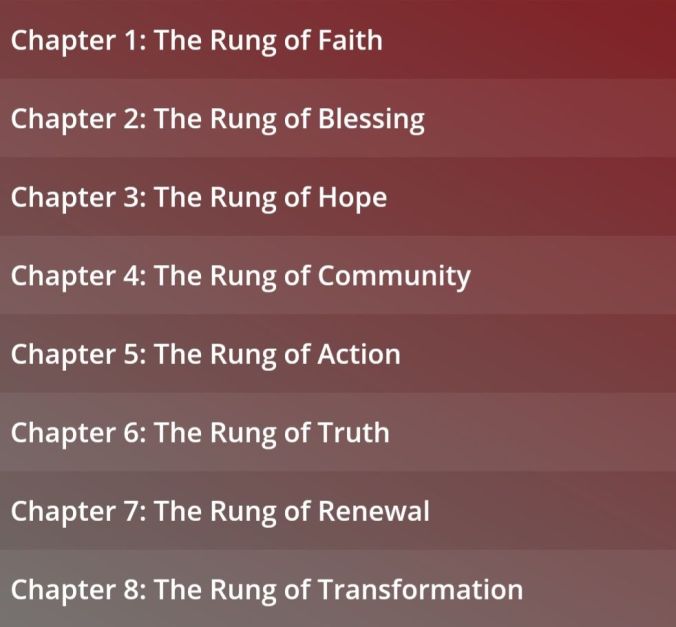
Charleston’s explanation of a kiva lays the foundation for why and how the darkness we experience should and can be addressed. A gradual ascent on each rung takes you out of the darkness and into the light.

Charleston’s theology is a mix of various religions, but its basis is Christianity. What I found most connecting for anyone of any religion is his constant contrast between the darkness and the light. We may not all agree on what falls in the category of dark, but hopefully we all could agree on the need to climb out of it.

The authors of both of these books have broadened my faith through their meditations, convictions, and actions based on their faith. I believe you could find the same by reading or listening to these works.

FYI, Charleston posts daily spiritual reflections on his facebook page. Follow this link.

And There Was Light (book review)

Last year I came across Jacques Lusseyran’s story by reading a collection of his essays. Before I left on my Christmas road trip last week while looking for an audio book to listen to, I was thrilled to find Lusseyran’s memoir, And There Was Light. What a story to listen to during this season of the year!

In my 2024 Library posting that you’ll find tomorrow, I’ve called this book the most thought-provoking book I read this year. Here are five reasons:

  • Lusseyran convinces you he can see light despite being blind
  • Lusseyran and his young friends lead a significant Nazi resistance in France
  • Lusseyran shows you the power of words, both spoken and written
  • Lusseyran reminds you of the strength of the human spirit whose foundation is faith in God
  • Lusseyran proves odds can be broken

There are so many quotes worth noting from this memoir. That’s one downfall to listening to it-unable to highlight them. However, I’d encourage you to listen to it rather than read it. Andre Gregory’s narration draws you into the world of a blind child who grows into a hero, a choice he made so all would be drawn to the light.

If you are a lover of history, check out this book.

If you enjoy World War II stories, check out this book.

If you are clueless like I was about the French resistance, check out this book.

If you wish to better understand the world of the blind, check out this book.

If you wish to shine light into the dark, check out this book.

The Unhappiness We Create

Jacques Lusseyran (1924-1971) was a blind author, professor, and leader of the French Resistance in WWII. At age 19, Lusseyran was arrested and spent nearly 15 months in the Nazis’ Buthenwald concentration camp. When the U.S. army arrived, Lusseyran was one of roughly 30 survivors of a transport of 2,000 French citizens.

In this collection of Lusseyran’s essays, he recounts becoming blind at age seven, reactions to societal progression, and observations from Buthenwald.

Essay #1, “The Blind in Society,” is his revelation that after his blindness he became aware of an inner light. Here’s one illustration of his observation of that light:

When I was overcome with sorrow, when I let anger take hold of me, when I envied those who saw, the light immediately decreased. Sometimes it even went out completely. Then I became blind. But this blindness was a state of not loving anymore, of sadness; it was not the loss of one’s eyes.

In the final essay, “Poetry in Buchenwald,” Lusseyran shares the power of poetry. His sharing of poetry with fellow prisoners brought hope and happiness. From that, he had this to say about unhappiness:

Unhappiness comes to each of us because we think ourselves at the center of the world, because we have the miserable conviction that we alone suffer to this point of unbearable intensity. Unhappiness is always to feel oneself imprisoned in one’s own skin, in one’s own brain.

I share these two thoughts to record them for future reference. I also share them in hopes that we move more toward love to eliminate the unhappiness we create in ourselves.

Running Blind

The other morning I woke up before the alarm and decided I might as well get up and run. Out the door before 6, it was still dark. Roughly 3/4 of a mile out, running in the bike lane through my neighborhood, I approached a clump of something in the lane. As I got closer and a passing car’s lights lit up the lane, I figured out it was a dead possum. Roughly 20 yards later I stepped over a dead armadillo. Then within just yards I had to maneuver around two huge palm branches crossing the lane. Within that same patch, cars timely passed so I could see and not do something stupid.

Thinking about it later, I remembered this verse I’d read and journaled about recently from I John 2:11.

“Those who hate a fellow believer are in the darkness and walk around in the darkness; they do not know where they are going, because the darkness has blinded them.”

Ever noticed how hate makes you do stupid things. Even while you’re doing them your mind is saying, “What is going on? I don’t want to do this. Where is this coming from?” Sometimes it’s not until much later, after you’ve totally blown it, that you figure it all out. Then you have to humble yourself, or at least you have the choice, and admit what was driving your outrageous actions.

Thank God for the light of love. It reveals the dead stuff, guides you to a better path, and helps you avoid roadkill and debris.

Choose it. Run in it. The alternative – running blind – can be quite costly.

(FB post from 8/27/2011)

Photo by Kouji Tsuru on Unsplash

Be Light

As the Community Care Director for a counseling center, it’s not uncommon to be in conversations about suicide. Yet, no matter how common it may be, it has yet to feel normal.

And the reason why is because it’s not. It’s a sign of hurt and pain. We live in a broken world, which can result in people’s minds taking them down this dark road. And it’s no respecter of minds.

  • The middle-age pastor’s mind that goes home after leading a Sunday service and questions why he should go on.
  • The twelve-year-old middle schooler’s mind that leads her to a parking lot where she chooses to end her pain.
  • The senior citizen’s mind that says, “I’m done fighting this battle with my body.”

As I witnessed again this morning, when a hurting mind is met with love, empathy, and strength, healing is available. It’s not instantaneous; it’s one step at a time. A step, however small it may be, toward the light may be all that mind needs to stop spiraling into darkness.

Be light to those you know or suspect are lonely, hurting, or in pain. That is normal. And it needs to be more common.

Photo by Melissa Askew on Unsplash

Light

Light uncovers

the begging to be

seen, corrected, confessed, forgiven, celebrated, heard, protected, cleansed.

Light pulls

out the

disfigured, undiscovered, forgotten, lonely, hurting, rotting, hidden, stolen.

Light comes

rhythmically to every

morning, home, friend, neighbor, child, field, highway, mountain.

Light resurrects

what darkness

broke, destroyed, severed, tore, distorted, invaded, belied, abandoned.

Light wins

in every

heart, mind, city, neighborhood, country, family, room, soul.

Photo by Josh Boot on Unsplash

Participating in Mystery

Recently a colleague referenced this book by Pat Schneider:

After doing my usual thing of sampling it on Kindle, I purchased it. (NOTE: “Usual thing on Kindle” means if I’m enticed to highlight while reading the sample, it’s more than likely an eventual purchase.)

At first I wasn’t enticed, but then came these two lines from the same paragraph:

When I achieve true waiting, true listening, something happens that I experience as a gift…If I am made in the image of the creator, then I am myself a creator, and my acts of creating participate in mystery.

That first line grabbed my attention. It aligns with several messages I’ve heard recently, the most recent while driving to Orlando yesterday. (NOTE: To radio DJs, your words carry power.) I’ve lived most of my life feeling like I’ve taken on a burden when someone shares intimate stories with me. I’ve been eased and encouraged lately to see these sharings as gifts, completely altering how I listen and experience the moment.

And that second line, it’s a different way to say what I’ve often told others. We are creators. We are creative. We were created to create. Opening our minds to that truth and expanding our definition of creativity frees us to “participate in mystery.”

16 more chapters. What light awaits?

Break a Cup

Here’s one other memorable story from David Platt’s book Something Needs To Change. While visiting a home housing girls who had been rescued from trafficking, he learned one example of how they were led to see themselves.

On a table in the room, I see cracked glass tea cups. The woman who leads the home, Liv, tells us how these cups were an art project. In a recent class, the group talked about seeing beauty in the middle of brokenness. Each girl was given a glass tea cup and asked to break it by throwing it on the floor. The girls were hesitant at first, but one by one they threw their cups and watched them shatter into pieces. Then each girl was asked to glue her cup back together, piece by piece.

Next they placed a small candle inside each cup and lit it. The cracks in those broken cups actually allowed the light of the candles to shine brighter. That led to a discussion of how in our lives we might feel broken because of what we’ve done or what’s been done to us. But if we let him, God puts us back together and the light of his love shines brightly for others to see, even through our hurts.

There are many “ifs” in this scene.

  • If they talked
  • If they threw them down
  • If they put them back together
  • If they lit the candle
  • If they let God

Beauty is hidden when we stay stuck in the ifs. The enemy loves our being stuck; our Redeemer longs to fully free us in order to shine through us. Are you stuck? Maybe it’s time to break a cup.

Repentance Defined

I’ve been thinking about repentance this week. Read a @youversion plan. Heard a sermon.

I can’t say I’ve ever really considered how I would define it personally. I’ve always leaned on others’ definitions, such as this one from the @youversion plan:

Repentance isn’t doing something about our sin; it is admitting that we can’t do anything about our sin.

I like that one. Certainly puts my mind in the right direction. Less about my ability and more about my need.

Here are a few definitions I’ve written this week:

  • A repentant heart is a softened heart.
  • A repentant heart has turned away from the dark and turned toward the light (Jesus said he was the light).
  • Repentance is when I stop disagreeing with the truth (Jesus said he was the truth).
  • Repentance is possible when the light finally comes on.
  • Repentance begins when I accept my self-given excuses are lies. 

This is a good exercise-defining repentance. Give it a try and see what it does to your heart and to your relational status with the truth and the light.

31 Proverbs Highlights: #4-Growth

(A simple series highlighting verses from each chapter of the book of Proverbs)

“The path of the righteous is like the light of dawn, shining brighter and brighter until midday.” ‭‭Proverbs‬ ‭4:18‬ ‭HCSB‬‬

The imagery of the path’s light getting brighter and brighter as the morning progresses seems to go along with the truth that spiritual growth is a process.

The more you walk in righteousness the clearer choices/decisions seem to be.

The more you seek God the closer he seems to be.

At salvation, you come out of the darkness. Sure, it can seem quite bright at first. But walking the path of sanctification only brings more brilliance.

Walk On to the Midday!