Behind the Curtain: 3 Questions Leaders Must Ask (Post #1)

(Written by Mark Stanifer, SightShift Certified Coach and founder of Dare2LiveCoaching.com)

“What questions must be answered to ensure your public persona matches your behind-the-curtain private one?”

John posed that question to me recently. While he didn’t elaborate on where it came from, knowing John there was an experience that led to him asking himself that question first. And then he followed his curiosity, wondering how others would answer it. In this article, I approach the question from a leadership lens. But, in truth, what follows applies to anyone who wants to fully be who they were created to be.

In thinking about that question, I couldn’t help but consider some very public and horrendous examples of where leaders displayed public personas that were very different than the one behind the curtain. Mark Driscoll, Bill Hybels and Ravi Zacharias come to mind immediately. Despite any positive impact these leaders had, it is now obvious that what was behind the curtain did not match the image on public display.

These are just three negative examples. The splashy and traumatic ones that make the news. There are countless others, as well as countless examples of where the public and private personas did match. Although they don’t make the news, no doubt you’ve experienced both.

So what makes the difference? What are the ingredients that lead to congruency in the personas of some and not others? What can we draw from the failures, and not just the epic and public ones, that will help us avoid similar outcomes? I’m going to borrow a line from C.S. Lewis’ opening forward to his book, Mere Christianity, here. There are “far more, and more talented, authors already engaged in such matters” as to the numerous differences between leaders who are congruent or not in public and private personas.

Instead, let’s return to the original curiosity of what questions can help lead to congruency for the leader.

The Temptation of Jesus

In Luke 4:1-13, the gospel writer describes the testing of Jesus in the wilderness. The importance of the experience Jesus had immediately before this — his baptism and the Father’s affirmation of Jesus’ identity — cannot be overlooked when considering the wilderness account of chapter 4. Jesus knew who he was and where he was going before facing the test of the wilderness. That was the foundation that allowed him to pass the test.

Yet, in the testing, we see a glimpse of what all leaders face. Jesus, as a man, was subject to the same temptations we face. Paul affirms this in 1 Corinthians 10:13. The Message version says this, “No test or temptation that comes your way is beyond the course of what others have had to face.” Including Jesus.

James 1 also talks about testing and trials and temptation. It’s helpful here to think of these words as describing a process of refining, so we can be “mature and complete, lacking nothing” (v4). In other words, the tests and temptations which life brings are opportunities the Father uses to help us become the fullest and best expression of who He wants us to be.

Although likely obvious, it is worth stating that the congruency of public and private persona to which we’re aspiring in this article is one in which the leader’s example is loving God and loving others. Christ-like. And with Jesus as the example, we find in his wilderness temptation three questions a leader can ask to help pass their own tests. To help keep the visible persona aligned with the behind-the-curtain persona.

Take or Give

The first test Jesus faced came after a 40-day fast. Jesus was hungry. The account in Luke 4:2 says so. It is not true to the text or Jesus’ humanity to believe otherwise. Jesus’ tempter surely understood that; otherwise the first question would have been different. There is no doubt that Jesus desired food. But in that moment, his desire for food was not greater than his desire to be grounded in who he was, who the Father said he was.

The first question a leader can ask is this: Where am I trying to take for me rather than give for others?

Jesus had the authority and the power to do what the tempter was suggesting. He had the desire for food; anyone fasting for only a few meals know that same desire. He had the means. He had the motive. And now had an opportunity. Yet he resisted the temptation. He passed the test and was refined in the process, because he chose not to take for himself.

This isn’t to say that desires should be denied or ignored. Hunger, left unfulfilled, doesn’t give life. Desire is natural, and God ordained. But when desire is not channeled by the grounding of one’s identity it will result in the choice to take rather than give. The consequences of taking for oneself could be small or they could be significant. Think of David and what his desire did to Bathsheba and Uriah and the ripple effect on his kingdom and impact as the leader.

Motive is important here. It’s what makes the difference between cooperating with the testing (refining) process and pushing against it. This first question helps the leader uncover the motive surrounding the desire — Is it for me and my gain or for the benefit of others?

Photo by Tim Marshall on Unsplash

(Series continued tomorrow)
Testing Google

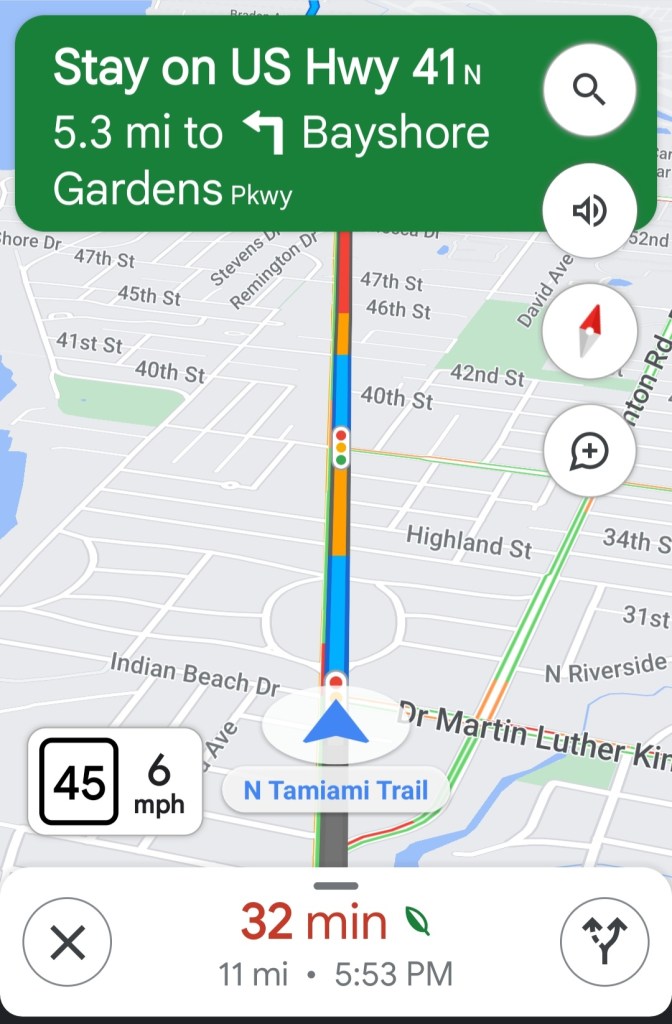
From my front door to the office is 18 miles. Depending on the time of day you drive it, it can take anywhere from 33 minutes to over an hour. I’ve experienced the shortest, the longest, and all the in-betweens.

I typed 33 minutes because at this moment that’s the estimated drive time according to Google maps. I use it quite often in order to find the best route, particularly when my drive is at peak traffic times. That usually means driving home in the afternoon. Here’s a screen shot from my drive this past Tuesday.

I may be the only person (pretty sure I’m not) who looks at that ETA time (5:53) and says to myself, “I better at least get there by that time, or even better, beat it. Game On!” A little motivation and self-competition isn’t bad, right?

What I’ve found is they’re not bad until I create an emotional expectation. And that emotion can turn into thoughts like, “What the heck with these lights? Come ‘on, Manatee County! Fix these lights!” or “People, drive with purpose. Why are we driving 33MPH in a 45MPH zone? Get off my road! I’m on the clock, here!”

On my less emotionally competitive drives, I decide to pay attention and see what I can learn or enjoy. On Tuesday I decided to test Google rather than rant at the lights or other drivers. Often on the drive at any given time Google gives me options. Each option designates the difference of my remaining drive time by reading something like “2 minutes slower” or “Similar ETA.” But unless I look at the map, I have no idea all the options that I have mid-drive. On this 18-mile drive, there are dozens of options. I can ignore them and just follow the original route demanding that it live up to its promise to get me there the fastest, or I can consider other options may not be the fastest but could bring some other unexpected benefit worth the alternate route.

The test basically became how many minutes are lost if I ignore Google and go whatever route I want. Google’s directions aren’t the law; they are suggestions. And on this drive, I ignored them several times, probably three, just choosing whatever option I felt like. The end result-I arrived at the same time Google predicted, 5:53.

There are several possible takeaways from this scene. Go with whatever comes first. But mine is, I have options. Any man-made or man-given map uses the best data available. That doesn’t demand it be followed mindlessly. On the flipside, God’s map doesn’t always make sense or align with the best data nor sit well with my expectations. And that’s where I’ve learned the value of surrendering to options.

Google isn’t God. No other map reigns over his; they don’t have his data. His route will have me arriving at whatever time is best but only in the mind and spirit possible by choosing his option. It’s worth the test.

Praying Your Desires

James points out a couple of issues in prayer in chapter four.

You desire and do not have. You murder and covet and cannot obtain. You fight and wage war. You do not have because you do not ask. (James 4:2, CSB)

Issues: Lack of right motive and lack of asking

What if we addressed both issues simultaneously? Here’s a suggestion how:

  1. Write down your top five desires
  2. Ask God to check your motives behind each desire
  3. Edit the list as needed
  4. Then pray over the list

I did this exercise today. Here’s what I realized:

  • What I listed as my desires were not things I have regularly been praying for
  • The act of writing down my desires while asking the Holy Spirit what he thought about them made checking my motives easier and, as a result of having already invited him into the exercise, made prayer a normal, flowing, and immediate outcome

Give yourself fifteen minutes to try this exercise this weekend and see how yours goes. Let’s go after praying our desires.

3 Self-Talking Points to Temper IOS

What is IOS? No, it doesn’t have anything to do with Apple. However, you can see people battling it as often as you see Apple products. IOS is a syndrome you have dealt with sometime in your life. People suffer with it on social media, tv shows, in the board room, and at the family reunion. It would be nice if there were a pill or shot for it, but so far, no.

We’ve all dealt with it, particularly in our formative years. When you gave that first book report in 3rd grade, when you got your first job, when you picked your date up for prom-it was heavy. Some people overcome it quickly; others struggle with it all their lives. Overcoming IOS may be a process or could be a defining moment. I had a defining moment my junior year in college and another a few years later that seemed to loosen the grip of IOS. Regardless of its hold on someone, the reality of it being loosened is real and is possible. 

This syndrome is Impressing Others Syndrome. Recognize it? Have you overcome it? If not, your self talk could be a solution. Most likely, your self talk is fear-based, maybe even lies you’ve been deceived to believe. 

So how do we counter those lies, that fear? Overcoming IOS will take addressing it at its roots. Those roots of lies and fears should be countered by our identity and truth as God sees us. The challenge is very personal, testing what we believe and just how true our convictions are. Our self talk should be based on truths that strengthen us to defeat IOS. These three are a great start.

  1. “God loves Me.” He created me and made me who I am. Who I am includes my looks, my abilities, my personality. He knows my history. No one else knows me like he does. His love is unconditional, and my performance and choices do not change it.
  2. “The best motives are eternity-focused.” Checking our motives should be a constant priority. Satan loves to tempt us to be temporally motivated and thereby tell ourselves to focus on things that have little or no eternal worth. When you check this root of IOS, you may discover the main self talk to change.
  3. “I’m a work in progress.” This reality can be personally humbling and also critically diffusing. This also creates in us a teachable spirit which allows us to not live for approval as much as growth. That’s a big difference.

What are you telling yourself? Lies or truths? Fears or convictions? IOS’s grip can be loosened. Ask God for your best self-talking points and be free.