In Psalm 115, the writer describes the gods of other nations besides Israel’s. He makes an interesting comment in verse eight. He says those who make their own gods will become like the gods they trust.
It certainly is convenient to make your own god. Making a god allows for the worshipping of that god to also be up to the maker. So the philosophy can go something like “make your own god, make your own rules, make your own values, make life what you want it to be and you should be happy and fulfilled.”
The challenge of making your god is that your god is confined to the stuff you used to make it. Since that stuff was determined by a human, then that god can only serve humans within their own limits. For me, I need something more. And I’d rather become like something more.
When the Maker and Ruler of the universe expresses a desire to be my god, I’m drawn to consider that option over any other option. He has the best chance to work outside of what I can do, make, or value. I choose to let Him continue to make me, in essence continue to create me into His likeness. I’ll take my chances on fulfillment and happiness in becoming like the god who made me rather than any god I could make.
A couple of months ago I got this text from my pastor:
How can I be praying for you today? You’re always asking me…
11/1/22
I responded with a 15-minute phone call-too much to explain in a text. I told him I knew what I wanted to do regarding a decision, but I wanted to take the time to see if it aligned with what God would have me do. The final thing he said was something like, “Be open. You might be surprised with the answer.”
I thought about our conversation when I read these thoughts this morning in my devotional plan:
When we ask God for wisdom, we must be willing to accept that wisdom and follow it, no matter what. Going to God is not like going to another person for advice. People are flawed. When they share their opinions, we have the right to disagree and disregard their advice. Not so with God. He is perfect, and His wisdom is flawless.
God will always guide us into what is best for us. His wisdom may not always be what we want to hear, but it is always true, always right. If we want to retain our rights to do whatever we please, we might as well not go to God in the first place. Until we are ready to lay down our rights, they will always be tugging at our souls. When we choose, however, to disregard our own desires and to follow God’s truth, we will receive the wisdom and guidance that will always lead us into His perfect plan for our lives.
That November conversation came to mind pretty easily because what I wanted to do was not how God answered me. However, within days of “disregarding my own desire,” God clearly honored that decision in a way that only he could.
Here are three takeaways from this layered interchange:
Offer to pray for someone. It could be direction-changing.
Be open to God’s answers. They can be surprisingly good.
You have options when seeking wisdom. Leaving God out isn’t a good one.
From my front door to the office is 18 miles. Depending on the time of day you drive it, it can take anywhere from 33 minutes to over an hour. I’ve experienced the shortest, the longest, and all the in-betweens.
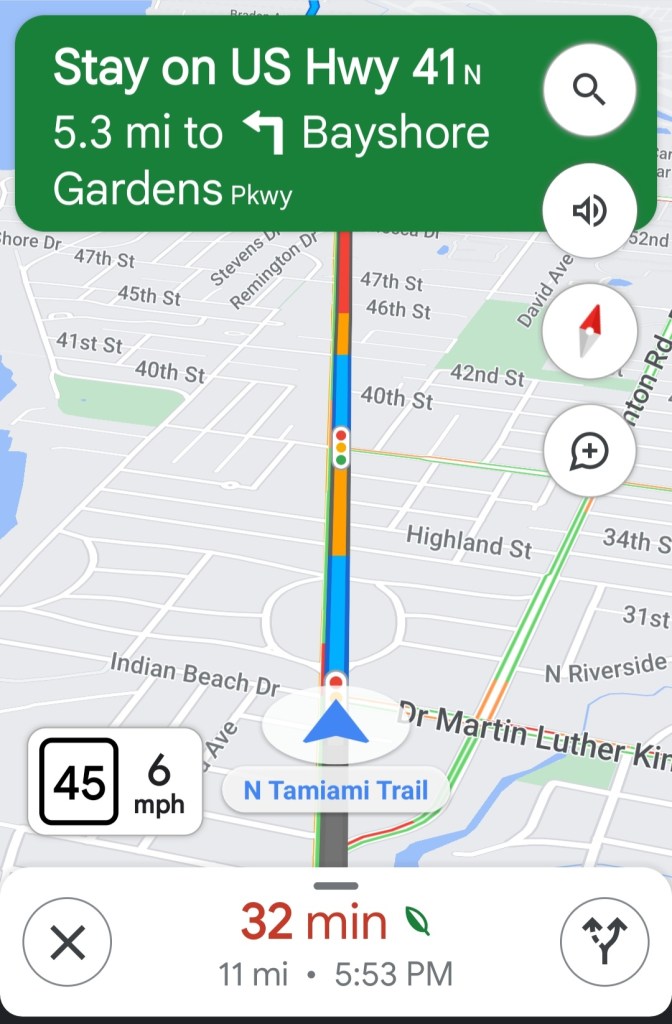
I typed 33 minutes because at this moment that’s the estimated drive time according to Google maps. I use it quite often in order to find the best route, particularly when my drive is at peak traffic times. That usually means driving home in the afternoon. Here’s a screen shot from my drive this past Tuesday.
I may be the only person (pretty sure I’m not) who looks at that ETA time (5:53) and says to myself, “I better at least get there by that time, or even better, beat it. Game On!” A little motivation and self-competition isn’t bad, right?
What I’ve found is they’re not bad until I create an emotional expectation. And that emotion can turn into thoughts like, “What the heck with these lights? Come ‘on, Manatee County! Fix these lights!” or “People, drive with purpose. Why are we driving 33MPH in a 45MPH zone? Get off my road! I’m on the clock, here!”
On my less emotionally competitive drives, I decide to pay attention and see what I can learn or enjoy. On Tuesday I decided to test Google rather than rant at the lights or other drivers. Often on the drive at any given time Google gives me options. Each option designates the difference of my remaining drive time by reading something like “2 minutes slower” or “Similar ETA.” But unless I look at the map, I have no idea all the options that I have mid-drive. On this 18-mile drive, there are dozens of options. I can ignore them and just follow the original route demanding that it live up to its promise to get me there the fastest, or I can consider other options may not be the fastest but could bring some other unexpected benefit worth the alternate route.
The test basically became how many minutes are lost if I ignore Google and go whatever route I want. Google’s directions aren’t the law; they are suggestions. And on this drive, I ignored them several times, probably three, just choosing whatever option I felt like. The end result-I arrived at the same time Google predicted, 5:53.
There are several possible takeaways from this scene. Go with whatever comes first. But mine is, I have options. Any man-made or man-given map uses the best data available. That doesn’t demand it be followed mindlessly. On the flipside, God’s map doesn’t always make sense or align with the best data nor sit well with my expectations. And that’s where I’ve learned the value of surrendering to options.
Google isn’t God. No other map reigns over his; they don’t have his data. His route will have me arriving at whatever time is best but only in the mind and spirit possible by choosing his option. It’s worth the test.
Three Saturdays ago I was sleeping the day away, pretty sure I had COVID. Test came back the next day affirming my suspicion.
I test my health often by running. Can I? How did it go? Do I need a nap soon after? Yadda yadda.
Thankfully my case was mild. I “ran a test” with a decent 5k the following Wednesday, but not every run since has been an indicator that all is well.
Earlier this week I set a plan to run each day this weekend-a progressive schedule of six miles on Friday, seven on Saturday, and eight on Sunday. Nothing new. This was a routine schedule this past Fall.
Not sure what it is, but Friday runs since the Summer have occasionally been rough. Yesterday was one of them. I cut it short, ending up with 4.15 miles. I haven’t let my mind look at Fridays any differently…well, until yesterday.
So last night and this morning I debated how far I should run this morning. Not running wasn’t an option I considered. I landed on simply running the same route as yesterday and see how the six went. Around mile two my legs felt pretty much like yesterday, not quite as sluggish. I decided it didn’t matter what pace I had to adjust to, how much walk/running I had to do, six miles was happening today.
A little over three miles I stopped for a quick water break in the park. I didn’t stop long. I didn’t want my body to tell my mind what to do. Somewhere in mile four my legs perked up. I told myself, “Go with it.” I adjusted my course and ran past my next turn taking the next road instead.
I ended up taking four more such turns and completed just under seven miles…with more in the tank.
Here’s my takeaway. We all have days when things don’t go according to plan. We all have to deal with letdowns, apparent failures, missed goals. At the end of those days when we assess the next one, we have options. They range from shutting down to overcompensating. Usually, somewhere in the middle is the best option.
How your next day goes is entirely up to you. You have options.
 John Gregory