Psalms: Being Prayed Over

Many of my more moving moments of prayer have been when someone is being prayed over.

Maybe it’s because we don’t do it enough. Maybe it’s because we wait too long. Maybe it’s simply because it’s the breath of communion.

Each time my spiritual director prays over me, there’s an invitation and connection with the Holy One. Those two things are always in reach, but they seem energized by the words and spirit of a fellow believer.

I’ve witnessed this twice in the last two months while praying over believers in emotional and spiritual pain. It seemed either they were hearing words they didn’t know how to voice or cries exactly aligned with their hearts. These were holy communion moments.

In a different but similar way, I’ve experienced this by an unexpected means this week. Rather than reading my daily scriptures, I’ve utilized the audio reading on the app. Since I’m in Psalms, my experience feels very much like I’m being prayed over. Phrases rang truer, praises raised higher, and promises rose stronger.

Maybe scripture feels lifeless for you today. Maybe someone reading it over you would restart your inhaling and exhaling.

Maybe you’ve ran out of words to pray. Maybe someone praying over you could pick up where you left off, even say what you didn’t know how to or knew you needed to.

Communion awaits.
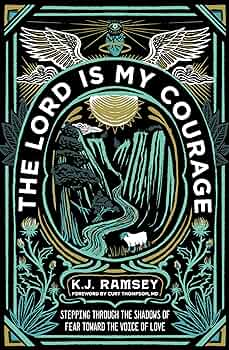
The Lord Is My Courage (book review)

I don’t recall what I thought I was going to get from K.J. Ramsey’s book The Lord Is My Courage. But here’s what I know I got:

  • New Language
  • Deeper Understanding
  • Fresh Appreciation

Ramsey’s approach to this subject is 1/4 part self-therapy, 1/4 part reader-therapy, 1/4 part church culture review, and 1/4 scripture exposition. That’s a lot. For her. And for the reader.

David, who wrote both Psalm 27 and Psalm 23, knew what it was like to have an enemy, knew how it felt to be afraid, and knew how much it hurt to wonder if you are heard.

Chapter 5, “He Makes Me Lie Down”

For this response, I took my time. Like a good meal, it’s better to pace yourself. The two chapters worth savoring the most were Chapters 5 and 20.

Chapter 5 includes nuggets rooted in a distinction of translation. Some scholars prefer a translation of the Greek to read “he settles me down” instead of “he makes me lie down.” Is that a big deal? To K.J., yes. “I thought God was a shepherd who made me lie down.  I needed to encounter God as a shepherd who settled me down.”

These kinds of bites are served throughout the book. The one I enjoyed the most was this one from chapter 20.

In John 16, Jesus is telling us, Peace is found only in my presence. And I will not leave you alone.

And then Jesus says to “take heart,” which can also be translated as “have courage,” telling us that our future is secure because he has already overcome the world.

Fear is just courage’s preamble. When we practice remembering that the Spirit of Christ is our companion, fear simply becomes one more prompt to pay attention to the voice and presence of Love. Fear doesn’t have to be an enemy to conquer. It can be a place to be companioned by Love.

Ramsey definitely follows the theme of the book, folded creatively in each chapter. Here are five illustrations:

  • “Courage is the practice of risking to trust that we have a Good Shepherd who is with us always-no matter what.”
  • “Courage is resisting the hurried pace of modern life and embracing the slower rhythm our bodies need to regulate and rise.”
  • “It takes courage to quit doing things for God to commune with God.”
  • “Courage is choosing to commune with someone who has already chosen to be with us.”
  • “Courage is simply the choice to be found.”

Is this book for you? If you enjoy the Psalms, yes. If you appreciate the integration of scripture and psychology, yes. If you are struggling with current or past church experiences, yes. If you like brain food, yes. If you could use a fresh look at who God is, yes. Chances are, yes.

Becomer’s Whispers

‭Did something a few weeks ago that I haven’t done in a while. Went to an actual bookstore. It was for work, but how does a reader go in a bookstore and not make a personal purchase?

So on my running trip two weeks ago, one of the books made the trip. I’m 15 chapters in.

Chapter 14 is entitled “Whispers.” This paragraph starter got my attention:

There is a verse in Psalms that says, “God whispers to those who trust him.”

Made me want to look it up. Couldn’t find it. Then I checked the chapter notes.

Psalm 25:14, author’s paraphrase

I respect that.

Next I opened my Bible app to compare various translations of this verse. Here are three that come close to Sowers’ paraphrase:

  • Psalms 25:14 ERV‬
    [14] The Lord tells his secrets to his followers. He teaches them about his agreement.
  • ‭Psalms 25:14 TPT‬
    [14] There’s a private place reserved for the devoted lovers of Yahweh, where they sit near him and receive the revelation-secrets of his promises.
  • ‭Psalms 25:14 MSG‬
    [14] God-friendship is for God-worshipers; They are the ones he confides in.

Chapter 14 is in Part 4 of the book entitled “Becoming.” These verses’ images encourage me to be becoming.

Making God

In Psalm 115, the writer describes the gods of other nations besides Israel’s. He makes an interesting comment in verse eight. He says those who make their own gods will become like the gods they trust.

It certainly is convenient to make your own god. Making a god allows for the worshipping of that god to also be up to the maker. So the philosophy can go something like “make your own god, make your own rules, make your own values, make life what you want it to be and you should be happy and fulfilled.”

The challenge of making your god is that your god is confined to the stuff you used to make it. Since that stuff was determined by a human, then that god can only serve humans within their own limits. For me, I need something more. And I’d rather become like something more.

When the Maker and Ruler of the universe expresses a desire to be my god, I’m drawn to consider that option over any other option. He has the best chance to work outside of what I can do, make, or value. I choose to let Him continue to make me, in essence continue to create me into His likeness. I’ll take my chances on fulfillment and happiness in becoming like the god who made me rather than any god I could make.

Photo by Jackson David on Unsplash

Family Grace

Today I was privileged to attend the celebration of life for a friend’s husband who passed last year. Due to COVID concerns, the family put off holding a gathering until now. I had only met her husband once that I recall, so I was attending purely to support her. I have found that when I attend such gatherings without much history with the deceased I actually walk away with more to think about. No exception today.

The top thing that struck me was an admittance from the youngest son. In his sharing about his dad, he spoke transparently stating that they hadn’t always had the greatest relationship. He said he didn’t want to go on about that. Instead he said this:

As an adult I’ve come to realize that parents are people to. My dad was a person. We all mess up.

He then went on to tell terrific stories of how he relied on his dad in many ways and will miss his being there to give advice and fix his mistakes. He gave a terrific image of how he remembered feeling like his dad would be behind him watching him do something and sensing that his dad wished he could wrapped his arms around his sides in order to fix what he wasn’t doing right. He said he imagines that his dad is still doing that.

This husband/father/friend was loved. And it appears he was loved because he accepted everyone’s humanity including his own. Could that be the answer to a tight family? Each one receives and shares grace out of their acceptance of their humanity?

As I listened to this son laugh and cry talking about his dad, this passage came to mind:

As a father has compassion on his children, so the Lord has compassion on those who fear him; for he knows how we are formed, he remembers that we are dust. The life of mortals is like grass, they flourish like a flower of the field; the wind blows over it and it is gone, and its place remembers it no more. But from everlasting to everlasting the Lord’s love is with those who fear him, and his righteousness with their children’s children-with those who keep his covenant and remember to obey his precepts.

Psalm 103:13-18

May families remember that they are dust.

May families receive and share grace.

May families bask in the everlasting to everlasting love of the Lord.

Photo by Brett Jordan on Unsplash

Pick Them Up

When a baby is distressed, they’re distressed because they are sleepy, hungry, uncomfortable, cold. And the way we respond to newborns is we pick them up…We are helping them begin to learn that when you are in distress you express your distress and someone comes to comfort you.

Curt Thompson, MD

Several takeaways from this statement in Episode 7, Season 1 of Being Known.

  • It’s normal to express distress. We were born doing it.
  • It’s normal to comfort someone who is expressing their distress. The majority of us have been comforted and can reciprocate it.
  • Comforting someone is picking them up. We pick each other up when we respond to distress cries with comfort.
  • The ultimate picker-upper is God. We express our distress through prayer. He comforts. He picks us up.

Are you in distress? Who are you sharing it with? Where can you trust to go for comfort? Have you expressed your distress to God?

Do you know someone in distress? How can you pick them up today? Have you prayed for God to pick them up?

Psalm 113:1-9 (The Message)

113 1-3 Hallelujah!
You who serve God, praise God!
    Just to speak his name is praise!
Just to remember God is a blessing—
    now and tomorrow and always.
From east to west, from dawn to dusk,
    keep lifting all your praises to God!

4-9 God is higher than anything and anyone,
    outshining everything you can see in the skies.
Who can compare with God, our God,
    so majestically enthroned,
Surveying his magnificent
    heavens and earth?
He picks up the poor from out of the dirt,
    rescues the forgotten who’ve been thrown out with the trash,
Seats them among the honored guests,
    a place of honor among the brightest and best.
He gives childless couples a family,
    gives them joy as the parents of children.
Hallelujah!

Photo by Heike Mintel on Unsplash

A Prayer for 2021 (Psalm 90)

My devotional on youversion today focused on Psalm 90 written by Moses. The writer zoomed in on verse 12, the reflective prayer opportunity in Moses’ words. I chose to read the whole chapter and then compare it in several translations. That’s when I came across the passage below from The Message.
Oh! Teach us to live well! Teach us to live wisely and well! Come back, God —how long do we have to wait?— and treat your servants with kindness for a change. Surprise us with love at daybreak; then we’ll skip and dance all the day long. Make up for the bad times with some good times; we’ve seen enough evil to last a lifetime. Let your servants see what you’re best at— the ways you rule and bless your children. And let the loveliness of our Lord, our God, rest on us, confirming the work that we do. Oh, yes. Affirm the work that we do! (Psalm 90:12‭-‬17 MSG)
These words seemed timely. I don’t remember reading them before from The Message. As I read them I was drawn to the action words of the prayer: teach, come back, treat, surprise, make up, let, affirm. Of those seven, I highlighted the four phrases that spoke most to me. I then wrote my own prayer, adding my 2021 focus. If I were to summarize that prayer, it would request, “Surprise me this year by showing off who you are.” What words in this passage speak to you? How would you word your prayer for 2021? Photo Credit: Ben White on Unsplash

Real Life Psalm 46:10

More than once this year, people have quoted Psalm 46:10 in conversations reflecting on 2020. This week, God has reminded me of it in two ways.

First, by this excerpt from a book I’m reading, Talking to High Monks in the Snow:

Once, I listened to a biologist. She had been awarded a grant supporting field study in the Kalahari Desert. It was the opportunity of a lifetime. Over vast distances, in a rented Land Rover, she scurried here and there. She marked sites. She took readings. She made plans. Always rushing to the momentous occasion, triggered by the distant rains, when the animals she studied would appear.

One day, the Land Rover overheated. In order to reach water and safety a strategy was devised. The vehicle could travel a few kilometers each day. Then the engine required rest to cool down. The result was that scientist was forced to spend many hours in remote locations where she had no business being. It nearly drove her mad.

There she was, with so much urgent busyness to be doing, in a place where nothing could be done. Loathing to waste time she transcribed her notes. Then she reread her field manuals. She stared impatiently across the vast wilderness, willing the coming of the rains, and the animals, or at least of a spare and sprightly jeep. “Here I am in the Kalahari,” she fumed, “having worked all my life to fulfill a girlhood dream. Here I am and everything has been thwarted.”

Then as the hours turn to days, it dawned on her. She was in the Kalahari with eyes and ears and time on her hands. This was her girlhood dream. The biologist took a deep breath and looked around. Some insects labored in the sands. She watched them for a while and her anxious pulse rate slowed.

And as the days stretched to a week, she noticed the subtle shifts in the scent of the desert during the day. She noticed that at a certain hour, if certain conditions prevailed-like 32 distinctive signs accompanying an auspicious horoscope-then small iguanas would appear.

Over time, her drive to achieve scientific notoriety eroded, and her sense of wonder emerged. In the desert the biologist found her motto. It is one that she carries to this day.

“Don’t just do something,” the scientist said to me, “sit there.”

Second, by this statement from a friend who’s facing COVID:

“It has been a remarkable feeling of God being shoulder to shoulder with me this week.”

Justice Must Be Foundational

Righteousness and justice are the foundation of your throne; faithful love and truth go before you. Psalms 89:14 CSB
This week I along with some friends completed a youversion reading plan by Dr. Tony Evans answering the question “What is Biblical Justice.”  A couple of thoughts stood out to me:
  • There is no clear and right definition of justice that excludes God.
  • Biblical justice encourages freedom through affirming accountability, equality, and responsibility by linking the spiritual to the social realm.
The last devotional referenced this verse from Psalm 89. I’ve read it many times over the years, but never has its words been more powerful than when considering the topic of justice. The imagery of the throne of God being built on a foundation of justice is transformational. Before fulfilling his mission for which he left that throne, Jesus gifted one last act of justice by caring for the repentant thief, this while dying unjustly. That’s justice found in one’s foundation. As a citizen of God’s kingdom, I must align myself with that foundation. In order for the King to reign in my heart, mind, and soul, justice must be sought and preserved. That’s possible if it’s in my foundation. Photo Credit: Unsplash/Mirko Blicke

Known: The Secret to Meaning

(Post #3 in a 4-part series collaboration)

By Shelby Welch (bio below)

Mark Twain is credited with saying, “The two most important days of your life are the day you are born and the day you figure out why.”

When I typed in “Meaning of Life” into Google, it gave me 2,350,000,000 results. It gave me results about books, videos, lectures, and numbers-all these different ways that people have tried to find meaning in their lives. Wikipedia even attempted to give possible answers such as to realize one’s potential, to seek wisdom and knowledge, to do good, to love, to have power-even the ultimate nihilistic answer: life has no meaning.

We see it over and over in media. Children dreaming of what they will do one day. Young adults trying to find what they are supposed to do with their lives. Middle-aged people trying to find purpose after a large upset in their lives. And the elderly scrambling to find meaning before their time on this earth runs out.

I am not guiltless in this pursuit. I have sought meaning to my existence in love, in friendships, in academics, and in achievements. Spoiler alert: they all come up empty. Lovers leave you. Friends betray you. Someone will always outsmart you. Someone will always outscore you.

But this year in my reading I think I may have discovered the secret. In C.S. Lewis’s The Problem of Pain, he points out the ultimate meaning behind Man’s existence. “If He who in Himself can lack nothing chooses to need us, it is because we need to be needed.” Our purpose in life is not that which we can give God but that we may be loved because we are His. Oh, how freeing it is to know that the merit of my life is not based on what I can achieve but on what my God has done for me.

Psalm 139:17 reads, “How precious are your thoughts about me, O God. They cannot be numbered!” Lewis calls it “the Intolerable Compliment.” That the God of all the Universe would choose to love Man, the one creature that is continually rejecting him; that he gives us the opportunity to love him back. That is the purpose of life. That we are known and loved by our Creator.

Thank you, Father God. Thank you for all that You have created and all that You do in our lives. Remind us of our purpose when we become anxious and weary, when we become tired and downtrodden, when we become weak and insecure. Remind us that our purpose is not in being the best parent in the world, not in being the highest-ranking employee, not in achieving all the accomplishments our peers have, and not in the relationships we choose to form. But that our purpose is to be known and loved by You. May we spend the rest of our lives learning to love You more.

Amen.


Blogger Bio: Shelby serves the animals and clients of Bishop Animal Shelter. She and her husband Frank met while studying at Florida Southern College and were married November 12, 2016. Shelby has swam with sharks.