Journaling For Beginners, Part 2: 30-Day Challenge

Another approach to journaling is answering a pre-determined set of questions. I’ve come across two this year that I’ve engaged.

The first one I started on Easter Sunday. It was a 30-Day challenge created by Alex Banayan, author of The Third Door.

Now, before you dismiss it thinking you can’t commit to something 30 days in a row, here’s your better option. Think 30 consecutive journal entries. Some missed days along the journey are to be expected and shouldn’t be viewed as failing. I took 40 days. No guilt or shame.

The focus is similar to yesterday’s post-a review of your day. But answering three questions may take a little more time and thought. Here they are:

  • What filled me with enthusiasm today?
  • What drained me of energy today?
  • What did I learn about myself today?

The balance in these questions is healthy. You give yourself an opportunity to engage what fills you, to overcome what drains you, and to grow in understanding yourself.

Banayan encourages this reflection as a final entry following the challenge: Read back over your entries to identify patterns for all three questions. That exercise will take some time. No rush. I didn’t do that in one setting, by the way. Took one question at a time over a couple of days.

What I liked about this challenge was that it led to progress. If you’re wanting more from your journaling than reflection, this challenge is for you.

Photo by Jac Alexandru on Unsplash

Intentions and Invitations

When people ask when I started running, I make a distinction in my answer. The distinction occurred in 2007 at age 39.

The fifteen years prior I ran, but there was no structure to it. I wasn’t following a plan, didn’t set any goals, had no purpose outside random decisions to go for a run. At best, I ran three times a week for less than 10 miles; I didn’t track it and wasn’t concerned about it. The thought of registering for a race never crossed my mind.

Around 2004 I began running more frequently. Still not tracking or challenging myself to add miles or distance. Just random jogs around the neighborhood. I don’t recall how I started getting considered a runner, but apparently folks around me got that impression. At that point, I wouldn’t have told people, “I’m a runner.”

Two things happened in 2007 that shifted everything. The first one was that I finished my masters degree, which I had started in 2003. While working fulltime, I had kept an average of 11 hours of classes each semester for four years. I had been going at a pretty intense pace. I distinctly remember sitting in my hotel room in New Orleans the week I was completing my last class and saying to myself, “I’m about to have a void in my life. I need to find something to fill it.” When I got home, I created intention to my running. No more randomness.

The second thing really propelled my running forward. And I didn’t see it coming. Two of my work colleagues entered triathlons. They decided they wanted to do a relay and invited me to be the runner. I remember pretty vividly the emotions of waiting at the stage exchange for the swim and bike legs to finish before I took off on the 5k. At that time, a 3.1 mile race seemed long. I had no idea about pacing, even if I could run that far without stopping. And God knows, I wasn’t going to be one of those walk/runners. I had so much to learn.

When I crossed the finish line of that 5k, I had become an intentional runner. My instincts to grow and challenge myself took over, and the rest is a history still unfolding. Another fifteen years have passed. I’ve ran dozens of races, raced in 26 states on the goal to run them all, and have averaged over 1,000 miles per year. These results reveal the power of intentions and invitations.

On this first day of 2023, what intentions would move your life forward? In your career, your family, your relationships, your finances, your spirit, your hobbies, your passions. What invitations you accept or extend would give those intentions a pathway taking you and others toward new heights and depths? A year from today, how would you like to reflect on your 2023 intentions and invitations?

If You Were a Flower Arrangement…

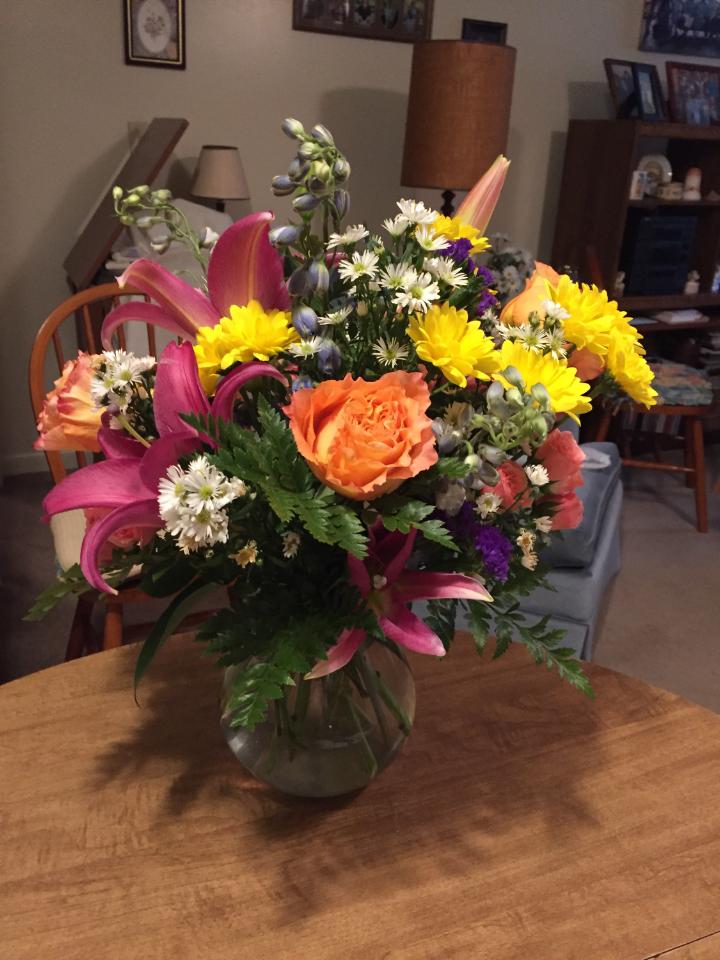
Today I had a terrific call with a coaching client. As they shared their reflections on the year, an interesting symbol came to my mind. It was somewhat fresh in my mind because I had just received it in a text this morning.

This image seemed appropriate to share because of symbolism we had used in the coaching work when we first began. The imagery was based on the petals of a flower. The exercise was to determine how many petals make up the different elements of one’s life and to create an image based on the importance of those elements – in essence, use the image of a flower to put your life in perspective.

That imagery for this client set the tone for eight months of work. Listening to them describe how they see themselves now and where they are on their journey, this idea came to mind. What if the exercise where expanding from the image of one flower to a bouquet of flowers?

So I pulled up this image to screen share:

This was an arrangement my mother received just this morning. After I pulled it up, I simply challenged my client to consider this: “How would a flower bouquet of your life eight months ago compare to one today?” As a person of vision and words, that spoke to them.

If that speaks to you, go ahead. Get out a pad. Write, draw, or both. Take an inventory. How would your life look as a flower arrangement? If you’d like it to look different, what are some things to address as you enter 2022? Pick one flower and start beautifying your bouquet.

Here’s to a nicer bouquet!

Tucson Reflection #1

I’m 53.   That means I’m in the generation between the Boomers and the Millennials.  I find that space an important one.

Each generation plays an important role in passing along knowledge, values, beliefs, worldviews, etc.  In a best case scenario, that happens in homes and offices.  If you’re a Boomer, born between 1946-1964, chances are this happened fairly seamlessly for you.  That means your parents and bosses did their job.

As a Gen-X, born in 1968, I’ve noticed a breakdown.  Whether it happened in Boomer land or my land, the seamless passing along of life’s need-to-knows is no longer a given.  Why do I say this?  Because we’re all saying it.

One way I hear and observe this is the rejection of Millennials (born between 1981-1996) by Boomers and vice versa.  Why? Bunch of reasons. Tom Gimbel wrote this explanation:

Many baby boomers see millennials as impatient, unprofessional, and lazy, while millennials may see baby boomers as unapproachable or old-school. 

https://fortune.com/2017/04/01/leadership-career-advice-millennials-conflict-feud-mentorship/

These insights are barriers-barriers that can be overcome. One overcoming suggestion Gimbel mentions is the importance of setting success expectations. On this suggestion, I’d like to point something out to the Boomers. Root for the Millennials in your world. They may not do things like you, and that’s actually a pretty good reason to cheer them on.

While in Tucson for three nights recently, I watched one Millennial virtually and one in person doing some incredible work. And I thought to myself, I wonder how they are being treated by the Boomers in their world.

The first one was Tommee Profitt. A friend posted a video on Facebook from Profitt’s 2020 Christmas album. I hadn’t listened to the entire album, so I took the time one evening to listen on YouTube. Wow! What an inspiration. I hadn’t really paid attention to Profitt before this hearing, so I did the Google thing. As I read comments about his work, mostly moving and affirming, an occasional statement surfaced stating “he’s not for everyone.” I see that. But what gifts he is giving to the world. Those gifts are “thanksworthy,” from all generations.

That was Saturday night. The next morning I accepted a new acquaintance’s invitation to his church, Saint Philip’s in the Hills. Pleasantly, although the majority of attenders were older than me, there was a youthful presence on the stage. Most speakers in the service appeared to be younger than me. But the one who grabbed my attention was the Rector, Reverend Hendrickson. His reflection was memorable, relatable, engaging, and thought provoking. And the spirit in the room was supportive, celebrative, communal, unified, and worshipful. It appeared the Boomers in this church knew how to root for the Millennials.

On behalf of all generations, thank you, Tucson! You are living proof generations can thrive together!
How to Turn

“I thought about my ways and turned my steps back to your decrees. I hurried, not hesitating to keep your commands.” ‭‭Psalms‬ ‭119:59-60‬ ‭CSB‬‬

1) Turning starts by taking the time to think about our ways

The more often this time is taken the less time will be spent on our ways

2) Turning moves forward by getting back in step with God’s ways

Moving forward and growing in life is best found in step with God

3) Turning is completed in haste

Hesitation is a sign our heart hasn’t turned