A Shepherd Looks at Psalm 23 (book review)

After reading The Lord is My Courage on hoopla, a related title was suggested which I decided to read because of the unique promise. That promise was a look at this poem from the basis of the author’s years as a keeper of sheep. It did not disappoint.
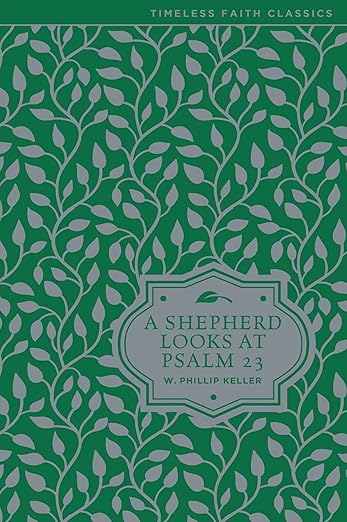
An overall takeaway is just how near death sheep can be unless their shepherd relentlessly cares for them. Keller explains that David’s poem actually addresses all four seasons in a year of a sheep’s life and what is necessary for the sheep to “not want.”

The strange thing about sheep is that because of their very makeup it is almost possible for them to be made to lie down unless four requirements are met…They are free of all fear, free from friction, free of pests, and free from hunger. (Chapter 3, “He Makes Me Lie Down in Green Pastures”)

In that same chapter he explains that a flock that is restless, discontented, always agitated, and disturbed never does well. Sound familiar? The value of being made to lie down is to our benefit.

The most vivid image Keller paints comes in chapter five, “He Restores My Soul.” He draws a parallel between another familiar David passage in Psalm 42:11, “Why are you downcast, O my soul? Why so disturbed within me? Put your hope in God…”

Only those acquainted with sheep and their habits understand the significance of a “cast” sheep or a “cast down” sheep.

This is an old English shepherd’s term for a sheep that has turned over on its back and cannot get up again by itself.

A cast sheep is a very pathetic sight. Lying on its back, its feet in the air, it flays away frantically struggling to stand up, without success. Sometimes it will bleat a little for help, but generally it lies there lashing about in frightened frustration.

If the owner does not arrive on the scene within a reasonably short time, the sheep will die…Nothing seems to so arouse his constant care and diligent attention to the flock as the fact that even the largest, fattest, strongest, and sometimes healthiest sheep can become cast and be a casualty.

He goes on to describe what’s required when he finds a cast ewe, which includes rubbing limbs to restore circulation after picking her up one or more times until she regains equilibrium and starts to walk steadily and surely.

One final noteworthy thought is this one from chapter 7, “Even Though I Walk Through the Valley.” Keller shares that this is a turn in the poem not only from the viewpoint but also in the season being described, how summer and autumn look for the shepherd and his flock. Keller explains David’s firsthand experience by making this statement: “Never did he take his flock where he had not already been before.”

If you find yourself today in search of freedom, or lying on your back flaying, or walking through the valley, rest assured your shepherd is with you. He has what you need. He’s watching over you. I encourage you to find a way to read this book to let those truths grow roots in your heart, mind, and soul.

Photo by Peter Hoogmoed on Unsplash

The Shepherd Beside Us

(By Guest Blogger Dawn Van Beck)

Let’s talk sheep.

Jesus talks a lot about sheep. Throughout most of the book of John, chapter 10, He speaks of sheep as an analogy for His people, His followers.

Therefore, Jesus said again, “I tell you the truth, I am the gate for the sheep. All who ever came before me were thieves and robbers, but the sheep did not listen to them. I am the gate; whoever enters through me will find pasture. The thief comes only to steal and kill and destroy; I have come that they may have life, and have it to the full.” (John 10:7-10)

A shepherd guards the gate to keep wolves out. He guides his flock to green pastures where they find their supply of life. Jesus illustrates how He is the gatekeeper and the good shepherd for each of us. He guards and protects us (His sheep) from danger. He leads us to places of abundance where we find nourishment, comfort, and peace. Resting in the pasture God provides, we find a permanent state of enjoying all we need to live the full, abundant life He desires for us.

Now, you may be thinking this all sounds great and wonderful, but are you and I really being compared to sheep? Is this good or bad? Hmmmmm.

The prophet, Isaiah, suggests we all are “like sheep” and “have gone astray;” “each of us has turned to our own way” (Isaiah 53:6). Research suggests that sheep tend to wander off from the flock and become lost, giving them a common, negative description. Therefore, we assume they are dumb, stupid.

Sheep get a bad rap.

I have a feisty Dachshund named Lilly, who obeys me, most of the time.

She stops what she’s doing when I admonish her. She comes running when I call out her name. She sits at attention and listens for my direction. Lilly is not always successful in her efforts to follow me though. She has her own will. She sometimes wanders off or gets sidetracked, or even lost (mostly due to any nearby lizard diversion). Overall, despite her lizard distractions, Lilly has a sincere intent to please and obey me.

Reflecting on our likeness to sheep, my Lilly comes to mind. I am her gatekeeper, protecting her from harm. I am her shepherd, leading her to sources of sustenance and comfort. Even though she occasionally becomes preoccupied with lizards (and goes astray), she follows me, because . . . she knows my voice.

Jesus speaks again, providing an action step on our part.

My sheep listen to my voice; I know them, and they follow me (John 10:27).

If we desire to be led, we must listen to our leader.

Sheep are not dumb. They are dependent. And they know the voice of their shepherd.

A flock of sheep has a dependent relationship with their shepherd. They require guidance to identify the proper fields to graze in. Given they are easy targets, they need protection from swift, aggressive wolves. Sheep can live with little worries because they enjoy the direction, protection, and strength of their shepherd who leads them so they can thrive.

We, too, are dependent, which is most definitely not a weakness or defect, but rather, a blessing.

How glorious it is to rest under the direction and protection of our shepherd, Jesus. He leads us to lush pasture where there is fulfilling refreshment and shelter from the elements. He does not keep us on a leash (like I do with Lilly) but allows us to freely roam, provided we remain within reach of His voice.

How do we hear His voice?

  • Confess. Eliminate any sin barriers that may prevent you from hearing God’s voice.
  • Read the Bible. Reading Scriptures helps you discover God’s promises and who He is.
  • Pray. Your prayer conversations provide intimate communication with God.
  • Get Quiet. Cut out the noise in your life so you are ready to listen and hear God.

We must trust our leader, Jesus, and listen attentively to His voice. This is how God will lead us to the richest and safest of life-giving pastures.

——

Dawn Van Beck is an author and speaker passionate about helping women discover the redemptive power of God’s forgiveness so they may walk in the freedom of Christ. She has authored several short story collections, which include fiction romance and inspirational stories, along with two children’s books. Her first non-fiction book for Christian women, Deliver Me: Ditching Your Shame and Embracing God’s Freedom, is soon to be published.