When the Body Says No (Book Review, Pt. 2)

After reading the bulk of Mate’s research and arguments, I was ready to take in the final three chapters, particularly #17 and #19.
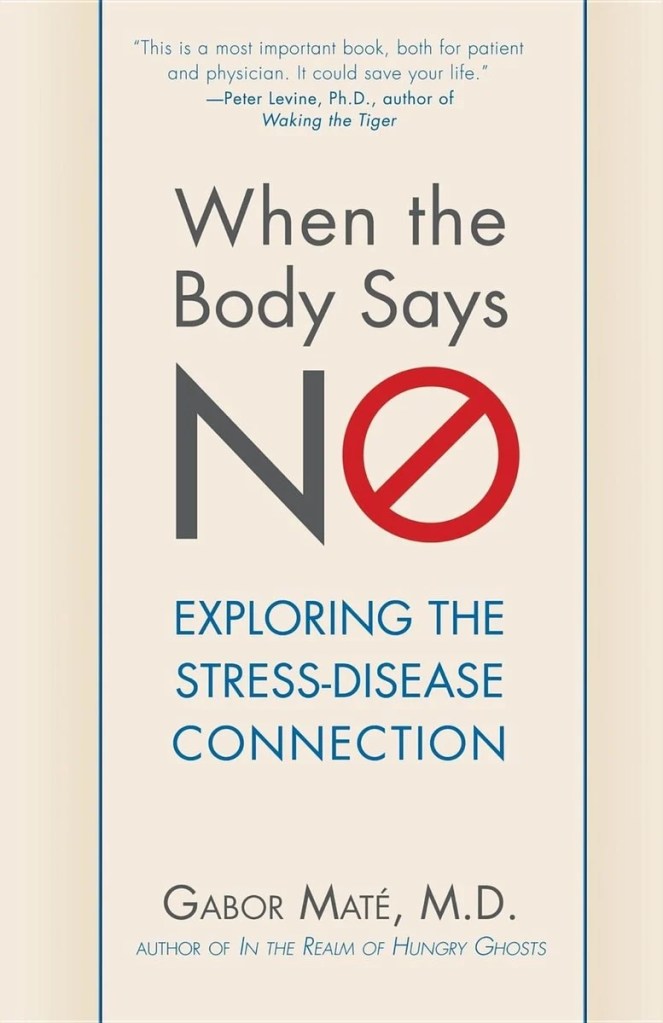
Chapter 17 is entitled “The Biology of Belief,” coined from Dr. Bruce Lipton. Dr. Lipton defines the biology of belief as the process where early experiences condition the body’s stance toward the world and determine the person’s unconscious beliefs about themselves in relationship to the world. Mate shares eight of these unconscious beliefs that control behaviors of defense or growth. He ends the chapter encouraging anyone overloaded with stress induced by these beliefs.

If we would heal, it is essential to begin the painfully incremental task of reversing the biology of belief we adopted very early in life. Whatever external treatment is administered, the healing agent lies within. The internal milieu must be changed. To find health, and to know it fully, necessitates a quest, a journey to the centre of our own biology of belief. That means rethinking and recognizing–re-cognizing: literally, to “know again”–our lives.

For those who may resist this last quote because it sounds void of spirituality, Dr. Mate addresses that in chapter 19, “The Seven A’s of Healing.” Although I have to say, “knowing again” sounds very salvific.

The final A of healing Mate describes is affirmation. Following his outline of the importance of creativity and connectivity, he wraps up the book with this:

Many people have done psychological work without ever opening to their own spiritual needs. Others have looked for healing only in the spiritual ways-in the search of God or universal Self-without every realizing the importance of finding and developing the personal self. Health rests on three pillars: the body, the psyche, and the spiritual connection. To ignore any one of them is to invite imbalance and dis-ease.

May rest and balance be yours.

When the Body Says No (Book Review, Pt. 1)

After several recommendations and references, I have read Dr. Gabor Mate’s When the Body Says No. Even more than after reading The Wisdom of Your Body, I value the connection of mind, body, and spirit.

The two significant beliefs Mate drives are how deeply stress impacts the body and how counterintuitive emotional repression is to the health of any human.

Much of the stress Mate shares from his patient’s stories stem from their relationships.

The nature of stress is not always the usual stuff that people think of. It’s not the external stress of war or money loss or somebody dying; it is actually the internal stress of having to adjust oneself to somebody else. -Chapter 6, “You Are Part of This Too, Mom”

These stories include mostly family relationships. In chapter 15, “The Biology of Loss,” Mate reveals just how encompassing the consequences can be.

It is intuitively easy to understand why abuse, trauma or extreme neglect in childhood would have negative consequences. But why do many people develop stress-related illness without having been abused or traumatized? These persons suffer not because something negative was inflicted on them but because something positive was withheld.

Much of the research on major illnesses like cancer, ALS, Alzheimer’s, and autoimmune diseases, Mate says, reveals how destructive repressed emotion is. For example, here’s a note from chapter 7, “Stress, Hormones, Repression and Cancer”:

In numerous studies of cancer, the most consistently identified risk factor is the inability to express emotion, particularly the feelings associated with anger. The repression of anger is not an abstract emotional trait that mysteriously leads to disease. It is a major risk factor because it increases physiological stress on the organism. It does not act alone but in conjunction with other risk factors that are likely to accompany it, such as hopelessness and lack of social support.

When my father died from cancer at the age of 40, no one discussed these types of factors. The only ones my 12-year-old ears heard regarded eating and work habits. Makes me ask many questions that I’ll never know the answers.

Mate doesn’t have all the answers, of course, but he does offer some hope in the final three chapters, which I’ll share in a second post.