Lay It Down Day(s)

In the Christian world, Sunday is a special day. It’s a day set aside for several reasons, depending on which lane of Christianity you’re following. I’ve been pondering this since before my alarm was set to go off this morning. I’m thinking in some ways Sundays aren’t necessarily special. More on that later.

This week had peaks and valleys. If I’m not paying attention, I can relive the valleys to the point the peaks are forgotten. That’s what I was dealing with to start the day-and I wasn’t even out of bed.

Before the alarm sounded, God and I had a talk. (SIDENOTE: A definition for prayer that I read yesterday described prayer as what happens when you pay attention. It’s okay if you stop to chew on that.) In thinking about heading to church this morning, we landed on this mindset: Everything the last six days have offered did not have to dictate how I showed up to this day. In fact, for the day to be what it’s intended, start by laying down whatever isn’t needed for the day.

What did that include?

  • Unresolved conflict
  • Confusion
  • Unanswered questions
  • Unmet expectations
  • Disappointment

To be clear, by laying it down we didn’t say these things don’t matter. Act like the week was just one big peak experience. Nothing truthful about that.

Laying it down meant don’t let it consume this day. If Sunday is going to be what it’s meant to be, I decided I didn’t need to carry those valleys into it. Today didn’t have to be a valley. The valley could have a small peak.

My word for the year is rest. I’m finding more and more that rest is a state of mind. Rest is possible in the valley just as much as it is atop the peak. It has to be chosen. That doesn’t make the valley disappear, nor does it mean the valley magically lights up. It means my body, mind, and spirit don’t have to hurry finding the path out of the valley. Chances are probably greater if I enter the church doors having already laid things down I will receive what God knows I need. I might even be able to help someone else lay something down.

Which leads me back to Sundays being special. Sure, it’s the day of gathering. But imagine if the other six days of the week were considered just as opportunistic. What if every day was a Lay It Down day? What if God and I had a similar talk every morning before standing up for my first step? I’m guessing that paying attention effort would result in more day’s intentions transpiring, valley or peak.

Four Corners Quad Keyah Series Lesson #5

Sunday came. There were two obvious changes. 1) The start time was 30 minutes earlier. 2) The temperature was 12F, by far the coldest day of the weekend.

I thought I was ready. Sure, I was a little tired from the previous two days, but I’ve been more tired and sore at a start line. I felt like I was layered properly. I believed I had eaten and hydrated well. We were running the same course they had ran on Thursday, which I didn’t run. I had been told, however, that it wasn’t a hard course. My mindset was, “Pace yourself. This shouldn’t be too bad. Do what you got to do and hit the road back to Albuquerque.”

For this course, we first were to run a 5+ mile loop twice in a direction that was new to me. About a mile in it became apparent for the first time that we were gradually running uphill. No canyons on this course like the previous two days. Just straight, but up.

I had thought any concerns about elevation were over. It had not been an issue the entire trip.

It became an issue around mile two. The loop included a turnaround at the top of a hill roughly 2.75 miles in, the highest peak of all 39.3 miles of the weekend. I got there, but it was doing a number on my breathing. Thankfully, to finish this loop was downhill, and I could relax.

I came through the aid station. After getting some fluids, I headed back out for loop two. I knew what to expect. I knew it wasn’t going to be easy. What I didn’t know was my body was shutting down.

Lesson #5: Most likely, there is a way to finish what you started. PIVOT.

It was probably a combination of two things: dehydration and elevation. Hard to tell in the moment. But all the signs were there-at mile 6 of 13.1. Not a good place to be at 12F. 

Running the remaining miles wasn’t going to happen. PIVOT #1: Walk/run the rest of the race in order to finish.

I was layered to run in 12F, not walk. PIVOT #2: Keep moving and get to the car for a self-enforced medical timeout. 

That was a first. Thankfully, it was an option. Since we ran by the parking lot to finish each loop, I knew all I had to do was get back to my car to warm up and add another layer. That was my focus for the next four miles. Without the hope of a medical timeout, I’m not sure I would have finished that loop allowing myself to experience the coldest walk of my life.

Chances are wherever you find yourself on your journey there is a way to finish it. Yes, there are those times it’s not the best answer. In my 76-race history, that’s only happened twice. Those odds are pretty good.

In the moment when it’s clear it’s time to pivot, don’t hesitate. There are options. Surrender to finding the best one and take it. The medal will still be waiting for you when you cross the finish line. This time it will say, “I hang around Pivoter’s necks the same way. Let’s go take a nap.”

8 “Give Me’s” for Waiting

4AM. Not my preferred alarm setting. But you do what you got to do.

I decided what I had to this morning in order to start this day right was to get in a run before having to be in my car by 6:15. After my run around 5:15 while stretching, I found myself taking a longer than usual time to spend some time praying. Very unexpectedly, I got an answer for a prayer I’ve been in for several months, actually most of this year. Maybe that story will come later; but for now, I’m focused on the reality that some prayer answers are a long time coming. That means a lot of waiting.

So it shouldn’t have surprised me that on the same day this answer came an email came to my inbox this afternoon with a prayer entitled “Prayer for the Waiting Time.” It not only was timely, but also affirming.

If you find yourself in waiting time, take your time to read through this prayer by Nicola Slee. These eight requests may be the support you need to carry on, to wait well, and to keep listening.

Give me the resolution to say ‘no’ to the good so that I will be ready to say ‘yes’ to the better.

Give me the courage to keep living in the open-endedness of the future without foreclosing the mysterious work of your Spirit in my haste or fear.

Give me the persistence to stay in the wilderness of unknowing until I am ready to receive your call.

Give me the strength to keep still and keep waiting when all about me is pushing towards movement and activity and choice.

Give me the acceptance to live these days in uneventfulness, simplicity and hiddenness, without craving excitement, distraction, or change.

Give me the grace to live in the emptiness of ‘not doing,’ without the rewards of achievement, fulfillment, or success.

Give me the wisdom to discriminate between my own impatience to move forward and your Spirit’s deep stirring of my spirit when the time is right to move.

Give me the faith to trust in your obscurity, the obedience to stay faithful to your mystery, the courage to keep trust with your inscrutability.

Photo by Şahin Sezer Dinçer on Unsplash

Sunday after Ian

I left town for Ian; technically, I left the state. Even though I don’t regret the decision, there’s a weird sense of guilt that comes with it (that may be for another post).

I got back to West Bradenton Thursday evening. Electricity on. Wi-Fi working. Cul-de-sac cleaned. It was like nothing had happened. But all you have to do is open any social media platform and be brought into the reality that something most certainly had happened.

Friday morning, my church sent out an email stating that the Sarasota elementary school where we meet isn’t able to host us today. So the challenge was issued to, instead of attending a service, serve the community. Here’s the challenge:

Even though we may not be gathering as a church this Sunday, we can still BE THE CHURCH. This Sunday, we invite you to join us in a SERVE SUNDAY. Would you get out and serve the people around you? Imagine the church in action spread throughout our neighborhoods and our city. What a beautiful thing that will be.  
Serve Sunday doesn’t have to look like just cutting debris and clearing yards, although it might be. This could look like making a meal with your kids for families still without power. This could look like taking some cookies to the local fire department. This could look like simply walking the neighborhood and checking in on each home, asking if they need anything.  
Let’s do this, if we see a need, let’s meet a need.

My guilt was already driving me to do something, which I managed to do on Friday and Saturday. I could have let that be it. But something was telling me that wasn’t enough.

This was supposed to be the first Sunday of my serving in a role that had me showing up at 7AM. With that off the table, I decided to drive to the beach to run, of course, but also to find answers to “enough.” Three hours later, God had given more answers than imaginable.

Before heading to the beach, I stopped to fill up the car. I overheard normal conversation about how other customers had fared the week and how challenging it was to have to keep generators running. AWARENESS #1: Not everyone has power yet.

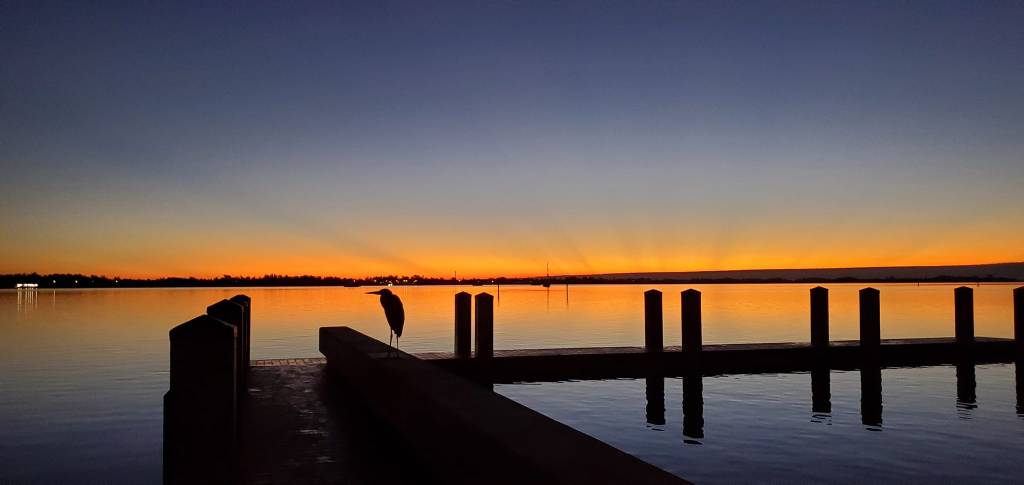
I always park on the Gulf side of Coquina Beach. But not today. The main public parking was not open. Across the street, however, is a smaller parking lot where boat trailers park and have water entry access. And across the street is where you get a great view of sunrise. I arrived just in time to get this shot.

AWARENESS #2: The sun always rises.

I took off north to head back to Cortez road and cross the bridge to Cortez Village. I had just come to the first bend in the sidewalk and this is what I faced (I took pictures after my run for better lighting).

AWARENESS #3: Ian didn’t respect age.

Few people were moving about as I made my way to the bridge. Honestly, I’m not sure how many people are back. Other than cars on the road, it felt mostly abandoned. When I got up to the bridge, I was thinking about just running up to the draw bridge and turning around, but I felt the urge to continue over. As I ran down the other side, my left shoe felt loose. At the foot of the bridge was a slight right turn into a mobile home park that I have never explored. I saw a sitting bench, so I paused there to tie my shoe. That led me down a further exploration of this park and Cortez Village, which was a first.

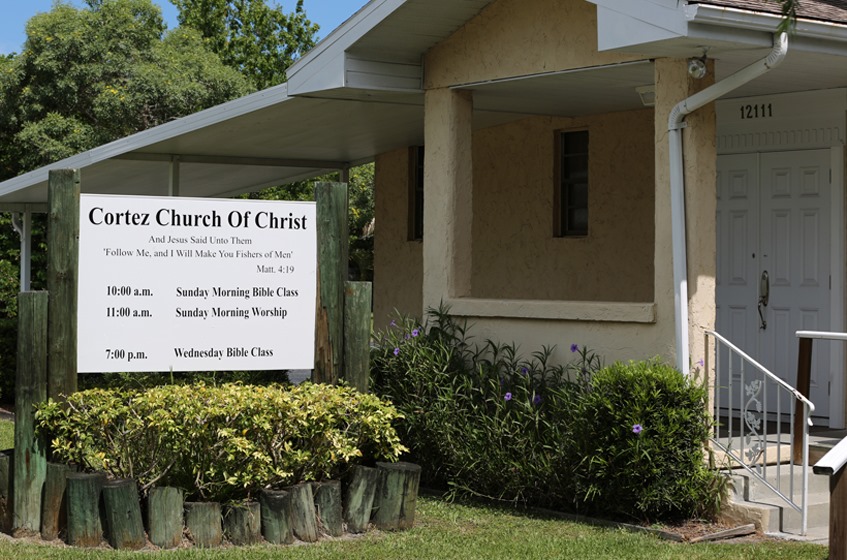
All along my run to that point, my “enough” was to pray for the residents, visitors, store owners, and businesses of Coquina Beach. As I continued that as I ran through the village, out of nowhere sat this little neighborhood church.

Photo from their Facebook page

At first, I ran by it. But then I knew I was to pause and serve this congregation by praying for them. I walked the parking lot. Nothing seemed damaged. It didn’t even look like there had been any debris. Either they’d already cleaned it up and disposed of it, or this little spot had not been touched. I counted the parking spaces; only 15 spaces, four of them handicapped. I thought about the pastor of this congregation. How unique his service is. How alone he may feel. How tempted he may be to believe the lie that his work doesn’t matter. AWARENESS #4: All service to others is service to God.

As I started back over the bridge to head back to my car, I still was asking God to show me what else I could do besides pray. The line “let’s meet a need from the email was my focus. And then it was clear. I had already heard the need. The folks buying gas beside me earlier illustrated a clear need people have. That was the final “enough.”

So back to the gas station I went. And I’m thinking, this is going to be a little weird-walking up to strangers and offering to pay for their gas. And my counter to my self talk was, “It’s only weird if you make it weird, John.”

My question after I pulled into a parking space was, how do I determine who to approach. I decided to just watch and see who might look like they had the most need. And as I watched and waited, it became clear.

I ended up approaching two customers. The first one was an elderly couple in an older car with a handicap license plate. He started walking toward the store with cash in his hand. When I asked if he’d allow me to pay for his gas with my card, he paused to see if I was serious. I let the silence speak. He said, “I have the money.” I replied, “I see that, but how about you keep it for something else.” And that was it. Nothing weird. Just mutual gratefulness. AWARENESS #5: Generosity is a universal language.

The second customer I suspected was serving others himself. He opened his truck’s tailgate and started taking the caps off of three 5-gallon gas cans. When I walked up and asked him if he’d paid for his gas yet, he said no. I asked then, “Will you let me pay for your gas?” Too bad we haven’t figured out how to take photos just with eye contact yet. He looked stunned, and his mind was swirling. Again I let the silence speak. The first thing he could say was, “I’m usually the one offering to help others. No one has ever asked me something like that.” My search was over. Customer #2 was enough. Those gas cans were to keep the generators running in his neighborhood. AWARENESS #6: Seek and you will find…God honors those who serve their neighbors.

Thank you, Hope City, for the challenge. The Sunday after Ian will always serve me as a reminder of the many ways God gives us enough.

The Gift of Balance: Rest/Play/Sabbath (Part 2)

(This is part two of the fifth topic in a series on the subject of balance. It being the holidays, we thought titling this series the gift of balance seemed appropriate. By “we,” I’m referring to the series contributors. Joining me in this series are Mark Stanifer and Tonya Waechter. At the end of this post are suggested resources on this topic.)

John: What are the key components for balance in this part of our lives?

Mark: A couple of thoughts. One that Tonya has already expressed is that we are wired differently. We need to understand how we are wired and recognize what healthy is in terms of resting mind, body, and spirit. Another one is acknowledging and understanding that it is important.

I came up with this analogy of junk food. When we are hungry, we eat; but we don’t always eat the healthy foods. Our body and minds can be craving rest, so we have to feed ourselves healthy rest. Sometimes we feed ourselves junk rest where we are not fully disengaged or something like watching TV three hours a night and calling that rest. It’s not the same thing as unplugging from electronics or work, or going out for a bike ride or a run. So being able to distinguish between healthy and junk rest is also important.

Tonya: That’s really important.  I agree with that need to understand ourselves.  Like, I know what time of night my brain is shutting down. So it’s stupid for me to think I can push through and do a little more work, and I can’t.  If I try, I get frustrated or angry, and then I’m upset with people around me. So I have to know my body and set up my schedule to fit my body.  So I like that, knowing when you need rest and what kind of rest.

John: Using your junk food analogy, Mark, what is healthy food for you?

Mark: I have always been fond of sleep. I’ve often used the phrase, “Sleep is not overrated.” I’m in tune with what I need in terms of sleep. And if I don’t get it, I feel it physically, emotionally; I’m more irritable. Even 30-45 minutes in change of bedtime makes a difference the next day in how I feel.

On the flip side, I’m not so good with play. Part of me being comfortable and valuing play is continuing being present. Being in the moment to laugh, to see an opportunity with the kids or my spouse to be in the moment and just let go of everything else to be creative, whether it’s with a puzzle or a walk or a game, whatever it is to be in the moment.

John: What works in California?

Tonya: Well, we have lots of sunshine, just like you, so a lot of outdoor activities. I agree with the area of sleep; I have to get about eight hours of sleep. If I don’t get that, then I’m not good.  I also know that I need to be in my bed by 9 o’clock.  I might be reading, but I’m winding down. If I try to push past 10, it’s going to go all bad for me.

The other part for me is I need a quiet morning. I get up early, but I don’t necessarily like to talk to anybody. That’s my time with the Lord. I often take that time to go on prayer walks or sit and read in my favorite chair and read; that time helps me get my mind prepared for the day.  I don’t want to be up and moving fast.

Play has also been important to us as a family. Going outside and shooting hoops, just goofing around in the yard throwing a ball; that’s always been important to us. At times, the margin to do that was being lost with traveling with the boy’s hockey. So we had to adjust; sometimes that meant going early ahead of the team or stay a day late and just goof off. That was important to us, but we had to be intentional about it sometimes.

John: Following thoughts about sleeping needs, I read several years ago that the optimal hours of sleep is from 10-2.  That’s when your body most gets what it needs from sleep. When I started paying attention to that, I realized how helpful that was. So it’s rare that TV stays on past 10. I’m working more toward turning it off an hour or two ahead of that, which I believe is a key thing for a single person. If you allow it, TV can become in essence a companion, another voice in the room. So shutting that down let’s you start shutting down your mind, your emotions in order to give space for renewal to start.

Mark: In a similar way, I’m thinking about how noise can be a challenge in a family as well. We can all be together and yet there’s noise in the background, whether it’s music or TV.  I think it’s a struggle for families also, to feel like we have to have this constant companion of noise.  I’m driving in the car and I have the radio going. Why is that? Is it a habit? Is it healthy? Or do I need to unplug and rest from input and work on being comfortable in silence?

John: Which is anti-cultural. Everywhere you go you are inundated, maybe feel like you’re in Time Square all the time. Your house is where you can control that. That’s up to you, how inundated you and your family are going to be.

Tonya: From a counseling perspective, when it’s silent you have to deal with yourself, your thoughts. If that’s painful, you keep noise. So it’s something to pay attention to. “Why is this hard?” There are times, by the way, when it all has to be off in my car.  I love listening to worship music, but sometimes it needs to be silent.

John: I have to tell you about the best day of my month off in October. Mark, it was the day I left your house and drove to New York. It was a nine-hour drive. I had no structure to the day, other than I knew where my hotel was in New York. I hadn’t traveled that highway before, so I determined in my mind that I was going to enjoy this road that I haven’t been on before; I got off on exits that I was curious about. When I got to New York I realized I had never turned on the radio, never had music on, didn’t listen to any podcasts. It wasn’t intentional. It was just the rhythm that worked for the day. When I realized it, it shocked me. It was just me and God and what I was looking at. It was revelational. “I need to pay attention to that.  I feel quite refreshed, and the only input was what I was seeing through my windshield.”

Mark: That’s a great reminder of being present and being in the moment.

John: We’re talking a lot about day to day. For the person who is committed to a weekly Sabbath idea, what’s your thoughts on establishing that for you or your family?

Tonya: I’m a big believer in a day off from work, and that includes house/yard work. We are not just the lay-around-sleep family. It usually means some type of sport, watching or playing. At least one day that is disconnected from work. For me, it is about making it a family day.

John: How does spiritual connection happen in that time frame?

Tonya: Typically when they were growing up that was Sunday. We’d do church together; I liked to have a tradition for going and getting donuts or coffee on the way to church. After church, we might discuss the message, but that was it for us.

Mark: Our family rhythm has been a lot like Tonya has described. Monday through Friday was school and career work.  Saturday has tended to be house work, chores, whatever. Sunday we try to put that down and not to work. Sometimes we are more successful than others; it’s more a guideline than a rigid rule. Sometimes we shift days because of weather, but that’s been the rhythm we have pursued.

In my career, I don’t think I appreciated the importance of unplugging from work for a day until I’d go through really long days weeks at a time. Growing up I had this perspective of Sabbath being a very spiritual day. Practically when Monday through Saturday is jammed packed, Sunday or a day can be very beneficial to give your body a chance to heal and recover so you can hit Monday on a full battery and not running on empty.

In terms of spiritual, for a significant period of our lives it was traditional church attendance with processing and discussion afterwards. For the last ten years, it’s been more of the home context where we set aside time as a family that we label as “God time.” It involves many of the components in a church context just in a smaller setting. We’ve always prioritized the spiritual together as a family for at least a specific time in the week to indicate it is a priority.

John: I just got this imagery of you passing the offering plate around, just the five of you. You should try that just to see what happens.

Mark: We have joked about that at times.

Tonya: That’s not a bad idea because kids are expensive.

John: To answer this for myself, sure Sunday is the day. As a staff member, it can very much feel like a work day; it’s labeled one. I have to play around with other times.  That’s going to look different. Sometimes it’s Friday; sometimes it’s Saturday; sometimes it’s a mix of those two days. I have to be intentional. When I’m good about it, there’s nothing else on the day. It’s probably little engagement with other people; it keeps me from expending energy and resting. I’m trying not to take in too much because it moves my mind toward work. I have to find things that make me disconnect. Running is usually in there somewhere, but the rest of the day goes better if I leave it more unstructured since I am a very structured person.

Tonya: We’re talking about something that is very much a western culture problem. We have so much information bombarding us, and people are moving fast. These are things we know, but it’s still hard. We have to really work at rest. I think it’s much more about where we live.

Mark: I think you’re right. The two words coming to mind are doing, which is how our western culture is biased, versus being, which may be found more readily in an eastern culture. We are raised to do, but we are talking about being.

John: Shelly Miller in her book hones in on that quite a bit. There are some things that we do that are okay to do on Sabbath or while resting, but if we forget the need to just be, or have any intentionality to be, we are not getting the full effect of what the commandment is really all about.

Anything else come to mind for you that you have to focus on to maintain balance?

Tonya: My big motto lately is living out of your values. “Does your time, your money, your life reflect that? What’s the evidence in your life that matches what you’re stating?”

Mark: We have to give ourselves permission to do the things that are beneficial and healthy for us. That’s not selfishness. It’s more about recognizing God’s context for wholeness and healthiness requires these things. Because of this, then you are best able to bless others through your service, your creativity, your relationships, your time. The ripple effect cascades through your impact of creating legacy.

John: I’ll add to that the importance of giving yourself permission to say no. When you are asked to do things that interfere with your normal rhythm of rest, you need to be okay to say no or make rearrangements so your rest is not put aside. It can be tweaked but shouldn’t be put aside. If you have to say yes to something, where else are you going to say no to create balance.

Mark: The image that comes to mind is putting boundaries around rest, just like we’ve talked about putting boundaries around work.

John: And not to be legalistic. You determine what it is.  You and God work it out.  You know what feeds, restores, and refuels you. So don’t let anything else take that away from you.

Mark: Honor the Sabbath and keep that holy and set apart.


Suggested Resources:

Mark’s:

Tonya’s:

John’s:

Baseball Series

Recently, my friend Mark Stanifer invited me to join him in a blog series sharing thoughts about life through the lens of baseball.  Of course I said yes.

So this is going to be a nine-post series, you know, because there are nine innings in a game.  But I have to confess, I’m getting you into the game late.  Why?  Because two posts have already been published.

So for those who don’t like getting to the game late, bear with me.  Here is a link to “inning one” that Mark posted last week.  Tomorrow, I’ll post “inning two,” which was posted on Sunday.

Feel free to subscribe to Mark’s blog, and you’ll see these upon publication as Mark posts them each Sunday.  I will try to do better to keep you “in the game” a little better for the remaining seven innings.

Go Cardinals!


Praying for Your Pastors

We paid church staffers are often asked, “What can I do for you? How can I pray for you?” So, let me give you an example of how any pastor could use your prayers.

Sunday mornings are when they have the largest volume of interaction with churchgoers, visitors and members. And the range of conversations is quite broad. Just this morning after the service, in less than ten minutes I had five different brief interactions with people about the following subjects:

  1. Church member facing gall bladder surgery
  2. Church member grieving loss of adult son
  3. Church member preparing for professional exams
  4. Church member out of work and shelter
  5. Church member asking about the temperature in the Worship Center

This is common, normal Sunday intake for your pastors. Put yourself in that space for a moment. What prayer(s) come to mind for you to offer on behalf of your pastors?

The one that comes to mind right now is that your pastors would be an example of Galatians 5:16-26. Your pastors are human. They are prone to the same tendencies as anyone else. Paul writes here that we cannot operate well for God’s kingdom without being led by his Spirit. Pray that your pastors stay closer to God than to anyone else, that they remain ready to withstand their flesh and anyone else’s, and that they then will produce the fruit of the Spirit not becoming “conceited, provoking one another, envying one another.”

A last thought. Tell your pastors you pray for them. Tell them how you feel led to pray for them. Tell them you have a glimpse of their Sundays.