I believe in the value and need of lamenting. If you’re familiar with the Old Testament book of Ruth, you know the characters had quite a bit to lament over. So it was no surprise as I read Paul E. Miller’s book A Loving Life based on Ruth that he devoted much of the first part teaching about lament.
Chapter three, “The Lost Art of Lament,” is entirely focused on it.
In the West, we’ve lost the practice of lamenting. In contrast, the ancient Hebrews were constantly in God’s face. About one third of the Psalms are laments where the psalmists pour out their hearts to God.
Later in chapter six, Miller gives a comparison between what happens when we don’t lament or when we actually over-lament. Attention grabbing.
…to not lament puts God at arm’s length and has the potential of splitting us. We appear okay, but we are really brokenhearted.
The opposite danger of not lamenting is over-lamenting. Dwelling on a lament is the breeding ground for bitterness. Bitterness is a wound nursed. Our culture’s emphasis on the sacredness of feelings often gives people an unspoken theology of bitterness. They feel entitled to it. -Chapter 6, “Entering a Broken Heart”
I am guilty of this opposite danger. Nursing a wound in such a way as to keep it rather than heal it has planted bitter seeds.
Having done or observed both of these treatments of lament has taught me valuable lessons. The truth of Ecclesiastes 3 bears witness here. “There is a time for everything.” May we all allow and balance lament’s time.
On recommendation, I recently read An Altar in the World by Barbara Brown Taylor. It’s subtitled A Geography of Faith. In the spirit of that lane, rather than offer a review I’ve selected my top highlights and will offer a meditation post for each one. Here’s quote #1:
Faith sometimes looks like a blunt refusal to stop speaking into the divine silence.
Chapter 10, The Practice of Feeling Pain
In the face of betrayal, keep speaking.
In the face of confusion, keep speaking.
In the face of loss, keep speaking.
When fear says, “No one cares,” refuse to listen.
When doubt says, “No one’s listening,” refuse to isolate.
When impatience says, “No one’s responding,” refuse to self-muzzle.
There is a time to be blunt.
There is a time to be persistent.
There is a time to be verbose.
If God is silent, might it be because he wants to keep hearing from you?
If God is silent, might it be because he’s respecting your need to process?
If God is silent, might it be because he’s taking a moment to appreciate your faith?
It’s Labor Day weekend here in the U.S. May mean you have more time to think. Here’s a reminder for you: Who God Says You are Matters Most.
In my thinking time already, I reviewed three conversations this week where descriptions were painted about someone. All were offered in constructive ways. Regardless of the intention or the relationship, human evaluations are limited. That’s not the case with God. Here are three reasons why:
Time known…God’s known you from conception…No one’s known you longer. Someone we knew in college may not recognize us today. It’s like that statement some middle-age adults make to a current friend: “If we’d known each other in college, we probably wouldn’t have been friends.” God’s been around for all the years. That history gives him the most information to back up what he says about you.
Depth known…God’s known you from formation…No one’s known you as deeply. The revelations we get from personality assessments make us say, “How did they know that? That’s so accurate.” It was no surprise to God. He wired you. He’s also been part of the ins and outs of life that have continued to form you, to mature you, to change you to the core. He knows you the most deeply, so his words about you carry the most weight.
Relationally known…God knows you by connection…No one’s more connected. Some people wear many hats in our relationship with them (family, boss, friend, neighbor, coworker, etc.). Naturally, we want to lean in to what they say. We long to be known by them. But there are many hats that only God can wear. When we are aware of them all, respect them, honor them, give thanks for them, the magnitude of what he says about us expands. Often, we forget just how much we most want to be known by him, but he cannot know us any more.
During this weekend, find some time to give him space to speak. Tune in to his voice. It matters most.
What is it about 3AM? God seems to enjoy waking me up from some whopper of a dream around this time, and off my mind goes. And my first thought is, “You know I’m trying to sleep here, right?”
This morning’s dream was fuzzy, but not. The main storyline was that a man had been told he had 24 hours to live. He wasn’t lying in a hospital bed. He hadn’t been in a tragic accident. Somehow he knew this was true, and he was working through letting everyone know.
He was sitting on a chair in the center of a room. People were coming and going from the room. It had the feeling of a wake, but the person wasn’t in a coffin. He was alive, still available for visitors to say, show, do whatever they wanted in the time they had.
And that’s the observation I had just made when I woke up. No one was rushed. Time seemed to not matter while it also ticked away. As he continued to contact people to share his news, people arrived to visit and say goodbye. But no one was panicked or hurried. The mood in the room was peaceful, almost sacred.
There could be many takeaways from this scene. The one that stood out to me at 3AM was the preciousness of space. It’s a gift when we receive it. It’s a gift when others protect it for us. It’s a gift that God offers to us probably more often than we think. It’s certainly a gift when we live in peace, without panic or hurry.
May we honor our spaces. May we recognize the sacred and sit in it as long as possible.
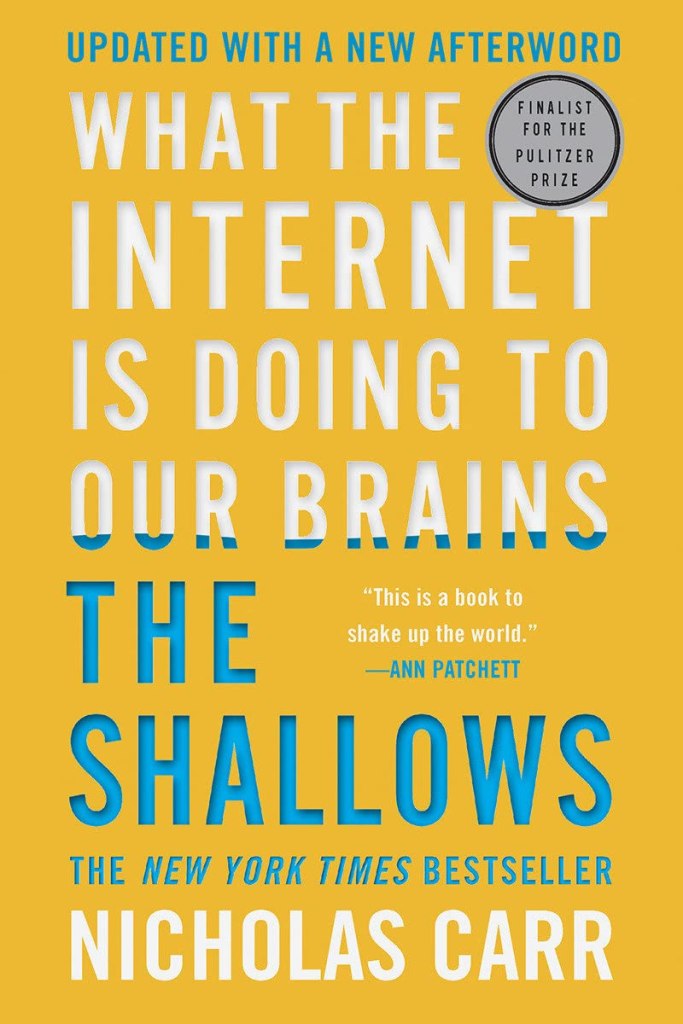
You never know what you’re going to learn by reading a book. Such was the case while reading chapter three in The Shallows by Nicholas Carr.
Chapter Three, “Tools of the Mind,” shares the history and impact of maps, clocks, and language on intellectual development. Carr includes these three in the same technology category, the intellectual technologies. He wrote that maps expanded man’s spatial technology. What maps did for space, clocks did for time.
To describe life before the creation of clocks, Carr quotes French medievalist Jacques Le Goff who said life was “dominated by agrarian rhythms, free of haste, careless of exactitude, unconcerned by productivity.” Hard to imagine such a life. Thinking about it presents a mixture of envy and gratitude.
Carr then shared this bit of history relaying how and why clocks came to be:
Life began to change in the latter half of the Middle Ages. The first people to demand a more precise measurement of time were Christian monks, whose lives revolved around a rigorous schedule of prayer. In the sixth century, Saint Benedict had ordered his followers to hold seven prayer services at specified times during the day. Six hundred years later, the Cistercians gave new emphasis to punctuality, dividing the day into a regimented sequence of activities and viewing any tardiness or other waste of time to be an affront to God. Spurred by the need for temporal exactitude, monks took the lead in pushing forward the technologies of timekeeping. It was in the monastery that the first mechanical clocks were assembled, their movements governed by the swinging of weights, and it was the bells in the church tower that first sounded the hours by which people would come to parcel out their lives.
Like Carr, I don’t share this to make a slam, but to make an observation. Balance is a tricky thing. Some would even say it’s an impossible thing. But like holiness, it’s worth pursuing.
When it comes to time, we can get imbalanced by rigidity and carelessness. We can get lost in the black and white as well as the disregard for parceling and regimentation.
As those seeking to walk in the Spirit, may we follow his lead in the moments when precision is best and when fluidity is lifegiving.
Last weekend we traveled to New Orleans to run the Rock ‘n’ Roll race. Unless you hibernate in your hotel, you see and therefore learn a lot in New Orleans. I’ve never been disappointed visiting New Orleans.
As for seeing and learning in New Orleans, a visit there should include taking in great food. We made it a point to not eat at the same place twice. Not necessarily hard to do, but certainly fun to achieve. Here’s the food establishments we visited during our stay:
We ate just about anything you could ask for: crawfish, shrimp and grits, crab, gumbo, pasta, burgers, pizza, chocolate, ice cream, and beignets. No regrets.
Boil Seafood House
I can only imagine the challenges these owners and employees have survived during the pandemic. This race, an annual event, wasn’t even held last year. And who knows how many others were canceled. So to be open and surviving is a testament to their commitment to their business and their customers.
We Floridians came to town somewhat clueless to the continuing COVID protocols in place in New Orleans. We learned real quick. Not in a rude way, but it was clear we were not at home. Mask mandates required us to mask up everywhere we went. No problem. Happy to comply. In some places, vaccination proof was required; we knew this as a requirement to enter the race expo. No problem. Happy to comply.
What was interesting to see was how the employees of these ten food businesses went about treating their customers while holding to these protocols. 9 out of 10 were excellent experiences. Regardless of their choosing to uphold the protocols or choosing to require vaccination proof, these employees treated their customers with excellent respect and warmth as they worked under unusual circumstances.
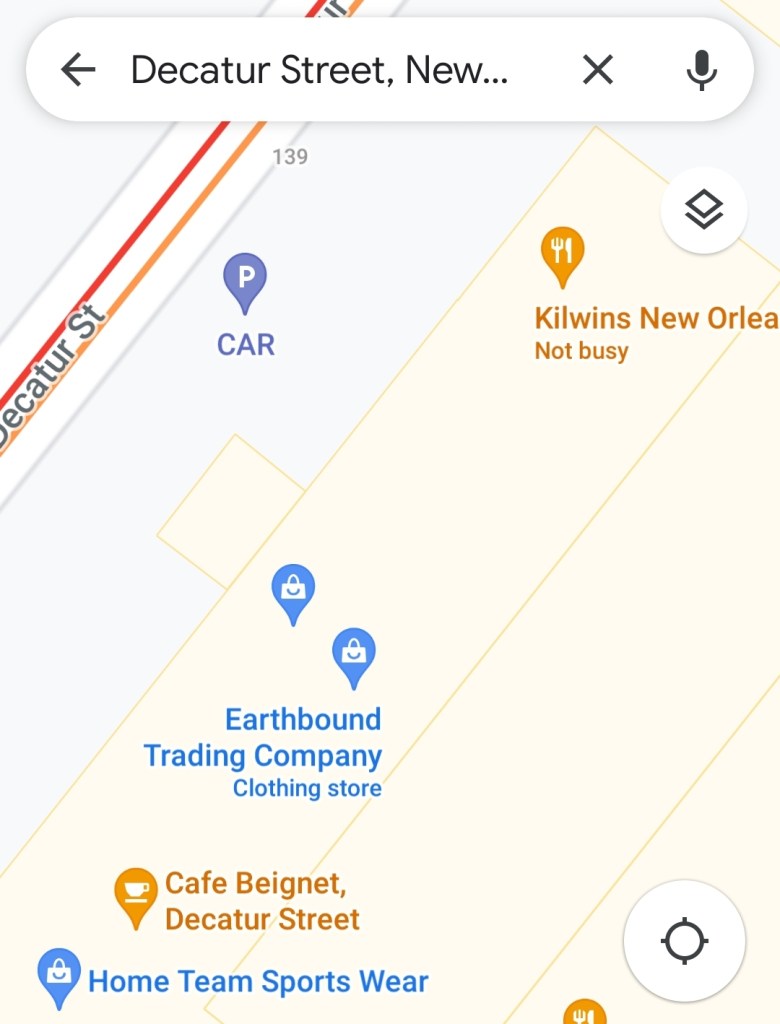
Our best experience was at Kilwins on Decatur Street. It was Sunday afternoon, and my friend wanted a shake. Google told us the closest shake available was Kilwins, so we headed there. We passed Cafe Beignet on our way there and decided it was time to get some beignets as well, after Kilwins. The next 10 minutes was a lesson in customer service.
If you know me, a “no” to ice cream is rare. But I was saving room for beignets. Even the chocolate was not tempting me in Kilwins. We already had our share from Leah’s Pralines, so I didn’t enter Kilwins with a shopping mindset. Just taking it in. We were not greeted at the door by anyone checking proof of vaccination. What we were greeted with was employees behind the counter welcoming us in the store, “Welcome to Kilwins!” My buddy ordered his shake, while I eyed the chocolate. Nicey, behind the counter, asked if I needed any help. I said, “No, just looking.” She offered to give me a fudge sample. Do you think I said no? After that sample of her favorite, she asked if I saw another fudge I’d like to sample. Well, I had to admit I didn’t need a sample. I had been hooked into buying a chunk of Toasted Coconut Fudge, simply because it sounded intriguing. Plus, Nicey lived up to her name. We walked out of Kilwins happy shake and fudge customers expecting to enjoy more happiness in beignet land.
We went from the best customer experience to the worst customer experience in what felt like another city, but only two stores apart. Not to bore you with the details, but suffice it to say one Cafe Beignet employee was determined to have things her way when it came to COVID protocols to the point customers did not feel welcomed. We were thankful for outside seating.
In that ten minutes in New Orleans, we saw and learned a few things about customer service, about how to treat one another during challenging times, about power, about treating others the way you want to be treated.
To the 90% of New Orleans businesses that made our trip amazing, thank you. We remember our time with you as minutes well spent, minutes we were seen and heard, minutes you thought more about us than you did yourself. Keep giving your customers great minutes!
The media, culture, and environment in which we live has sought to define love as a feeling that lives rooted deep within our emotional character. This could not be farther from the truth when understood through the focused lens of God’s Word. God defines love not in emotional terms but in commitment and covenant. God has self-defined Himself as love and rests His identity in His intention that He will never recant that commitment to humanity nor will He break His own special covenant no matter our propensities toward sinfulness or spiritual rebellion. (-The Pastor’s Wife and The Other Woman)
I started a new book last night. This quote is from a section discussing how our choices regarding our time indicate what is significant to us.
What is significant is more than what feels good. What we know we can count on, what is solid, what has been tested, what has survived fire-that is significant.
When we question our significance to God, here are three questions to ponder:
What promises has He kept?
How has He shown Himself to me recently?
When was the last time He forgave me?
Turning the spotlight on the other person in the relationship, here are three questions for us:
A couple of posts ago I mentioned Ben Sasse’s book Them. I’ll finish it before the sun goes down, but I’m taking a break to ask a question.
The question comes after reading chapter seven entitled “Buy a Cemetary Plot” (you should get your own copy to find out what that title’s about). That chapter contains thoughtful words from a 2017 commencement address by Josh Gibbs, a teacher and author in Richmond, Virginia. Address paraphrase: life is full of seasons in which we are tempted to look forward to the next season in order to find contentment. Sasse includes this quote by Gibbs:
Contentment is a condition of the soul, and it does not come with getting what you want, but in giving thanks to God for what you have been given.
Both writers lead their reader to the third chapter of Ecclesiastes where Solomon describes how everything has its time:
Birth, death; love, hate; gain, lose; weeping, laughing; breaking down, building up; silence, speaking; war, peace; gathering, discarding; mourning, dancing; planting, gleaning; embracing, distancing; tearing, sewing.
Then Sasse wrote this:
The wise man learns how to grow where he is planted. He chooses joy. He embraces the time and season.
And that’s what forms my question: What time is it?
What time is it in your season of life?
What time is it in your family?
What time is it in your community?
What time is it in your church?
What time is it in your country?
Solomon said every time has a purpose. To wring every ounce of purpose out of their time, the wise make these choices:



 John Gregory