Now I Know Why

Rarely do I regret reading a book. Actually, if I think that’s going to be the case, I don’t finish it. Again, that’s rare.

However, often I finish a book and think, “I’m glad I read it. It’s not for everyone, but maybe there’s someone I’ll be able to share this book with.” That’s exactly what happened today.

The last book I read was Finding God in the Waves by Mike McHargue. Actually, I listened to it through Hoopla on audio. I believe I came across it by reference in another book I read earlier this year, so I put it in my queue.

I hadn’t heard of McHargue. But apparently his writings and podcasts have created a stir. I see why, which is why I know his book isn’t for everyone. But I met Dave today, and it was obvious I had to share this book with him.

Why isn’t important. What’s important is that sometimes we’re fortunate to experience firsthand, and even within days, what God is up to. We can wonder and be curious. Sometimes we see it; sometimes we don’t. I counted it a rich moment to say to Dave, “Now I know why I read that book.”

Photo by kaleb tapp on Unsplash

Acting Despite the Stone

You know that moment when you read something for the umpteenth time and it feels like the first? That happened to me reading the first three verses of Mark 16. Here they are:

When the Sabbath was over, Mary Magdalene, Mary the mother of James, and Salome bought spices so that they might go to anoint Jesus’ body. Very early on the first day of the week, just after sunrise, they were on their way to the tomb and they asked each other, “Who will roll the stone away from the entrance of the tomb?”

Even though I’d read this multiple times, something jumped out at me clear as day. That something was the order of events.

It wasn’t the first thing on these three ladies’ minds to ask themselves about the stone in the way. No, they bought the spices, set their alarms (although I have a sense they didn’t really need to), and were already headed to the tomb to tend to Jesus’ body before they really pondered exactly how they were going to get in.

I found that very telling. Many times we let the impossible keep us from preparing for it. These ladies didn’t worry about that. Why?

I believe it was because they were so focused on serving Jesus. Literally. The stone in the way didn’t deter them from buying the spices. They could have said, “Uh, what’s the point of spending money on something that I might not be able to use. I’ll just pray about it and hope that stone gets out of the way somehow.”

Instead they bought them, got up early, and headed for the tomb. It seems they had so much faith they were going to get to tend to Jesus that their attitude was, “Somehow, we don’t know how, but somehow that stone will not keep us from getting to him.”

I have a sneaky feeling their question wasn’t one of doubt but one of wonderment. Just how was God going to help them.

It seems that God often does his best work when we let him deal with the impossible while we deal with the possible. They did everything they could to be ready to serve. What did God do? He made sure the obstacle in their way was removed.

The Lesson: Act despite the stone. Avoid letting the impossible paralyze you from living an active life of faith. These ladies would have seriously kicked themselves had they let the question come first.

What they would have missed. I’m thankful for their example of not letting the question of the impossible stifle their actions of faith.

Photo by Katherine Hanlon on Unsplash

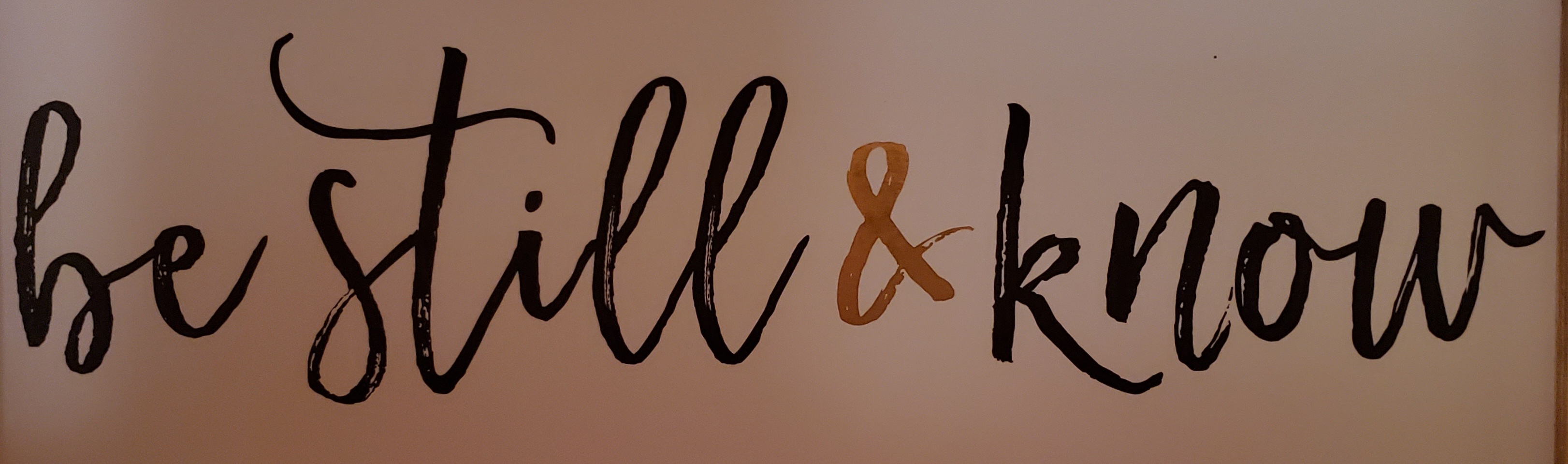
Real Life Psalm 46:10

More than once this year, people have quoted Psalm 46:10 in conversations reflecting on 2020. This week, God has reminded me of it in two ways.
First, by this excerpt from a book I’m reading, Talking to High Monks in the Snow:

Once, I listened to a biologist. She had been awarded a grant supporting field study in the Kalahari Desert. It was the opportunity of a lifetime. Over vast distances, in a rented Land Rover, she scurried here and there. She marked sites. She took readings. She made plans. Always rushing to the momentous occasion, triggered by the distant rains, when the animals she studied would appear.

One day, the Land Rover overheated. In order to reach water and safety a strategy was devised. The vehicle could travel a few kilometers each day. Then the engine required rest to cool down. The result was that scientist was forced to spend many hours in remote locations where she had no business being. It nearly drove her mad.

There she was, with so much urgent busyness to be doing, in a place where nothing could be done. Loathing to waste time she transcribed her notes. Then she reread her field manuals. She stared impatiently across the vast wilderness, willing the coming of the rains, and the animals, or at least of a spare and sprightly jeep. “Here I am in the Kalahari,” she fumed, “having worked all my life to fulfill a girlhood dream. Here I am and everything has been thwarted.”

Then as the hours turn to days, it dawned on her. She was in the Kalahari with eyes and ears and time on her hands. This was her girlhood dream. The biologist took a deep breath and looked around. Some insects labored in the sands. She watched them for a while and her anxious pulse rate slowed.

And as the days stretched to a week, she noticed the subtle shifts in the scent of the desert during the day. She noticed that at a certain hour, if certain conditions prevailed-like 32 distinctive signs accompanying an auspicious horoscope-then small iguanas would appear.

Over time, her drive to achieve scientific notoriety eroded, and her sense of wonder emerged. In the desert the biologist found her motto. It is one that she carries to this day.

“Don’t just do something,” the scientist said to me, “sit there.”

Second, by this statement from a friend who’s facing COVID:

“It has been a remarkable feeling of God being shoulder to shoulder with me this week.”
As If You Were There

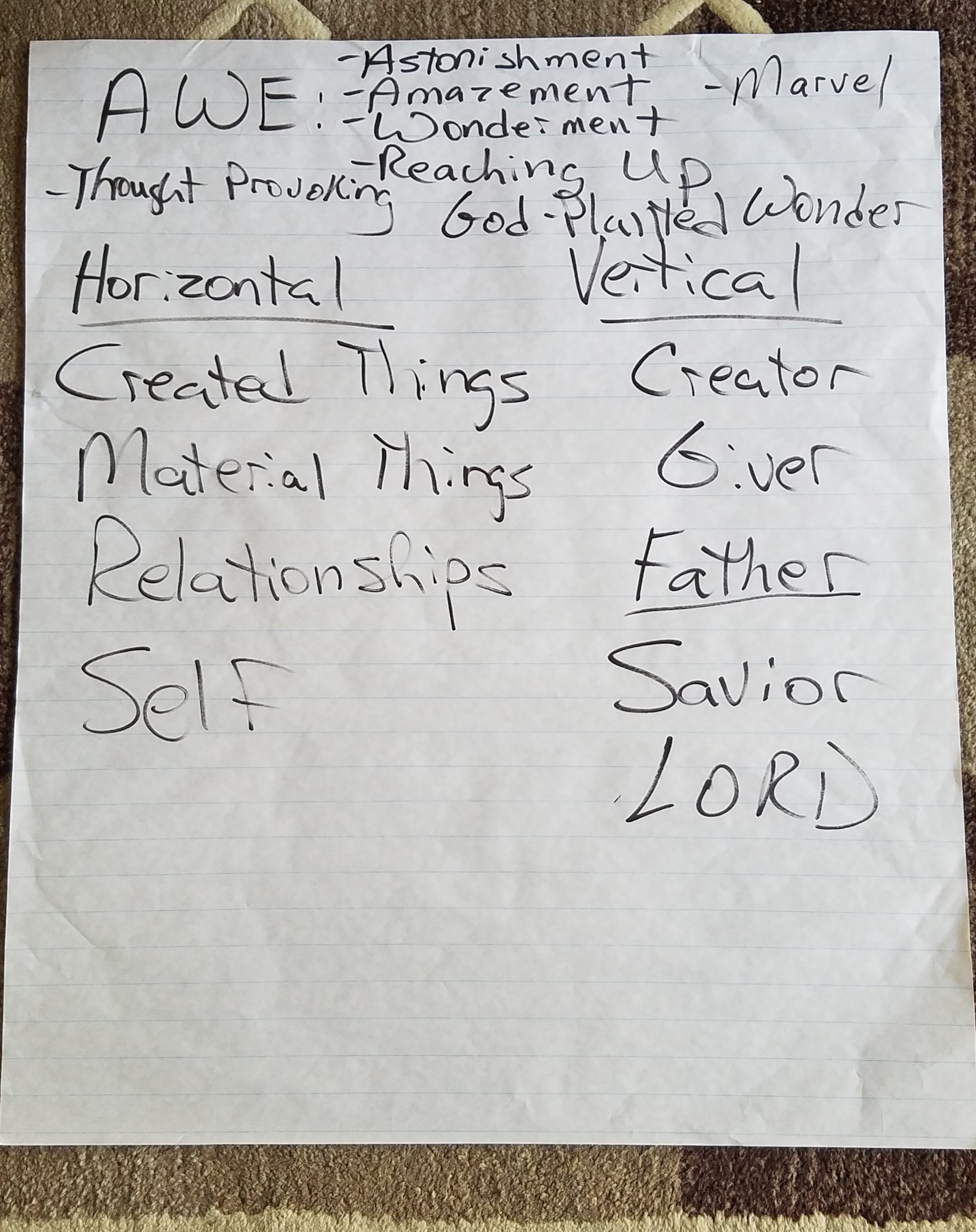
Our Life Group finished a 4-week study last night of Paul David Tripp’s book Awe. Before I discard the easel notepad sheets, I thought I’d share our discussion notes. This will be a refresher if you’ve read the book. If you haven’t read it, these notes may make you feel as if you were there with us and entice you to get a copy. Who knows? Maybe you could get a group together to do a similar study.

From Chapters 1-2 (Humanity and War)

From Chapters 4-5 (Replacement and Amnesia)

From Chapters 7-8 (Complaint and Materialism)

From Chapters 9-10 (Growth and Worldview)