Blog Series: Behind the Curtain

No matter the organization you choose to analyze, there’s an understanding every one doesn’t see all the stuff. There are things not seen or known by the public and, often, not the majority of those engaged in the organization (staff, volunteers, etc.). Some call it seeing behind the curtain.

Others refer to as organizational politics. I’m not a fan of that label, but it’s understandable why people use it. And therein lies what we’re really analyzing-people.

The stuff behind the curtain is actually the actions/interactions of organizational leaders. How do they get along? How do they manage themselves? Is there a mirror anywhere, and who’s responsible for its use?

It seems healthy, thriving organizations care about what’s behind the curtain as much as, if not more than, the other side. A couple of weeks ago in watching a young organization I wondered to myself what it would take for it to be one of those organizations for the long haul-an organization whose public persona matches what’s behind the curtain.

I invited my friend Mark Stanifer to join the wondering by sending this question: What questions must be answered in order for what’s behind your organization’s curtain to match your public persona? The result is a blog series that we’ve co-authored.

Mark’s contributions focus on questions for leaders; mine focus on questions for the leadership team.

Keep watch for Mark’s first post.

Photo by Kelly Sikkema on Unsplash

Saving Lives: We All Can

Recently in a class I was facilitating, two references to suicidal ideation were unexpectedly mentioned. The first one was definitely out of nowhere for me and the rest of the class.

The main topic of that night’s class was finding peace in your beliefs. Naturally, the first presenter of three on the night’s program was a pastor. While he was speaking, a participant shared this in the chat (Zoom meeting):

I just want to let you know that you saved my life when I found you on tiktok.

The second reference to the possible loss of life was shared by the second presenter, a church attendee sharing their story in finding a church home. Part of this story included suicide consideration-this after serving on several church staffs, by the way.

After hearing these personal stories from two people who could easily no longer be on earth, a connection crossed my mind. The theme of the class was finding peace. These two had a season where they were searching for peace. In that season of lacking peace, their lives were at risk.

CONNECTION: Lack of peace is life threatening.

I shared that connection with the class and then offered this encouragement to everyone. Whatever you have offering peace to any community (family, neighborhood, work, church, city), your offering saves lives. It’s not only the pastor who brings peace by preaching or aiding someone in securing their personal beliefs. It’s also the teacher who asks the student about the bruise. It’s the law enforcement officer who delivers good news. It’s the grocery shopper who commends the cashier. It’s the neighbor who offers to mow the yard. It’s anyone who takes time to notice and inquires when they sense a lack of peace.

Any effort to bring, restore, support, or provide peace is life saving. For them. For you. For us.

“Blessed are the peacemakers, for they will be called the children of God.”

Matthew 5:9

Child of God, how did you make peace this week? Congratulations! You saved life.

Photo by Priscilla Du Preez 🇨🇦 on Unsplash

Against Empathy (book review)

Took me a while, but I finished Paul Bloom’s Against Empathy.

As a more rational than emotional human, not only did I appreciate Bloom’s premise and defense, I also gained perspective. The sense of empathy he addresses is this:

Empathy is the act of coming to experience the world as you think someone else does.

Chapter 1, Other People’s Shoes

The title of that chapter is certainly something I’ve attempted to pursue in compassion growth. Try walking in other people’s shoes. What Bloom suggests is a balance of emotion that can go awry when rational compassion is untapped. For example, he shared this truth about himself:

…in the year of the Sandy Hook killings, more schoolchildren were murdered in one American city-Chicago-than were murdered in Newtown, and yet I’ve never thought about those murdered Chicago children before looking that up, and I’m not likely to think about them again…while my mind often drifts back to Newtown. Why?

Chapter 1, Other People’s Shoes

Bloom argues what really matters in everyday life is self-control and intelligence about compassion not being highjacked by high empathy caught up in the suffering of other people. Caring for the suffering must involve assessing how best to do so. This assessing is what effective altruists define as combining heart and head.

With each chapter, Bloom digs deeper touching on intimacy, violence and cruelty, and the age of reason. He admits his views are not readily appreciated, but stands his ground with fair judgment of his own work and other researcher’s results.

The result: I’m no longer going to mindlessly nod my head in agreement the next time a voice heralds a need for empathy. I’m going to check my own voice. I wouldn’t use Bloom’s declaration that empathy is something to avoid. But I am going to go deeper than the surface of immediate reaction to suffering. If Bloom’s premise raises any level of reaction for you, add this title to your list to read.

By the way, it’s available on hoopla.

Role Clarification: It’s Critical

In my years of leadership, one vital item that continues to gurgle to the top determining the health of a team member and ultimately the entire team is role clarification. Just this week, I was reminded again how often simple clarifications are missed and how they impact decisions and conversations.

I was having a second conversation which some would call “hard” with a leader after a first with their colleague. Come to find out, that first one wasn’t necessary, but only because the second one clarified both of these leader’s roles. Totally changed that conversation and explained some odd, head scratching moments over the past two years. I felt bad, but not for long when this leader said, “Yeah, that happens a lot.”

They may be right more than they know. Hopefully in their context they can work to lower that frequency. Speaking of context, there seems to be a common thread of how role clarification gets missed. That thread can be summed up in one word: CHANGE.

If it’s true that change is constant, then it must be true that clarification also needs to be constant. For example…

  • If a team member receives a new title or responsibility, repeated clarification for everyone is necessary. A one-time announcement by email, social media post, or meeting announcement doesn’t suffice. And just stating the title doesn’t cover it. Consider delivering a brief job description, purpose for the title, and who is impacted by this role; it probably wouldn’t hurt to update the organization chart. What may seem like a small change is still change.
  • When a new team member is added (no matter the level), repeated clarification for everyone is necessary, particularly if the position is a new position. One could ask, “So whose responsibility is that?” My opinion, it’s the primary responsibility of the new team member’s immediate supervisor; in the case of their reporting to a board, then the board should own this task. Please avoid making it the new team member’s responsibility to explain why their job was created, what their job is, and what the new organization chart looks like. If that’s how your leadership rolls, you may be looking to refill this position sooner and more often than you’d like. It may seem obvious, but adding new team members is change.
  • When your organization is growing or goes through any major leadership shift, repeated clarification may seem like overkill. But consider this question: How many ripples does growth or a shift create? When you finish the list of all the ripples, that number multiplied by no less than two is how many clarifications are needed to avoid confusion and misunderstanding and their potential fallout. One truth to grab on to-growth is change.

Change equals a clarification need. If that stresses you out as a leader, then this task is most likely not in your wheelhouse. Odds are you know the team member that lives in that wheelhouse. Talk to them soon. It’s critical.

Photo by Austin Distel on Unsplash

Sunk Down Deep

‭‭A little one-question quiz for you. Which biblical character said these words:

I had sunk down deep below the mountains beneath the sea. I knew that forever, I would be a prisoner there. But, you, Lord God, rescued me from that pit.

When I read this particular verse this week, I chose to sit in it for a few minutes in attempt to feel the impact of their situation. Any of these words or phrases feel familiar?

  • “Had sunk down”…indicates an awareness of the gradual process that led to where they found themselves.
  • “Deep below the mountains”…expresses they feel completely alone, no one is around.
  • “Beneath the sea”…not only do they feel alone, it’s a sense of desperation that no one can even go where they are.
  • “I knew”…they believed, were convinced, had come to the realization.
  • “Forever”…this was it; there was no hope of things ever changing; they were resigned to their fate.
  • “A prisoner”…they saw no way out, certainly not a way within their power, and no one was around to provide a way.
  • “But, you, Lord God”…no one, that is, but their God. Their God was the only one with a way out.

If any of these thoughts, emotions, and expressions correlate to you today, take a few minutes to find this person’s story and read it through a different lens.

You’ll find this person’s story in the Old Testament. The person? Jonah. The quote? Verse 6 from his prayer in chapter 2 (CEV).

Photo by Jeremy Lanfranchi on Unsplash

Five Whys from Bridge A Life’s Superhero 5K

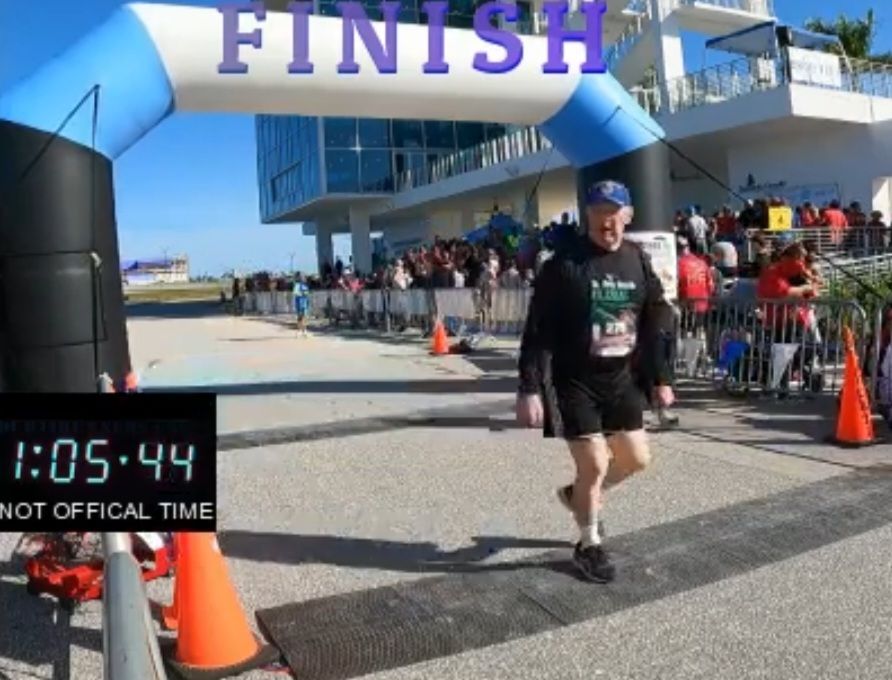
Ran a 5k this morning at the 13th Bridge A Life Superhero Race. This was just my second time at this race, first since 2021 when the event included a 10k for their 10th Anniversary.

Each time I run a 5k I ask myself why. It’s certainly not as taxing as a full marathon, but it’s not my favorite distance. That’s for another post…maybe.

After being at the race for a second time, the answers why this 5k are many.

One: To share about our work at Samaritan Counseling. The tent was busy!

Two: To see what’s possible. Always with goals in mind, I had given myself four lofty goals this week. Managed to achieve one of them: Placed 2nd in Age Group. I’ll take it. (RACE ORGANIZERS: Thanks for including a child’s name on my bib. Thinking of them kept me moving in Mile 3.)

Three: To encourage other runners. Five coworkers also entered the race, and several community partner colleagues were on hand as well.

Four: To be inspired. The oldest male competitor, Bill Welch from Parrish, introduced himself at our tent. He said he enters a 5k every Saturday to support charity. He’s completed over 1,100 races. He’s 86. He took home 3rd place in his age group. Let’s just say it’s going to take over 1,000 races for me to catch Mr. Welch.

Five: To support Bridge A Life‘s vital work in Foster Care. This event brings awareness to the reality of children in out of home care in Manatee, Sarasota, and DeSoto Counties. This year, nearly 700 names were chalked at the start/finish line.

P.S. Great Job, Bridge A Life! I imagine you feel somewhat like I did at the finish line. 

SURPRISE!

Monday, I was waiting for an interviewee to enter our Zoom meeting. I already had an opinion of how it would go, yet I knew that wasn’t a good mindset as an interviewer.

I decided prayer was a good option while I waited. The main request I voiced was to have an open mind.

Twenty-eight minutes later I voiced a second prayer admitting to God and the interviewee that I was surprised by our conversation. The first thing I remember saying was, “Thank you for being a God that surprises us.”

After I closed the meeting, I wondered why that is. Why am I surprised when God gives me what I ask for?

There are many possible answers for that question. One may be correct for one instance and another for another.

In this case, I tend to think I was surprised how quickly God showed me I was wrong, and it actually brought me joy. Doesn’t quite sound normal.

Surprise!

Photo by Xavi Cabrera on Unsplash

A New Pair of Glasses

Last September I saw an eye doctor. My bifocals didn’t seem to be cutting it in all circumstances. He confirmed. Nothing major, but a slight change to my lens prescription. 

Made me think about the next-to-last time I saw an eye doctor. I didn’t realize how much I needed bifocals until I tried on my brother-in-laws’ in order to read the inscription on his daughter’s high school class ring. It was crazy how much clearer I could see small details. I had no idea what I was missing.

The truth to having no idea what I’ve been missing seems to magnify daily. Three times this week I had conversations about a project I’m involved with where I find myself shaking my head. “How did I end up here?”

Most of the time that question carries a regretful or sorrowful tone. That’s not the case at all in this instance. No, it’s more like, “If you’d told me five years ago I’d be involved in this project, I’d thought you were out of your mind.” I told someone this week that 15 years ago the answer would have been, “Absolutely not!”

What’s changed? I see things differently. For reasons that don’t need to be explained, my vision has changed. Call it growth, personal development, or broader understanding, I’m able to contribute in ways I wasn’t capable five or fifteen years ago. And very much like my physical eyes, I had no idea what I was missing.

How about you? What are you doing today that you weren’t capable of doing five years ago? What experiences or influences have broadened your vision to sit with those you couldn’t sit with fifteen years ago? Who might you need to thank for figuratively giving you a new pair of glasses?

Photo by David Travis on Unsplash

The 6 overlooked words of Numbers 20

Numbers 20 tells a significant story in Moses’ life. After reading it this week, I believe it actually tells two significant stories. One just overshadows the other.

Both stories changed Moses’ future. The one that gets the most focus is his “not trusting in God enough to honor him as holy in the sight of the Israelites” (v.13) by striking the rock rather than speaking to it to produce water. This decision cost him dearly; he didn’t get to enter the Promised Land.

Before that choice, Moses experienced a normal but ugly thing in life, something he couldn’t control. Death.

In the first month the whole Israelite community arrived at the Desert of Zin, and they stayed at Kadesh. There Miriam died and was buried.

Verse 1

Those last six words jumped off the page. I knew his sister died before Moses and his brother Aaron, but I had never put her death as happening in the same chapter as his future-altering choice.

Unfortunately, those six words are all we have. We don’t know anything else. We’re left to wonder.

  • How did Miriam die?
  • Had their relationship healed from the scene in Numbers 12? (By the way, that’s where we find this statement: (Now Moses was a very humble man, more humble than anyone else on the face of the earth.)
  • How much time passed between verse 1 and verse 2 in this chapter?
  • What level of grief did Moses experience after his sister’s death?

Moses’ story has always intrigued me. These questions will go answered, but they should be infused in our interpretation and meditation of his life. 

  • Is it possible grief influenced this meek man to a choice he didn’t see coming?
  • Considering the unique elements of Moses’ early life (being pulled from his family of origin, conflicting allegiances, father/son relationship), certainly they impacted his development and actions, right? 
  • Death had to be a struggle for Moses considering his history of taking it into his own hands, right?

I’m learning this more and more. Rather than judge the action in the moment, we’d show more care and love to consider what led up to it. Particularly when we are in the dark, a place we often find ourselves in biblical stories. 

All the words matter. I’m doing my best to consider them all.

Photo by Ahmed M Elpahwee on Unsplash

Best Recent Running Gear Purchase

Not all Facebook ads are worthless. Particularly if they have to do with running.

We know how it works. You do a search and suddenly ads appear for that and similar items. Apparently I did a search for running socks and started getting ads for toe socks. Somehow in 16 years of running I’d never seen them. Shoes, yes, but not socks. How is that possible?

Anyway, I thought, “Why not try them. If what they say is true, I’m in.”

Guess what? What they say is true.

The product detail for the item in this blog’s featured photo promises this:

The ankle toe socks provide individual compartments for each toe, allowing for better flexibility and movement of the toes. These men’s toe socks reduce friction, cutting down on the risk of blisters in outdoor activities such as walking, jogging, traveling, climbing, cycling, gym, and training…

https://www.amazon.com/dp/B0C3HBVZWH?psc=1&ref=ppx_pop_dt_b_product_details

More and more, these are the socks I run in, particularly for long runs. My main testing ground was the 39-miles for the Four Corners Quad Keyah Series in December. My toes were and are grateful. 

As the product detail says, you don’t have to be a runner to give them a try. If you try them, reply and let us know what you think.

2024 just got better!