More from Mark Chironna’s “Rising With Hope” devotional
Here are three clips:
Whatever you do, do not surrender your praise or self-isolate. Lift your praises to God and allow someone in the faith whom you trust to remind you who you are. (Day 5, Facing the Unthinkable)
The hardest thing about being here, in the place of your pain, is the thought that you might be there alone. I can assure you that you aren’t. Wherever here is, He is. (Day 7, Being Here)
David said to God, “You have…put my tears in your bottle. Are they not in your record?” Imagine! Your tears are so precious to God that He collects and keeps them! (Day 8, Being with Your Pain)
I’m three days into Mark Chironna’s “Rising With Hope” devotional
Here are two clips:
Sometimes you cannot see what you covered over until a crisis forces it back to the surface. Then you cannot unsee it. (Day 1, Firmly on the Edge of Hope)
Yes, you are called to live by faith rather than by sight. But faith does not ignore feelings. Faith considers feelings in the light of faith. (Day 2, Pay Attention)
There are plenty of things that are pretty black and white for me.
All diets can include daily servings of ice cream
Baseball over hockey
“Thou shalt take naps” is the 11th Commandment
One that I wish were but it just isn’t is when to be still and when to move. We’ve all been there. The last 24 hours have reminded me that it’s not simple.
Last night a friend asked for prayer. In my efforts to pray scripture over them, Exodus 14:14 spilled out.
The Lord will fight for you; you need only to be still.
Based on the need, this seemed like an honorable reply for prayer.
This morning while waiting in the green room at church between worship sets, I resumed reading this book:
In describing a lifechanging conversation with a longtime friend, Chacour acknowledged the grayness of being still.
Here was that old question that had troubled me so long: As a Christian do you speak out against the actions of your enemies-or do you allow them to crush the life out of you? So many seemed to think that submitting to humiliation was the only Christian alternative. Should you not, sometimes, be stinging and preserving like salt?
Old question. So many people have answered it in ways that we admire, question, or scratch our head. If only it were black and white.
Here’s my answering history. Sometimes I’ve been still successfully; sometimes I’ve sat still too long. Sometimes I’ve moved timely; sometimes I’ve moved too quickly.
It feels like I’m constantly learning the lesson much like engaging traffic lights.
“Good Lord (not really a prayer). When is this light ever going to turn green?”
“I’m sorry (sort of a prayer). I was looking at my phone.”
If I were in charge, the traffic light of being still would have three different colors from the traditional ones.
Black = “You’ll regret moving, so don’t.”
Gray = “Have some ice cream, and chill.”
White = “Floor it!”
Good Lord (this is a prayer), thank you for fighting for me…and forgiving me when I don’t let you.
A few weeks ago I decided to find a book about Lent. I’ve read articles about Lent, but I don’t recall reading a book about it. My search led me exactly to what I was looking for.
I found that Esau McCaulley and I share two things: we grew up in Alabama, and our church upbringing didn’t include Lent. Kindred spirits. I’ll have to research to see if he roots for the right football team.
I knew I was reading the right selection when he ended his introduction with these two sentences:
What follows is an attempt to point out the things I’ve seen along the way. It is not just an explanation of Lent but an invitation to experience it, a chance to meet our risen Lord who always runs just ahead of us, beckoning us forward.
Only four chapters long, the book is manageable, ideal before and throughout Lent’s forty days. For those looking for the how’s of Lent, chapter two covers seven rituals of Lent. For those questioning the place and value of rituals, chapter three walks through the prayers and scriptures of Lent.
Ritual is both a means of spiritual formation (we learn through repetition) and an encounter (God meets us in the act of worship and praise in the liturgy)…we do not outgrow God. We never arrive at a place where we are able to “take it from here.”
The final chapter is a beautiful walk through Holy Week. Whether you grew up fully aware of Holy Week or it’s a new journey for you, McCaulley encourages embracing the freedom found in the repentance and renewal of each day and its reflection.
As it is the end of Holy Saturday, here’s one reflection about this day:
At this point in the Gospel story, there is no work left for the disciples to do. There are no more great deeds to perform. All that remains is the waiting. Holy Saturday reminds us-as the Sabbath itself does-that for all our activity, our hope is not in the things we accomplish.
After reading the bulk of Mate’s research and arguments, I was ready to take in the final three chapters, particularly #17 and #19.
Chapter 17 is entitled “The Biology of Belief,” coined from Dr. Bruce Lipton. Dr. Lipton defines the biology of belief as the process where early experiences condition the body’s stance toward the world and determine the person’s unconscious beliefs about themselves in relationship to the world. Mate shares eight of these unconscious beliefs that control behaviors of defense or growth. He ends the chapter encouraging anyone overloaded with stress induced by these beliefs.
If we would heal, it is essential to begin the painfully incremental task of reversing the biology of belief we adopted very early in life. Whatever external treatment is administered, the healing agent lies within. The internal milieu must be changed. To find health, and to know it fully, necessitates a quest, a journey to the centre of our own biology of belief. That means rethinking and recognizing–re-cognizing: literally, to “know again”–our lives.
For those who may resist this last quote because it sounds void of spirituality, Dr. Mate addresses that in chapter 19, “The Seven A’s of Healing.” Although I have to say, “knowing again” sounds very salvific.
The final A of healing Mate describes is affirmation. Following his outline of the importance of creativity and connectivity, he wraps up the book with this:
Many people have done psychological work without ever opening to their own spiritual needs. Others have looked for healing only in the spiritual ways-in the search of God or universal Self-without every realizing the importance of finding and developing the personal self. Health rests on three pillars: the body, the psyche, and the spiritual connection. To ignore any one of them is to invite imbalance and dis-ease.
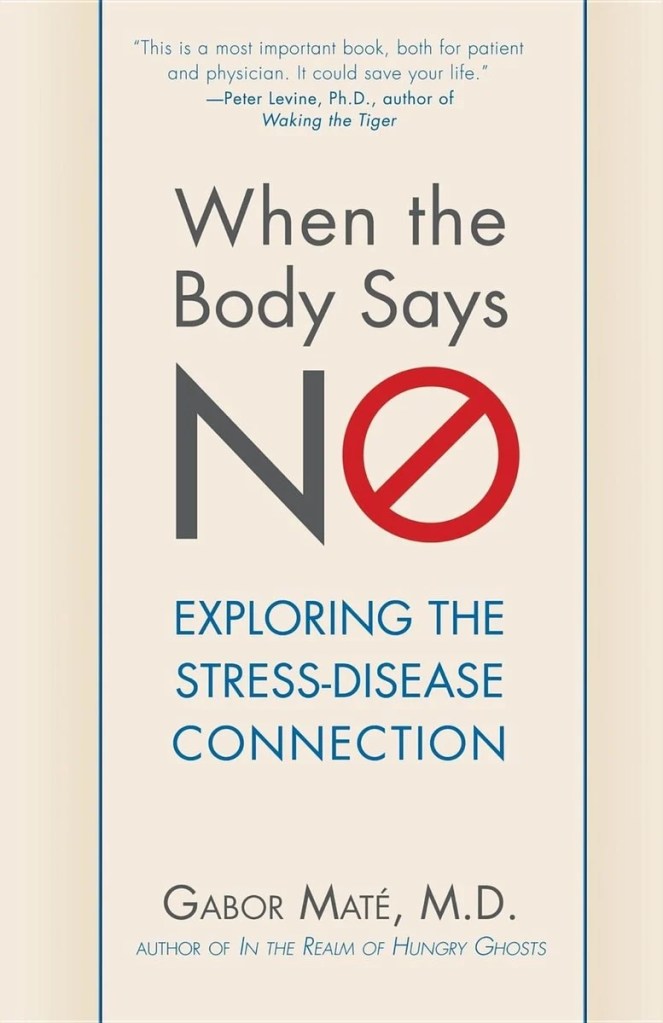
After several recommendations and references, I have read Dr. Gabor Mate’s When the Body Says No. Even more than after reading The Wisdom of Your Body, I value the connection of mind, body, and spirit.
The two significant beliefs Mate drives are how deeply stress impacts the body and how counterintuitive emotional repression is to the health of any human.
Much of the stress Mate shares from his patient’s stories stem from their relationships.
The nature of stress is not always the usual stuff that people think of. It’s not the external stress of war or money loss or somebody dying; it is actually the internal stress of having to adjust oneself to somebody else. -Chapter 6, “You Are Part of This Too, Mom”
These stories include mostly family relationships. In chapter 15, “The Biology of Loss,” Mate reveals just how encompassing the consequences can be.
It is intuitively easy to understand why abuse, trauma or extreme neglect in childhood would have negative consequences. But why do many people develop stress-related illness without having been abused or traumatized? These persons suffer not because something negative was inflicted on them but because something positive was withheld.
Much of the research on major illnesses like cancer, ALS, Alzheimer’s, and autoimmune diseases, Mate says, reveals how destructive repressed emotion is. For example, here’s a note from chapter 7, “Stress, Hormones, Repression and Cancer”:
In numerous studies of cancer, the most consistently identified risk factor is the inability to express emotion, particularly the feelings associated with anger. The repression of anger is not an abstract emotional trait that mysteriously leads to disease. It is a major risk factor because it increases physiological stress on the organism. It does not act alone but in conjunction with other risk factors that are likely to accompany it, such as hopelessness and lack of social support.
When my father died from cancer at the age of 40, no one discussed these types of factors. The only ones my 12-year-old ears heard regarded eating and work habits. Makes me ask many questions that I’ll never know the answers.
Mate doesn’t have all the answers, of course, but he does offer some hope in the final three chapters, which I’ll share in a second post.
One final takeaway from Richard Rohr’s The Tears of Things was this: Sadness is a journey to be embraced and valued.
Rohr’s connecting sadness as the avenue the prophets took to move from anger to compassion painted this reality. Sad is not something to “not be.” Instead, sadness is a normal, valid, and, therefore, valuable emotional journey to be completed, to be processed. If the journey isn’t taken, a compassionate life may never be found.
Following Rohr’s teaching, here are four lifegiving outcomes from the sadness journeys of four Old Testament prophets:
Isaiah wrote this after a sadness journey over social injustice:
But those who hope in the Lord will renew their strength. They will soar on wings like eagles; they will run and not grow weary, they will walk and not be faint. – Isaiah 40:31
Jeremiah shared this after his sadness journey over covenant breaking:
“For I know the plans I have for you,” declares the Lord, “plans to prosper you and not to harm you, plans to give you hope and a future.” – Jeremiah 29:11
Habakkuk declared this after his sadness journey over suffering caused by evil:
The Sovereign Lord is my strength; he makes my feet like the feet of a deer, he enables me to tread on the heights. – Habakkuk 3:19
Zephaniah promised this after a sadness journey over abandonment of God’s ways:
The Lord your God is with you, the Mighty Warrior who saves. He will take great delight in you; in his love he will no longer rebuke you, but will rejoice over you with singing. – Zephaniah 3:17
CHALLENGE: Think back to the completion of your sadness journey. What lifegiving message do you now have? Where could you share it? Who might be in need of it while they go through their sadness journey?
My biggest takeaway from Richard Rohr’s The Tears of Things is an overall view of the Old Testament prophets that looks something like this:
Anger>Tears/Sadness>Compassion
Each prophet had a thing they were angry about, either themselves or on God’s behalf. Just that thought alone is oddly comforting. Anger is normal. No matter whose, mine or God’s. Being angry is part of being human. And for those who believe in being created in the image of God, that equates to it’s part of being God.
However, by the end of their writings, or at least woven in them, is a message of the loving nature of God. The prophet, speaking from their heart or God’s, shares the truth that their audience is loved. Somewhere along the way, anger has turned to compassion (more on that journey in the next post).
How? How does an angry person become compassionate?
One way the prophets do this is by letting truth step into the anger. Such as…
God’s heart is for all people, not just those that look or act like me (Jonah).
People’s actions don’t have to dictate my reactions to them or God (Jeremiah).
Disorder is normal. It’s in need of some holiness, which can start with me (Ezekiel).
Once the prophets embrace the truth of the situation from God’s viewpoint, they are moved to pursue the available redemption. They show compassion by…
Not withholding love from anyone (Jonah).
Forgiving and living peacefully with those who wrong them (Jeremiah).
Breathing life everywhere they go, even in places that appear lifeless (Ezekial).
Easy? No
Possible? Yes
If you’re stuck in anger, consider asking God for truth to enter your heart that could make way for redemption.
I’m listening to Richard Rohr’s The Tears of Things.
In chapter five he discusses the writings of Jeremiah. One aspect Rohr pulls out is Jeremiah’s challenge to not be attached to the exterior works of religion and to choose the inner transformation found in a relationship with the one being worshipped. Be more in love with God instead of the rituals that supposedly bring you closer to him.
This particular statement stung me:
Church loyalty is commonly substituted for the love of God. Loyalty is actually a form of codependency giving a warped sense of control and safety while love is a dive into perfect freedom.
Loyalty – I have wrestled with this value most of my life. I’ve come to the realization that the temptation to be loyal to what or who I can see is a great tool of the enemy. So yes, it’s easy to understand how one could substitute it for the real thing.
Codependency – This is a good possibility of why we choose that substitution. This temptation to be in control and to pursue safety is the oldest tool of spiritual warfare. It’s not a reason to run from the church; it’s a worthy awareness to maintain church health.
Love of God – I’ve been challenged several times over the last five years by those speaking into my life that my dive into perfect freedom needs more attention. That’s why this quote resonated. That is how I avoid yielding to these two temptations.
For an eighth year I have followed a self-developed reading strategy with the objective to read broader. The goal: read books falling under diverse headings. This strategy is still working for me, probably the richest year yet.
For the curious, here is the library of 25 books including avenue of reading:
Attached to God by Krispin Mayfield (hoopla)…2nd read
Becoming Rooted by Randy Woodley (hoopla)
Beyond the Third Door by Maria Heckinger (hoopla)
Bone Songs by Andre Gregory (hoopla)
Centering Prayer and Inner Awakening by Cynthia Bourgeault (hoopla)
The Cloister Walk by Kathleen Norris (hoopla audio)
Courage Doesn’t Always Roar by Mary Anne Radmacher (hoopla)
Deliver Me by Dawn Van Beck (hard copy)…most recommended Christian life book on the list-several “I needed this book” responses
Dream Weaver by Jenny Jing Zhu (hard copy)
From Beneath the Ice by Todd Arkyn Crush (audible)…most compelling book on the list-leading to a new friendship
Fully Alive by Timothy Shriver (audible)…favorite read of the year
The Gap and the Gain by Dan Sullivan (audible)…most practical book on the list–bought hard copies for coworkers
Hello Darkness, My Old Friend by Sanford Greenberg (hard copy)…most engaging book on the list
In the Shelter by Padraig O Tuama (hoopla audio)
Ladder to the Light by Steven Charleston (hoopla audio)
The Lord Is My Courage by K. J. Ramsey (hoopla)
A Loving Life by Paul E. Miller (hoopla)
Resurrecting Jesus by Adyashanti (hoopla audio)
Seeing with the Eyes of the Heart by Adyashanti and Cynthia Bourgeault (hoopla audio)
Separation of Church and Hate by John Fugelsang (audible)
A Shepherd Looks at Psalm 23 by W. Phillip Keller (hoopla)
Single at Heart by Bella Depaulo (hoopla)…most thought-provoking book on the list
The Third Door by Alex Banayan (audible)
Unlimited by Jason Dunn (hoopla)
The Wisdom of Stability by Jonathan Wilson-Hartgrove (hoopla)…the best big idea book on the list–a fresh take on the definition of and need for stability