Praying Your Desires

James points out a couple of issues in prayer in chapter four.

You desire and do not have. You murder and covet and cannot obtain. You fight and wage war. You do not have because you do not ask. (James 4:2, CSB)

Issues: Lack of right motive and lack of asking

What if we addressed both issues simultaneously? Here’s a suggestion how:

  1. Write down your top five desires
  2. Ask God to check your motives behind each desire
  3. Edit the list as needed
  4. Then pray over the list

I did this exercise today. Here’s what I realized:

  • What I listed as my desires were not things I have regularly been praying for
  • The act of writing down my desires while asking the Holy Spirit what he thought about them made checking my motives easier and, as a result of having already invited him into the exercise, made prayer a normal, flowing, and immediate outcome

Give yourself fifteen minutes to try this exercise this weekend and see how yours goes. Let’s go after praying our desires.

The “Right” Quest

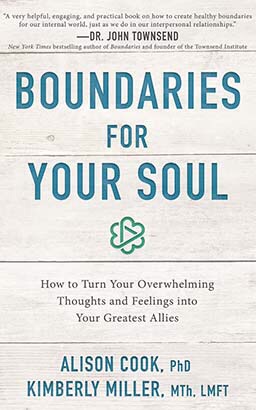
I just finished reading Boundaries For Your Soul by Kimberly Miller and Alison Cook. Chances are, since you’re human and created with a soul, you will glean help for your life when you read this book.

Questions you could ask yourself that would indicate so:

  • Are there emotional parts of me that I don’t like?
  • Are there emotional responses I have that I don’t understand?
  • Is there something I’m burdened with that needs resolution?
  • Do my prayers about these things seem unheard or useless and have left me wondering if God cares?

We’ve all had these questions. These ladies have some help for us in their work.

An example from the last chapter entitled “Boundaries With Challenging Parts of Others” involves some insight based on brain science. They discuss the difference between the “thinking” brain and the “emotional” brain. In their discussion they show how important it is to know the difference and to achieve the balance possible when both brains work together. The quote I found intriguing was actually from another Christian psychiatrist’s, Curt Thompson, book Anatomy of the Soul.

We are more interested in knowing right from wrong (a dominantly left-brain hemisphere function used to cope with fear and shame) than knowing God, which requires the integration of all parts of the brain. Our quest to be “right” – a cognitive activity – can actually keep us from deep connection and a holistic knowledge of God and others.

Oh, how many Christians need to be done with the “right” quest, including me.

See what I mean now? Get your hands on this book and see what other insights await you.

Loss & Pain & Redemption

About a month ago, I walked through a situation that I could only explain with one word: sad. So when I came to chapter 11 entitled “Boundaries with Sadness” in the book I’m reading (Boundaries For Your Soul), I was ready. 


Of my many highlighted quotes in the chapter, this was the most helpful:

It’s helpful to think of the causes of sadness in three categories: sadness as a response to the loss of something good, the loss of something bad, and the loss of what might have been.

Categories one and three I get and I’ve used to befriend my personal sadnesses recently. But category two tilted my head…until I read Maria’s story. 

Maria, a bright woman, dated an abusive, addicted man for four years. When asked, “What keeps you from leaving?” she answered honestly, “I don’t want to face the pain.” She had given four years of her life to loving someone who had hurt her repeatedly. A part of her didn’t want to accept the reality that she had wasted so much time on a destructive, dead-end relationship. So she was choosing the pain she knew over the pain she didn’t know – and was missing an opportunity to move forward with her life.

I instantly understood category two. Choosing the pain we know can be crippling. Most likely we don’t know this is what we are doing until someone or some happening makes it clear to us. The strength and comfort when we allow the Spirit of God to assist us in facing that unknown pain is worth embracing to free us to move forward and start over. 

However long it takes, the freed life-found by trusting God to help us face the unknown pain-awaits us. Rather than run from the sadness, we should turn into it. Why? Here’s a final quote from the chapter:

Pain becomes redemptive when it causes you to draw near to God and experience his power.

Drainer or Refresher

Lunch took an interesting turn at Chickfila on Friday. For one reason, my Fridays normally don’t involve lunch out, so there’s that. And it was a late lunch, so add that.

But I ordered my lunch and took a seat. Within minutes, two of their employees, also friends of mine, joined me to chat. So not only was my tummy getting full but my soul was also. In our chat, one of them mentioned an opportunity they have coming up that even though it may seem like work actually felt like the opposite. Exact words, “I don’t leave there drained.” When I left the restaurant, I had gotten refreshed with more than Combo #1.

That interaction led me to ask this question that I’m throwing out to you: Am I a Drainer or a Refresher? In my interactions with others, do they leave drained or refreshed? No doubt there are days I know I’m drained, so it’s seems impossible to be a refresher. But is that excusable?

One of the most draining days of Jesus’ life is recorded in Matthew 14. On this day…

  • …he found out his cousin John the Baptist had been beheaded…
  • …while trying to find seclusion, he ended up healing many people and feeding five thousand with five loaves and two fishes…
  • …and ended the day walking on the Sea to rescue his disciples and calming the storm. 

My worst day will never match that one. What Jesus models for us is even when we’re drained we can be a refresher. Does that mean we always have to ignore our drained state? Absolutely not. We are not the Son of God. It does mean that it is within our relationship with him to be something to others what only he could be through us.

When I’m drained, I need Refreshers.  When I’m drained, may I allow others to refresh me so I avoid being a Drainer.

When others are drained, I need to be a Refresher.  When I come across a drained person, may I allow the Holy Spirit to make me a Refresher.

3 Values for Your Calling

In some circles, the term calling can make for quite a discussion. People get all wrapped up in what it means and implies or how they feel when asked any questions that include it. You could say it is a trigger word for many people for many reasons.

But not enough for us to avoid using it. For much of this year, again for various reasons by various people, the idea of our lives having a calling has sprinkled conversations in my circles. Regardless of whether it’s used to describe one’s purpose or to indicate how others view God’s unique design for someone else’s vocation, calling is considered by most to be something to be taken seriously.

So, much like choosing to marry or to procreate, how one views one’s calling determines its fulfillment. As a Christian, my values about my calling derive from my belief in the sovereignty of God. He’s in charge of all things. When that belief goes offline, life gets wacky. To keep it in check, here are three values that cannot be dismissed.

True callings are God-given.

Everything I have comes from him-that includes their purposes. My job, my friends, my talents, my time, my possessions, my money-all of it. When I allow him to reign over all areas of my life, I’m living from the value of his calling for me through them.

True callings are God-ended.

Since they come from him, then it only seems to reason that he determines when they are completed. I leave a job when he says. A friendship ends or doesn’t end when he says. My talents are to be used until he says stop. My money goes where he directs until he says, “That’s finished. Now send it here.” All my callings start and end by God. All other’s thoughts, including the enemy’s, take a backseat to his.

True callings are God-empowered.

Any calling from God in any area of life comes with the capacity to do it. When the first two values are in place, I resist the temptation to fulfill my calling in my own power. Without his empowerment, the calling has no chance of fulfilling all he intended. When tempted to doubt their calling can be accomplished, believers must yield to his power.

No matter where you are in your calling-just starting, sailing along, or wishing to be done-hear the words of Joshua:

Have I not commanded you? Be strong and of good courage; do not be afraid, nor be dismayed, for the Lord your God is with you wherever you go. -Joshua 1:9
Terrified…But Looking Forward

A flashback for all the parents: Remember the day you found out you were going to be a parent? Joy mixed with fright. Thrilled but terrified.

The birth came and maybe those feelings got worse. But after a few diapers and spit ups, no big deal. Until a few years later and those Terrible Twos arrived. And then preschool came…and then puberty came…and then graduation…and then…and then…

A friend recently told me that a life change had them terrified, but they were looking forward to the future. Terror doesn’t have to result in paralysis. It’s normal and doesn’t have to lead to life-smothering, dream-crushing, or ice cream-binging sorrow. With the right mindset mixed with faith in God’s power over all his creation, the future can be rushed toward versus never encountered.

For example, suppose…

…Noah never picked up a hammer

…Moses never went back to Egypt

…Ruth never left home

…David never slung a stone

…Esther never approached the throne

…Daniel never revealed his interpreting skills

…Joseph never married Mary

…Jesus never drank from that cup

If God has shown you a glimpse of the future and it looked scary, you are in good company. Of course, you could pull a Jonah, if you’re into seasickness and other kinds of goo. But why bother with that drama? The better drama is found in trusting your faith in the One who will help you finish what he’s starting.

Go ahead. Walk toward the Terror.

Instead Of

I’m finding the best part of Bevere’s book is the 30-day devotional guide at the back. He directs you to read a portion of a chapter, then leads you through a short, relatable devotional, very practical and forward moving in dealing with offense.

Day 11 entitled Hiding from Reality has this quote:

Offense blocks spiritual growth, but suffering and obedience take us to a deeper relationship with the Lord and with others.

This quote aligns well with the one I posted about on August 4: “If you stay free from offense, you will stay in the will of God.” Staying clear of offense isn’t only freeing; it also allows growth to continue. The truth is we grow from suffering (Joseph, Esther, Daniel, Peter, Elijah). What the enemy baits us to do is run from the suffering, or at least be distracted from the growth by focusing on the hurt or the ones guilty of causing it.

It’s quite possible that God has allowed the enemy to shower us with suffering. Think Job. Satan thought he could break him. Satan was wrong. The end result was Job’s deeper trust in God.

So how does our obedience play out in these moments? It could be that we…

  • …stay instead of run
  • …face instead of ignore
  • …wait instead of hurry
  • …listen instead of ramble
  • …submit instead of control
  • …rest instead of worry

If you’ve been feeling stunted or blocked in your spiritual growth, maybe it’s time to check your obedience, time to give up the bait.

The Ideal Image

About 24 hours ago I saw something beautiful. At the moment I didn’t recognize it for its beauty, but God did.

The outward portrayal on this human’s face may have been interrupted as sadness, maybe pain, or possibly frustration. Even though my mind told me that’s what it was, it didn’t sound, taste, or appear like any of those things. None of those words described what was on the inside. The outside doesn’t always portray the inside.

God sees the inside. What looks outwardly wrecked to me may look inwardly beautiful to him. Brokenness can be beautiful.  In fact, it just may be the ideal image he longs for. It took me a full day to come to the right word describing what the outward appearance was revealing about the inward condition: broken. And it was beautiful. Unexpected. Attractive.

When David wrote Psalm 51, he was in pain, tremendous sorrow, and recently aware it was his own doing. No human knew what to do for him. So he turned his heart again to God. He wrote that God was pleased with his brokenness and humility. God saw something beautiful.

Our brokenness doesn’t have to be tragic, destructive, or separating. Anything but. Our brokenness can be refreshing, reenergizing, and even breathtakingly beautiful. It’s possible when others see you sad or in pain, you can echo David to pray, “Lord, open my lips (even in my brokenness), and my mouth will declare your praise (even when I’m broken).”

“Stayer” or “Walker”

This is one of those books that you could read many times and grow each time. This being my first read, I’m already seeing growth.

Here’s a quote that stuck out to me today:

If you stay free from offense, you will stay in the will of God.

Offense is easy to create and to receive. Bevere declares it’s a trap, the bait of Satan. When we take the bait, we are in for some rough going. Been there, done that.

This quote makes something clear-where we stay has much to do with our freedom and peace, our relationship with God and others. Where we stay is entirely up to us. If we choose to stay close to God, we will choose to stay free from offense. If we choose to stay offended, we choose to not stay, to distance ourself, to walk away from God and what he’s working in and for us.

Simply put, here’s a new mantra based on this quote: I’d rather be a “stayer” with God than a “walker” from God. In allowing God to search my heart, it’s clear I have an offense that requires a better choice. Time to give up the bait.

You taken the bait? Ready to give it up?

What’s Really Sacred?

We don’t understand what it means for something to be “sacred.” We live in a human-centered world among people who see themselves as the highest authority. We are quick to say things like “That isn’t fair!” because we believe we deserve certain rights as humans. Yet we give little thought to the rights God deserves as God. Even in the Church we can act as though God’s actions should revolve around us. The stories in Scripture are meant to show us that there exists something of greater value than our existence and rights. There are things that belong to God. Sacred things. His ark of the covenant, His command to Moses, His offerings in the temple, His Holy Spirit, His Holy Communion, His sacred Church. In all the above situations, people rushed into something sacred and paid the price. We shouldn’t be surprised; we should be humbled. We have all done things more irreverent than those mentioned above. Let’s thank God for His mercy and tread more carefully into sacred matters.

This excerpt is from Day 1 of a @youversion devotional plan by Francis Chan entitled Letters to the Church. I agree we have lost the understanding of something being sacred according to what God calls sacred. In addition, we often make things sacred without affirming with God whether they should be.

I’m guilty of saying or agreeing “That’s not Fair” about something God didn’t label sacred. I’ve set up my own sacred pillar similar to what is mentioned several times in the Old Testament. And I’ve paid the price for rushing in to the sacred as well as exalting the unsacred.

So how does this play out for us? A pretty clear example is in our relationships. We can rush a very sacred relationship (parent/child, current/future spouse) and destroy it by dismissing God’s role in it to force our wants in it. We can also make a relationship sacred that has no place being elevated to that position, particularly if we make it more sacred than our relationship with our Creator and Savior.

Chan has made me think. Where might I have mislabeled something as sacred? What God-ordained sacred things have I selfishly lowered their value?