This quote is still with me. Not because we haven’t already heard the analogy about life being a story, having a story to tell, our stories being unique, or next chapters. This particular quote highlights three thoughts casting a meaningful light.
“Everyone you meet…” God is writing everyone’s story. Not just the people close to you. Not just your coworkers. Everyone.
The Indiana Snowbird
The Hotel Desk Clerk
The Ice Cream Shop Scooper
The FedEx delivery guy
The AC repair guy
There isn’t anyone alive, all eight billion, whose story God isn’t writing.
“…is a rough draft of the final story…” It’s not done. The plot is unfolding. The future isn’t fixed.
The divorcee’s story isn’t final
The addict’s story isn’t final
The college dropout’s story isn’t final
The early retiree’s story isn’t final
The great grandmother’s story isn’t final
Today is the next page in everyone’s final story.
“…God is writing…” The story’s author determines its outcome. Big question: what happens when I steal the pen from God…
…in my financial story?
…in my family story?
…in my faith story?
…in my vocational story?
…in my golden year’s story?
There’s freedom in trusting God to write the story.
A couple of months ago I got this text from my pastor:
How can I be praying for you today? You’re always asking me…
11/1/22
I responded with a 15-minute phone call-too much to explain in a text. I told him I knew what I wanted to do regarding a decision, but I wanted to take the time to see if it aligned with what God would have me do. The final thing he said was something like, “Be open. You might be surprised with the answer.”
I thought about our conversation when I read these thoughts this morning in my devotional plan:
When we ask God for wisdom, we must be willing to accept that wisdom and follow it, no matter what. Going to God is not like going to another person for advice. People are flawed. When they share their opinions, we have the right to disagree and disregard their advice. Not so with God. He is perfect, and His wisdom is flawless.
God will always guide us into what is best for us. His wisdom may not always be what we want to hear, but it is always true, always right. If we want to retain our rights to do whatever we please, we might as well not go to God in the first place. Until we are ready to lay down our rights, they will always be tugging at our souls. When we choose, however, to disregard our own desires and to follow God’s truth, we will receive the wisdom and guidance that will always lead us into His perfect plan for our lives.
That November conversation came to mind pretty easily because what I wanted to do was not how God answered me. However, within days of “disregarding my own desire,” God clearly honored that decision in a way that only he could.
Here are three takeaways from this layered interchange:
Offer to pray for someone. It could be direction-changing.
Be open to God’s answers. They can be surprisingly good.
You have options when seeking wisdom. Leaving God out isn’t a good one.
From my front door to the office is 18 miles. Depending on the time of day you drive it, it can take anywhere from 33 minutes to over an hour. I’ve experienced the shortest, the longest, and all the in-betweens.
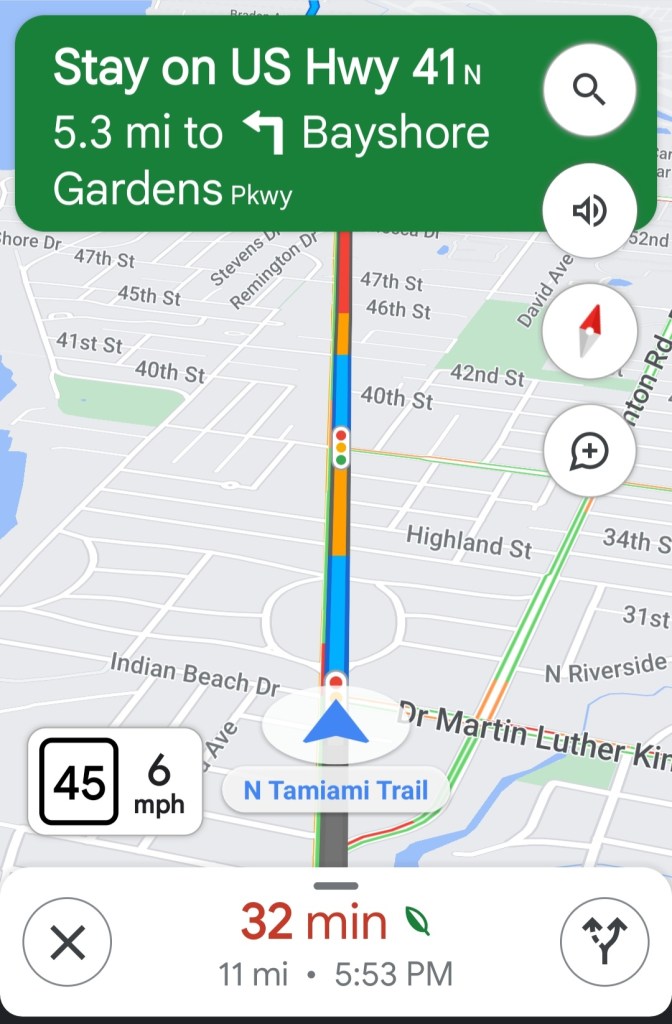
I typed 33 minutes because at this moment that’s the estimated drive time according to Google maps. I use it quite often in order to find the best route, particularly when my drive is at peak traffic times. That usually means driving home in the afternoon. Here’s a screen shot from my drive this past Tuesday.
I may be the only person (pretty sure I’m not) who looks at that ETA time (5:53) and says to myself, “I better at least get there by that time, or even better, beat it. Game On!” A little motivation and self-competition isn’t bad, right?
What I’ve found is they’re not bad until I create an emotional expectation. And that emotion can turn into thoughts like, “What the heck with these lights? Come ‘on, Manatee County! Fix these lights!” or “People, drive with purpose. Why are we driving 33MPH in a 45MPH zone? Get off my road! I’m on the clock, here!”
On my less emotionally competitive drives, I decide to pay attention and see what I can learn or enjoy. On Tuesday I decided to test Google rather than rant at the lights or other drivers. Often on the drive at any given time Google gives me options. Each option designates the difference of my remaining drive time by reading something like “2 minutes slower” or “Similar ETA.” But unless I look at the map, I have no idea all the options that I have mid-drive. On this 18-mile drive, there are dozens of options. I can ignore them and just follow the original route demanding that it live up to its promise to get me there the fastest, or I can consider other options may not be the fastest but could bring some other unexpected benefit worth the alternate route.
The test basically became how many minutes are lost if I ignore Google and go whatever route I want. Google’s directions aren’t the law; they are suggestions. And on this drive, I ignored them several times, probably three, just choosing whatever option I felt like. The end result-I arrived at the same time Google predicted, 5:53.
There are several possible takeaways from this scene. Go with whatever comes first. But mine is, I have options. Any man-made or man-given map uses the best data available. That doesn’t demand it be followed mindlessly. On the flipside, God’s map doesn’t always make sense or align with the best data nor sit well with my expectations. And that’s where I’ve learned the value of surrendering to options.
Google isn’t God. No other map reigns over his; they don’t have his data. His route will have me arriving at whatever time is best but only in the mind and spirit possible by choosing his option. It’s worth the test.
Apparently I needed to hear from C.S. Lewis because both authors included this quote from Mere Christianity, Tripp at the end and Erickson at the beginning:
In the couple of articles I read, it’s agreed the number is over 100 Billion, fluctuating between 105 and 117. I could go in lots of various directions from here, but I’ll land only on this additional stat: that means roughly 7% of all of human history is alive right now.
This question came to me during a personal communion prayer as I thought about the scriptural teaching that Jesus died for all of humanity, past/present/future. One and done. The teaching states beyond his blanket sacrifice he knows each and every one of those he died for. It’s mind-blowing to think about knowing 7 billion people personally enough to count the hairs on their head, at the same moment in time. Add to it the remaining 93% of those who have lived…not to mention those yet to live.
I fear at times Christians get so caught up in their relationship with God that they forget they aren’t the only ones. We cross the line, if we aren’t careful, into genie world. “He loved me enough to die for me and promised to give me what I ask for. How Great is That!”
This question and its answer humbled my heart, filled me with awe, and deepened my love. There are no bounds to God’s love. Yes, he loves me. He also loves the other 117,000,000,000.
Earlier this year, my friend Mark invited me to regularly cohost his podcast, The Next Man Up. We’re roughly 20 episodes in, and he hasn’t fired me.
In the middle of recording an episode about Angry White Males, I remembered a reel I’d seen recently that seemed relevant to our conversation. The video showed the behavior of two dogs on opposite sides of a fence. Check it out:
The episode topic surfaced because of a college course based on it. Our conversation led us down several roads. All the roads circled around this truth: everyone deals with anger. It’s not just men, and it’s not just white folks. All God’s children have moments of anger…which can turn into seasons…which can turn into years. The question we wrestled with is “How do we deal with it so that it doesn’t become a college course title?”
Plenty of answers exist for that question. I’m going to do something that might anger you and answer it with two other questions: 1) What fuels your anger and 2) What are you going to do with it.
I’ve been asking myself that first question for two years. And yes, it’s taking me that long to get to the real answer. Why? At first I was doing what most of us do-looking at what I wanted it to be rather than digging deep in my soul to discover what it actually was. It’s a lot easier to bark at the fence. Removing the fences we erect to keep us safe and comfortable forces us to see more of what God sees-the sacredness of his creation, including those on the other side.
What led me to start asking question one was when I was asked question two. I was barking about folks on the other side of the fence when a trusted voice asked, “What are you going to do with your anger, John?” They had stopped listening for what had happened to me and who did it. They removed that fence and asked me to see what they saw, a man caressing his anger. My erected fence was gone with one question.
Stop and consider what anger does to you. How does it impact your gut? What does it do to your emotional health? How does anger manifest in your body?
Ready to stop barking?
Start tearing down the fence. Ask God to open your eyes to what he sees.
Feel the blessing of finding your answers to the fuel. Embrace the healing when your anger is replaced by beauty.
This past week has been full of stories. They range from brokenness and sorrow to joy and hope. That’s exactly what was in the room one morning this past week when I heard this story.
The storyteller was mostly wanting to express appreciation for those who served her before Hurricane Ian arrived. But her story ended up vividly painting how others had been served by her generosity which started by an invitation.
She evacuated. When she returned, many of her neighbors were without electricity and water and had been for a week. In her efforts to serve them, it crossed her mind that humans feel better when they feel fresh. Practically, that means we feel fresh when we have showered and when we can put on clean clothes. Carrying that thought, she decided to invite her neighbors to use her shower and hand over their laundry.
She didn’t mean to be funny, but the way she described her neighbors response made me chuckle. Taking up the offer to shower is one thing, but handing over your laundry creates angst. Knowing your neighbor is going to see your underwear crinkles the brow. Her words were, “They had to cough up their underwear.”
That imagery still puts a smile on my face. Many tangents to consider with that portrait, but I’ll follow the hint she gave. Her neighbors were in a needy position; her invitation came with a choice. And the one thing that could keep them from feeling fresh was pride. Which would they choose?
We experience tremendous freedom when we hand over our pride. Being seen just as we are requires vulnerability. Fear leads us to think that absolutely no one will still love me after they learn what I’ve been hiding, what I did or what happened to me, what I think, or what I feel. Fear has programmed us to expect shame or rejection when the truth is we most likely will receive understanding and comfort.
These thoughts led me to a song I came across recently by Land of Color. It’s also an invitation. The imaginary isn’t about laundry or underwear but the familiar scene of what’s possible when we allow the Jordan to wash over us. I believe both are freeing.
Come on down and know it’s okay to cough up what’s keeping you from knowing peace and freedom.
I left town for Ian; technically, I left the state. Even though I don’t regret the decision, there’s a weird sense of guilt that comes with it (that may be for another post).
I got back to West Bradenton Thursday evening. Electricity on. Wi-Fi working. Cul-de-sac cleaned. It was like nothing had happened. But all you have to do is open any social media platform and be brought into the reality that something most certainly had happened.
Friday morning, my church sent out an email stating that the Sarasota elementary school where we meet isn’t able to host us today. So the challenge was issued to, instead of attending a service, serve the community. Here’s the challenge:
Even though we may not be gathering as a church this Sunday, we can still BE THE CHURCH. This Sunday, we invite you to join us in a SERVE SUNDAY. Would you get out and serve the people around you? Imagine the church in action spread throughout our neighborhoods and our city. What a beautiful thing that will be. Serve Sunday doesn’t have to look like just cutting debris and clearing yards, although it might be. This could look like making a meal with your kids for families still without power. This could look like taking some cookies to the local fire department. This could look like simply walking the neighborhood and checking in on each home, asking if they need anything. Let’s do this, if we see a need, let’s meet a need.
My guilt was already driving me to do something, which I managed to do on Friday and Saturday. I could have let that be it. But something was telling me that wasn’t enough.
This was supposed to be the first Sunday of my serving in a role that had me showing up at 7AM. With that off the table, I decided to drive to the beach to run, of course, but also to find answers to “enough.” Three hours later, God had given more answers than imaginable.
Before heading to the beach, I stopped to fill up the car. I overheard normal conversation about how other customers had fared the week and how challenging it was to have to keep generators running. AWARENESS #1: Not everyone has power yet.
I always park on the Gulf side of Coquina Beach. But not today. The main public parking was not open. Across the street, however, is a smaller parking lot where boat trailers park and have water entry access. And across the street is where you get a great view of sunrise. I arrived just in time to get this shot.
AWARENESS #2: The sun always rises.
I took off north to head back to Cortez road and cross the bridge to Cortez Village. I had just come to the first bend in the sidewalk and this is what I faced (I took pictures after my run for better lighting).
AWARENESS #3: Ian didn’t respect age.
Few people were moving about as I made my way to the bridge. Honestly, I’m not sure how many people are back. Other than cars on the road, it felt mostly abandoned. When I got up to the bridge, I was thinking about just running up to the draw bridge and turning around, but I felt the urge to continue over. As I ran down the other side, my left shoe felt loose. At the foot of the bridge was a slight right turn into a mobile home park that I have never explored. I saw a sitting bench, so I paused there to tie my shoe. That led me down a further exploration of this park and Cortez Village, which was a first.
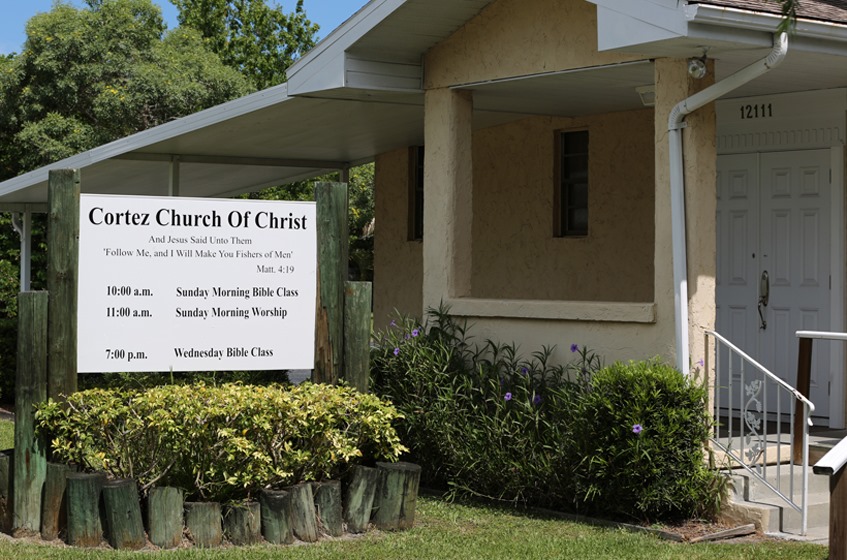
All along my run to that point, my “enough” was to pray for the residents, visitors, store owners, and businesses of Coquina Beach. As I continued that as I ran through the village, out of nowhere sat this little neighborhood church.
Photo from their Facebook page
At first, I ran by it. But then I knew I was to pause and serve this congregation by praying for them. I walked the parking lot. Nothing seemed damaged. It didn’t even look like there had been any debris. Either they’d already cleaned it up and disposed of it, or this little spot had not been touched. I counted the parking spaces; only 15 spaces, four of them handicapped. I thought about the pastor of this congregation. How unique his service is. How alone he may feel. How tempted he may be to believe the lie that his work doesn’t matter. AWARENESS #4: All service to others is service to God.
As I started back over the bridge to head back to my car, I still was asking God to show me what else I could do besides pray. The line “let’s meet a need“ from the email was my focus. And then it was clear. I had already heard the need. The folks buying gas beside me earlier illustrated a clear need people have. That was the final “enough.”
So back to the gas station I went. And I’m thinking, this is going to be a little weird-walking up to strangers and offering to pay for their gas. And my counter to my self talk was, “It’s only weird if you make it weird, John.”
My question after I pulled into a parking space was, how do I determine who to approach. I decided to just watch and see who might look like they had the most need. And as I watched and waited, it became clear.
I ended up approaching two customers. The first one was an elderly couple in an older car with a handicap license plate. He started walking toward the store with cash in his hand. When I asked if he’d allow me to pay for his gas with my card, he paused to see if I was serious. I let the silence speak. He said, “I have the money.” I replied, “I see that, but how about you keep it for something else.” And that was it. Nothing weird. Just mutual gratefulness. AWARENESS #5: Generosity is a universal language.
The second customer I suspected was serving others himself. He opened his truck’s tailgate and started taking the caps off of three 5-gallon gas cans. When I walked up and asked him if he’d paid for his gas yet, he said no. I asked then, “Will you let me pay for your gas?” Too bad we haven’t figured out how to take photos just with eye contact yet. He looked stunned, and his mind was swirling. Again I let the silence speak. The first thing he could say was, “I’m usually the one offering to help others. No one has ever asked me something like that.” My search was over. Customer #2 was enough. Those gas cans were to keep the generators running in his neighborhood. AWARENESS #6: Seek and you will find…God honors those who serve their neighbors.
Thank you, Hope City, for the challenge. The Sunday after Ian will always serve me as a reminder of the many ways God gives us enough.
Someone might say, “Maybe the first question isn’t how, but does He.”
To answer that one, most folks would give examples illustrating their “yes” or “no.” I’m a “yes.”
My “yes” has had the usual answers through my spiritual journeying years. They include prayer, creation, spiritual texts, and other people. Oh, and one more, dreams.
In my early church history, dreams weren’t high on the list. What I mean is, teachers didn’t give them much attention. That was for various reasons. So as a young follower, I didn’t give it much thought. Then as an adult when others have mentioned visions or dreams as means of God speaking to them, it felt like a foreign language. It came across as very real and personal for them, so it left me feeling left out.
The first time I recall believing God had spoken to me through a dream was in 2005. I remember it very vividly. Both the dream and the message I received. I no longer felt like an outsider. Since that experience, I often wake from a dream with a notion to pause and listen. And when there’s a message, it’s pretty obvious. It happened two nights ago.
This post isn’t written to share the message (If you know me and want to know about it, reach out to me). I’m sharing these thoughts for one main reason. I believe the answer to “does God speak” and “how” are found in the heart of each created man and woman. Creators commune with their creations. The challenge we have is returning the favor. Sometimes from boredom, emotional hurt, doubt, discontent, impatience, expectations, or arrogance, we disconnect from all the communion avenues with our Creator. Which offers this counter question posed to the mirror: “Am I plugged in?” Like the first question about IT issues, “Did you check the power cord?”
My experience has led me to believe if I’m not hearing from God it’s not His fault. It’s on me to check all the power cords.
The whole purpose of the gathering of the church is to prepare people for their encounters with death…Everything we do runs in the opposite direction. It’s all in the direction of triumphalism. It’s all in the direction of how great life can be if we get our act together or follow this leader.
Mike Cosper is referring to the writings of another leader. It richly resignates with me. It seems like another way to paint the picture of living for the kingdom of heaven, not building treasures here, etc.
In some odd way this thought validates what I’ve often told people. If I had a choice between participating in a wedding or a funeral, hands down I pick a funeral. Whatever you call it, life celebration/memorial service/funeral, everyone comes with a reality check in their minds and souls. So much room exists, so many impactful moments are possible in the days surrounding the passing of a loved one. If we are prepared, we don’t miss them, and they have the potential for even deeper joy in our sorrow than we experience in other expected, highly anticipated, and tremendously prepared for joyful life moments.
How’s your church preparing you for death? Probably not a question you’ve ever asked. Which probably indicates it’s worth answering.