It’s Ok if They Say ‘No’

When someone tells us no either directly in conversation or indirectly in their actions, we are tempted to take it personally. We are most tempted to do that when we were expecting a yes.

In my @youversion reading plan today, the topic was that God is a giver, in particularly a giver of choices. Here’s a quote from the reading:

When people say no, he allows it and keeps on loving them. God is a giver. And one of the things he always gives is a choice. But like a real giver, he also gives the consequences of those choices. He respects boundaries because he created boundaries in the first place. 

So if you want to give and love like God does, you can give others a choice to say “No…

  • …I don’t forgive you”
  • …I don’t want your help”
  • …I don’t like your decision”
  • …I don’t want to talk right now”
  • …I don’t understand where you’re coming from”
  • …I don’t agree with you”
  • …I don’t think you’re right for this position”

When you give them the loving choice to say no, then you will less likely take their no personally. It’s their choice. Give it to them. It’s okay if they say no.

Fear and Conviction

One more insight to share from Wilson’s book, The Next Level. Here’s a quote from chapter 27, The Excuses Test:

Our response to change is a reflection of the condition of our hearts. We live in fear when we insist on every question being answered and success guaranteed before we are willing to take the slightest step. We show our conviction of God’s wisdom, goodness, and strength when we trust and move forward without knowing all the answers.

If you find yourself paralyzed by fear, one way out is to stop demanding. Demand less from yourself, from God and from others. Pray for enough trust to take just one step out of your fear without demanding any degree of guarantee.

If you find yourself lacking conviction, check the object of your faith. Conviction’s strength comes from the object of faith. If the object is personal peace from having all the answers, life is going to be very stressful. If the object is the character of God, life is going to be more joyful. Discuss with God the object of your faith. You’ll find He’s a good listener, particularly to those who choose him as the object of their faith.

4 Ways to Let Them Walk Away

Speaking truth with grace and love can be hard business. Like it or not, it is a business we should all practice and work to improve our giving and receiving of it.

In chapter 26 of his book The Next Level, Scott Wilson talks about this business between Jesus and the Rich Young Ruler in Mark 10. 

“And as he was setting out on his journey, a man ran up and knelt before him and asked him, “Good Teacher, what must I do to inherit eternal life?” And Jesus said to him, “Why do you call me good? No one is good except God alone. You know the commandments: ‘Do not murder, Do not commit adultery, Do not steal, Do not bear false witness, Do not defraud, Honor your father and mother.'” And he said to him, “Teacher, all these I have kept from my youth.” And Jesus, looking at him, loved him, and said to him, “You lack one thing: go, sell all that you have and give to the poor, and you will have treasure in heaven; and come, follow me.” Disheartened by the saying, he went away sorrowful, for he had great possessions. And Jesus looked around and said to his disciples, “How difficult it will be for those who have wealth to enter the kingdom of God!””

‭‭Mark‬ ‭10:17-23‬ ‭ESV‬‬

Here’s what Wilson wrote about Jesus’ interactions in this situation:

Jesus didn’t shake his fist at the man, and he didn’t warn him of impending doom if he didn’t repent. He simply spoke the truth with grace and love, and he let the man respond however he chose. Mark tells us the man was “very sad” to hear Jesus’ invitation, and he walked away. To him, money was more important than God’s favor. The man, though, wasn’t the only one who was sad that day. I’m sure Jesus felt sorrow as he watched him walk away.

If you’ve engaged in this business, you can relate to how Jesus possibly felt. When someone hears the truth but rejects it and walks away, the truth teller faces many possible reactions, emotions, and temptations. As Jesus modeled, the truth listener needs to be given the chance to walk away. For many truth tellers, this may be the roughest part of the business. Here are four ways for the truth teller to let the truth listener walk away:

  1. Be sad for them but refuse to follow them
  2. Love them but refuse to enable them
  3. Forgive them if necessary but refuse to receive repeated behaviors 
  4. Receive them if they return but refuse to ignore any relapsing behaviors

You may think of other boundaries to help. That’s good. This business is necessary. 

Yes, the listener may choose to walk away. That’s okay. Stay in business.

The Next Level (Book Review)

Thankfully, I took my time reading through this book. Bought it four years ago on recommendation, but it’s been waiting its turn. As often happens, the timing was perfect. So thanks for the recommendation, Nancy.

This book is palatable for readers of all levels, by the way. The 31 chapters, that Wilson labels days, are no longer than 8 pages. So one could move leisurely through the book if desired. Each chapter is very devotional in nature, ending with a few questions for personal meditation or for group discussion. If you are a small group leader, you should definitely consider using this book for your group.

God has good and specific purposes for the tests he gives us. 

Each day focuses on a character in the Bible and a test they passed or failed that provided a next-level opportunity in their life’s journey. What Wilson does very well is make these tests applicable to the reader’s life as well. Examples of these tests include obedience, identity, perseverance, readiness, honesty, humility, loneliness, direction and courage. Who of us have or won’t face these tests? Here are some observations from these tests:

In many ways, knowing who we are and whose we are is at the heart of every other test in our lives. 

God never wastes our pain. He uses it to draw us deeper into a relationship with him and to touch people’s lives. 

Insisting God answer our questions creates a roadblock for our faith. 

There’s a difference between saying “yes” to God and saying “yes” to people. 

We get the most joy in life when we become holders of the spotlight instead of insisting on being in the spotlight. 

Whether you read it now or it waits its turn, this book should be in your library.

Ambidextrous Faith

Gregory of Nicea once called St. Basil’s faith ambidextrous because he welcomed pleasures with the right hand and afflictions with the left, convinced both would serve God’s design for him. (Philip Yancey, Reaching for the Invisible God)

When we look at our lives at what seems best for us, rarely would we think that afflictions fit in the picture. So it appears unnatural for someone to welcome them with conviction that God is behind them, at work completing his design. But as believers, we should know from biblical examples that this it true.

  • Joseph, whose affliction led to thousands being saved during famine
  • Esther, whose race was rescued after she stood up to a bully
  • Naomi and Ruth, whose heartache led to a new family in the lineage of the Messiah
  • Job, whose wholly affliction has given hope to every generation since
  • Jesus, betrayed/beaten/forsaken/crucified in order that all may have eternal life with his Father

Are you in an affliction? Have you considered how it might fit into God’s design for you? If not, take a look at the pleasures in your right hand and thank God for them. It might help you develop ambidextrous faith as you look at what’s in your left hand.

Laying It Down…AGAIN

Just because you make one statement or decision of commitment doesn’t put you in autopilot for the rest of your life. You aren’t clear of ever having to restate or redecide you will follow through. For example, Brad Johnson wrote about this in his book on forgiveness. When Jesus said we should forgive 7×70, he was talking about more than just the surrendering of the spirit. He was also talking about understanding follow through is a process that might take a while. It’s very much understanding the discipline of daily carrying your cross.

  • Like a runner who has to continuously set the alarm clock for dark thirty
  • Or the husband who has to choose to listen attentively rather than hold the hand up because it’s 3rd and long
  • Or the nursing student who might have to try one last time to pass anatomy to move forward in the program

Laying it down the first time probably was a big deal. Maturing to the place where you know laying it down is an ongoing journey is a whole different level of big deal.

Chris Tomlin’s “Lay It Down” speaks into this subject very well:

With this heart open wide

From the depths from the heights

I will bring a sacrifice

With these hands lifted high

Hear my song, hear my cry

I will bring a sacrifice
I lay me down I’m not my own

I belong to you alone

Lay me down, lay me down

Hand on my heart this much is true

There’s no life apart from you

Lay me down, lay me down
Letting go of my pride

Giving up all my rights

Take this life and let it shine


It will be my joy to say Your will Your way always

Peaceseekers

Twelve hours ago I walked through the Arab American National Museum in Dearborn, my second visit there. Currently, the museum has an exhibit called What We Carried.

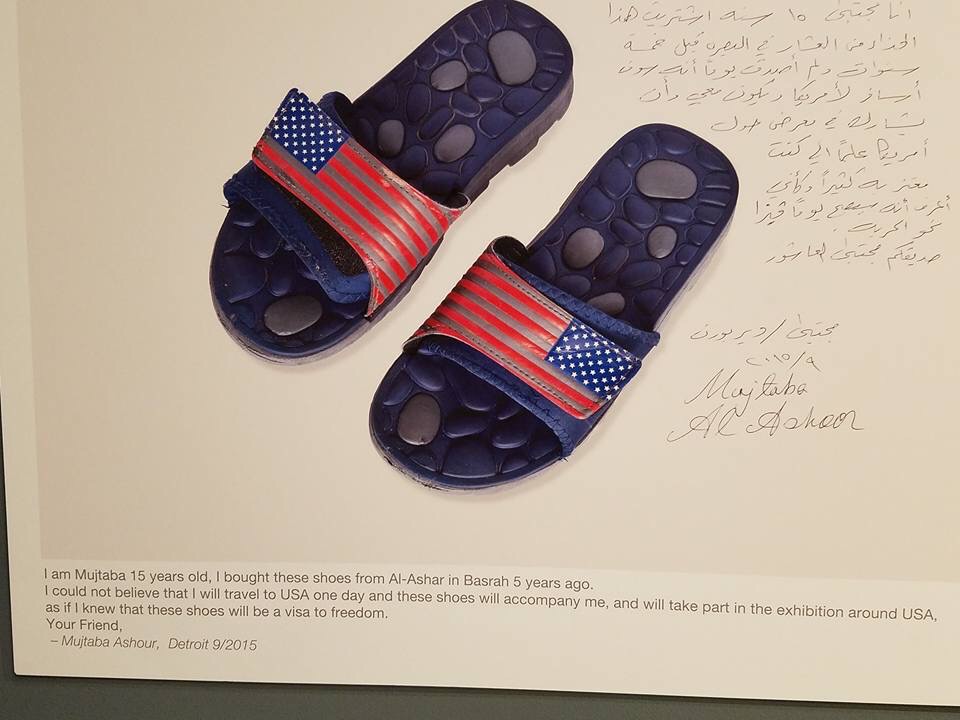
Since 2003, more than four million Iraqis have left their homes and relocated in hopes of creating a better future for themselves and their families in a setting free of war and uncertainty. Many Iraqis sought refuge in Syria only to find another dangerous situation. Approximately 140,000 of these refugees have immigrated to the U.S., the majority with nothing more than the clothes on their backs and a small memento to remind them of home.

To document their life-changing journey and shed light on the trials and tribulations refugees experience in their search for stability, renowned freelance photographer and author Jim Lommasson has created a project documenting what it means to leave everything behind.

Lommasson invited Iraqi and Syrian refugees to share a personal item significant to their travels to America, such as a family snapshot, heirloom dish or childhood toy. Lommasson photographed each artifact and then returned a 13″ x 19″ archival print to the participant so the item could be contextualized by the owner. Exhibition visitors will receive firsthand insight into the consideration of what objects, images and memories might be chosen if one was forced to leave his home forever.

The carried objects and the intense personal stories behind them combine in more than 85 images that illustrate the common threads that bind all of humanity: the love shared for family, friends and the places people call home. All of the pieces in this exhibition will be presented in both English and Arabic.

The exhibit displays a total of 93 images. The three that are stuck in my mind include a pair of sandals from a 15-year-old who said he never believed they would become like a visa to freedom, a VHS tape of a wedding including images of a father “that would not be known,” and a quilt made of neckties from family relatives.

I walked away from the museum with this thought-history is repeating itself. You learn in the museum that from 1880-1920 another huge migration happened, again because of families seeking refuge, seeking peace.

We Americans are blessed. More deeply, believers in God are blessed. No matter where we live, no matter what the circumstances of life, we can have peace. My prayer is that all people of all nations would find peace in a relationship with God, their Creator, Redeemer, and Peace Giver.

The Four Laws of Forgiveness (Book review)

This is my second read of this book by Brad Johnson. And, by the way, nice to read it on my kindle to see my previous highlights and compare what stood out to me this time.

First, this is a quick read. Good for anyone looking for a “to the point” reference on this subject. Also good for a “reminder” read. We all need to have a habit of forgiveness. This book can not only give the first step toward that habit but also can provide checkpoints for the ongoing routine.

Chapter 4 stood out to me in this read. Johnson’s fourth law deals with risks and reward. These are his three principles for this law:

  1. Risk can be godly
  2. Vulnerability can be godly
  3. The rewards of forgiveness are great

Did God show his love and give his life before or after you and I chose to love him? He did it before, which was a risk. He had no assurance we would ever love him back.

I needed this reminder. Like Jesus (NT) and Joseph (OT), godliness includes risk and vulnerability. As believers, we have access to the same power that produced the rewards of their risk and vulnerability. We can forgive.

Book Review: The Power of the Other

I just finished reading Dr. Henry Cloud’s latest book, The Power of the Other, and I’ve already given it away.

That might sound like I didn’t like it. Not the case. I passed it on to someone else because it needs to be read.

  • It should be read by anyone who tends to isolate themselves.
  • It should be read by anyone who is drawn to bad relationships.
  • It should be read by anyone who doesn’t deal well with reality.
  • It should be read by anyone seeking to establish healthy, honest, trustworthy, supportive and deep relationships.

Here are some teasers to see if you agree:

Good, caring people can be perceived wrongly by others simply because a connection has not been made. 

Rarely invest in or with someone who can’t listen. 

Character is much more than whether or not someone is going to lie, cheat, or steal. 

Healthy cultures embrace people where they are but they also nudge them and sometimes even push them to get better. 

When we are in a negative critical state, the brain, the mind, the spirit, and the soul are all in a downturn. 

Under Construction 

James wrote, “My brethren, count it all joy when you fall into various trials, knowing that the testing of your faith produces patience. But let patience have its perfect work, that you may be perfect and complete, lacking nothing.”

Patience. Who wants it? Who needs it? Apparently we all should and do, when we are looking for God’s completeness.

My devotional reading today included an illustration of a ministry leader pointing to a completed building project and saying that the building built him. Which led me to this question: Who or what has or is building me?

Looking at a trial with that question in mind should steer the mind and emotions away from making the experience about something that God didn’t intend. We can look at trials very horizontally when God intends all things to be viewed vertically. Vertical lookers ask where is God building, what is He building in me, in the organization, in the community, or in this relationship. Horizontal lookers ask how could God allow this, how could they treat me like that, where is the justice, or what were they thinking.

When the horizontal view has robbed you of your joy, step back. Look at “the construction.” Ask God what are the plans, what is He building in you. Then reply, “Thank you. You are in charge. You are wiser than I am. I look forward to your completed work.”