Into

Into the normal of a borrowed room the Bread of Life memorialized

His hope remains

Into the fog of the garden the Vine agonized

His connection remains

Into the mockery of the temple the Door submitted

His welcome remains

Into the denial in the courtyard the Good Shepherd understood

His forgiveness remains

Into the torture of the flogging the Way, the Truth, and the Life endured

His love remains

Into the abandonment on the cross the Resurrection and the Life embraced

His victory remains

Into the darkness of the tomb the Light of the World invaded

His promise remains

Photo by Brett Jordan on Unsplash

Reading to Understand the War in Ukraine

Last month The Atlantic published an article Nine Books to Read to Understand the War in Ukraine. It moved me to expand my knowledge, to educate myself, and to better respond to other’s opinions on the current crisis.

Any of the recommended books sounded interesting to me. I decided to take a trip to the library and see what I could find. I had my favorites selected, but the reality was I was at the library’s mercy. Unfortunately, they didn’t have copies of most of the books. The book that most interested me that they did have I decided was too long of a read. So I browsed other books with related topics and checked out this one by a professor and former foreign policy analyst, Constantine Pleshakov. Turned out to scratch the itch.

One could certainly read this book faster than I did, but I wanted to sit in it more than just do a quick read. Truthfully, I would probably need to read it several times to fully grasp all the history and political nuances addressed. Yet, I’ve gained so much from this read that otherwise I wouldn’t possess.

My one trip to that area of Europe was ten years ago. I went to Belarus as one of several ESL teachers for a week-long schooling. That glimpse was a blink, but an excellent thumbnail into the mindset of those who face the dilemma between holding on to their past or ferociously determining their future. An individual making that life choice can be stuck for much of their life. Imagine the nth degree reached when it’s an entire nation or region.

For anyone facing that dilemma but more importantly for the leaders and citizens of Ukraine, I share this blessing from Numbers 6:

The Lord bless you and keep you; the Lord make his face to shine upon you and be gracious to you; the Lord lift up his countenance upon you and give you peace.

The vast majority of us base our thoughts about this war on what we read online or hear on the news. I encourage you to do yourself and the Ukrainians a favor-take the time to do your own digging. You’ll benefit more from conducting your own dig that looking in someone else’s hole.

Photo by Marjan Blan | @marjanblan on Unsplash

Branch Living

Tonight I was reminded of sharing a message based on John 15:1-17. I told my friends I’d look up my notes. Unfortunately, I only have a hard copy of them, so I’m going to take care of that now.

Introductory Truth Statements:

  • God the Father is the gardener (His chief job is pruning).
  • Jesus, the Father’s Son, is the vine (The vine relies on the Gardener. He’s our example for reliance. Chief job=provide life, strength, and connection to the Father).
  • All who place their faith in the Son are the branches/shoots (Chief job=produce fruit).
  • Non-fruit-bearing branches are cut off (They have no worth or glory).
  • Fruit-bearing branches are pruned (Vines require pruning. The Gardener watches over every branch, yet he gives you the choice to remain).
  • To bear fruit, a branch must remain.
  • Apart from the vine, a branch cannot bear fruit.
  • The Gardener works to increase the fruit of the branch.

Job #1 = Remain in the Vine

  • Remain = don’t wander, stay, invest, pay attention, give up control, continue, cling, linger, abide, dwell, live, stand, stay connected
  • Test your remaining by your fruit
  • Test your remaining by your love

Job #2 = Value Pruning

Pruning is not the removal of weeds or thorns or anything from outside that may hinder the growth. No, it’s cutting off the long shoots of the previous year, removing something that comes from within that has been produced by the life of the vine itself, a proof of the vigor of its life. The more vigorous the growth has been, the greater the need for the pruning. It is the honest, healthy wood of the vine that has to be cut away.

Abide in Me by Andrew Murray and Bo Stephens
  • Test your valuing by your attitude toward the Gardener
  • Test your valuing by your reaction to circumstances
  • Test your valuing by your response to the Gardener’s Word

The great things God will do through you are going to grow in the soil of persistence, prayer, obedience, and sacrifice. That means there will be plenty of plowing and pruning. That’s the way living things grow…God has to work in us before he can work through us…when we want what God wants for the reasons he wants it, you’re unstoppable….When you ask God to do the impossible, he usually instructs you to do something uncomfortable. And inconvenient. (For church attenders, re-read this quote and replace the bold words with “a church.”

Sun Stand Still by Stephen Furtick

Closing Prayer: “By your grace, Gardener, no matter what it costs me, I’m going to remain. I’m going to take you at your word. Even if it seems like you don’t know what you’re doing, I will trust that your pruning knife will cut away what’s not good in my life. I will trust that you work all things in my life together for my good and your glory. Cleanse me through your word. Cut away any roots that will hinder the Vine from finding me wholly free to receive life. I desire to love and to bear fruit in my life for you alone.”

Photo by Zbynek Burival on Unsplash

Whispers to a Hot Minute

A hot minute about anger.

This morning I was angered by a social media post by a friend. This post, without a doubt, did harm. That in itself causes anger. This post, without a doubt, did harm to a mutual friend. That causes more and deeper anger.

And the reality is, social media posts can cause us anger just about every minute of the day, giving us the opportunity to feel like the whole day is one hot minute. These posts don’t necessarily have to be by people we know. Unfortunately, we are leered into getting hot from posts by people we don’t even know. We can believe the lie that we know their intentions, but reality is that’s impossible.

This morning, I had the same impulse most of us do. “Why don’t I point out the harm and basically put my friend in his place?” Thankfully, I refrained. Then my hotness said, “Well, sure, don’t put it out there for everybody to see. Just send him a private message.” Very tempting, but thankfully I still refrained. So what did I do? I went for a run.

So let me explain. Rarely do I run at 1PM. And rarely is going for a run a solution. But I know myself enough to know that one way to keep me from doing something stupid is to do something good. And some of my best thinking is while I’m running.

Sure enough, the hot minute subsided and the angry rebuttal left the front of my mind. Some call that regulation or de-escalation. In spiritual terms, I’d say it’s dropping your ego in order to let God have a say.

So here are God’s whispers while on my run:

  • “One person’s lack of turning their cheek doesn’t give you the right to do the same.”
  • “A fool is better left alone. I don’t need your help setting them straight.”
  • “Offer forgiveness rather than advice or judgment.”
  • “Consider how Jesus approached the harm Judas created.”

And that’s how I’ll be able to go to sleep tonight. Listening and following the whispers cooling my hot minute.

Photo by Aarón Blanco Tejedor on Unsplash

Even in the Silence

Recently I was introduced to artist Makoto Fujimura. In exploring his works, I discovered his love for another artist, novelist Shusaku Endo. This admiration led to Fujimura becoming an advisor for the movie production based on Endo’s book Silence, a movie directed by Martin Scorsese. With all this overlapping of creativity, I decided I would read the book and then watch the movie. Today I finished the book and managed to find the movie on demand to watch this afternoon.

First, let me say what a joy it is to receive the creative gifts by these three artists-a contemporary artist, a novelist, and a filmmaker. Not only are they masters at their craft, but they engage all of who they are into their work, including their faith and beliefs. Unafraid of transparency, they allow you into their wrestling and therefore make it acceptable for you to acknowledge yours.

Endo’s Silence is set in seventeenth-century Japan. The tale challenges your commitment to your faith as you follow two Portuguese Jesuit priests encounter the forced renouncing of beliefs by their Japanese Christian brothers and dialogue with a silent God. You are forced to acknowledge persecution has always been a part of Christian history and will always be, something we prefer to forget Jesus told his disciples to expect.

Such stories produce various responses. Responses usually focus on what ifs and reminders to not forget those currently experiencing persecution. My biggest response today is this: I am the sole guardian of my faith. It’s not up to the church, a pastor or priest, or anyone close to me to secure my faith. In decisive moments where I have to live out my faith, it’s entirely up to me. When my mind tells me I’m alone and God has abandoned me, my faith reminds me that he said “I am with you always,” even in the silence.

Limping and Flying

“What does it mean to trust God?”

That was the opening question in our staff meeting recently. Then a devotion was shared which compared trusting God to the work between trapeze artists. In their work, there are two roles: flyers and catchers. The job of the flyer is to do what it sounds like-release from the bar and fly in the air to be caught by their teammate. And by fly they mean do nothing. Don’t try to help the catcher. Don’t reach for the catcher. Just be in the air and trust that you will be caught.

As I listened to the devotion and the following discussion, my mind went to the previous day and my personal experience of trying to help when I wasn’t supposed to. Since my second neck surgery in 2014, I keep regular appointments with my massage therapist, Mike. And we have some interesting conversations while I’m on the table. There are rarely any lulls.

My neck was particularly tight that day, so Mike was having to spend more time on it. He always starts on my neck while I’m on my back. And he always finishes working on my neck with the same move. I know it’s coming; after 8 years I pretty much know exactly what he’s going to do next. His final move is to put both hands under my head, lift, and slowly bend my neck toward my chest. Most visits, he’ll do this several times.

On that day, I immediately knew I had done something Mike told me not to do the first time he worked on me. Rather than let him do the work, I helped. I mean, do I really need someone to lift my head toward my neck? I wasn’t born yesterday. Mike is from New York; he’s got no problem calling you out. So on that first visit when I helped him lift my head he said, “Don’t do that. While you’re on my table, you need to let me do all the work. Just pretend you’ve lost all control of your body. Go limp. Trust me and don’t get in the way of my work.”

In my talking while Mike lifted my head on this visit, I knew instantly that I had helped and wasn’t limp. So before he scolded me I said, “I helped you, didn’t I?” He said, “Yes, you did. Stop it.”

Too many times I try to help God. I get in the way. He doesn’t scold me, but he certainly lets me know things could be done more in his way, in his time, and in his perfection if I’d just go limp. Sure, I can do all the work I should while off the table. But when I’m on the table, he’s most going to have his way when I’m trusting him to do what only he can do.

Fly! God will catch you.

Go limp. God doesn’t need your help.

You can trust him.

Photo by Joseph Frank on Unsplash

Mimickry

I’ve been at it for over two years. It’s a slow burn.

When I transitioned to a new job and anticipated working more from home and not having an office, I knew something had to be done. All my books weren’t going to fit on one bookcase at home. So it began. The personal library deconstruction. As the walls enclose, the books are finding new homes.

I’m guessing all book lovers have similar problems. Not only do we buy more than we need nor have room for, we tend to not get around to reading all of them either. I’d guess someone has labeled this a disorder. I mean, chocolate lovers don’t buy boxes of chocolate just to put them on display never to be opened and eventually discarded. At least I don’t. I enjoy what’s inside. The chocolate box, just to be clear.

To address this problem, I’ve continued the deconstruction in two ways. One, if I’ve never read the book and don’t see that I will in the near future, “off with its head (given away in some fashion).” Two, rather than buying new books (Kindle doesn’t count), I’m reading the books I haven’t read and then deciding if it deserves to stay or go.

Occasionally, I encounter deja vu. Happened yesterday. I finished a book, which deserved to stay on the shelf. So I picked out another one I was pretty sure I hadn’t read. Not even sure where I got it, honestly. It’s signed by the author, which most likely explains why it’s still on the shelf. As I’m reading the first few chapters, it reads like a new book-nothing familiar at all. And then, with the light on the page just right, I see faint yellow highlighting. Are you kidding me? I’ve read this book before, even highlighted it, and I don’t remember. Another book lover problem. Actually, there’s several problems in that realization, but let’s move on.

One joy in re-reading a book is your eye, your mind being captured with more. Something you didn’t engage the first time speaks to you the second time. Like re-watching a movie. Here’s the line in this book that captured me:

We mimic the god we serve.

God’s Resting Place: Finding Your Identity In His Peace, by Ron Marquardt

Marquardt explained that our belief of God’s character plays out in how we live. “If I believe God is angry and hard to please, I find myself behaving the same way. If I find Him happy one moment and angry the next, I will soon follow suit.” (p.19) Mind captured.

So I chose to meditate on that in a journal entry. Rather than analyze my mimicry, I decided to make a list of truths I believe about God. This list, certainly not exhaustive, can then serve as a checklist of how I’m mimicking Him:

  • God loves us as we are
  • God sent his son not to condemn
  • God receives us from our wandering
  • God seeks the lost sheep
  • God rests
  • God listens to his children
  • God blesses those who bless him
  • God humbled himself for his creation
  • God keeps his promises
  • God forgives
  • God is faithful
  • God has eternity in mind
  • God gives generously
  • God has compassion
  • God remembers we are dust

Deconstruction leading to deja vu leading to mimickry. Here’s to the slow burn!

Photo: Izabela Zagaja-Florek

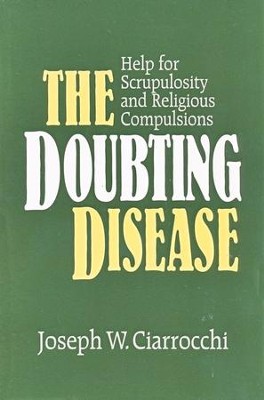
The Doubting Disease (book review)

“If you make listening and observation your occupation, you will gain much more than you can by talk.”­ – Robert Baden-Powell, founder of the scouting movement

I’m still working at this occupation at age 53. Certainly hope I’m better than at 23.

A while back during staff meeting, a colleague mentioned a book on a subject I’d never heard of-scrupulosity. I downloaded the Kindle sample. After reading that, I couldn’t help but buy it and see what I could gain.

Ciarrocchi defines scrupulosity as seeing sin where there is none, a “phobia concerning sin.” The title of his book comes from a label the French give to the emotional condition which is sometimes part of scrupulosity.

Having been in church life since I was born in a pastor’s home and then serving over 20 years on church staffs, I have witnessed this phobia. But reading the connection Ciarrocchi makes to OCD was eye-opening to exactly how doubters struggle. With this knowledge, one can see a variety of ways to navigate life while struggling with deep emotional and spiritual challenges.

He quotes Dr. Judith Rapoport of the National Institute of Mental Health as describing OCD as losing the ability “to know if you know something.” This description paints a picture of OCD as being as much about doubt as it is about anxiety. Quite a different view of what an OCD patient is enduring. Dealing with their compulsions and obsessions can lead to depression therefore challenging everything they believe and think they know. To show the severity of it, he shares historical examples in chapter three through the lives of John Bunyan and St. Ignatius Loyola. Both considered suicide. Ignatius prayed, “Show me, Lord, where I can obtain help: and if I have to follow a little dog to obtain the cure I need, I am ready to do just that.”

The hope Ciarrocchi provides begins in chapter 4 and continues through the rest of the book. This hope is directed to both professional and pastoral counselors. Unfortunately, those living like Bunyan and Ignatius often feel like they’ve tried everything and have failed, nothing is available to help. He provides worksheets (chapters 5-7) and techniques for counselors to use to send this message to their clients: “Past failure does not mean you are weak-willed or hopeless. You have simply lacked some essential ingredients for effective change. You can learn skills with patience and proper direction.” Chapter 8 is where he provides those ingredients. One of the most helpful directions by Ciarrocchi is his listing and explanations of three types of scrupulous behavior in chapter 9:

  • Developmental, prominent during adolescence and following a religious conversion in adulthood
  • Milieu-influenced, as taught by family and religious educators
  • Clinical, the version associated with OCD symptoms

He ends the book encouraging those in religion and psychology that they can learn from one another.

Clinical work also requires validation of counseling methods that make explicit use of clients’ religious perspective. This research is long overdue, and some preliminary work indicates the utility of this approach. Researchers studied treating depressed patients who had a religious orientation. They found that incorporating the clients’ religious beliefs through either cognitive-behavior counseling strategies or standard pastoral counseling methods led to more rapid recovery than standard counseling methods without using the clients’ religious beliefs. What is even more intriguing is that using the clients’ religious beliefs was effective even if the counselors were agnostic themselves.

I’m thankful I was listening in that staff meeting and have read this book. Had I read this during my church ministry days, I know of at least one lady I would have ministered to better. My encouragement to all those remotely touched by this review, get your copy and gain.

Photo by Annie Spratt on Unsplash

10 Minutes in New Orleans

Last weekend we traveled to New Orleans to run the Rock ‘n’ Roll race. Unless you hibernate in your hotel, you see and therefore learn a lot in New Orleans. I’ve never been disappointed visiting New Orleans.

As for seeing and learning in New Orleans, a visit there should include taking in great food. We made it a point to not eat at the same place twice. Not necessarily hard to do, but certainly fun to achieve. Here’s the food establishments we visited during our stay:

The Milk Bar

We ate just about anything you could ask for: crawfish, shrimp and grits, crab, gumbo, pasta, burgers, pizza, chocolate, ice cream, and beignets. No regrets.

Boil Seafood House

I can only imagine the challenges these owners and employees have survived during the pandemic. This race, an annual event, wasn’t even held last year. And who knows how many others were canceled. So to be open and surviving is a testament to their commitment to their business and their customers.

We Floridians came to town somewhat clueless to the continuing COVID protocols in place in New Orleans. We learned real quick. Not in a rude way, but it was clear we were not at home. Mask mandates required us to mask up everywhere we went. No problem. Happy to comply. In some places, vaccination proof was required; we knew this as a requirement to enter the race expo. No problem. Happy to comply.

What was interesting to see was how the employees of these ten food businesses went about treating their customers while holding to these protocols. 9 out of 10 were excellent experiences. Regardless of their choosing to uphold the protocols or choosing to require vaccination proof, these employees treated their customers with excellent respect and warmth as they worked under unusual circumstances.

Our best experience was at Kilwins on Decatur Street. It was Sunday afternoon, and my friend wanted a shake. Google told us the closest shake available was Kilwins, so we headed there. We passed Cafe Beignet on our way there and decided it was time to get some beignets as well, after Kilwins. The next 10 minutes was a lesson in customer service.

If you know me, a “no” to ice cream is rare. But I was saving room for beignets. Even the chocolate was not tempting me in Kilwins. We already had our share from Leah’s Pralines, so I didn’t enter Kilwins with a shopping mindset. Just taking it in. We were not greeted at the door by anyone checking proof of vaccination. What we were greeted with was employees behind the counter welcoming us in the store, “Welcome to Kilwins!” My buddy ordered his shake, while I eyed the chocolate. Nicey, behind the counter, asked if I needed any help. I said, “No, just looking.” She offered to give me a fudge sample. Do you think I said no? After that sample of her favorite, she asked if I saw another fudge I’d like to sample. Well, I had to admit I didn’t need a sample. I had been hooked into buying a chunk of Toasted Coconut Fudge, simply because it sounded intriguing. Plus, Nicey lived up to her name. We walked out of Kilwins happy shake and fudge customers expecting to enjoy more happiness in beignet land.

We went from the best customer experience to the worst customer experience in what felt like another city, but only two stores apart. Not to bore you with the details, but suffice it to say one Cafe Beignet employee was determined to have things her way when it came to COVID protocols to the point customers did not feel welcomed. We were thankful for outside seating.

In that ten minutes in New Orleans, we saw and learned a few things about customer service, about how to treat one another during challenging times, about power, about treating others the way you want to be treated.

To the 90% of New Orleans businesses that made our trip amazing, thank you. We remember our time with you as minutes well spent, minutes we were seen and heard, minutes you thought more about us than you did yourself. Keep giving your customers great minutes!

“You’ve No Idea”

(Luke 22:15 MSG)

Three years in the making by your time

Eternity of anticipating by my time

Maybe just another meal from where you sit

Undoubtedly my most important from where I sit

A moment to remember the past in your heart

A moment to embrace the future in my heart

A flurry of questions through your mind

A calming of purpose through my mind

Confusing challenges for your spirit

Surrendered offerings for my spirit

Everything about this moment you’ve no idea

Before, now, and after I’ve every idea

(Photo by James Coleman on Unsplash)