Honoring Tiny Achievements

Along with back to blogging, I’ve renewed listening to podcast episodes. If I were so inclined, I’d post on a regular basis responses to these episodes. But rather than burden myself with that task, I most often choose to point you to them. But not this time. This episode is too rich. Here’s the first of three responses to a timely episode of Everything Happens.

In Kate‘s conversation with Parker Palmer entitled Standing in the Gap, he shares a twist on journaling worth exploring. Rather than narrow it down, here’s the portion of the transcript for you to hear Parker’s description:

I was talking with this therapist who said, what I want you to do in the midst of this despair you have about being nothing and nobody and of no use, a worm, I want you to start keeping a journal. And I just, you know, drew whatever energy I could and did the fair imitation of a depressed blow up which isn’t a real blow up because you just don’t have the energy for a real blow up. But I said, are you out of your mind? I can’t write a sentence. I can’t read a page. I get lost in the very act of trying to articulate a thought or absorb it sort from the outside. He said, well, I’m not talking about a lengthy discursive journal. I’m talking about a journal of tiny achievements. And I said, what does that mean? And he said, well, for example, you told me that you were finally able to get up at 10:30 this morning, having spent most of the night and morning just in a darkened bedroom hiding under the covers. He says, write that down in the journal. You also you also told me that today you were able to get out on your bike, which is your preferred mode of exercise, because you don’t have to talk to anybody when you’re on a bike. And in this state, you’re incapable of even a simple conversation with a neighbor. You were able to ride your bike for ten minutes. Write it down. Tomorrow, start a new page with a new date. What you’re going to find, if you are faithful to this simple, this journal of tiny achievements, you’re going to find that you’re getting up a little earlier from time to time. You’re going to find that you’re riding your bike a little longer from time to time. The day’s going to come when things are going to start feeling a little more normal from time to time. The pattern of depression is sawtooth. It’s sometimes better, sometimes worse, day in and day out. Now, I was a guy for whom an achievement was writing a new book, selling 100,000 copies, getting great reviews, being invited to give talks and workshops all over the country. That’s how I spent 40 plus years of my life. These didn’t seem like achievements at all. But I today, to this day, in good mental health and in times when things are a little dark, I have recalibrated my sense of what an achievement is, and I embrace myself over much smaller achievements. And at age 85, when I probably don’t have another book in me and I don’t have a lot of post-COVID travel in me, this is probably as important as it was to honor my tiny achievements as it was when I was in deep depression. It’s a tool. And for me, it worked.

Parker has journeyed through several bouts of clinical depression. This suggestion from his therapist has turned into a life-changing, long-lasting practice. He called it a tool. That it is.

I’d also call it a blessing. Why? My last conversation with my spiritual director resulted in my awareness of needing to revive a gratitude exercise I’d abandoned. It’s a tool that helps keep me focused on the best things. It’s grounding. That’s a blessing. I imagine acknowledging tiny achievements also a blessing. Often times, my statements of gratitude seem tiny as well. But boy do they offer recalibration. Seriously, sometimes it’s good to just be grateful for toothpaste and soap. Tiny things usher in humility.

Thank you, Parker Palmer, for encouraging me to not only be grateful for tiny things, but to also honor tiny achievements.

So here we go from the first half of my Sunday:

  • Stopping to get gas before the light came on
  • Retrieving a shopping cart out of the Winn Dixie parking lot bushes so the buggy guy had one less to corral
  • Saving over 30% on groceries (A big shoutout to the inventor of BOGOs…huge achievement)
  • Out of bed after the first alarm…no snooze button today
  • Posting for a second day in a row
  • Not giving in to the temptation to respond to divisive Facebook posts

I encourage you to utilize Parker’s tool before the end of the day. May you find value and peace in your honoring.

Photo by Markus Spiske on Unsplash
Putting Ourselves in the Center

My annual reading of AWE by Paul David Tripp last month was timely. It also was impacted by growth in the last 12 months. I read through a different lens. Result: I continue to appreciate the big idea that checking our awe is valuable.

The first quote that stood out to me in this reading was from chapter 4, “Replacement”:

When we put ourselves in the center of the story, not only do we become rebels against God, we become a danger to ourselves and others.

Is putting ourselves in the center of the story a battle? For everyone. Is the thought that this means rebelling against God and endangering everyone mainstream? Nope. Maybe that’s why everyone battles it.

We don’t have to agree with Tripp. What we can do is challenge our mind and spirit to check our heart when we find ourselves in the center of the story. Is God on my heart’s throne right now? Are any relationships struggling right now? How is my joy and rest?

The second quote that stood out was from chapter 13, “Work”:

If you look to achievement to feel good about your life, to feel secure, or to have a life of meaning and purpose, then you will be dissatisfied with today’s success.

This sounds familiar (check out this post). The buzz of achievement dies. That buzz will not be satisfied by another achievement. Funny how my achievement also puts me in the center of the story.

When we find ourselves in the center of today’s story looking for the next buzz, it’s time for an awe check.

Photo by Austin Neill on Unsplash

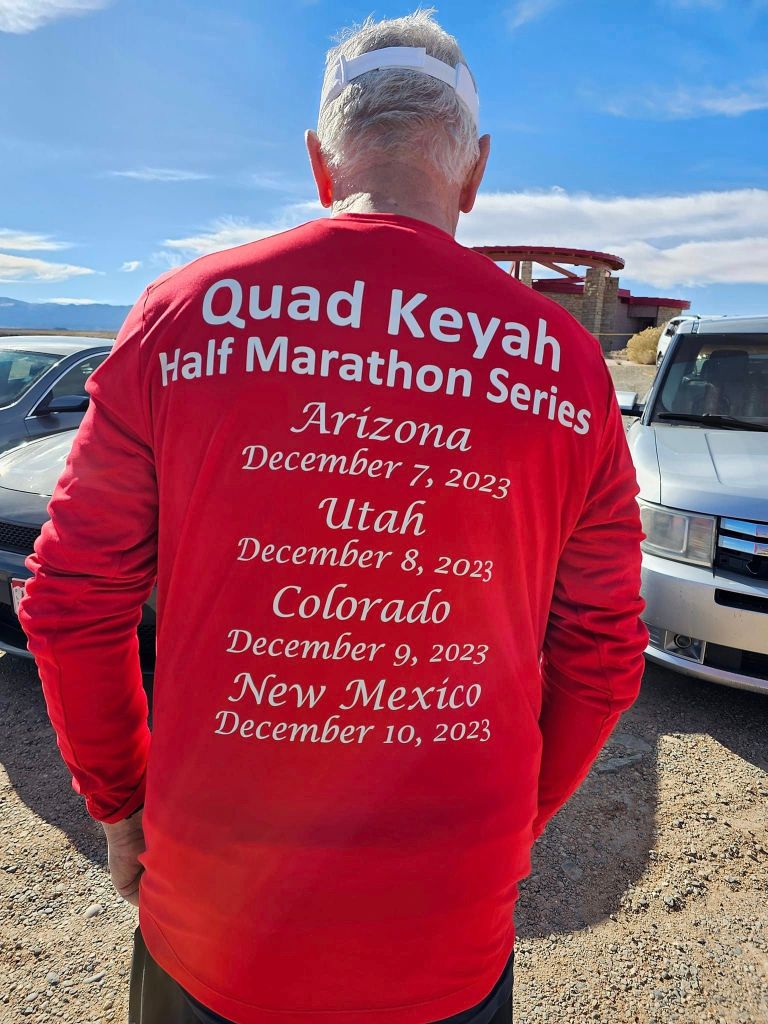
Four Corners Quad Keyah Series Lesson #6

As shared in the previous post, “Easy like Sunday morning” was not playing in my head on the drive back to Albuquerque. I had three things on my mind: Heat. Food. Fluids.

Well, there was a fourth thought going on. 

Lesson #6: If no one else cares how long you took to finish, let that be a sign. Caring trumps Competing.

As far back as I can remember I’ve been driven by achievement. Guess that explains why one of my top StrengthsFinder is Achiever. Setting goals and self discipline are second nature for me. Two balancing acts that come with that are competition and perfectionism.

This journey to run a race of any distance in all 50 states has certainly improved that balance. I can set goals all day, but there’s no guarantee of meeting them. And at the end of race day, I’m still learning it’s more about the journey than the finish time.

On Sunday in New Mexico, two runners illustrated this to me. We had been on these courses together for three days. We didn’t share names, but we shared encouraging words. And on the day they recognized I was struggling, they made sure to check in on me. Caring for a fellow runner was more important than competing against them.

On these long runs in unfamiliar places with complete strangers, you learn a lot about yourself and others. I’m grateful to be reminded over and over of the more important things. 

Personal achievement is one thing. Loving others and creating community is a better thing.

I-35 Lesson #4

Have you ever finished something that you started with dread or uncertainty or self-doubt and thought, “Well, that wasn’t so bad”?

Maybe you jumped out of a plane only because your friend coerced you.

Or you survived the dreaded public speaking gig you just knew would end your life.

Or you breathed in relief after that forever-avoided conversation with that family member.

I was surprised at the frequency of the question “would you do it again?” once someone heard of my completing the I-35 Challenge. The answer is, probably not. But that answer has nothing to do with the experience. It has more to do with how completing a once “questionable something” turned “not so bad something” impacts your mindset.

I-35 Lesson #4: Achievement reveals there’s probably something more

Making the photographer’s job easy (early on Saturday, before I’d hit double digit miles). Photo by @sportsphotoscom.

I’ve experienced it, and I’ve observed it. The lack of confidence at the start line of a race is always alive and well. And for the first-time runner or the first-time attempt at a distance, it’s as much about your mind as it is your legs, your shoes, or your sunglasses.

But somewhere along the journey to completion, the thought crosses your mind, “I’m actually going to get this done. I can’t believe this.” And for many of us, maybe even most, another thought crosses your mind at some point when it’s all over, “I wonder if I can do more.”

Yes.

Yes, you can get that degree.

Yes, you can get that promotion.

Yes, you can climb that mountain.

Yes, you can get completely out of debt.

Yes, you can be a great step-mother.

Yes, you can switch careers in your 40’s.

Yes, you can _____________________.

Yes, there’s more.

Would I do it again? Probably not. There’s something more.