Single At Heart: The Ones vs. The One

Chapter five was by far the most insightful and helpful in DePaulo’s book, Single At Heart. Entitled “The Ones,” the message is clear-single at heart people flourish because of their investment in a posse of friends rather than putting all of their emotional and relationship capital into just one person.

After decades of obsessive preoccupation with the study of marriage and romantic partnerships, scholars are increasingly turning their attention to friends.

The awareness of the possibility of a rich life as a single person through friends cannot be overstated. It starts by dropping the fantasy that one person, The One, will be sufficient. DePaulo’s shared research makes that clear.

What does having The Ones look like? It could be through the formation of what some call chosen or found families. Found family members choose over and over again to be there for one another when neither law or custom demands it. These relationships honor authenticity, knowing and loving one another as you are.

As for all the other possibilities, it looks however works best for you. There isn’t an expectation that has to be met. One single person’s group of Ones could be large and another’s much smaller. DePaulo said she doesn’t have nearly as many Ones as others. She has someone she turns to when she has good news, a different person she seeks out when she’s distraught. When she needs to vent some righteous anger, that’s usually someone else.

As a different example, here’s how one subject explained her friends:

There is the friend with whom I go on road trips, the friend who I go to see movies with, the theater buff who is my companion when I wish to see plays, the foodies who like trying out new restaurants like I do, and the potluck and other dinners I have with friends.

Then there’s the reality that some singles at heart can be their own source of comfort and security. Other people aren’t as necessary.

DePaulo’s advice for the Single at Heart:

If friends are at the center of your life, you already take them seriously. Let other people know that…If other people do not have a particularly important place in your life and that’s how you like it, own that too.

Single person, may your Ones enrich your life!

Photo by Considerate Agency on Unsplash

Seen Too Much

You’ve seen too much to do nothing

In the beauty

In the brutal

In the church

In the margins

In friend’s lives

In families

In the loving

In the hurting

In the calling

In the yelling

In the blessing

In the cursing

In the welcoming

In the dismissing

In the running

In the crawling

In the dying

In the living

You’ve seen too much to do nothing

(For deeper understanding, view this message by Pastor Matt Cote)

Thank you, Black Beans!

His name is Yohel Pozo. St. Louis Cardinals’ fans know him…more by the day.

This photo from yesterday is his winning-the-game stance, waiting for his teammates to rush him in celebration after he hit the winning single in the 11th inning to end the game. As usual, there’s much more to his story than that one moment.

Before this season, 27-year-old Pozo, a native of Venezuela, had played just 21 major league games with the Rangers back in 2021. Believe it or not, only a year earlier Pozo and his family found themselves homeless and living out of their car. Why? Besides being out of work due to the Minor League season being canceled due to the COVID pandemic, his young son had suffered a stroke when he was just a few months old, depleting the family’s finances.

How has Pozo managed to stay focused and deliver once-in-a-lifetime results, such as homering in his St. Louis debut back in April? Based on this quote, it appears it’s having a foundation of fundamentals skills that make him a clutch, reliable hitter in any situation.

That type of routine may sound drastic, even unnecessary. But its results have sustained Yozo and his family, who are reaping the long-awaited benefits.

He’s having fun. The fans are too. We all can thank dad and grandpa…and I suppose black beans.

Sources:

https://www.mlb.com/cardinals/news/yohel-pozo-wants-grandfather-and-father-to-see-him-play-in-the-big-leagues

https://www.mlb.com/cardinals/news/yohel-pozo-homers-in-cardinals-debut

Deeper, Stronger Love

About this time last Saturday, I was sitting in the stands of Washington-Grizzly Stadium on the campus of the University of Montana in Missoula waiting for the Zootown Challenge 5k to start. Not too sure how the race would go due to fighting off altitude sickness the last 18 hours, I was anxious to get moving.

When they separated the competitors based on expected pace, I ended up standing by this guy, one of several competitors wearing the same shirt.

I asked, “Tell me about the shirt so many of you are wearing. Are you part of a team?”

“No,” he smiled. “We’re just all here to remember my brother, the guy on our shirts. He died last year. He ran this race the first two years it was put on, so we’re all here to honor him.”

“That’s really amazing. There are a lot of you. How many are there?”

“54. And he’s laughing right now. This is something I never do.”

We chuckled at that thought and ended the short chat with encouragement. Basically, no matter what, we’re going to get this done. The line started moving, and we eventually separated. I passed him once on the course with a nod to keep moving.

Nothing was said about how his brother died. A year later, that wasn’t important to share in a random conversation with a stranger. What was most clear was the brother left behind loved his lost brother and was doing things now because of what he saw and remembers. I’m guessing being in that stadium and running the course was a way for him to say, “I haven’t forgotten you. Odd to say, but I love you probably now more than ever.”

This was fresh in my mind as I had just read these words from Henri Nouwen’s book Life of the Beloved:

I am called to trust that life is a preparation for death as a final act of giving…If love is, indeed, stronger than death, then death has the potential to deepen and strengthen the bonds of love. It was only after Jesus had left his disciples that they were able to grasp what he truly meant to them. But isn’t that true for all who die in love? (Chapter 8, “Given”)

May your loves deepen and strengthen.

The 6 overlooked words of Numbers 20

Numbers 20 tells a significant story in Moses’ life. After reading it this week, I believe it actually tells two significant stories. One just overshadows the other.

Both stories changed Moses’ future. The one that gets the most focus is his “not trusting in God enough to honor him as holy in the sight of the Israelites” (v.13) by striking the rock rather than speaking to it to produce water. This decision cost him dearly; he didn’t get to enter the Promised Land.

Before that choice, Moses experienced a normal but ugly thing in life, something he couldn’t control. Death.

In the first month the whole Israelite community arrived at the Desert of Zin, and they stayed at Kadesh. There Miriam died and was buried.

Verse 1

Those last six words jumped off the page. I knew his sister died before Moses and his brother Aaron, but I had never put her death as happening in the same chapter as his future-altering choice.

Unfortunately, those six words are all we have. We don’t know anything else. We’re left to wonder.

  • How did Miriam die?
  • Had their relationship healed from the scene in Numbers 12? (By the way, that’s where we find this statement: (Now Moses was a very humble man, more humble than anyone else on the face of the earth.)
  • How much time passed between verse 1 and verse 2 in this chapter?
  • What level of grief did Moses experience after his sister’s death?

Moses’ story has always intrigued me. These questions will go answered, but they should be infused in our interpretation and meditation of his life. 

  • Is it possible grief influenced this meek man to a choice he didn’t see coming?
  • Considering the unique elements of Moses’ early life (being pulled from his family of origin, conflicting allegiances, father/son relationship), certainly they impacted his development and actions, right? 
  • Death had to be a struggle for Moses considering his history of taking it into his own hands, right?

I’m learning this more and more. Rather than judge the action in the moment, we’d show more care and love to consider what led up to it. Particularly when we are in the dark, a place we often find ourselves in biblical stories. 

All the words matter. I’m doing my best to consider them all.

Photo by Ahmed M Elpahwee on Unsplash

Make Them Say “No”

Checked out a podcast episode today entitled “Why Leaders Need to Make Bold Proposals.” J.R. Briggs shares stories how he’s worked through his fear leading to a tendency not ask for what he wants. He’s landed on two questions to ask himself before asking for something that creates angst or fear:

  1. What’s the worst they could say to my request?
  2. Can I handle a “no” to my request?

My version of these two thoughts I’ve shared many times is “What’s the worst that can happen”? If I or the group I’m in considering an ask can handle the worst, why not ask?

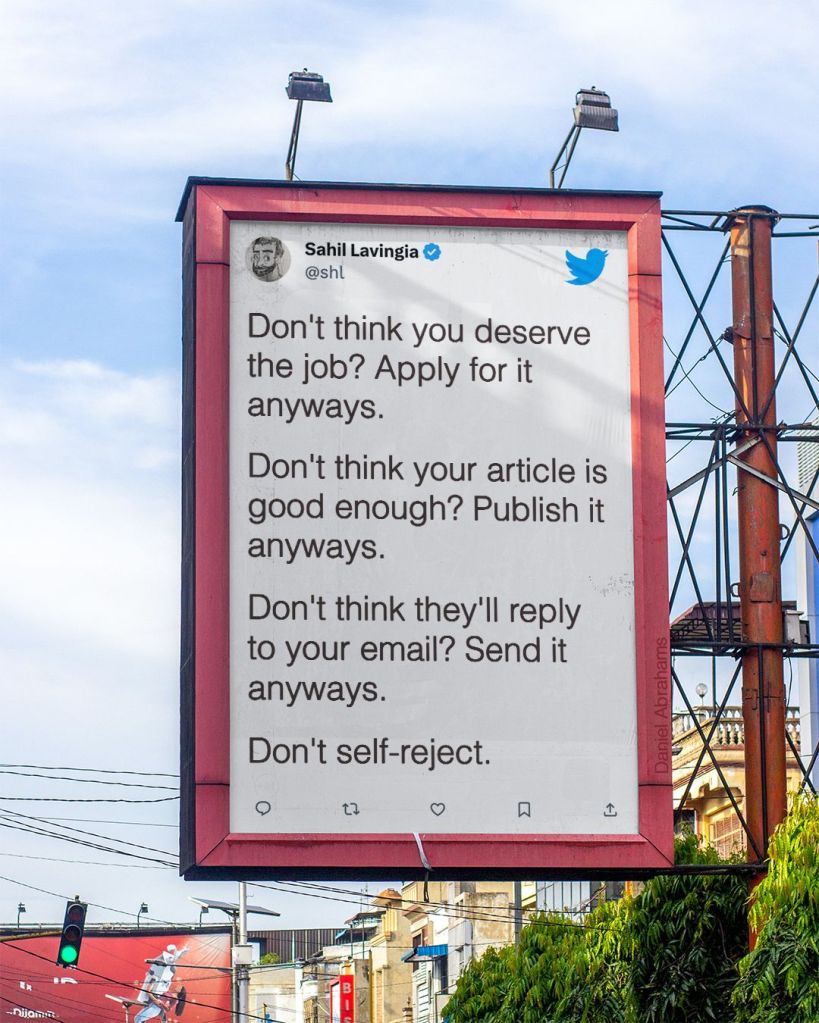
These thoughts are reinforced by this tweet image I saw recently:

I liked the self-rejection line. The mindset I’ve adopted is that the other party has to say no. Don’t say it for them by not asking.

More importantly, don’t say it for yourself. Some of us are really good at saying no to ourselves about the wrong things. The things that are the next step for us, the breakthrough, the healing, the answer we’ve been looking for can naturally have a fear factor attached. The courage for us to accept the no from the other party may be all we need. In these cases, say yes to the courage in order to avoid the missed opportunity of your no.

Family Illustration: Last March our mother turned 85. While celebrating in the Daytona Beach area, we scheduled a family photo session. The photographer commented it was too bad we didn’t take advantage of it being bike week to somehow include a bike in our props. Seed planted. Let’s just say, had we not asked the owner of this bike for a photo op at lunch after our session, we wouldn’t have this memorable photo:

Thank you to our mother and the bike owner for saying yes.

Weeds in the Shadows

In my efforts to look up these days, something caught my eye today as I walked by this church steeple. Do you see it?

Looks like they’ve been growing for a while. Probably hasn’t caught too many people’s eyes…yet. It is on the other side from the road view. And the roofline of the building behind them also keeps them hidden. Do you see them?

My first question was a pretty obvious one: How in the world are those weeds growing there? Something like 30 feet off the ground, on a dirtless structure. Weird.

My next question was more reflective: How many steeples have weeds growing in their shadow that aren’t being addressed? In this case, I’m thinking about all kinds of things.

  • Accountability of leadership
  • Protection for members
  • Factions forming over nonspiritual concerns
  • Workaholic pastors
  • Financial mismanagement
  • Emotional imbalances

Of course, this thought could be asked about all social units, corporations, and communities.

Weeds aren’t hard to identify or address. This requires two basic routines: observant eyes and willing hands.

Observant eyes are aware that weeds grow and aren’t surprised when they see them. Without willing hands to address the weeds, the weeds keep growing, they go unaddressed. Willing hands define those who know that the weeds must be addressed and aren’t afraid to do so, the sooner the better.

Which are you, the observant eyes or the willing hands?

What’s being done about the weeds in the shadows in your family, in your city, in your business, in your church, in your own heart?

A Different Kind of Rich

Last night I finished reading Rich In Heaven by Chris Mackey.

This morning I got an example of what Mackey wrote about told to me by a stranger. There’s something about snowbirds (a northerner who moves to a warmer southern state in the winter) and conversation. They don’t shy from it.

I’m on vacation in Orange Beach, Alabama. If I turn my head just so, I see the Gulf of Mexico right now. This morning I decided to walk the beach first thing. After being stopped by one snowbird to view passing porpoises about 100 yards out in the water, I was stopped by another couple to chat. I really don’t know what started the conversation. But 10 minutes later, the husband had told me all I needed to know about his family.

I didn’t ask his name. Since he’s from Gardendale (which probably doesn’t really classify him as a snowbird…it’s in the same state), I’ll call him Dale.

Dale is retiring April 1st from Alabama Power where he’s worked for 46 years. One of his younger brothers retired today. His wife said Dale’s a little miffed by that. His other younger brother took over the family farm. His wife said he’ll figure out that wasn’t a good move.

Dale doesn’t care for the beach; he’d rather be on a bushwhacker. That reminds him of growing up on the farm with his parents. They’re both gone, but he’s very proud of who they were. When his dad passed, people told Dale stories of how he’d done something personally impactful for them that they’d never forget. That’s who he was.

From Dale’s own experience, he remembers when his Dad would announce in church that the next weekend his corn crop would be ready for people to come get whatever they wanted. They stood in lines for that free corn. And the same with the family chickens. They always had 2,000-3,000 chickens (Dale said that wasn’t a lot. I’ve never had one, so that sounded ginormous to me.). Dale’s dad would announce a Sunday prior that fryers would be available the next weekend. That meant Dale and his brothers would have to skin them to be ready to give away.

Dale said he never got a satisfactory answer from his dad why he didn’t ask folks to pay for that corn or those fryers. His dad only said, “One day you’ll understand.” When Dale said they were never rich or anything, I replied, “Your dad was a different kind of rich.” He replied, “And I understand now.”

Chatting with my vacationing neighbors reminded me of a few things Mackey wrote:

We ought to think about “us and ours” instead of “me and mines.”

The way to more blessing is giving what you have away.

God is displeased, not by what we choose to give Him, but by what we refuse to give Him.

The two types of people in this world are not the haves and the have nots but the “use wells” and the “do nothings.”

The rich in heaven are those who are not okay with God working out His plan apart from them.

Nothing promotes inaction more than comfort.

It is the place where you refuse to grant God access that marks the extent of heaven’s reign in your life.

I met some rich folks this morning. I’m richer.

An Open Letter to 22E Dad on Southwest Flight 1477

I had decided for this flight I wanted an aisle seat.  Seat 22D by you and your wife was the first one I came to, so I took it.  Immediately I wondered if I’d made a bad choice. 

You even gave me a “Are you sure” look.  I failed to consider what may transpire during the 2hr 45m flight with your child you were holding.  But I decided to embrace it and build a connection. 

“First flight?”

“Yeah.  He’s three months old.”

“Congratulations!  First child?”

“Yes.”

“That’s a big deal.”

“Yes, it is.”

That 18-word interchange said a lot.  The smile on your face and the light in your eyes said more.  But you had much more to say without words the rest of the flight.

To start the flight, “Junior” (I never asked you his name) was asleep.  The sharp tone of the captain’s voice changed that.  It wasn’t long before he started letting you know it was diaper time.  Your wife wondered which restroom had a changing table.  Not only did you get the answer from the attendant-you did the deed yourself.

While you and Junior were gone, your wife got his mid-flight bottle ready, which he seemed to expect the second you returned.  Without hesitation, you took the bottle and met his expectation.  Then you burped him.  Then you rocked him in various ways until he checked back in to dreamland.

Back in dreamland

Dad, I don’t fly a lot-two or three times a year.  And I can’t say I’ve ever sat beside a couple with a baby.  So the sample size is small.  But I’m going to go out on a limb and say, “You’re not normal.”  I would say, “Think about it,” but the proof says you already did.

You intentionally sat in the middle seat, which put you on bathroom duty and gave your wife as much privacy as possible.  You did these things all without a spirit of having lost a bet or it was “your turn.”

Dad, I’d like to think I’m wrong, but I’m guessing the reason this is noteworthy to me is I don’t believe the average dad thinks ahead like that. And even if they do, I’m also going to guess the joy you had isn’t the emotion the average dad would have knowing diaper and bottle duty is part of the flight plan.

This is what your actions said to me. More importantly to be considered is what your actions said to your wife and your son. Dad, I congratulate you even more for how you are starting your fathering and husbandry journey. Sure, not every plane ride will go this well. There will plenty husband/father rides that you’ll be tempted to be average, maybe even below average. On those days, pause to look back on this one. Remember the honor you gave, the love you expressed, and the joy you received in return. My guess is you have an above average dad. For everyone’s sake, but especially your family’s generations to come after “Junior,” keep up this great start and may other dads follow your lead.

P.S. Thank you for making 22D an above average choice.

6 Signs of a Great Dad

Yesterday, I heard a dad make two comments in response to things said to him about his children.

The first was about his preschool-age son. Apparently he wasn’t feeling well. When asked about what may have caused the sickness, the dad basically said, “You never know with him.” He didn’t say this with disgust; more like, “He’s his own man.”

The second was about his elementary-age daughter. In talking about how they chose to sit where they were seated, she was given credit for the choice. Dad’s response: “She’s a natural leader.” He didn’t say this with pride; more like, “I can only imagine what’s in store for her.”

I don’t know this dad that well. We’re at the acquaintance stage. But these two comments tell me some things about him.

  • He loves his kids.
  • He respects his kid’s personhood.
  • He’s parenting with the future in mind.
  • He’s not a control freak.
  • He’s pursuing contentment.
  • He’s got a pretty good grasp on his identity.

Photo by Juliane Liebermann on Unsplash