What You Can Control

Every July, it’s a joy to witness the Hall of Fame Induction ceremony for Major League Baseball. This afternoon’s inductees included Ichiro Suzuki, CC Sabathia, Billy Wagner, Dave Parker, and Dick Allen. Every speech was unique, as one would expect from five distinguished players. But the one who seemed to shine the brightest was Ichiro Suzuki.

Ichiro at the ceremony for his induction into the Mariners Hall of Fame. (Daniel Macadangdang/Seattle Refined)

In their wrap up following his speech, the MLB network hosts were in awe. They celebrated his humor, his speaking in English, and the audience’s amazement and adoration. In stating what they most appreciated about it, one of them captured his message with this statement:

Focus on what you can control.

Even though he was told not to embarrass his home country…even though he didn’t speak English…even though he was told he was too small…he chose to focus on what he could control when starting and throughout his MLB career.

  • Like making sure his spikes were clean
  • Like setting goals rather than focusing on dreams
  • Like not letting team staff lace up his glove and doing it himself
  • Like not making excuses for failure and taking responsibility to improve

Many forces tempt us to focus on the wrong things. Sometimes they succeed. Reaching the goals we are called to requires resisting temptations, whether they’re mental, emotional, physical, relational, or spiritual.

Ichiro admitting having strong doubts in the beginning and along the way of his historic career. The one person he said never doubted him was his wife. She helped him stay focused on what he could control.

May we all pay more attention to what we can control, listen to those closest to us, and resist the temptations to do otherwise.

Unlimited (book review)

Jason Dunn’s accomplishments are extraordinary. His drive definitely seems to put him in a small percentage of not just athletes but people of any discipline or profession.

His strategies to prepare and execute his goals are worth attempting. It may be tempting to think, “I can’t do anything close to what he’s done (100-mile races, Ironman World Championship).” But I believe he’d be the first to reply, “This is not about going after what others go after. It’s about overcoming the doubt and fear to pursue what feels impossible.”

These four quotes thread how Dunn went about setting goals, going after them, and accepting the ups and downs.

Finding inspiration is often easier than people realize; you just need to choose to see the good in the world around you.

If you think or say that something is hard, it will be hard.

Grateful people are not only beautiful, but they are often humble, too.

To be truly successful, you must first do what you don’t want to do when you don’t want to do it-until you do!

If you are on the fence about going after something that seems out of reach, give this book a read. May you find the inspiration to test your limits.

DONE

When I tuned into the Olympics yesterday afternoon, a wrestling match was on. Wrestling is definitely one of those watch-only-every-four-years sports. So I left it there. And then this happened.

The wrestler had just won the gold medal. But it wasn’t his first. It was his fifth…in the same event…over five Olympics! He’s the first to do that. INCREDIBLE!

After celebrating, he went to the center of the mat, took off his shoes, and left them there as the sign of his retirement. Read more about him, Cuban wrestler Mijain Lopez, here.

One could have several takeaways from this scene. I’ve landed on two.

One, it’s a great goal to be able to say, “It’s done. I finished what I set out to do.”

Two, it’s a sign of a healthy mind to say, “I’m done with this part of life. I did my best. It’s time to go after my next best.”

Got any DONE goals? What will it require for you to say, “I did my best”?

Five Whys from Bridge A Life’s Superhero 5K

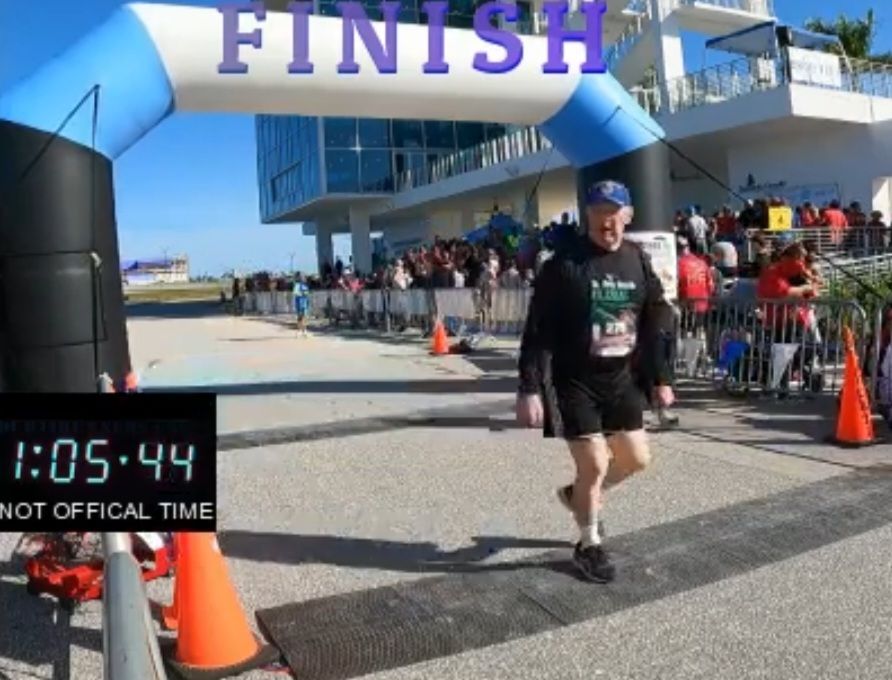
Ran a 5k this morning at the 13th Bridge A Life Superhero Race. This was just my second time at this race, first since 2021 when the event included a 10k for their 10th Anniversary.

Each time I run a 5k I ask myself why. It’s certainly not as taxing as a full marathon, but it’s not my favorite distance. That’s for another post…maybe.

After being at the race for a second time, the answers why this 5k are many.

One: To share about our work at Samaritan Counseling. The tent was busy!

Two: To see what’s possible. Always with goals in mind, I had given myself four lofty goals this week. Managed to achieve one of them: Placed 2nd in Age Group. I’ll take it. (RACE ORGANIZERS: Thanks for including a child’s name on my bib. Thinking of them kept me moving in Mile 3.)

Three: To encourage other runners. Five coworkers also entered the race, and several community partner colleagues were on hand as well.

Four: To be inspired. The oldest male competitor, Bill Welch from Parrish, introduced himself at our tent. He said he enters a 5k every Saturday to support charity. He’s completed over 1,100 races. He’s 86. He took home 3rd place in his age group. Let’s just say it’s going to take over 1,000 races for me to catch Mr. Welch.

Five: To support Bridge A Life‘s vital work in Foster Care. This event brings awareness to the reality of children in out of home care in Manatee, Sarasota, and DeSoto Counties. This year, nearly 700 names were chalked at the start/finish line.

P.S. Great Job, Bridge A Life! I imagine you feel somewhat like I did at the finish line. 

Four Corners Quad Keyah Series Lesson #4

The day before I flew to New Mexico I got a massage. Mike keeps me ready to run.

In our conversation I told him I had prepared for this race series better than I had since 2012. That’s how well I knew I had trained. I set goals and met them all. Nothing left to do but run.

Lesson #4: Prepare the best possible. But accept you can’t control everything.

For example, Race #1, starting temperature, 37F. Race #2, starting temperature, 25F. Race #3, starting temperature, 12F. But hey, no precipitation.

Next: At the start of Saturday’s race they announced a change in the course. Not that I really knew the difference, but still. Running down the side of a steep canyon to start the race was not what I had in mind. But hey, the easier course meant I finished 20 minutes faster than Friday.

Then came Sunday. More on that later. Suffice it to say, it was a day I’ll not soon forget. Pretty sure I’ve never been that cold. But hey, the rental car heater was amazing.

This is life. Prepare the best you can for the test and your nerves rattle your memory. Prepare the best you can for your wedding day and people turn out to be unreliable. Prepare the best you can for retirement and a diagnosis changes everything.

Part of the best preparation is accepting there is no way you can control all things. You can control your preparation. You can also control your response to what you can’t control. 

SUGGESTION: Purposefully place yourself in new or uncomfortable situations. Try a new route to work. Try a new recipe with your dinner guests. Go for a run in the rain. Let the kids decide where to go for dinner. 

With some practice, 2024 could be the year you accept it’s impossible to control it all.

The Stairmaster & Integrated Character

I’m halfway through Henry Cloud’s Integrity. It’s been too long since I read it, and I want to get it read before yearend.

Today I read this quote from chapter nine, “Finishing Well”:

The ability to make a move, make the call, face rejection or loss, is a character issue, and if it is missing, results do not happen. Fear of failure, rejection, disapproval, anxiety, unknown outcomes, loss of security, and other fears keep people from achieving the results that they could, if they were not afraid.

People of integrated character do not think of failure that way. They think that if things do not go well, that is another reality that they will deal with and overcome. In a sense, the integrated character never sees failure as an option. These people just see problems to be solved, and they will meet the challenge when it occurs, so “go for it.”

Here’s a simple illustration of this. I’m not running much right now while a left-foot injury heals. So my Planet Fitness craze is the Stairmaster. In response to a couple of challenges and opportunities next year, I’ve decided to push for some new personal records on the Stairmaster. The main record I’m after is time. Until last week, the longest workout I’d done was 35 minutes. Respectable. My new goal is an hour.

I could do it today if I had to. But I’d have to do it at a slower level/pace than I’d like. So my strategy is to add minutes slowly but maintaining high levels. So last Friday night I found a blog post for a 40-minute workout; it was beyond my skill set, so I modified it and went to the gym the next morning with my 36-minute routine ready to “go for it.”

I about died. This is the plan I didn’t succeed:

  • Two minutes starting at level 8 increasing one level every two minutes up to level 13 (12 minutes total). Complete three times.

After the first twelve minutes, I had a pretty clear idea I had overestimated myself. Two more rounds wasn’t going to happen unless I wanted to be the subject of a viral video of what it looks like to be eaten by a Stairmaster. In the end, I ran out of gas at 30 minutes.

I was pretty sure the way to solve my problem was to address my heart rate. I’ve never really concerned myself with it, so I needed to learn about it. According to active.com, it is recommended that you exercise within 55 to 85 percent of your maximum heart rate for at least 20 to 30 minutes to get the best results from aerobic exercise. The MHR (roughly calculated as 220 minus your age) is the upper limit of what your cardiovascular system can handle during physical activity.

Good to know. Why? All along, I’ve been pushing my heart rate way over the recommendation. Using this formula, my heart rate should be between 90-145. On Saturday, I mostly stayed between 155-170. No wonder I ran out of gas.

With a better grip on reality, I went back and boarded the machine yesterday with one goal in mind: monitor my heart rate well in order to get to 36 minutes. Here’s what I ended up achieving:

  • Level 7-2 minutes. Level 8-4 minutes. Level 9-6 minutes. Level 10-8 minutes. Level 11-6 minutes. Level 10-4 minutes. Level 9-6 minutes.

I even had a little left in the tank. As my friend told me, I had some experiential learning. Here’s what I learned:

  1. Knowledge about heart rate on this machine is power for meeting my goal.
  2. Getting there alive is certainly better than not at all.
  3. There is a way to accomplish my goal. Adjust and “go for it.”
  4. The Stairmaster can also integrate character.

There Will Be Pain

I came home two nights ago facing a choice. The choice was how to check off the 10-mile run on the training schedule. To make the choice, I chose to lay down on the bed to ponder (a hindsight look at the choice I ended up making).

As I saw it, I had three choices:

  1. Don’t
  2. Do it now while it’s 80 degrees
  3. Wait until morning, which meant the alarm would go off in time for me to hit the pavement by 4:30

Choice #1 quickly went away to avoid regret somewhere along the race route a week from Sunday. That left choosing between heat and sleep. Choosing heat meant getting it done but with much more strain. Choosing sleep meant getting less and running unfully rested. As usual, my mind ran away from heat strain choosing the dreaded early alarm. Neither sounded fun; both had pain levels more bearable than regret.

Achieving a goal, developing a discipline, and pursuing growth require sacrifice; and with sacrifice there will be pain. Committing to the pain may be half the battle of achieving, developing, and pursuing. Your commitment raises your chances of avoiding regret, knowing your sensible strain level, and rising to the challenge when doubts invade your mind.

When facing choices, maybe these questions can help:

  • How important is avoiding regret?
  • How much is too much?
  • What am I willing to sacrifice?

2017 Running Review

Almost 365 days ago, I ran an 11k in North Carolina on 1-1-17. Not a whole lot of those offered. So why did the race coordinators plan that? The mantra was do a little more, which I translated, push yourself. So instead of running traditional 5ks or 10ks, we did 6ks and 11ks. I wasn’t terribly excited that morning, though. Two days prior I had some ridiculous stomach virus unlike anything I’ve ever had. So without much energy I lined up at the start line. Thanks to good training and raw stubbornness I managed to finish first in my age group.

What I took away from that experience was the goal to do a little more throughout this year in my running. So in setting a total mileage goal for the year, instead of 1,000 I set the goal for 1,111. Happy to say I met that, and a little more (1,133).

In my blog entry on January 17, the word I set my mind on for 2017 was thrive, and for the most part I did. Being a numbers guy, here are a few of my stats:

  • Completed 7 races: 5k, 10k, 11k, and four half marathons
  • Checked off 6 states on the goal to running in all 50: AR, DE, IN, KY, NC, TN (Total stands at 15)
  • Total miles for the year: 1,133 (For the last 9 months, mileage increased from prior month making December the highest total month for the year).

Looking into next year, my phrase is this-More of the Same. Here are my goals and current plans:

  • Total mileage: 1,200
  • Run an ultra marathon-(50k, 31 miles)
  • Check off at least 3 more states-(my eyes are on MS, OH, PA)

Running may not be your thing. Whatever your thing is, how did 2017 go and what do you want to achieve in 2018? 

Winning at the Game of Life

(This is the ninth and final post in a series on wisdom from baseball; and how about it posting just a few hours before GAME 7. In this article, Mark Stanifer continues to mine his playing experience for insights into how to better play the game of life.)

One hundred and sixty-two regular season games. Three wins for the Division Series. Four more wins for the League championship. All for the chance to win four more games and be called the best in baseball. Only the Dodgers and the Astros have a chance to reach this final goal for the season.

Over the course of our article series, baseball has provided some excellent material for how to excel at the game of life. Of course, it is not a perfect analogy, but it is a good one.

Clear Goals Are Important

Last season, the Astros finished with a record barely over 0.500. The Dodgers lost in the League Championship to the eventual World Series winners. Both teams came into this season with something to prove, and they have. Although only one team will finish first, all the goal setting, planning, and hard work have paid off for both teams.

It’s likely that the other twenty-eight teams now watching the games on TV set a goal to win the World Series as well. Setting a goal does not guarantee it will happen. There are many factors which go into achieving a goal, some of which are outside of your control. But without a clear vision of what you are working for, how will you know when you achieve it? If the Astros had set their goal as simply “do better than last year,” it is likely they would have significantly underperformed. Winning the World Series is a big stretch goal, but it is specific and clear.

Team Effort

Each team has stand out players, but without the whole team, winning championships doesn’t happen. During this article series, we covered the importance of playing your role, doing the little things, and being the ideal team player. Suffice it to say, it takes a team to win the World Series.

It takes a team effort to win at the game of life too. Anyone who has achieved a level of success, broadly defined, has had help along the way. I don’t mean to diminish the individual effort. Instead, I want to emphasize the role that others — parents, mentors, coaches, teachers, partners, friends, spouses — play in their success. Moreover, truly successful people help others to be successful as well. MVP’s and all-stars garner a lot of attention, but I believe being praised as a great team player is a more desirable accolade.

Staying Focused

Spring training starts in March. The World Series sometimes finishes in November. That’s almost nine months of baseball, and over 200 games all told. How do teams stay focused for that long? There are multiple factors here, but I want to highlight one in particular. The players make a choice to stay focused on what they are pursuing — a championship.

Choices like this require sacrifice. I don’t mean to imply that a single minded pursuit of goals is always admirable. Rather, I’m highlighting a principle Greg McKeown writes about in Essentialism, which is this: “The way of the Essentialist rejects the idea that we can fit it all in. Instead it requires us to grapple with real trade-offs and make tough decisions.” Said differently, staying focused on your goals requires consistently choosing activities that lead to accomplishing your goals, and saying no to things that don’t. It also reinforces the importance of being clear about goals. Regrets arise from saying no to things that should have been a yes.

Not Just One Winner

The big flaw in using a sports analogy for life lessons is that in sports there is only one champion. Not so in life. A winner does not have to come at the expense of a loser. Winning, again broadly defined, is achievable for many. That said, let me be clear — I am not advocating for “participation trophies.” That diminishes the achievements and actions of those who have truly excelled. Rather, I’m advocating for a perspective that allows for many winners in the game of life, as each plays the game in the way they were created play. Some might call this an abundance mindset.

If I were to summarize this series in just a few sentences, it would be this: Be clear on where you are going and do what is yours to do to get there. Recognize the importance of being on a team and do the little things to help each other win. Realize that much of this game is mental and overcoming mistakes or failure will be critical. If you do all these things, it won’t guarantee victory, but it will increase your chances of living up to your full potential, and of winning big in life.

But I Don’t Want To

One reality to living alone-if you don’t do the chores, ain’t nobody else going to either. As a task-oriented guy, not usually a big deal.

But then there’s these two things: mopping and dusting. What is it with these two? Does anyone else dislike them as much as I do? I won’t tell you my lack of getting them done in order to protect my reputation of being neat and tidy.

I’ve noticed something else. There are also some spiritual disciplines that I have the same problem with. Just like house chores, some spiritual disciplines are just more enjoyable, easier, or natural. Yet, when I make myself do the less enjoyable ones, just like when I dust or mop, I’m glad I did. Like the reflection of mopped tile, my soul feels cleaner and more reflective of God.

So how do we tackle these “but I don’t want to” chores and disciplines? It doesn’t seem to work to wait until the mood strikes or to just suck it up and grudgingly put them on the to do list, on which they seem to easily get bumped down. I’m not sure what would work for you, but I can tell you what happened today to cause me to dust. I decided I wanted to see clean, to see a reflection more than anything else. It comes down to choice, to wanting better, to having the end in mind, to not settling for easy. My want has to change.

The example I can draw from in a different area of my life is running. Right now, I’m back to running 20+ miles a week-haven’t been there in almost 4 years. I’m doing that to build a foundation that will prepare me to train for the longest race in my life next year. I want to run this race. I don’t always want to get up in the dark and run. I don’t always want to endure the summer humidity. But when I remember the end in mind, I get up and hit the road. And I’m glad I did when I finish.

What’s your end game? What do you need to decide you want in order to do what you don’t want to do? Nail it down. You’ll be glad you did.