5 Steps to Customize Your Own Year-Long Bible Reading Plan on YouVersion

(updated from 1/21/23 post)

A year’s commitment to anything can sound daunting. I imagine that’s the feeling most people have when they consider committing to a 365-day Bible reading plan.

Besides that, most of those plans are designed to take you through the entire Bible. A worthy goal to pursue at least once in life. Yet, the challenge to get that done in a year can be tempting to ditch.

I completed one of those plans once on YouVersion…in about 3 years. See the point.

It took me that long because I choose to take my time. And I like to veer off track. If I want to campout in Jonah longer, I do. If I’m intrigued by a theme in Romans, I’ll take a break from the plan and complete other plans covering that theme…as many as I want as long as I want. Coloring outside the lines.

But the idea of reading a portion of the Bible every day does not mean you have to read the entire Bible in any set amount of time. All it means is placing a priority, developing a rhythm in your day that includes reading the Bible. Whenever you do it, how long you do it, where you do it, that’s entirely up to you. And, for those other rule breakers, what you read is also entirely up to you.

For quite a while, I’ve been using YouVersion reading plans. A nice thing that’s possible is customizing a year-long reading plan. Want to give it a try? Here are five steps.

  1. Determine to Make a Daily Commitment. Pretty obvious, but if you aren’t resolved to it, you won’t make it to December 31st. Sure, you might miss a day here or there. Understandable. Give yourself some grace and think about the fact that odds are you’ve got 5 minutes to give to this commitment and missing it a couple of times doesn’t make you a loser. If you are in, move on to step 2.
  2. Decide on a Theme. There’s a popular trend that’s replacing making New Year’s Resolutions. Instead of setting goals and aspirations, you choose a word that you’d like to guide you for the year. Not sure about that, check out this podcast episode to learn more. I started this in 2020. Each year I’ve utilized it differently, more broadly. This year, that word is what I’m using to customize my Bible reading. My word for 2024 is courage. Know your theme? Move on to step 3.
  3. Search Plans. On the YouVersion app (download it now if you haven’t already), you can search for reading plans simply by typing in a word. Most likely, dozens of reading plans are available. You’re ready for step 4.
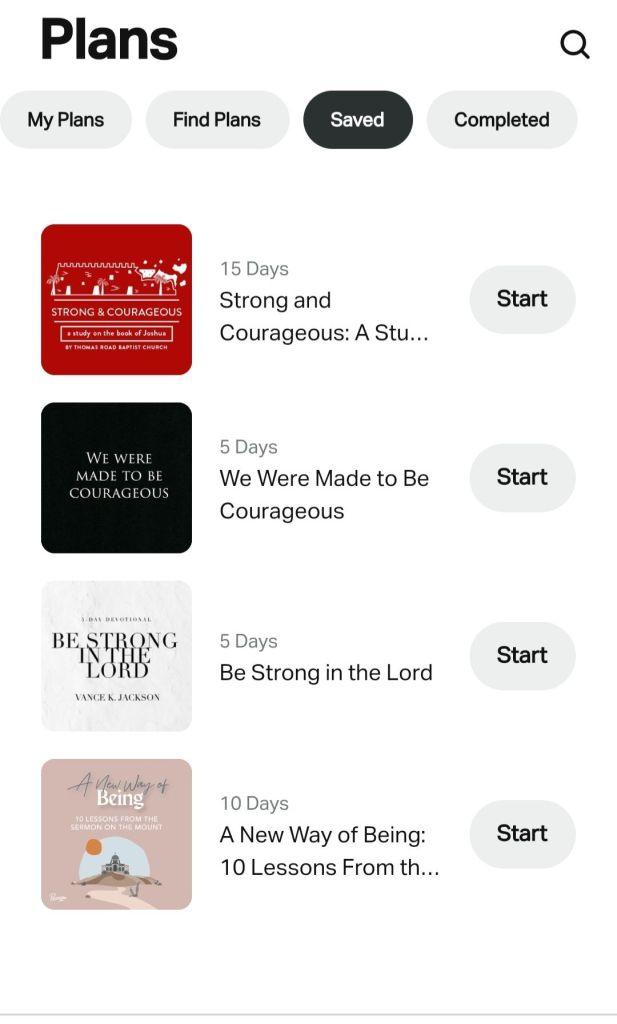
  4. Save for Later. On each plan description, you have two choices: sample and save for later. Sample allows you to check out any day of the plan. I do that to get an impression if I think I’ll complete it. If I think so, then I save it for later. You don’t have to start the plan when you find it. I’m not worrying about saving enough plans that equal 365 days, by the way. I just saved the ones that looked interesting to me for now. At the moment, I’ve saved enough plans to get me into February (total up the days for each plan to see how many days you’ve already covered). Saved at least one plan? Final step is next.
  5. Follow the Thread. As you read each plan, some verse/story/character will stand out, grab your attention. Take note. Follow that lead to search for other plans to save for later. For instance, since I did my initial plan saving, the book of 1 Peter has gotten my attention. Adding reading plans can feel very fluid and interactive.

That’s it. This approach proved worthwhile and meaningful last year. If it ain’t broke…

The Value of Tears

The latest YouVersion reading plan I’m in addresses bitterness. Day 3 of the plan ended with this question:

How can failing to shed bitter tears result in sinful bitterness of heart and life?

Overcoming Bitterness, by Stephen Viars

Can’t say I’ve ever made the connection between not shedding tears and bitterness. Before answering the question, I rephrased the question into a statement:

Failing to shed bitter tears results in sinful bitterness of heart and life.

Viars revisited the stories of David, Mordecai, and Peter to illustrate his thought. When I considered situations from the past that I may still have bitterness about, I wondered, “Maybe I haven’t sufficiently shed tears about them. Now, it seems unnecessary. Yet, it’s worth the encouragement to acknowledge how tears could have served in the past and the value of embracing them in the future to eliminate bitterness growing.”

By the way, to answer his question I flipped it to list three ways tears help us:

  • Tears help us fully grieve.
  • Tears help us find clarity.
  • Tears help us face weakness and sin.

What’s your answer? How do tears help you?

Photo by Louis Galvez on Unsplash

The Awakened Brain (book review)

Last month I came across the work of Dr. Lisa Miller, unaware of her connection to the national institute that accredits the counseling center where I work. Quickly I was up to speed and got a copy of her book The Awakened Brain.

I started reading it during the downtime of Hurricane Idalia, finishing it today. Here is one statistic from the introduction that gives reason for Miller’s work:

A study of more than 67,000 college students across 108 institutions in the United States published in 2019 found that 20% reported that they had engaged in self-harm such as cutting, 24% reported suicidal ideation, and 9% had attempted suicide.

Introduction: Anything Can Be Shown

She defines the awakened brain in the introduction to give you some sense of the foundation she is going to build for this way of approaching life.

The awakened brain is the neural circuitry that allows us to see the world more fully and thus enhance our individual, societal, and global well-being…The awakened brain includes a set of innate perceptual capacities that exist in every person through which we experience love and connection, unity, and a sense of guidance from and dialogue with life.

Introduction: Anything Can Be Shown

In chapter four she makes an interesting observation about heredity and environment. Through research, she’s determined that spirituality isn’t solely determined by environment. A person isn’t limited only by the spiritual environment of their early years; in fact, we are born with spiritual awareness. That is good news for everyone.

A person’s degree of spirituality is determined 29% by heredity and 71% by environment…People at greater risk for mental illness due to their developmental stage actually have the most to gain from spirituality.

Chapter 4, Two Sides of the Same Coin

Woven throughout the book are compelling stories of spiritual journeys, including her own. These stories, including clients as well as business and national leaders, illustrate the transformation of lives who live responding to what life is showing them, particularly when they lean in to spirituality.

What I was witnessing was less that we heal when we impose a more positive meaning on the world, and more that we shift toward health when somehow, and usually through struggle, a bigger meaning is revealed to us…feeling better isn’t just a matter of creating new thoughts, of replacing unhappy ones with happier ones; it’s also about noticing and aligning ourselves with whatever life is showing us.

Chapter 7, When Inner and Outer Align

Admittedly, Dr. Miller’s work has not been easy in the scientific community. In many ways she is countercultural, somewhat blazing a trail to question if the way of American living has been wrong for many years.

We make our best decisions when we integrate our heads, hearts, and life’s guidance, learning to tune into our choices and hurdles as part of our spiritual path…We discover that we are seekers rather than makers of our path.

Chapter 9, The Castle and The Wave

Having lived many years in achieving mode and wondering how to step back from it, chapter 12 gave language to my struggle that is lifegiving. It may not ring true to everyone, but the clearness Dr. Miller makes between the two modes of awareness is my main takeaway from the book. I believe it’s the usage of the two words achieving and awakened.

We all have two modes of awareness available to us at all times: achieving awareness and awakened awareness…Achieving awareness is the perception that our purpose is to organize and control our lives…When we engage our awakened awareness, we make use of different parts of our brain, and we literally see more, integrating information from multiple sources of perception. Instead of seeing ourselves as independent makers of our path, we perceive ourselves as seekers of our path.

Chapter 12, The Two Modes of Awareness

Dr. Miller, of Jewish faith, does not use the language of the New Testament. I suggest she paints a clear picture of the difference between Paul’s teaching regarding walking in the flesh and walking in the spirit. Flesh walkers live for themselves; spirit walkers have their eyes open to the world, ready to put themselves aside for others.

Through awakened attention, we open up more channels of perception. We learn not only to notice but also to draw meaning from what shows up in our lives. We see more, and we’re better able to use what we see.

Chapter 14, Awakened Attention

If you are a believer who questions the place of science in your faith, I encourage you to read this book. If you are an academic who questions the place of spirituality in your life, I encourage you to read this book. Allow Dr. Miller to challenge your brain and your faith. What’s the worst that can happen?

10 Endurance Tests

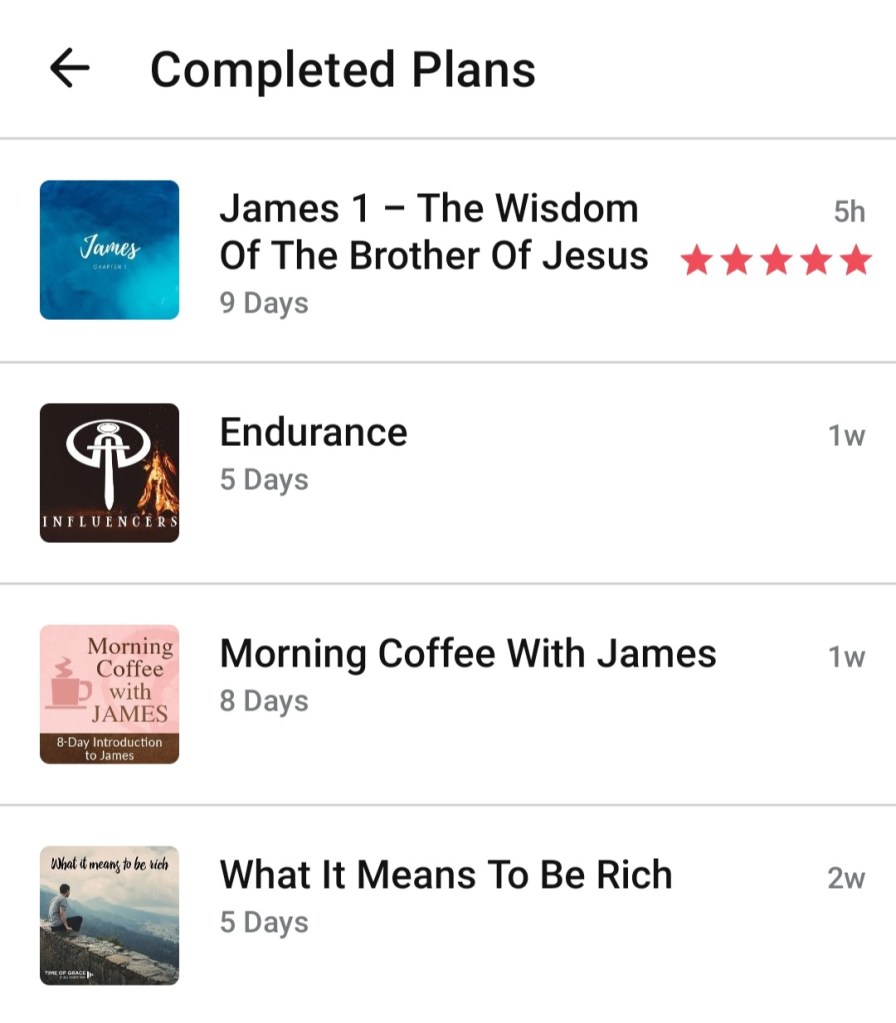
Currently I’m going through a YouVersion reading plan for James 1. The first four days of ten have pretty much focused on this verse:

For you know that when your faith is tested, your endurance has a chance to grow.

James 1:3 NLT

Reading this the other day, it struck me to get specific. For instance, when faith in one area of life is tested it has a chance to grow. To flesh that out, here are ten additions where growth can be experienced by faith testing.

When your faith in your spouse is tested, your endurance as a vow-keeping partner has a chance to grow.

When your faith in your boss is tested, your endurance as a loyal employee has a chance to grow.

When your faith in your children is tested, your endurance as a loving parent has a chance to grow.

When your faith in your parents is tested, your endurance as an honoring child has a chance to grow.

When your faith in your government is tested, your endurance as a contributing citizen has a chance to grow.

When your faith in your company is tested, your endurance as a committed team player has a chance to grow.

When your faith in your church is tested, your endurance as a kingdom-minded citizen has a chance to grow.

When your faith in your investments is tested, your endurance as a focused treasurer has a chance to grow.

When your faith in your friend is tested, your endurance as a reliable presence has a chance to grow.

When your faith in your God is tested, your endurance as an image bearer has a chance to grow.

Photo by Hu Chen on Unsplash

An Open Letter to 4:30AM Single Mom

Dear Single Mom,

It was a significant insignificant comment. And it stuck. Most likely you had no idea. But that’s usually how those go.

In describing your morning routine, you halted then flew by the fact you get up at 4:30 in order to get everyone ready for the day and get to work. As a guy who moans about mornings period, that didn’t go unnoticed. As an adult with no children, that urged my respect. As a bachelor, that forced a pause.

In my opinion, no one in their right mind chooses to get up at 4:30. But you don’t really have a choice. And I’m guessing that’s because if you don’t you might lose your mind. And you nor your children can afford that; at least, that’s what you’re modeling.

I’m guessing if I could ask 16-year-old you what you’d be doing at your age, she wouldn’t say getting up at 4:30 to do “all the things”:

  • Have three minutes to yourself
  • Shower/dress/etc.
  • Check the dryer
  • Check the dishwasher
  • Wake the rest of the house
  • Prepare breakfast/lunch/dinner
  • Sign school stuff
  • Doublecheck everyone’s everything as you walk to the car

And that’s just the physical stuff. Lack of life experience leaves her unable to comprehend the emotional journey she’s going to take between then and now. No matter why you’re single (never married, divorced, separated, widowed), she has no idea the weight on your shoulders, much less your heart. All the emotions I won’t bother to list-generated by your own thoughts and likely magnified by those who should know better-she had no idea they were coming.

Before I share the five things I most want you know, I want you to know that we (dad, mom, siblings, children, neighbors, coworkers, friends) see you. We see your tenacity. We see your fortitude. We see your faithfulness. We see your love. Even though you didn’t choose this place, you are choosing to stay in it. No leaving. No abandoning. No quitting. No resigning.

And all the things we see, God sees. I believe he wants you to know he is pleased with you today and every day.

I close with these final thoughts:

  1. I’m sorry for all the judgment you’ve gotten/get/will get. It’s ugly. And it’s not a gift from God.
  2. I’m sorry your 16-year-old-self’s dreams aren’t reality. Yes, that’s life. But it’s not the vision you had. Yet, God is with you even in the broken dreams.
  3. I’m happy your children have you. You are the mom God intended them to have. He knows that. They know that. We all know that.
  4. I’m grateful for your faith model. Not everyone chooses to keep their faith when their dreams are shattered. Be of good courage. Fear not.
  5. Tomorrow is the next day of the rest of your life. Sure, reconcile with the past. But God has something ahead that only He can give you. Keep getting up. The rest of your life is waiting.

Photo by Benjamin Manley on Unsplash

Weeds in the Shadows

In my efforts to look up these days, something caught my eye today as I walked by this church steeple. Do you see it?

Looks like they’ve been growing for a while. Probably hasn’t caught too many people’s eyes…yet. It is on the other side from the road view. And the roofline of the building behind them also keeps them hidden. Do you see them?

My first question was a pretty obvious one: How in the world are those weeds growing there? Something like 30 feet off the ground, on a dirtless structure. Weird.

My next question was more reflective: How many steeples have weeds growing in their shadow that aren’t being addressed? In this case, I’m thinking about all kinds of things.

  • Accountability of leadership
  • Protection for members
  • Factions forming over nonspiritual concerns
  • Workaholic pastors
  • Financial mismanagement
  • Emotional imbalances

Of course, this thought could be asked about all social units, corporations, and communities.

Weeds aren’t hard to identify or address. This requires two basic routines: observant eyes and willing hands.

Observant eyes are aware that weeds grow and aren’t surprised when they see them. Without willing hands to address the weeds, the weeds keep growing, they go unaddressed. Willing hands define those who know that the weeds must be addressed and aren’t afraid to do so, the sooner the better.

Which are you, the observant eyes or the willing hands?

What’s being done about the weeds in the shadows in your family, in your city, in your business, in your church, in your own heart?

5 Steps to Customize Your Own Year-Long Bible Reading Plan on YouVersion

A year’s commitment to anything can sound daunting. I imagine that’s the feeling most people have when they consider committing to a 365-day Bible reading plan.

Besides that, most of those plans are designed to take you through the entire Bible. A worthy goal for sure-I believe one that should be set and achieved at least once in life. Yet, the challenge to get that done in a year can be tempting to ditch, say, around Numbers 22 (just a random guess…nothing scientific…or biased against whatever happens in that chapter and book).

I completed one of those plans once on YouVersion…in about 3 years. See my point.

It took me that long because I choose to take my time. And I like to veer off track. If I want to campout in Jonah longer, I do. If I’m intrigued by a theme in Romans, I’ll take a break from the plan and complete other plans covering that theme…as many as I want as long as I want. I color outside the lines.

But the idea of reading a portion of the Bible every day does not mean you have to read the entire Bible in any set amount of time. All it means is placing a priority, developing a rhythm in your day that includes reading the Bible. Whenever you do it, how long you do it, where you do it, that’s entirely up to you. And, for those other rule breakers, what you read is also entirely up to you.

For quite a while, I’ve been using YouVersion reading plans. And for the first time this year, I’ve decided to use them to customize a year-long reading plan. It’s already added richness to my reading. Want to give it a try? Here’s how I’m doing it.

  1. Determine to Make a Daily Commitment. Pretty obvious, but if you aren’t resolved to it, you won’t make it to December 31st. Sure, you might miss a day here or there. Understandable. I have already. Give yourself some grace and think about the fact that odds are you’ve got 5 minutes to give to this commitment and missing it a couple of times doesn’t make you a loser. If you are in, move on to step 2.
  2. Decide on a Theme. There’s a popular trend that’s replacing making New Year’s Resolutions. Instead of setting goals and aspirations, you choose a word that you’d like to guide you for the year. Not sure about that, check out this podcast episode to learn more. I started this in 2020. Each year I’ve utilized it differently, more broadly. This year, that word is what I’m using to customize my Bible reading. My word for 2023 is rich (maybe more on that later). Know your theme? Move on to step 3.
  3. Search Plans. On the YouVersion app (download it now if you haven’t already), you can search for reading plans simply by typing in a word. When I typed in rich, dozens of reading plans were available. You’re ready for step 4.
  4. Save for Later. On each plan description, you have two choices: sample and save for later. Sample allows you to check out any day of the plan. I do that to get an impression if I think I’ll complete it. If I think so, then I save it for later. You don’t have to start the plan when you find it. I’m not worrying about saving enough plans that equal 365 days, by the way. I just saved the ones that looked interesting to me for now. At the moment, I’ve saved enough plans to get me through April (total up the days for each plan to see how many days you’ve already covered). Saved at least one plan? Final step is next.
  5. Follow the Thread. As you read each plan, some verse/story/character will stand out, grab your attention. Take note. Follow that lead to search for other plans to save for later. For instance, since I did my initial plan saving, the book of Luke and the chapter of 1 Chronicles 29 have gotten my attention. Adding reading plans for those has increased my initial plan list by five plans adding 53 days. Feels very fluid and interactive.

That’s it. I’m convinced this approach is going to continue to prove worthwhile and meaningful. By the end of the year, I anticipate remembering more, appreciating more, and embracing more of the Bible. I’ll be more rich.

By the way, I just looked up Numbers 22. That’s where a donkey talks. You might want to check it out. Not sure what thread that starts, but have fun.

Who’s Your Alvin?

Yesterday I met Alvin. Alvin is a medical assistant. I was in his office for an exam.

At the start, he had that moment where he was trying to create conversation, somewhat to see if his patient would talk. Did I need to talk or not, you know, that awkward avoidance of silence that we try to fill. He wouldn’t know that I wasn’t looking for conversation. It was 8AM. But I honored his efforts.

One way I did that was to ask about the very faint music I heard. His replied, “Oh, it’s Christian music. I have to have it playing.”

That’s all it took. When I said I thought I recognized the music, he felt released to go down the church conversation. I let him guide the conversation, inquire whatever he wanted, express his thoughts, etc.

How would I have known that he’d land on the topic of how challenging the job of being a pastor is? He described his observations about people having no idea the things pastors have to deal with, how scrutinized they are, the stress they deal with, and that they rarely seem to be able to relax.

Then he said this: “My pastor and I have a pretty close relationship that I’m grateful for. And our family makes a point to make our home a safe place for him and his family. I’ll call him up and invite them over just to give them a place to be themselves and hopefully release some stress. We don’t talk about church stuff. Our family wants to make sure we do what we can to support the pastor and his family.”

I’m just smiling on the inside and saying to myself, “He has no idea who he’s talking to.” Then he asked what I thought about it. I decided to answer that I’m a preacher’s kid. He busted out laughing. “Well, I don’t have to tell you. You’ve seen it all, from the inside.” I left it at that.

I was Alvin’s first patient. I left thinking he’d had a good start to the day. I know I had. Why? I witnessed a man not only seeking to live a holy life given a chance to express his faith but also to model what many people need in their lives. Many people, particularly anyone in a leadership position, need safe people. The safe people they need have no agenda other than to honor them, respect them, accept them as human beings, and support them in ways they may not even know or acknowledge they need.

But let’s be real. Everyone needs safe people. Everyone needs an Alvin. And we all have the chance to be an Alvin.

Who’s your Alvin?

Whose Alvin are you?

Photo by Tyler Nix on Unsplash

Meaningful Life Light

“Everyone you meet is a rough draft of the final story God is writing for their life.”

Jamie Erickson, Holy Hygge

This quote is still with me. Not because we haven’t already heard the analogy about life being a story, having a story to tell, our stories being unique, or next chapters. This particular quote highlights three thoughts casting a meaningful light.

“Everyone you meet…” God is writing everyone’s story. Not just the people close to you. Not just your coworkers. Everyone.

  • The Indiana Snowbird
  • The Hotel Desk Clerk
  • The Ice Cream Shop Scooper
  • The FedEx delivery guy
  • The AC repair guy

There isn’t anyone alive, all eight billion, whose story God isn’t writing.

“…is a rough draft of the final story…” It’s not done. The plot is unfolding. The future isn’t fixed.

  • The divorcee’s story isn’t final
  • The addict’s story isn’t final
  • The college dropout’s story isn’t final
  • The early retiree’s story isn’t final
  • The great grandmother’s story isn’t final

Today is the next page in everyone’s final story.

“…God is writing…” The story’s author determines its outcome. Big question: what happens when I steal the pen from God…

  • …in my financial story?
  • …in my family story?
  • …in my faith story?
  • …in my vocational story?
  • …in my golden year’s story?

There’s freedom in trusting God to write the story.

Photo by MJ S on Unsplash

The Hollywood Commandments (book review)

While on vacation I caught an interview of a hollywood executive. His infusion of his faith into his work intrigued me. His name was new to me, but I quickly learned that he’s worked on many projects that I’ve watched. His name is Devon Franklin. The interview was old, surrounding the release of a book. When I looked it up on hoopla, it wasn’t available, but another book more recently published was. So I borrowed it to read the rest of my time away.

Franklin has a few agendas in this book. One major one is to dispel the myth that Christians can’t be called to work in the entertainment industry. He respectfully gives illustrations of how he overcame this myth after being taught it and discouraged in his pursuit of his passion to produce life-changing projects.

Success comes from being the distinctive person that God created us to be…The moment you begin to exchange what makes you different for what makes you ordinary because you want to fit in, you give away that which God wants to use to elevate you and take you somewhere extraordinary.

Chapter 8, Your Difference is Your Destiny

A second agenda is to lay out his ten commandments to not only succeed in the entertainment business but in life in general. He’s clear that success isn’t possible without the guidance and daily presence of God in your life. He illustrates from his own journey the importance of prayer, service, understanding God’s view of your talent, and distinguishing between your intuition and God’s.

We don’t get enough experience through the church in trusting our intuition, which is strange because intuition and instinct are really the Holy Spirit at work in us…Originality terrifies people…Prayer helps you determine who is speaking through your intuition, God or you.

Chapter 5, Your Gut is Hiding God

Is this book for everyone? No. But if you’re needing some clarity, even some encouragement on pursuing success in your career with a spiritual mindset, give Franklin a look.

Stop worrying so much about immediate results and start appreciating the process…If you’re going to survive in any field, you just can’t take yourself too seriously. Having a short memory goes a long way.

Chapter 9, Your Amnesia is an Asset