Behind the Curtain: 3 Questions Organizations Must Ask (Post #2)

I grew up a PK. For those outside of church world, PK stands for preacher’s kid.

In addition to growing up in a preacher’s home, I also spent over 20 years serving on church staffs. There are many interesting dynamics to being on a church staff, but I believe one of the keys to organizational health behind the curtain has to be relationships.

In my dad’s day, the prevailing thought was pastors didn’t make friends in their churches. I hear that thought, but I never accepted it for myself. More and more, this seems to be the choice. Reality is, either way you live, it’s going to come with some challenges. But that’s true about all relationships, right?

Building on the first question about values to ensure your public persona matches your behind-the-curtain private one, it seems you must answer this question about your team: How are you building community in your organization?

Community is all about relationships. A healthy community invests in one another, cares for one another, listens to one another, trusts one another, celebrates one another, challenges one another, and commits to one another. If any of these actions are what you claim to do for your customers, it has to be going on in your team also. Community requires intention. It has to be pursued.

Leaders, to engage this question further, here are four more questions for your team to discuss:

  • In our hiring process, how much attention is given to community health?
  • What have we done in the last six months to build community?
  • How well does our team pursue community by growing in understanding one another?
  • Who’s really in charge of the community behind the curtain?

May your community behind the curtain shine in front of it.

Photo by Windows on Unsplash

Who’s Your Alvin?

Yesterday I met Alvin. Alvin is a medical assistant. I was in his office for an exam.

At the start, he had that moment where he was trying to create conversation, somewhat to see if his patient would talk. Did I need to talk or not, you know, that awkward avoidance of silence that we try to fill. He wouldn’t know that I wasn’t looking for conversation. It was 8AM. But I honored his efforts.

One way I did that was to ask about the very faint music I heard. His replied, “Oh, it’s Christian music. I have to have it playing.”

That’s all it took. When I said I thought I recognized the music, he felt released to go down the church conversation. I let him guide the conversation, inquire whatever he wanted, express his thoughts, etc.

How would I have known that he’d land on the topic of how challenging the job of being a pastor is? He described his observations about people having no idea the things pastors have to deal with, how scrutinized they are, the stress they deal with, and that they rarely seem to be able to relax.

Then he said this: “My pastor and I have a pretty close relationship that I’m grateful for. And our family makes a point to make our home a safe place for him and his family. I’ll call him up and invite them over just to give them a place to be themselves and hopefully release some stress. We don’t talk about church stuff. Our family wants to make sure we do what we can to support the pastor and his family.”

I’m just smiling on the inside and saying to myself, “He has no idea who he’s talking to.” Then he asked what I thought about it. I decided to answer that I’m a preacher’s kid. He busted out laughing. “Well, I don’t have to tell you. You’ve seen it all, from the inside.” I left it at that.

I was Alvin’s first patient. I left thinking he’d had a good start to the day. I know I had. Why? I witnessed a man not only seeking to live a holy life given a chance to express his faith but also to model what many people need in their lives. Many people, particularly anyone in a leadership position, need safe people. The safe people they need have no agenda other than to honor them, respect them, accept them as human beings, and support them in ways they may not even know or acknowledge they need.

But let’s be real. Everyone needs safe people. Everyone needs an Alvin. And we all have the chance to be an Alvin.

Who’s your Alvin?

Whose Alvin are you?

Photo by Tyler Nix on Unsplash

Some Texts Are Better Than Others

A couple of months ago I got this text from my pastor:

How can I be praying for you today? You’re always asking me…

11/1/22

I responded with a 15-minute phone call-too much to explain in a text. I told him I knew what I wanted to do regarding a decision, but I wanted to take the time to see if it aligned with what God would have me do. The final thing he said was something like, “Be open. You might be surprised with the answer.”

I thought about our conversation when I read these thoughts this morning in my devotional plan:

When we ask God for wisdom, we must be willing to accept that wisdom and follow it, no matter what. Going to God is not like going to another person for advice. People are flawed. When they share their opinions, we have the right to disagree and disregard their advice. Not so with God. He is perfect, and His wisdom is flawless.

God will always guide us into what is best for us. His wisdom may not always be what we want to hear, but it is always true, always right. If we want to retain our rights to do whatever we please, we might as well not go to God in the first place. Until we are ready to lay down our rights, they will always be tugging at our souls. When we choose, however, to disregard our own desires and to follow God’s truth, we will receive the wisdom and guidance that will always lead us into His perfect plan for our lives.

YouVersion plan “Morning Coffee With James”

That November conversation came to mind pretty easily because what I wanted to do was not how God answered me. However, within days of “disregarding my own desire,” God clearly honored that decision in a way that only he could.

Here are three takeaways from this layered interchange:

  1. Offer to pray for someone. It could be direction-changing.
  2. Be open to God’s answers. They can be surprisingly good.
  3. You have options when seeking wisdom. Leaving God out isn’t a good one.

Photo by Austin Chan on Unsplash

Uniquely

Recently-well, before “stay in place orders”-a ministry leader stopped by the office to leave some information. He was with The Bivocational and Small Church Leadership Network. Check out their website; you’ll learn some things like I did.

One of the pieces this leader left with me was a book, Uniquely Bivocational: Understanding the Life of a Pastor who has a Second Job, which I’m reading now.


For sure, there are unique things to consider about a man finding himself living this out. However, after reading chapter 8, The Need for Balance, there are general things for believers, and particularly any ministry leaders, to keep in mind. For instance, here’s the list of twelve keys to achieving balance Gilder mentions:

  1. Put God first in your life
  2. Establish priorities
  3. Link your calling to your calendar
  4. Have a clear purpose and direction for your life
  5. Be proactive rather than reactive
  6. Maintain a clear conscience
  7. Find an accountability partner
  8. Have a family council
  9. Find the secret of contentment
  10. Realize you are not superman
  11. Make regular deposits into your emotional bank
  12. Do what you do as unto the Lord

Look like a list that could help your balance? 

Yes, I’m reading this book as designed. But I’m finding that much of it could be generally applied to anyone desiring to live as God would have them-Uniquely.

Hey Leader…Get Some Help

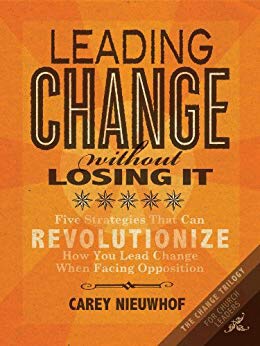
A copy of this Carey Nieuwhof book was given to me recently. Just finished reading it. Worthwhile.

I want to pass along one paragraph that may be one of the most helpful practices in the book. In chapter five entitled “Don’t Quit,” Nieuwhof lists five practices that have helped him, the founding pastor of a multi-site church near Toronto, persevere. The second practice reads:

2. Get some help. A decade ago I sat down with a counselor for the first time. Jim helped me get through some key issues, and he helped my wife, Toni, and me navigate some of the pitfalls common to couples when one is called into ministry. I’ve seen a few counselors over the last decade during different seasons and am quite sure I wouldn’t be in ministry today if it weren’t for their influence in my life. When I’ve been tempted to quit moments before a key breakthrough, my wife, prayer, wise words from others, and the help of a counselor made all the difference. I really believe God uses other people to speak to us. Interestingly enough, I don’t know of a single influential ministry leader who’s made it over the long haul who hasn’t been through some form of formal or informal counseling. My only question is why I didn’t go sooner.

Leader, consider the practice of your colleague. Get some help.

Saying No to Say Yes (book review)

I don’t recall how I came across this book. I’m guessing it was a “if you like that book you’ll like this book” Kindle referral. God bless Kindle.

If you are remotely involved with pastors (you are one, you serve one, you sit under one, you counsel one, you plan to be one, you’re married to one, you are searching for one, you just hired one, you used to be one), this book is gold. Why? Because the church world more often than not fails when it comes to pastoral boundaries. Ask your pastor.

We cannot become an expert at anything if we are responding to everything.

If for no other reason, get the book for chapter three, Setting Boundaries in Anxious Congregational Systems. Congregations become anxious for all kinds of reasons. That’s part of community. In those anxious seasons, they respond in various ways. Chapter three discusses four of those: projection, scapegoating, triangles, and multigenerational transmission. Immensely helpful.

The greater the anxiety, the more primitive the functioning of members… The greater the anxiety and emotional contagion, the more primitive and reactive people become and the less capable of creative thinking.

Chapter three also introduces the topic of differentiation-the ability to be in emotional contact with others yet still autonomous in one’s emotional functioning.

True differentiation is the ability to go home, not become emotionally reactive, and attempt to maintain a one-to-one relationship with key members of the family… Trying to keep everyone happy is not differentiation nor is avoiding or cutting off from unpleasant people. Differentiation is the ability to lead, set clear boundaries, say “no” when necessary, while at the same time building intimate relationships – even with those with whom we disagree.

All pastors will face boundary issues. It comes with the serving people career. If your pastor is up to pursuing excellence, he will agree with this final quote:

It is our job to preach, teach, and live a gospel that doesn’t depend on human over-functioning but on God’s grace.

Do him and yourself a favor. Get copies of this book and start creating healthy boundaries that connect to an overwhelming “Yes.”

Praying for Your Pastors

We paid church staffers are often asked, “What can I do for you? How can I pray for you?” So, let me give you an example of how any pastor could use your prayers.

Sunday mornings are when they have the largest volume of interaction with churchgoers, visitors and members. And the range of conversations is quite broad. Just this morning after the service, in less than ten minutes I had five different brief interactions with people about the following subjects:

  1. Church member facing gall bladder surgery
  2. Church member grieving loss of adult son
  3. Church member preparing for professional exams
  4. Church member out of work and shelter
  5. Church member asking about the temperature in the Worship Center

This is common, normal Sunday intake for your pastors. Put yourself in that space for a moment. What prayer(s) come to mind for you to offer on behalf of your pastors?

The one that comes to mind right now is that your pastors would be an example of Galatians 5:16-26. Your pastors are human. They are prone to the same tendencies as anyone else. Paul writes here that we cannot operate well for God’s kingdom without being led by his Spirit. Pray that your pastors stay closer to God than to anyone else, that they remain ready to withstand their flesh and anyone else’s, and that they then will produce the fruit of the Spirit not becoming “conceited, provoking one another, envying one another.”

A last thought. Tell your pastors you pray for them. Tell them how you feel led to pray for them. Tell them you have a glimpse of their Sundays.