Finished listening to Seeing with the Eyes of the Heart today. One of the last discussion points centered on the reality we all encounter of facing aloneness.
Adyashanti stated he believed almost no one understood Jesus, making him one of the most alone figures in spiritual literature. To explain what he meant, his reply included these thoughts about aloneness.
Engaging spirituality in an authentic way will bring us to encountering our aloneness many, many, many times…Ironically the greatest feeling of belonging comes through these deep and profound encounters with our aloneness. It’s so paradoxical that our greatest sense of belonging comes by going through those doorways of aloneness…We almost always try to do end runs around aloneness, finding surrogates for the experience of aloneness rather than really meeting it…We’re all one. That’s a really great and nice thing. But we all are simultaneously very unique expressions of the one. We all have our very unique journey that is not exactly like anyone else’s…Aloneness, in the ends, leads through the door not only to connectedness but a kind of spiritual autonomy.
I relate.
There is an aloneness on the journey of making your faith yours, not anyone else’s. Think of any faith decision you’ve made to this point that was lifechanging or formative. It came down to you making that choice by yourself. Those decisions, those moments rooted you, grounded you, expanded the territory of your faith, and girded your faith in such a way that it no longer relied on another person’s faith.
Yet, because of that, you now have the strength, the maturity, or the allure to those in your faith community that draws people to inquire how you got it. And the connectedness is more about the kingdom than you. Your aloneness that you walked through, whether you wanted to or not, brightens your image of God. It’s attractive while also preparatory for your next round of aloneness.
These thoughts remind me of this quote:
“Here is the world. Beautiful and terrible things will happen. Don’t be afraid.” -Frederick Buechner, Beyond Words
Beautiful and terrible await you in aloneness. Don’t be afraid.
The final segment from this podcast episode transcript to highlight focuses on the value of silence. Opinion: silence should be a love language.
Parker: I’m grateful to the Quaker tradition. I’ve been hanging around with Quakers since I was 35, I guess for 50 years, and I’ve learned a lot from them about the power, the value of silence, which I did not learn in my mainline Protestant upbringing… whenever the minister said in the church, I grew up in the Methodist church, now we’ll have a moment of silence. The organ broke into loud pouring for sixty seconds so that none of us could hear what we were thinking. Which was precisely the point.
Kate: Oh my gosh my son said something like that the other day. He goes, why do you keep, he said it so sweetly, but he was like, why do you keep bringing me to this place where they keep saying listen to God, but everyone’s talking.
Parker: Exactly, oh I like that a lot. Tell your son that’s so good. Exactly. So I learned a lot from the Quakers who don’t worship the silence. They worship in silence, and what they’re doing is listening. And Quakerism has its problems, just like every religious tradition or sect does. But I have seen wonderful things come out of that silence where people kind of touch a bedrock of truths. It emerges in vocal ministry, as Quakers call it. And community starts happening around those deeply held concerns. Because so often when we speak from that place of depth, we’re tapping into the aquifer that feeds all the wells. And it turns out that other people, as they tap in, are feeling that same thing or getting that same message. And then we’re poised to do something that’s real and could well make a difference in the world.
“They worship in silence, and what they’re doing is listening.”
Without question, my spiritual formation is strengthened by the amount of silence I naturally have living alone. In the silence I have been freed to listen which, with proper discipline, leads to worship.
In these last three months, I’ve done less writing and reading. When I heard this part of the conversation, I wondered if that may be attributed to my subconscious (mind/body/spirit) leading me to more silence in response to disaster and heartbreak.
Imagine what’s possible when silence is consciously pursued.
Healing
Forgiveness
Grace
Clarity
Direction
Humility
Surrender
Joy
Imagine what awaits as one speaks upon exiting silence.
Last month I came across the work of Dr. Lisa Miller, unaware of her connection to the national institute that accredits the counseling center where I work. Quickly I was up to speed and got a copy of her book The Awakened Brain.
I started reading it during the downtime of Hurricane Idalia, finishing it today. Here is one statistic from the introduction that gives reason for Miller’s work:
A study of more than 67,000 college students across 108 institutions in the United States published in 2019 found that 20% reported that they had engaged in self-harm such as cutting, 24% reported suicidal ideation, and 9% had attempted suicide.
Introduction: Anything Can Be Shown
She defines the awakened brain in the introduction to give you some sense of the foundation she is going to build for this way of approaching life.
The awakened brain is the neural circuitry that allows us to see the world more fully and thus enhance our individual, societal, and global well-being…The awakened brain includes a set of innate perceptual capacities that exist in every person through which we experience love and connection, unity, and a sense of guidance from and dialogue with life.
Introduction: Anything Can Be Shown
In chapter four she makes an interesting observation about heredity and environment. Through research, she’s determined that spirituality isn’t solely determined by environment. A person isn’t limited only by the spiritual environment of their early years; in fact, we are born with spiritual awareness. That is good news for everyone.
A person’s degree of spirituality is determined 29% by heredity and 71% by environment…People at greater risk for mental illness due to their developmental stage actually have the most to gain from spirituality.
Chapter 4, Two Sides of the Same Coin
Woven throughout the book are compelling stories of spiritual journeys, including her own. These stories, including clients as well as business and national leaders, illustrate the transformation of lives who live responding to what life is showing them, particularly when they lean in to spirituality.
What I was witnessing was less that we heal when we impose a more positive meaning on the world, and more that we shift toward health when somehow, and usually through struggle, a bigger meaning is revealed to us…feeling better isn’t just a matter of creating new thoughts, of replacing unhappy ones with happier ones; it’s also about noticing and aligning ourselves with whatever life is showing us.
Chapter 7, When Inner and Outer Align
Admittedly, Dr. Miller’s work has not been easy in the scientific community. In many ways she is countercultural, somewhat blazing a trail to question if the way of American living has been wrong for many years.
We make our best decisions when we integrate our heads, hearts, and life’s guidance, learning to tune into our choices and hurdles as part of our spiritual path…We discover that we are seekers rather than makers of our path.
Chapter 9, The Castle and The Wave
Having lived many years in achieving mode and wondering how to step back from it, chapter 12 gave language to my struggle that is lifegiving. It may not ring true to everyone, but the clearness Dr. Miller makes between the two modes of awareness is my main takeaway from the book. I believe it’s the usage of the two words achieving and awakened.
We all have two modes of awareness available to us at all times: achieving awareness and awakened awareness…Achieving awareness is the perception that our purpose is to organize and control our lives…When we engage our awakened awareness, we make use of different parts of our brain, and we literally see more, integrating information from multiple sources of perception. Instead of seeing ourselves as independent makers of our path, we perceive ourselves as seekers of our path.
Chapter 12, The Two Modes of Awareness
Dr. Miller, of Jewish faith, does not use the language of the New Testament. I suggest she paints a clear picture of the difference between Paul’s teaching regarding walking in the flesh and walking in the spirit. Flesh walkers live for themselves; spirit walkers have their eyes open to the world, ready to put themselves aside for others.
Through awakened attention, we open up more channels of perception. We learn not only to notice but also to draw meaning from what shows up in our lives. We see more, and we’re better able to use what we see.
Chapter 14, Awakened Attention
If you are a believer who questions the place of science in your faith, I encourage you to read this book. If you are an academic who questions the place of spirituality in your life, I encourage you to read this book. Allow Dr. Miller to challenge your brain and your faith. What’s the worst that can happen?
My understanding of spiritual disciplines has been exposed as limited in the last few weeks. A thread of three interactions pulled back the curtain.
Depending on who you’ve read or what denomination you’ve participated in, any teaching on spiritual disciplines containing a list most likely included any or all of these:
meditation
prayer
fasting
study
simplicity
solitude
submission
service
confession
worship
guidance
celebration
This list is from Richard Foster. The article where you can find this list includes several more. Seems a lot to master. One could see why many just don’t bother. Daunting.
The first peek behind the curtain came when a lunch conversation mentioned Rob Bell’s teaching that everything is spiritual. I hadn’t heard his name is years and wasn’t familiar with his book by that exact title. I read the Kindle sample and checked out a few videos (here’s one). Bottom line: Goes to reason if everything is spiritual, then all disciplines are spiritual.
Not long after that, Chuck DeGroat pulled the curtain back further when I read this in his book:
Disciplines place us in relationship-with Christ and within a community of wounded healers. The discipline of a disciple is to follow-that is, to walk in the shadow of Christ, to learn his ways, to struggle together when difficulties arise, to laugh and to cry. This is how friendship with God unfolds, as a relationship between two persons deeply committed to each other in covenant love. This relationship cannot be reduced to a mere practice or ritual, but it certainly involves practice and ritual-the give and take required in any relationship.
These two lead-ins prepared my mind to completely receive the final one. In a conversation on this subject and how to freshen them up, out of nowhere the question was asked, “Have you looked at blogging as a spiritual discipline?”
This morning I listened to a student pastor speak on the importance of being for the next generation. He used the analogy of passing off a baton in a relay race. His last point was an encouragement to not waste your weakness-meaning your past brokenness, your inabilities, or your inexperience do not disqualify you from being on the track, being part of passing off your baton to the next generation. You can carry a baton and pass it on.
Got me to thinking about the actual baton. What is the baton we are passing off? Is it just a broad view of a way of life? What if each one of us knew in more detail what the baton is that we are carrying? I believe we have our own unique baton that we can pass off to countless others throughout life.
Many things come to mind for me. I have a baton of music that I have passed on in many ways. I have the baton of church leadership that is still running its course. I have a baton of living a contented single life. One could say I have a baton of running that I occasionally pass on.
Those are skills and experiences. We could, and I believe we should, consider our spiritual batons also. These spiritual batons are the core of who we are, how we live. We run with the baton of faith, surrender, peace, hope, love, mercy, humility, kindness, patience-what Paul calls the fruit of the Spirit.
Another thought about our unique baton could include the life challenges that God has used to mature us. These could be anything from experiencing loss of jobs, finances, relationships to seasons of doubt, distance, or disconnect. All of these things make up the baton that we are carrying.
What if we held tight enough to our unique baton making sure we don’t drop it but loose enough to let God keep molding it? What if we passed on these batons as often as we are prompted to while we are living rather than only after we die? What if we lived more for what we relay than what we grip?
You might have to get a wheelbarrow for all those batons. But imagine the impact when your race is over and your batons are still in the race.
Here’s a clear truth from the last few weeks: we’ve learned some new words and phrases. And one of the most repeated I’ve heard is “social distancing.” We introverts know all about that, but this usage doesn’t quite mean the same.
And so it has people talking-even wondering if it’s quite right. See this post from a Facebook friend.
In talking about this with a staff member today along with the choices churches are facing due to “gathering” restrictions, it hit me that we are dealing with another thing for many people; I’ll call it spiritual distancing. For some, this isn’t a new thing. They already keep their distance from spiritual people and conversations. So what about those who are not only being restricted socially but in some sense spiritually?
Multiple answers abound, thanks to the Internet. If you are hungry and resourceful enough, you can find spiritual food to keep you close and healthy rather than distant and wondering. Here are my top two suggestions:
Podcasts…if you haven’t dipped your toe in this ocean, now would be a great time to get wet. Two suggestions: 1) Most well-known pastors/authors have podcasts. Search for them and subscribe. 2) My preference is to search for episode topics rather than follow the same person. For instance, you could search “prayer,” “faith,” “peace from God,” or “overcoming fear.” Search and find voices God can use to overcome spiritual distancing.
Youversion…the best Bible app. I have to be honest. I haven’t tried any others. But there is so much to like about this one. One element that can tremendously impact spiritual distancing is the reading plans. There are loads of options. And maybe the best kept secret about the app is that you can invite friends to read the plan with you and offer conversation between all those reading the plan. That brings spiritual people closer to one another and hopefully closer to God.
My encouragement to you is this. Whatever some one or some thing may create to force distance between you and God, stand up. Resist. Draw close. Feed that hunger. Connect. Avoid spiritual distancing.
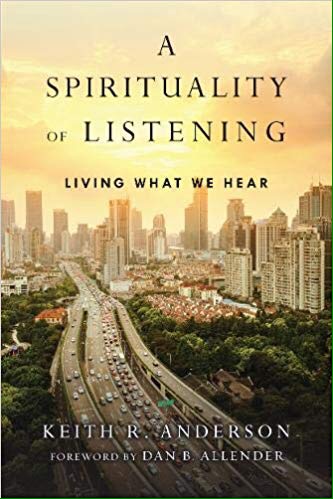
I’m really enjoying my current read, A Spirituality of Listening by Keith Anderson. If you’re attending First Baptist Bradenton tomorrow, you’ll hear some references.
I just finished chapter five, Story: Shaped by Biblical Narrative. Here are some examples of why you might enjoy this book:
God doesn’t ask that we rise above all of life’s pain; rather, he asks that we bring all of our story to God. God doesn’t ask that we walk around in disguise pretending there are no holes in our hearts; God asks that we bring those painful hearts to the throne of grace.
When someone says thank you for something you have done, it is a gift of gratitude from God. When someone shows you love, that love is a gift of grace from God. When someone tells you the truth, it is a gift of love because God cares to move you from your defenses, hiding, and resistance. Telling our story to one another is perhaps the most sacred thing we do because God shows up in the words, emotions, and crafting of our words.
Listening isn’t always something we want to do. I’ve become fascinated by our capacity for hearing in recent years. Now in my 60s, I am losing capacity to hear in one ear. It comes in handy when I’m being told something I really don’t want to hear. It’s convenient when I need a good excuse to miss a deadline or just prefer not to have definite instructions for something I might not want to do. It doesn’t mean I can’t hear at all in the “bad ear,” I just sometimes can’t tell you what the words are. I might hear sounds, muffled words and intonations. To hear the words, I must turn my face and my good ear to the speaking voice. That makes it, for me, a metaphor for spirituality – we turn our face so we can hear again. We turn our face in a new direction so the words have meaning and are not merely sounds.
This is a quote from a book I just started reading entitled A Spirituality of Listening.
I appreciate the metaphor. If I’m going to hear what God is saying to me, it’s vital that my face and my ears are turned in his direction. What might keep my face and ears turned away?
Inconvenience
Resistance
Stubbornness
Pride
Comfort
All sorts of fears and lies that the enemy would rather I choose to listen to
So in order to listen, I have to turn my face and ears by choosing humility, surrendering control, trusting truth, embracing discomfort, and recalling God’s ways are indeed best.
This afternoon I finished reading my final book for 2017, The Rest of God by Mark Buchanan. I shared a thought from his book a few days ago regarding a sabbath type exercise, which he offers many of in this book. Here’s one from chapter 10 that seems fitting for New Year’s Eve:
A good Sabbath exercise is to take stock. It is to sit and reckon where you are spiritually and calculate the gap between that and where you want to be – or, at least, where you know you ought to want to be. Do you want more grace, or trust, or peace? Do you want a greater sense of God’s presence and goodness? Do you want to live by Paul’s exhortation in Ephesians 4:29, to “not let any unwholesome talk proceed out of your mouth, but only what is helpful for building others up according to their needs, that it may benefit those who listen”?
What if our resolutions for the new year were spiritual in nature?
What if our first priority was about our souls, our spirits?
What if a year from now we could say, “Thank God my spiritual gap isn’t as big as it was“?

 John Gregory