Against Empathy (book review)

Took me a while, but I finished Paul Bloom’s Against Empathy.

As a more rational than emotional human, not only did I appreciate Bloom’s premise and defense, I also gained perspective. The sense of empathy he addresses is this:

Empathy is the act of coming to experience the world as you think someone else does.

Chapter 1, Other People’s Shoes

The title of that chapter is certainly something I’ve attempted to pursue in compassion growth. Try walking in other people’s shoes. What Bloom suggests is a balance of emotion that can go awry when rational compassion is untapped. For example, he shared this truth about himself:

…in the year of the Sandy Hook killings, more schoolchildren were murdered in one American city-Chicago-than were murdered in Newtown, and yet I’ve never thought about those murdered Chicago children before looking that up, and I’m not likely to think about them again…while my mind often drifts back to Newtown. Why?

Chapter 1, Other People’s Shoes

Bloom argues what really matters in everyday life is self-control and intelligence about compassion not being highjacked by high empathy caught up in the suffering of other people. Caring for the suffering must involve assessing how best to do so. This assessing is what effective altruists define as combining heart and head.

With each chapter, Bloom digs deeper touching on intimacy, violence and cruelty, and the age of reason. He admits his views are not readily appreciated, but stands his ground with fair judgment of his own work and other researcher’s results.

The result: I’m no longer going to mindlessly nod my head in agreement the next time a voice heralds a need for empathy. I’m going to check my own voice. I wouldn’t use Bloom’s declaration that empathy is something to avoid. But I am going to go deeper than the surface of immediate reaction to suffering. If Bloom’s premise raises any level of reaction for you, add this title to your list to read.

By the way, it’s available on hoopla.

13 Quotes from Faith Beyond Belief

Just finished reading another book that’s delivered richness.

It reads like a podcast transcript. When they say a conversation, they mean it. So it’s refreshing in that way.

The 22 chapters feel like episodes. They don’t necessarily connect one to the next, but they definitely weave the thread of faith and spirituality.

Rather than critique or review the book, I choose to share these quotes for your meditation:

“Love your neighbor as yourself” means be aware that you and your neighbor are one.

The Creative Meaning of Life

The answer I would give the agnostic: if you cannot see [accepting unity with God] yet, you don’t have to accept it. Wait until you experience it. It is not a dogmatic principle we want to impose on you. We only want to say that millions of people experience it. You can too. Open yourself to it.

The Epic Discovery of Self

You have a “vibe.” What do you want to transmit? Bitterness, dissatisfaction, loneliness, or understanding, warmth, and love? None of that requires any great achievement. It simply happens in the way I live my life.

A decision in favor of something is also a decision to let go of something.

“Fear not!” means “take courage, and take anxiety as it comes!”

Calling, Courage, and Fear (this chapter alone is worth checking out this book; so much to digest on the subject of anxiety and courage)

When someone says she doesn’t believe in God, I ask: which god don’t you believe in?

On the Temptation to Want to Possess the Truth

Prayer warms what is frozen and hard into living water.

We fulfill God’s will when we forgive on earth as God forgives in heaven.

The “Our Father” and God’s Trustworthiness

Many people are afraid of death because they have not lived. Unlived life is hard to let go. Those who live deliberately can also let go.

On the Mortal and the Eternal

I cannot explain why there is suffering, but I can influence how I meet it.

Suffering and Reconciliation

Humility is the appropriate attitude by which to accept oneself with one’s strengths and weaknesses.

Transformation is the result of a crisis.

Spiritual Growth

Despite all the deviations, we can say that if the church did not exist, our society would be essentially colder.

What is the Christian’s Focus?

An Altar in the World, Meditation #4

On recommendation, I recently read An Altar in the World by Barbara Brown Taylor. It’s subtitled A Geography of Faith. In the spirit of that lane, rather than offer a review I’ve selected my top highlights and will offer a meditation post for each one. Here’s quote #4:

Our bodies remain God’s best way of getting to us.

Chapter 3, The Practice of Wearing Skin

One might argue there are other ways just as impactful that God gets to us, but Taylor makes an interesting point. Whether through our body loathing, our seasons of suffering, or our comparing our bodies to our neighbor’s, we certainly have many opportunities for more of God.

I believe a good chunk of these opportunities revolve around the work of acceptance. Accepting the diagnosis, the loss, the genes, the future produces humility, alignment, focus, and peace that may only come through the avenue of our bodies.

I’ve had few physical challenges in my 55 years of life. The main one I’ve dealt with in recent years is a Schatzki’s Ring. If that’s a new term to you, you’re not alone. Bottom line: I have to be careful and alert to food getting stuck in my esophagus.

It’s more annoying than anything, but it has caused me to attune to myself and others in ways I hadn’t before. It all started in a Miami restaurant in 2014 when I had no idea what was going all. All I knew was my chest was tightening, and everything I had eaten wasn’t going to stay in my body. Since then this has happened in friend’s homes, multiple restaurants, even on stage this past Sunday. That was weird. Try singing with a wedged orange slice on the verge of shooting out of your mouth-a whole new method of God getting your attention.

I’ve learned many lessons from these situations. I believe the key one is the value of lowering our guards. Here are three lived examples of what I mean:

  • Lower your guard rather than hiding behind any sense of embarrassment or shame when you have to excuse yourself from the table.
  • Lower your guard rather than exploding in anger or pride when you have to seek help for something you can’t explain or fix.
  • Lower your guard rather than ignoring the obvious and making matters worse for you and those in your company.

How does that connect to God getting to me through my body, in this case a Schatzki Ring?

  • My guard hinders his releasing my shame.
  • My guard halts his providing my desperately needed healing.
  • My guard eliminates his growing and maturing me and therefore my community.

May we pray, “God, even in my body, get to me however you want. I’m all yours.”

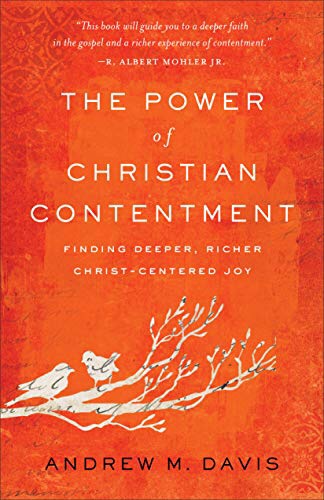
The Power of Christian Contentment (book review)

Releasing this book last year, there’s no way Andrew Davis knew how helpful this book could be this year.

I agree with a life coach that said this about COVID-19: “It’s not creating fear. It’s exposing the fears we already had.” The same could also be said about our contentment.

Each of the twelve chapters are rich. The most helpful ones are entitled The Mysterious Mindset of Contentment (5), The Excellence of Christian Contentment (7), The Evils and Excuses of a Complaining Heart (8), and Contentment in Suffering (9). Here are quotes from the entire book to help you tap into the power of contentment:

  • Christian contentment is finding delight in God’s wise plan for my life and humbly allowing him to direct me in it.
  • It is no stretch to say that the Lord may orchestrate amazingly challenging circumstances for you and your family for the primary purpose of giving your supernatural hope and Christian contentment a platform.
  • Abiding, supernatural contentment is a “secret” to be learned, not part of the original equipment of conversion.
  • Cosmologists estimate the total number of stars in the universe to be 1,000,000,000,000,000,000,000,000. Each of those stars is named and sustained moment by moment by God.
  • The combination of complete satisfaction in the world and complete dissatisfaction with the world is a mystery of contentment.
  • There is an inherent humility in Christian contentment and a basic arrogance in discontentment.
  • Tempting a content man is like shooting flaming arrows at an iron wall.
  • Christian contentment enables us to worship God excellently, in a way far purer and more glorious than any other form, better than hearing a sermon or attending corporate worship without contentment.
  • Esteem contentment highly; hate complaining passionately.
  • Old wicked habits die through starvation, and new godly habits grow through obedience.
  • American evangelicals of the 21st century are the wealthiest Christians in the history of the church. According to one study, evangelicals worldwide collectively made $7 trillion in income for that year. The Christian income in America represents nearly half of the world’s total Christian income. That is a massively weighty responsibility for American Christians.
  • The tapestry of our life’s history is made up of Todays.
  • God sees everything in super slow motion, and every microsecond of history is calculated and part of God’s providential plan. Don’t let Satan speed things up. Slow down! Breathe!
  • Ask the Holy Spirit to show you how your electronic devices, especially your smartphones, are making you discontent.

Suffering: A Story To Share, Accept, and Embrace

Came across this tweet yesterday from a soon-to-be-released book by author K.J. Ramsey:

I wonder how much less anguish we would experience in suffering if the church treated suffering like a story to tell rather than a secret to keep until it passes.

Then this morning our pastor, while focusing on Jesus’ coming to experience human life, categorized suffering into three types:

  1. Suffering we can avoid
  2. Suffering we cannot avoid
  3. Suffering we must not avoid

Both of these thoughts need sharing and dialoguing.

There is power is sharing how our choices led us to suffering we could have avoided. Our focus can be directed to the truth of scripture and the forgiving, unconditional love Jesus came to bring.

There is healing in accepting how circumstances out of our control don’t go unnoticed by God. Our focus can be directed to his sovereignty and the relatability Jesus has to offer.

There is strength in embracing how running from something we don’t want may keep us from what we need. Our focus can be directed on God’s promises and the model of endurance and commitment Jesus completed through his resurrection.

The 7-year-old & The 77-year-old

Many believers claim Jeremiah 29:11 as a favorite verse. Rarely have I heard anyone share the next two verses along with it. There’s more to claim.

You will call to me and come and pray to me, and I will listen to you. You will seek me and find me when you search for me with all your heart.

Wednesday morning I shared verse 13 with a lady in my office. It came to my mind while I listened to her explain how she has been drawn to God by attending our church since moving to Bradenton. At the age of 77, she is seeking God with all her heart for the first time in her life. And God is keeping His promise.

Yesterday God showed himself to a 7-year-old. The nurse at her school inquired if we could help this little second grader with some new shoes. She has tremendous health issues, so her family struggles to meet basic needs. When we showed up with a pair of shoes for her, unbeknownst to us we were showing her God listens. She loves pink. And we had brought a pair that looked like these:


God cares about your details.

God listens to your calls.

God sees all hearts, the 7-year-old whose heart is suffering and the 77-year-old whose heart is searching.

Call. Come. Pray. Seek. Search. With All Your Heart.

Instead Of

I’m finding the best part of Bevere’s book is the 30-day devotional guide at the back. He directs you to read a portion of a chapter, then leads you through a short, relatable devotional, very practical and forward moving in dealing with offense.

Day 11 entitled Hiding from Reality has this quote:

Offense blocks spiritual growth, but suffering and obedience take us to a deeper relationship with the Lord and with others.

This quote aligns well with the one I posted about on August 4: “If you stay free from offense, you will stay in the will of God.” Staying clear of offense isn’t only freeing; it also allows growth to continue. The truth is we grow from suffering (Joseph, Esther, Daniel, Peter, Elijah). What the enemy baits us to do is run from the suffering, or at least be distracted from the growth by focusing on the hurt or the ones guilty of causing it.

It’s quite possible that God has allowed the enemy to shower us with suffering. Think Job. Satan thought he could break him. Satan was wrong. The end result was Job’s deeper trust in God.

So how does our obedience play out in these moments? It could be that we…

  • …stay instead of run
  • …face instead of ignore
  • …wait instead of hurry
  • …listen instead of ramble
  • …submit instead of control
  • …rest instead of worry

If you’ve been feeling stunted or blocked in your spiritual growth, maybe it’s time to check your obedience, time to give up the bait.

Through the Thorn

This week I finished a book that a friend gave me entitled Kiss the Wave by Dave Furman. Furman is a pastor in Dubai who suffers from a nerve disease and struggles with disability in both arms. I’ll just go ahead and recommend this book for anyone who is living with or giving support to someone with a lifelong disability.


Chapter 9, “Weakness is Always the Way,” had the most nuggets for me. Furman reminds the reader that God’s ways are not our ways. He talks about the Japanese form of art called Kintsugi, which involves joining together broken pottery pieces with gold or another precious metal, as an example. God uses the brokenness of pain and suffering to create in us images of his power through our weakness. Weakness is the way (a borrowed title from a book of the same name by J.I. Packer).

If we were steel vessels without blemish or weakness, we might be tempted to think we have no need for God. However, God uses weakness to show our need for dependence upon him.

It is a privilege to boast in our weaknesses because they reveal who our Father really is – a great God.

Have you ever considered that your weakness is a part of God’s glorious plan for your life?

We can embrace God in our trials with faith that God is doing a work in us beyond our comprehension. Our scars are not things to run from or to hide from others. Through them we exalt the one who is conforming us more and more into his image.

Furman’s final scriptural example in this chapter is from 2 Corinthians 12 where Paul talks about his weakness of a thorn in the flesh. Paul says he boasted in his weaknesses and was content with them because he was made strong through them. Then Furman wrote this: “We might wonder what Paul could have accomplished if he didn’t have that the thorn. But the reality is, everything Paul accomplished was done by God – not in spite of the thorn but through the thorn.”

Most likely you have a thorn. It could be physical, emotional, mental, even spiritual. Maybe you live with MS, or you battle depression, or you’re trying to overcome the emotional scars of family history. Maybe your thorn is like Thomas’s where you tend to doubt and worry more than trust and believe. What if you studied Paul’s life then followed his example of surrendered contentment? What could God do if you let him work through your thorn?

3 Heart Tests

(A post for the church-going reader)

This morning we were reminded in our American church to pray for believers attending church in Pakistan earlier this morning where terrorists struck. Terror striking churches around the world has certainly found it’s way to American soil. We know this in our heads. I’m wondering if it’s made it to our hearts.

Here are three heart tests we could personally administer to check:

  1. The heart purity test: Why am I here? Would I be here if I lived in constant threat because of my faith? 
  2. The heart condition test: How did I prepare myself before coming? What do my expectations about my church experience say about my heart’s condition?
  3. The heart openness test: What’s my level of focus and attention and engagement? What’s the posture of my heart to what I’m hearing, seeing, and feeling?

We live out of what’s in our hearts. We worship only at the level of our heart’s pure and open condition. May we enter our gatherings with ready hearts.

Redeeming Suffering

For those in my circles, they are probably about tired of my latest references to podcasts. It’s much like hearing from someone who’s back from a conference or a vacation. It’s better for you if you experience it yourself.

Sorry for those people, but here’s yet another reference. I heard this quote from Donald Miller talking about what makes a good hero and villain in a story plot. “A hero redeems his suffering while a villain becomes bitter about suffering and seeks vengeance.” The word that grabbed me was “redeemed.” The concept of redeeming suffering is a new one to me.

But think about it. That’s pretty much what heroes do. They make their suffering useful. Batman redeemed his suffering of losing his parents. From other movies, William Wallace (Braveheart) and Maximus Meridius (Gladiator) both redeemed their suffering of losing their wives. One of the most familiar biblical and historical heroes is David. What did he redeem? He redeemed his people from their longtime enemies, the Philistines. These four men made a choice. They chose to redeem their suffering.

Redeem means to make something that is bad or unpleasant better or more acceptable, to buy back something. Suffering is often the result of something bad or unpleasant. Suffering certainly is attached to loss. 

We suffer in our workplace when business slows. We suffer in our families when our parents age. We suffer in our sense of security when bombs explode. We suffer because we live in a broken world. And in our suffering we have a choice. Make the unpleasant better or become bitter, making ourselves unpleasant. Redeem what was lost or cause more loss through our lack of redemption. Be a hero or be a villain.

Truth is, we all know what the right choice is. Truth is, being a villain is easier. Being heroic is hard. Ask Jesus. By the way, when you ask Him, stop to thank Him for your redemption that He gave you through His suffering.